
BuddhistCatholicContemplativeEvangelicalGeneral ChristianHinduJewishLatter-day SaintMuslimNew VisionsProgressive Christian
Beliefs
- Buddhist
- Catholic
- Contemplative
- Evangelical
- General Christian
- Hindu
- Jewish
- Latter-day Saint
- More Voices
- Muslim
- New Visions
- Pagan
- Progressive Christian
Topics
- Religion News
- Food and Religion
- Sports and Religion
- Religious Art
- Religious Music and Entertainment
- Religious Events
- History and Religion
- Style and Religion
- Politics and Religion
- Women in Religion
- Recreation Outdoors and Religion
- Business Finance and Religion
- Careers Workplace and Religion
- Education and Religion
- Family Parenting and Religion
- Health Fitness and Religion
- Home and Religion
- Relationships and Religion
- Technology and Religion
- Travel and Religion
Columnists
- Buddhist Columnists
- Business Finance and Religion Columnists
- Careers Workplace and Religion Columnists
- Catholic Columnists
- Contemplative Columnists
- Education and Religion Columnists
- Evangelists Columnists
- Family Parenting and Religion Columnists
- General Christian Columnists
- Health Fitness and Religion Columnists
- Hindu Columnists
- History and Religion Columnists
- Home and Religion Columnists
- Jewish Columnists
- More Voices Columnists
- Latter Day Columnists
- Muslim Columnists
- New Visions Columnists
- Nonreligious Columnists
- Pagan Columnists
- Politics and Religion Columnists
- Progressive Columnists
- Recreation Outdoors and Religion Columnists
- Relationships and Religion Columnists
- Religion News Columnists
- Religious Art Columnists
- Religious Events Columnists
- Religious Music and Entertainment Columnists
- Sports and Religion Columnists
- Style and Religion Columnists
- Technology and Religion Columnists
- Travel and Religion Columnists
- Women in Religion Columnists
Resource Library
- 2026 Calendar
- Library of World Religions
- The 100 Most Holy Places on Earth
- Patheos Answers
- Podcasts
- Videos
- Faith Leaders Database
- Anglican Episcopalian
- Bahai
- Baptist
- Buddhism
- Christianity
- Confucianism
- Eastern Orthodoxy
- Hinduism
- Holiness and Pentecostal
- ISKCON
- Islam
- Judaism
- Lutheran
- Methodist
- The Church of Jesus Christ of Latter-day Saints
- New Age
- Paganism
- Presbytarian and Reformed
- Protestantism
- Religion Behind the Scenes
- Roman Catholic
- Scientology
- Shia Islam
- Sikhism
- Sufism
- Sunni Islam
- Taoism
- Zen
- See all religions
Research Tools
 Ad-Free & Subscriber Log-In Subscription Support
Ad-Free & Subscriber Log-In Subscription Support
Follow Patheos 

- Trending:
- Forgiveness
- |
- Marriage
- |
- Consciousness
- |
- Death Penalty
- |
- Election
- |
- Halloween
 Pop Theology
- Home
- Progressive Christian
- Religious Music & Entertainment
- Les Mis and the Doctrine of Atonement
Les Mis and the Doctrine of Atonement
Last updated on: June 14, 2013 at 8:43 pm by Richard Lindsay
Les Mis and the Doctrine of Atonement 2013-06-14T20:43:05-07:00 Richard Lindsay
Patheos Explore the world's faith through different perspectives on religion and spirituality! Patheos has the views of the prevalent religions and spiritualities of the world.

Very rarely does one come away from a movie musical with a new understanding of a theological doctrine. But, surprisingly enough, for all it’s melodrama and schmaltz, that’s where I ended up after seeing Les Miserables.
I’ve made it clear on these pages that I have a problem with one important element of orthodox Christianity, at least as interpreted by my Protestant tradition through the lens of the Apostle Paul and the theological matrix of Augustine, Luther, and Calvin. I’m talking about substitutionary or juridical atonement. The idea that Christ took on not just our sins, but our Sin, which is original to our birth and an inescapable legacy of the “Fall.”
This doesn’t make sense to me. There was no Fall. We evolved this way. As animals shaped by natural selection, we are inheritors of the “selfish gene.” At times our evolutionary inheritance makes us greedy, myopic, and downright horrible. Miraculously, however, our consciousness and sense of ethics has also evolved beyond our animal past, and has made us capable of acts of kindness, generosity, and mercy. Summing up the scope of history and the slow, halting movement toward justice and increased human and planetary well-being, I see a species struggling, often failing, but still possessing the possibility of a future of greater wholeness with God.
Furthermore, Jesus never “saved” me from anything I really had to go through myself. My belief in him has not saved me from illness or spiritual confusion, from heartbreak or loss of relationships. He has not saved me from my human nature, for good or for ill. And although I have hope for the permanence of the human soul, he has not saved me from the process of my inevitable decline and death.
And that’s my spoiled, First World view of things. The world, particularly the developing world, suffers more in a day than Jesus could ever atone for in six hours on a cross. When you look at what we have not been saved from, the idea of a theoretical salvation from guilt over the imperfection of human nature seems like pretty thin gruel.
Les Miserables, both the book by Victor Hugo, and the Schonberg-Boublil-Kretzmer musical, sets up a stark contrast between theologies of atonement. The juridical is represented by Inspector Javert, who sees justice as primarily an accounting for the wronging of the righteousness of God. An atonement of grace is represented in the life of Jean Valjean, who is granted a new life by the merciful actions of a bishop who saves him from being condemned permanently to prison after an act of theft of the bishop’s household silver.
At first Valjean is uncertain what to do with this act of mercy, whether he can even let go of the hatred he has built up against his fellow human beings and live his new life. He thinks he might be able to live a virtuous life by becoming a “job creator”—starting a factory for destitute women to make Rosaries. But even this basic act of good economic stewardship is not a sufficient enough response to the mercy he has received. He finds he must actually stand in the place of the poor and oppressed, taking the place of a prisoner in the dock, rescuing a “fallen” woman, adopting her orphaned child as his own, and eventually, joining with revolutionaries barricaded against the very systems of government and commerce that oppress the poor.
A recent article by Rev. Morgan Guyton, “Valjean and Javert: The Two Christianities of Les Miserables,” brings up the important contrast between law and grace, and even brings out the social justice themes of the story as crucial to understanding Valjean’s salvation.
“Both before and after his conversion to Christianity, Valjean’s actions display a justice that is rooted in personal solidarity… People who live in security have a vested interest in the justice of the social order that provides their security; people who live in desperation are going to care more about the justice shown to personal individuals in their lives than respecting a social order that doesn’t provide them with any stability.”
Guyton then takes this a step further and suggests that Valjean’s “salvation” challenges the very notion of retributive justice that is central to much orthodox Christianity.
“The bishop’s mercy pays a ransom to buy the soul of Jean Valjean in the same way that God pays a ransom through Jesus’ cross not to Himself out of a need for the eternal bank of retribution to avoid default, but to us in our need to be paid back for the injustices we have suffered and to be assured of our amnesty for the injustices we have committed.”
Guyton is correct in understanding that in terms of righting wrongs, the truly just act is not one of retribution, but of “unconditional mercy.” It is this kind of justice that we are asked to emulate when Christ says, “Take up your cross and follow me” (Matt. 16:24). This is an invitation to suffer with Christ in actions of justice that show solidarity with the poor and oppressed, to practice the sacrificial mercy of forgiveness for those that have wronged us, and, when necessary for specific wrongs we have committed, to experience the lighter yoke of Christ’s forgiveness.
But even here, Guyton’s “mercy rather than righteousness” atonement doesn’t take the whole Christ experience into account. Most orthodox Christianity, especially Protestantism, might better be called Pauline-Johannine Christianity. The book of Romans, when interpreted through the Augustinian heresy of Original Sin, provides the guilt.[1] The high Christology of John, with “it is accomplished” uttered at the climax of the crucifixion, not after Jesus is raised from the dead, provides the required retribution.
By focusing solely on the matrix of sin and atonement, orthodox Christians can avoid the best news of the Good News: the Resurrection. Rather than living out an Easter theology of resurrection, most theologians have preferred that believers live in a continual Good Friday cycle of sin and atonement. Terms like sanctification, suggesting an eventual holiness of the human soul, are reserved for some far-off future after death, or even after the end of all time.
In doing so, these theologians avoid the mystical element of the Christ story—the Resurrection—that leads beyond sin, atonement, salvation, and justification, into reconciliation. The fatal flaw with juridical or substitutionary atonement, or even an atonement of mercy over punishment, is that at the material level, yes, justice must in some way be sought after. In our daily lives, there are wrongs committed, and we must do what we can to right those wrongs.
But at the spiritual level, in a universe in which resurrection is possible, we have the opportunity to move beyond justice to reconciliation. And in our daily lives it is often our guilt, our sense of unworthiness in being able to share in the gifts of Christ’s Resurrection, that keep us from reconciliation with God, with ourselves, and with each other.
I have no problem following Christ to the cross, even nailing myself to it if need be. And as a gay man in the Church, there are usually plenty of fellow Christians who are willing to help me if I can’t get the nails in myself. But when it comes to resurrection, when the stone is rolled away and the angel says, “Get up!” I often just want to hit the snooze alarm. Embracing the gifts of resurrection—of life restored, of relationships renewed, of freedom from guilt and living into the full potential of a being created in the image of God—has been my most difficult spiritual struggle.
This is supposed to be a review of Les Mis, and maybe I’ve gotten carried away here. But the theology of Resurrection fits Jean Valjean’s experience as well. After a few days in the rectory after the bishop’s merciful act, Valjean frees himself from his own guilt by ripping up the parole warrant that has kept him from living fully after his release from prison. He takes on a new identity, and begins a life that is full of (this-worldly) virtue and justice and (other-worldly) love and compassion.
This new identity echoes the new identity of all believers in the resurrected Christ, inspired by perhaps the most radical words in the Bible: “In Christ there is neither Jew nor Greek; there is neither slave nor free; there is neither male nor female, for you are all one in Christ.” What we were we are no longer, what we are becoming is what we are.
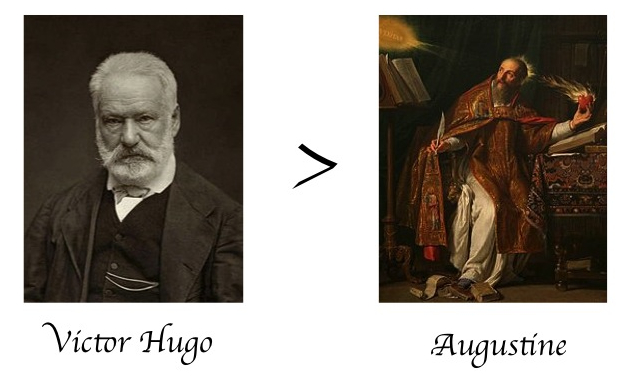
[1] There is significant evidence that Augustine misinterpreted Romans 5:12. The verse reads: “Therefore, just as sin entered the world through one man, and death through sin, and in this way death came to all men, because all sinned…” Augustine’s Latin text at the time would have read, “In him all have sinned,” creating, in Hans Küng’s words, an “inherited sin” rather than a “primal sin.” See: Hans Küng, Christianity: Essence, Future, and History, 293.
Previous Post

February 12, 2013
Just Talk to Your Partner
Next Post
February 18, 2013 Peaceful Progress?
Browse Our Archives
Select a Category Classics DVD Film Music News Pop Culture Events Print Sports Television Uncategorized Video Games
Select a Month March 2017 February 2017 January 2017 December 2016 November 2016 October 2016 September 2016 August 2016 July 2016 June 2016 May 2016 April 2016 March 2016 February 2016 January 2016 December 2015 November 2015 October 2015 September 2015 August 2015 July 2015 June 2015 May 2015 April 2015 March 2015 February 2015 January 2015 December 2014 November 2014 October 2014 September 2014 August 2014 July 2014 June 2014 May 2014 April 2014 March 2014 February 2014 January 2014 December 2013 November 2013 October 2013 September 2013 August 2013 July 2013 June 2013 May 2013 April 2013 March 2013 February 2013 January 2013 December 2012 November 2012 October 2012 September 2012 August 2012 July 2012 June 2012 May 2012 April 2012 March 2012 February 2012 January 2012 December 2011 November 2011 October 2011 September 2011 August 2011 July 2011 June 2011 May 2011 April 2011 March 2011 February 2011 January 2011 December 2010 November 2010 October 2010 September 2010 August 2010 July 2010 June 2010 May 2010 April 2010 March 2010 February 2010 January 2010 December 2009 November 2009 October 2009 September 2009 August 2009 July 2009 June 2009 May 2009 April 2009 March 2009 February 2009 January 2009 December 2008 November 2008 October 2008 September 2008 August 2008 July 2008 June 2008 May 2008 April 2008 March 2008 February 2008 January 2008 December 2007 November 2007 October 2007 September 2007 August 2007 July 2007 June 2007 May 2007 April 2007 March 2007
Follow Us!
TAKE THE
Religious Wisdom Quiz
What happened to Lot's wife as they fled Sodom?
Select your answer to see how you score.
She died by fire She fell into a well She turned into a pillar of salt She became blind
Related posts from Pop Theology

The Mastodon In The Room: A Conversation with...


At SXSW2017: Music Festival Day 5
At SXSW2017: Music Festival Day 4
TRENDING AT PATHEOS Progressive Christian

What Being a Modern-Day Apostle Means to Me
In my last column, I discussed the ins and outs of modern-day...

Did Ancient China Once Worship the God of...
Across human history, a common thread weaves through the origins of the...

Love Your Neighbor – Including Earth-Kin: Lev. 19,...
God’s command to love your neighbor means acting in an ethical and...

Lead a Church Study of “Jesus and Lao...
Guest writer Jack Thomas (The Irreverent Reverend) reflects on leading his church...

Pastoral Wisdom for Responding to Sermon Pushback
Getting sermon pushback on your social justice sermon? Learn practical, Proverbs-based strategies...

Principles for Understanding the Apostolic Ministry Today
Whenever people discover that my formal ministry title is "apostle," as in...
view all Progressive Christian blogs
Ad-Free & Subscriber Log-In Subscription Support
- About Us
- 2026 Calendar
- Videos
- Podcasts
- Library of World Religions
- Faith In Media Tracker
- Advertise With Us
- Write for Us
- Privacy Policy
- Terms of Service
- Do Not Sell My Data
- Contact Us
- Radiant Digital
- Manage Newsletter Subscriptions
- Unsubscribe From Notifications
- Sitemap
Copyright 2008-2026, Patheos. All rights reserved.
Subscription Support Ad-Free & Subscriber Log-In
Follow Patheos