
BuddhistCatholicContemplativeEvangelicalGeneral ChristianHinduJewishLatter-day SaintMuslimNew VisionsProgressive Christian
Beliefs
- Buddhist
- Catholic
- Contemplative
- Evangelical
- General Christian
- Hindu
- Jewish
- Latter-day Saint
- More Voices
- Muslim
- New Visions
- Pagan
- Progressive Christian
Topics
- Religion News
- Food and Religion
- Sports and Religion
- Religious Art
- Religious Music and Entertainment
- Religious Events
- History and Religion
- Style and Religion
- Politics and Religion
- Women in Religion
- Recreation Outdoors and Religion
- Business Finance and Religion
- Careers Workplace and Religion
- Education and Religion
- Family Parenting and Religion
- Health Fitness and Religion
- Home and Religion
- Relationships and Religion
- Technology and Religion
- Travel and Religion
Columnists
- Buddhist Columnists
- Business Finance and Religion Columnists
- Careers Workplace and Religion Columnists
- Catholic Columnists
- Contemplative Columnists
- Education and Religion Columnists
- Evangelists Columnists
- Family Parenting and Religion Columnists
- General Christian Columnists
- Health Fitness and Religion Columnists
- Hindu Columnists
- History and Religion Columnists
- Home and Religion Columnists
- Jewish Columnists
- More Voices Columnists
- Latter Day Columnists
- Muslim Columnists
- New Visions Columnists
- Nonreligious Columnists
- Pagan Columnists
- Politics and Religion Columnists
- Progressive Columnists
- Recreation Outdoors and Religion Columnists
- Relationships and Religion Columnists
- Religion News Columnists
- Religious Art Columnists
- Religious Events Columnists
- Religious Music and Entertainment Columnists
- Sports and Religion Columnists
- Style and Religion Columnists
- Technology and Religion Columnists
- Travel and Religion Columnists
- Women in Religion Columnists
Resource Library
- 2026 Calendar
- Library of World Religions
- The 100 Most Holy Places on Earth
- Patheos Answers
- Podcasts
- Videos
- Faith Leaders Database
- Anglican Episcopalian
- Bahai
- Baptist
- Buddhism
- Christianity
- Confucianism
- Eastern Orthodoxy
- Hinduism
- Holiness and Pentecostal
- ISKCON
- Islam
- Judaism
- Lutheran
- Methodist
- The Church of Jesus Christ of Latter-day Saints
- New Age
- Paganism
- Presbytarian and Reformed
- Protestantism
- Religion Behind the Scenes
- Roman Catholic
- Scientology
- Shia Islam
- Sikhism
- Sufism
- Sunni Islam
- Taoism
- Zen
- See all religions
Research Tools
 Ad-Free & Subscriber Log-In Subscription Support
Ad-Free & Subscriber Log-In Subscription Support
Follow Patheos 

- Trending:
- Forgiveness
- |
- Marriage
- |
- Consciousness
- |
- Death Penalty
- |
- Election
- |
- Halloween
 Pop Theology
- Home
- Progressive Christian
- Religious Music & Entertainment
- Flight, Forgiveness, and Ray Lewis
Flight, Forgiveness, and Ray Lewis
Last updated on: February 6, 2013 at 12:57 pm by J. Ryan Parker
Flight, Forgiveness, and Ray Lewis 2013-02-06T12:57:50-08:00 J. Ryan Parker
Patheos Explore the world's faith through different perspectives on religion and spirituality! Patheos has the views of the prevalent religions and spiritualities of the world.
After the Super Bowl, Richard called me to vent some more about Ray Lewis. In the course of our conversation, he posed a difficult theological question about the fervently devoted Raven. Last night, I watched Denzel Washington‘s latest Oscar-nominated film, Flight, which put Richard’s question and Ray Lewis’ faith into (for me) fresh perspective.
In Flight, Washington plays Captain Whip Whitaker, a hard-drinking, drug-using airline pilot. As you can imagine, his life is a mess: he is divorced from his wife and alienated from his teenage son. At the beginning of the film, he boards a plane drunk and high to fly from Orlando to Atlanta. He and his co-pilot navigate bad weather and severe turbulence to reach a smooth cruising altitude. Twenty-seven minutes into the flight, however, the plane malfunctions, sending it into a nose-dive free fall. Even in his inebriated condition, Captain Whitaker performs a series of miraculous maneuvers and, with the help of his crew, performs an emergency landing in a field. Only six people die. FAA officials simulate the events and 10 out of 10 pilots fail to save a single soul on the plane. The rest of the film follows the aftermath of the wreck, Captain Whitaker’s unsuccessful attempts to quit drinking, his budding relationship with an AA member who almost overdosed, and the NTSB’s investigation into the accident.
The film, at 138 minutes long, pardon the pun, flies by thanks to Washington’s engrossing performance and strong supporting cast, particularly Kelly Reilly as Nicole the AA member and eventual romantic interest and John Goodman as a hilarious drug dealer. It’s a credit to Washington’s talent that, as much of a mess as Captain Whitaker is, we’re actually rooting for him to get better and get through the investigation scott-free. The crash sequence is a thing of technical brilliance, and the film somehow manages to maintain that energy through to the final credits, even though nothing remotely as harrowing takes place.

Flight will no doubt appeal to the theologically and/or religiously inclined. Various characters have conflicting opinions on God’s role in the plane crash in particular and, by extension, every-day experiences as well. Some think God had nothing to do with it: Captain Whitaker in a moment of brilliance landed the plane. Others believe that God caused the equipment to malfunction and the plane to crash in order for the crew, passengers, and their friends and family to have, in a sense, a spiritual awakening. These discussions of the omnipotence and will of God are interesting…to a point. Far more important, I think, are the themes of confession, repentance, forgiveness, and reconciliation at the heart of the film.
While Captain Whitaker was drunk and high while flying the plane, his inebriation did not cause the crash. In fact, he saved 96 lives. However, if the manufacturers can pin any responsibility on him, they can avoid having to foot the bill by citing his criminal negligence. Captain Whitaker’s (and his union’s) lawyer “kills” his toxicology report and works the case so that he can inevitably get off as a hero. SPOILER: At the moment of truth, however, when Captain Whitaker could place the blame for two empty vodka bottles on one of his dead crew members and continually lie about his alcoholism, he comes clean. His confession of alcoholism (he’s drunk at the hearing as a matter of fact) and, implicitly, irresponsible behavior on the job lands him in jail for 5-6 years. Yet as he tells his AA group in prison, “I’ve never felt this free.” He also tells his imprisoned peers that his punishment is just and right and that he has apologized to and sought reconciliation with the families of the deceased and his own friends and family members who were hurt by his alcoholism.
As I watched the conclusion to Flight unfold, I recalled Richard’s comments about Ray Lewis and asked him to email me a couple of thoughts. Here’s what he’s thinking:
The question that emerges is whether or not someone is forgiven if they do something punishable by a prison sentence if they just confess their sin to God then try to live their lives according to Christian principles? Every time someone tries to bring up Ray Lewis’ past, he changes the subject and says, “This is God’s time.” Or, “That’s the devil trying to distract me.” I actually think God’s concern in a larger sense is not so much “justice” where every wrong is made up for in some way, but “reconciliation.” So in a sense, it may be possible to say, “I’ve confessed to God on this and now I just want to keep playing football,” because there’s no way you’re going to “right the wrong” of being involved in a double murder, even if you serve time. But ultimately, that doesn’t lead to reconciliation, either with the person you wronged, with yourself, or with God. Ray Lewis’s over-religious act strikes me as someone who is living a double life spiritually.
I think Richard’s question is an important one because it points to an eagerness that we all have to get beyond (a) sin. Of course, God forgives us, and for many people that settles it. But it doesn’t have to be…and in fact isn’t…the only ingredient in reconciliation. Personal responsibility, particularly in the form of facing up to the consequences of our actions, must play a part. And I believe that this undergirds many people’s problems with Ray Lewis. He has never lived up…or owned up…to that “half of the bargain.”
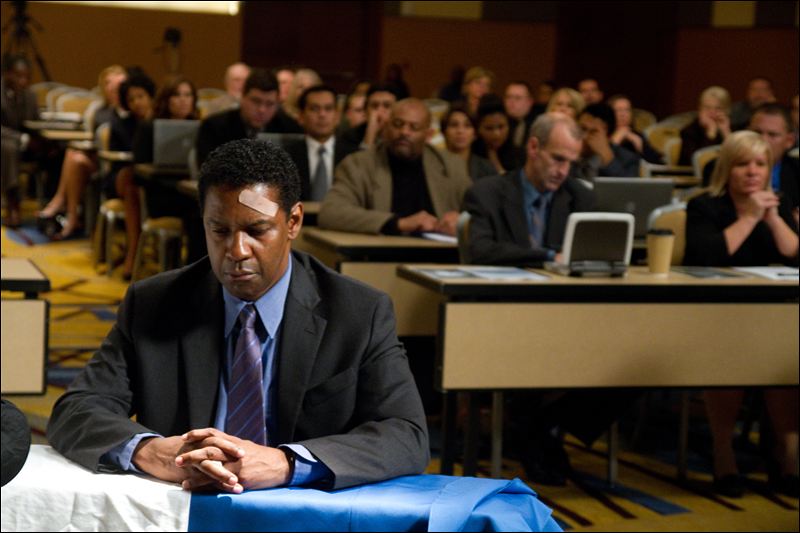
Whip Whitaker (Denzel Washington) faces up to and names his demons.
What we have in Flight is completely different. Captain Whitaker didn’t kill six people. Did he endanger 102 people that day? Of course. But his alcoholism had been ruining numerous lives, primarily his, long before he set foot on that doomed (or divinely ordained) faulty plane. For much of the film, he is in denial of his condition and flees his responsibilities and lashes out against those who want to help him. It is only at the end, when he is “on trial” that he has the courage to speak the truth and embrace the consequences. Will his confession and accepted punishment make everything right? Of course not. Some families accepted his apologies while others didn’t. The process of reconciliation depends on work on the part of the violator and the victim.
Flight is a fine film and Washington owns it. It’s a wild scenario to be sure…flying a commercial jet upside down on the way to an emergency landing. But frequently we all find ourselves in topsy-turvy situations…out of whack, confused, looking for a safe place to rest. Flight seems to suggest that a great way to start is by naming our self- and other-destructive actions and responsibly facing the consequences. As far as Ray Lewis is concerned, perhaps his fervent, publicly-proclaimed faith is no so different from Captain Whitaker’s addiction to drugs and alcohol…it’s just another hit to take the guilty edge off.
Flight (138 mins.) is available on DVD and is rated R for drug and alcohol abuse, language, sexuality/nudity and an intense action sequence.
Previous Post

February 6, 2013
The Marginalized Shall Change the World
Next Post
February 11, 2013 Living Beyond Epic Means
Browse Our Archives
Select a Category Classics DVD Film Music News Pop Culture Events Print Sports Television Uncategorized Video Games
Select a Month March 2017 February 2017 January 2017 December 2016 November 2016 October 2016 September 2016 August 2016 July 2016 June 2016 May 2016 April 2016 March 2016 February 2016 January 2016 December 2015 November 2015 October 2015 September 2015 August 2015 July 2015 June 2015 May 2015 April 2015 March 2015 February 2015 January 2015 December 2014 November 2014 October 2014 September 2014 August 2014 July 2014 June 2014 May 2014 April 2014 March 2014 February 2014 January 2014 December 2013 November 2013 October 2013 September 2013 August 2013 July 2013 June 2013 May 2013 April 2013 March 2013 February 2013 January 2013 December 2012 November 2012 October 2012 September 2012 August 2012 July 2012 June 2012 May 2012 April 2012 March 2012 February 2012 January 2012 December 2011 November 2011 October 2011 September 2011 August 2011 July 2011 June 2011 May 2011 April 2011 March 2011 February 2011 January 2011 December 2010 November 2010 October 2010 September 2010 August 2010 July 2010 June 2010 May 2010 April 2010 March 2010 February 2010 January 2010 December 2009 November 2009 October 2009 September 2009 August 2009 July 2009 June 2009 May 2009 April 2009 March 2009 February 2009 January 2009 December 2008 November 2008 October 2008 September 2008 August 2008 July 2008 June 2008 May 2008 April 2008 March 2008 February 2008 January 2008 December 2007 November 2007 October 2007 September 2007 August 2007 July 2007 June 2007 May 2007 April 2007 March 2007
Follow Us!
TAKE THE
Religious Wisdom Quiz
Who prophesied the virgin birth?
Select your answer to see how you score.
Ezekiel Isaiah Jeremiah Daniel
Related posts from Pop Theology


At SXSW2017: May It Last: A Portrait of...

At SXSW 2017: "Untold Tales of Armistead Maupin"
TRENDING AT PATHEOS Progressive Christian

Why Christians Have a Sacred Duty to Vote:...
The Bible offers strong support for the sacred duty to vote. Here...

What Being a Modern-Day Apostle Means to Me
In my last column, I discussed the ins and outs of modern-day...

Did Ancient China Once Worship the God of...
Across human history, a common thread weaves through the origins of the...

Love Your Neighbor – Including Earth-Kin: Lev. 19,...
God’s command to love your neighbor means acting in an ethical and...

Lead a Church Study of “Jesus and Lao...
Guest writer Jack Thomas (The Irreverent Reverend) reflects on leading his church...

Principles for Understanding the Apostolic Ministry Today
Whenever people discover that my formal ministry title is "apostle," as in...
view all Progressive Christian blogs
Ad-Free & Subscriber Log-In Subscription Support
- About Us
- 2026 Calendar
- Videos
- Podcasts
- Library of World Religions
- Faith In Media Tracker
- Advertise With Us
- Write for Us
- Privacy Policy
- Terms of Service
- Do Not Sell My Data
- Contact Us
- Radiant Digital
- Manage Newsletter Subscriptions
- Unsubscribe From Notifications
- Sitemap
Copyright 2008-2026, Patheos. All rights reserved.
Subscription Support Ad-Free & Subscriber Log-In
Follow Patheos