
BuddhistCatholicContemplativeEvangelicalGeneral ChristianHinduJewishLatter-day SaintMuslimNew VisionsProgressive Christian
Beliefs
- Buddhist
- Catholic
- Contemplative
- Evangelical
- General Christian
- Hindu
- Jewish
- Latter-day Saint
- More Voices
- Muslim
- New Visions
- Pagan
- Progressive Christian
Topics
- Religion News
- Food and Religion
- Sports and Religion
- Religious Art
- Religious Music and Entertainment
- Religious Events
- History and Religion
- Style and Religion
- Politics and Religion
- Women in Religion
- Recreation Outdoors and Religion
- Business Finance and Religion
- Careers Workplace and Religion
- Education and Religion
- Family Parenting and Religion
- Health Fitness and Religion
- Home and Religion
- Relationships and Religion
- Technology and Religion
- Travel and Religion
Columnists
- Buddhist Columnists
- Business Finance and Religion Columnists
- Careers Workplace and Religion Columnists
- Catholic Columnists
- Contemplative Columnists
- Education and Religion Columnists
- Evangelists Columnists
- Family Parenting and Religion Columnists
- General Christian Columnists
- Health Fitness and Religion Columnists
- Hindu Columnists
- History and Religion Columnists
- Home and Religion Columnists
- Jewish Columnists
- More Voices Columnists
- Latter Day Columnists
- Muslim Columnists
- New Visions Columnists
- Nonreligious Columnists
- Pagan Columnists
- Politics and Religion Columnists
- Progressive Columnists
- Recreation Outdoors and Religion Columnists
- Relationships and Religion Columnists
- Religion News Columnists
- Religious Art Columnists
- Religious Events Columnists
- Religious Music and Entertainment Columnists
- Sports and Religion Columnists
- Style and Religion Columnists
- Technology and Religion Columnists
- Travel and Religion Columnists
- Women in Religion Columnists
Resource Library
- 2026 Calendar
- Library of World Religions
- The 100 Most Holy Places on Earth
- Patheos Answers
- Podcasts
- Videos
- Faith Leaders Database
- Anglican Episcopalian
- Bahai
- Baptist
- Buddhism
- Christianity
- Confucianism
- Eastern Orthodoxy
- Hinduism
- Holiness and Pentecostal
- ISKCON
- Islam
- Judaism
- Lutheran
- Methodist
- The Church of Jesus Christ of Latter-day Saints
- New Age
- Paganism
- Presbytarian and Reformed
- Protestantism
- Religion Behind the Scenes
- Roman Catholic
- Scientology
- Shia Islam
- Sikhism
- Sufism
- Sunni Islam
- Taoism
- Zen
- See all religions
Research Tools
 Ad-Free & Subscriber Log-In Subscription Support
Ad-Free & Subscriber Log-In Subscription Support
Follow Patheos 

- Trending:
- Forgiveness
- |
- Marriage
- |
- Consciousness
- |
- Death Penalty
- |
- Election
- |
- Halloween
 Pop Theology
- Home
- Progressive Christian
- Religious Music & Entertainment
- Protest Filmmaking
Protest Filmmaking
Last updated on: January 30, 2013 at 11:17 am by J. Ryan Parker
Protest Filmmaking 2013-01-30T11:17:22-08:00 J. Ryan Parker
Patheos Explore the world's faith through different perspectives on religion and spirituality! Patheos has the views of the prevalent religions and spiritualities of the world.
Like few other media, film can capture the fragility of life and the pain of its loss. It also has the ability to more viscerally capture instances in which that loss results from injustice and oppression. Few recent films have done this as powerfully as one of this year’s Oscar-nominated documentaries, 5 Broken Cameras.
Directed by Emad Burnat and Guy Davidi and edited by Davidi and Veronique La Goard-Segot, the film is composed, primarily, of footage that Burnat shot on five digital cameras while documenting his experiences on the Israeli/Palestinian border. Emad participates in countless non-violent protests and marches against encroaching Israeli occupation near his village of Bil’in. Israelis are removing olive trees (a source of food and income for these Palestinians) and erecting a fence on their land. Armed with flags, musical instruments, signs, and, of course, cameras, the protestors are met with tear gas and machine guns. While the group marches for years enduring arrest and abuse, Emad does conclude his documentary with a minor, but potentially hollow, victory.
Several critics have argued that 5 Broken Cameras won’t necessarily move the needle or sway people’s opinion of the Israeli/Palestinian conflict. This might be true, but I find it hard to believe that people could leave this film without greater sympathy for the Palestinians…or at least those with whom Emad lived and worked. With his cameras, Emad captures instances of horrific brutality on the part of the Israelis toward the Palestinians…they beat them, shoot them, and gas them. That some Israeli activists support these Palestinian protests makes no difference as armed forces fire indiscriminately into the crowds and, in one instance, injure a fellow Israeli. In one of the most tragic scenes, Emad captures the shooting and subsequent death of one of the most vocal and beloved protest leaders.
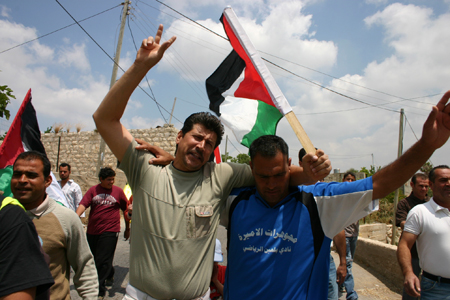
Adeeb (left), one of the more vocal and energetic protestors.
Of course, we must also watch 5 Broken Cameras with an awareness of the fact that not all Palestinian (re)actions have been non-violent, even though this documentary reveals that some groups are pursuing alternate means for change. Yet with the destruction of each camera, Emad begins to despair that their protests and marches will never achieve anything of significance. Moreover, he fears that his children will grow angry and, in turn, violent. It will be difficult to view any potential violent acts on their part as nothing more than a return of the violence that has been enacted upon them and their friends. As a result, the cycle of violence will spin further downward and make breaking it all the more difficult.
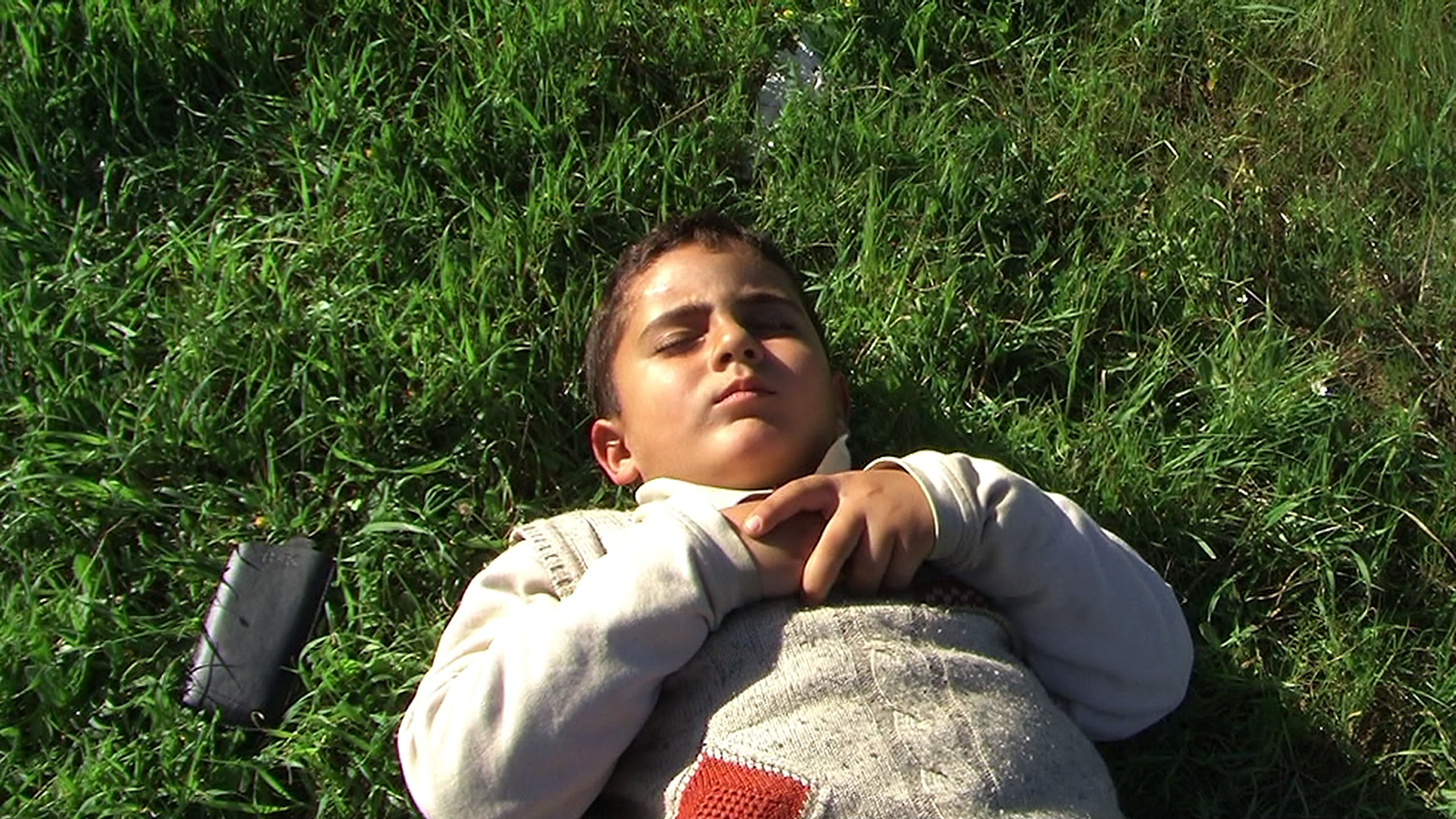
Emad's youngest son, Gibreel.
As A. O. Scott has pointed out 5 Broken Cameras is also “a visual essay in autobiography and, as such, a modest, rigorous and moving work of art” and that “even in the midst of that [political] crisis, it is more than just politics that needs to be seen and understood.” Emad’s work is an intimate account of one individual’s experience of this conflict and, as such, puts a troubling human face on it. It’s also an example of courage in the face of danger and the prophetic potential of filmmaking when individuals dare to put down the gun and pick up the camera to document and expose the atrocities that they endure at the hands of oppressive forces. At a time of despair in his village, Emad gathers folks together to look at some of his footage in an effort to solidify them and encourage them to remain strong. Hopefully viewers of 5 Broken Cameras will be similarly moved to non-violently work for a just resolution to this ongoing conflict.
5 Broken Cameras (94 mins.) is streaming on Netflix and contains disturbing scenes of violence.
Previous Post

January 28, 2013
Exposing the Invisible War
Next Post
January 31, 2013 Living a Double Life
Browse Our Archives
Select a Category Classics DVD Film Music News Pop Culture Events Print Sports Television Uncategorized Video Games
Select a Month March 2017 February 2017 January 2017 December 2016 November 2016 October 2016 September 2016 August 2016 July 2016 June 2016 May 2016 April 2016 March 2016 February 2016 January 2016 December 2015 November 2015 October 2015 September 2015 August 2015 July 2015 June 2015 May 2015 April 2015 March 2015 February 2015 January 2015 December 2014 November 2014 October 2014 September 2014 August 2014 July 2014 June 2014 May 2014 April 2014 March 2014 February 2014 January 2014 December 2013 November 2013 October 2013 September 2013 August 2013 July 2013 June 2013 May 2013 April 2013 March 2013 February 2013 January 2013 December 2012 November 2012 October 2012 September 2012 August 2012 July 2012 June 2012 May 2012 April 2012 March 2012 February 2012 January 2012 December 2011 November 2011 October 2011 September 2011 August 2011 July 2011 June 2011 May 2011 April 2011 March 2011 February 2011 January 2011 December 2010 November 2010 October 2010 September 2010 August 2010 July 2010 June 2010 May 2010 April 2010 March 2010 February 2010 January 2010 December 2009 November 2009 October 2009 September 2009 August 2009 July 2009 June 2009 May 2009 April 2009 March 2009 February 2009 January 2009 December 2008 November 2008 October 2008 September 2008 August 2008 July 2008 June 2008 May 2008 April 2008 March 2008 February 2008 January 2008 December 2007 November 2007 October 2007 September 2007 August 2007 July 2007 June 2007 May 2007 April 2007 March 2007
Follow Us!
TAKE THE
Religious Wisdom Quiz
What does the rider of the White Horse in Revelations carry?
Select your answer to see how you score.
A sword A bow Scales A scroll
Related posts from Pop Theology


At SXSW2017: May It Last: A Portrait of...

At SXSW 2017: "Untold Tales of Armistead Maupin"
TRENDING AT PATHEOS Progressive Christian

Why Christians Have a Sacred Duty to Vote:...
The Bible offers strong support for the sacred duty to vote. Here...

What Being a Modern-Day Apostle Means to Me
In my last column, I discussed the ins and outs of modern-day...

Did Ancient China Once Worship the God of...
Across human history, a common thread weaves through the origins of the...

Love Your Neighbor – Including Earth-Kin: Lev. 19,...
God’s command to love your neighbor means acting in an ethical and...

Lead a Church Study of “Jesus and Lao...
Guest writer Jack Thomas (The Irreverent Reverend) reflects on leading his church...

Principles for Understanding the Apostolic Ministry Today
Whenever people discover that my formal ministry title is "apostle," as in...
view all Progressive Christian blogs
Ad-Free & Subscriber Log-In Subscription Support
- About Us
- 2026 Calendar
- Videos
- Podcasts
- Library of World Religions
- Faith In Media Tracker
- Advertise With Us
- Write for Us
- Privacy Policy
- Terms of Service
- Do Not Sell My Data
- Contact Us
- Radiant Digital
- Manage Newsletter Subscriptions
- Unsubscribe From Notifications
- Sitemap
Copyright 2008-2026, Patheos. All rights reserved.
Subscription Support Ad-Free & Subscriber Log-In
Follow Patheos