
BuddhistCatholicContemplativeEvangelicalGeneral ChristianHinduJewishLatter-day SaintMuslimNew VisionsProgressive Christian
Beliefs
- Buddhist
- Catholic
- Contemplative
- Evangelical
- General Christian
- Hindu
- Jewish
- Latter-day Saint
- More Voices
- Muslim
- New Visions
- Pagan
- Progressive Christian
Topics
- Religion News
- Food and Religion
- Sports and Religion
- Religious Art
- Religious Music and Entertainment
- Religious Events
- History and Religion
- Style and Religion
- Politics and Religion
- Women in Religion
- Recreation Outdoors and Religion
- Business Finance and Religion
- Careers Workplace and Religion
- Education and Religion
- Family Parenting and Religion
- Health Fitness and Religion
- Home and Religion
- Relationships and Religion
- Technology and Religion
- Travel and Religion
Columnists
- Buddhist Columnists
- Business Finance and Religion Columnists
- Careers Workplace and Religion Columnists
- Catholic Columnists
- Contemplative Columnists
- Education and Religion Columnists
- Evangelists Columnists
- Family Parenting and Religion Columnists
- General Christian Columnists
- Health Fitness and Religion Columnists
- Hindu Columnists
- History and Religion Columnists
- Home and Religion Columnists
- Jewish Columnists
- More Voices Columnists
- Latter Day Columnists
- Muslim Columnists
- New Visions Columnists
- Nonreligious Columnists
- Pagan Columnists
- Politics and Religion Columnists
- Progressive Columnists
- Recreation Outdoors and Religion Columnists
- Relationships and Religion Columnists
- Religion News Columnists
- Religious Art Columnists
- Religious Events Columnists
- Religious Music and Entertainment Columnists
- Sports and Religion Columnists
- Style and Religion Columnists
- Technology and Religion Columnists
- Travel and Religion Columnists
- Women in Religion Columnists
Resource Library
- 2026 Calendar
- Library of World Religions
- The 100 Most Holy Places on Earth
- Patheos Answers
- Podcasts
- Videos
- Faith Leaders Database
- Anglican Episcopalian
- Bahai
- Baptist
- Buddhism
- Christianity
- Confucianism
- Eastern Orthodoxy
- Hinduism
- Holiness and Pentecostal
- ISKCON
- Islam
- Judaism
- Lutheran
- Methodist
- The Church of Jesus Christ of Latter-day Saints
- New Age
- Paganism
- Presbytarian and Reformed
- Protestantism
- Religion Behind the Scenes
- Roman Catholic
- Scientology
- Shia Islam
- Sikhism
- Sufism
- Sunni Islam
- Taoism
- Zen
- See all religions
Research Tools
 Ad-Free & Subscriber Log-In Subscription Support
Ad-Free & Subscriber Log-In Subscription Support
Follow Patheos 

- Trending:
- Forgiveness
- |
- Marriage
- |
- Consciousness
- |
- Death Penalty
- |
- Election
- |
- Halloween
 Pop Theology
- Home
- Progressive Christian
- Religious Music & Entertainment
- A Magical, Mystical Journey
A Magical, Mystical Journey
Last updated on: June 18, 2013 at 8:56 pm by Richard Lindsay
A Magical, Mystical Journey 2013-06-18T20:56:30-07:00 Richard Lindsay
Patheos Explore the world's faith through different perspectives on religion and spirituality! Patheos has the views of the prevalent religions and spiritualities of the world.
 Ryan Parker is back in the Land of the Free Gift with Purchase, but a family situation has kept him from posting his thoughts on Life of Pi. I also have some thoughts, so here is a first ever, two-part, side-by-side review from your PopTheology co-editors.
Ryan’s Review
Life of Pi is the most recent film (and one of the best to do so in a long time) that gets at my love of film, religion, and the relationship between the two. Like many characters in the film, my response to the film about Pi’s story says as much about me as it does the film.
The film tells the harrowing story of a boy’s, Piscine (Pi) Patel’s, lost-at-sea survival on a lifeboat with only a Bengal tiger as his companion. Directed by Ang Lee, it is a magical adaptation that is every bit as captivating and awe-inspiring as Yann Martel’s original novel—perhaps more so. Lee wields his digital effects in service of the story; nothing ever feels gratuitous or distracting. The creation and use of the tiger alone surely merits a making-of documentary on its own. The film’s cuts back and forth between past and present happen seamlessly and the transitions themselves are a thing of beauty.

The film is bolstered by fine performances, two for the same character (Suraj Sharma and Irrfan Khan as the younger and older Pi, respectively) which are worthy of Oscar attention (the former for Best Actor and the latter for Best Supporting Actor). When was the last time two actors were nominated for playing the same character…The Godfather 2?
For the non- or anti-religious among us, I submit Life of Pi as exhibit A in religion’s favor. Growing up in an extremely fertile religious environment in India, Pi is drawn to the pantheon of gods in Hinduism, the puzzling sacrificial love of God for humanity in Christianity, and the language and ritual practices of Islam. His father, an extreme rationalist, attempts to derail Pi’s religious journey or to at least force him on a more singular path. He fails to see that, for Pi, God transcends any single faith and exists outside the bounds of human reason. Pi shows us that faith doesn’t have to be a zero sum game.
This religious diversity will no doubt trouble particular viewers of all faiths…or those of none at all. I found Pi’s perspective of God…or the work of God…somewhat troubling. Lost at sea, tossed about by violent storms, and left alone with a violent beast for company, Pi often views his situation as God punishing or testing him. Here, God is both tormentor and savior. While God does challenge us, I fear that this way of viewing an event that also resulted in the deaths of dozens of other people as a way in which God tempers Pi’s faith to be deeply simplistic and troubling. Like Pi, surely God mourns the loss of the rest of his family along with him.
In recent months, I’ve also given thought to the importance of stories and the ways in which stories told to us (and those we tell ourselves) shape our experiences in the world…and of God. This is the central thesis, so to speak, of Life of Pi. At heart, religions are stories, and the stories we “buy into” often say as much or more about us as they do about the Divine. Like many Christians can do, Pi presents the competing versions of his survival, one that is more violent than the other. We too vacilate between images of a violent God and a God of unconditional love and peace. Which one we “choose” certainly gives insight into our own hopes, fears, and ways of viewing the world.
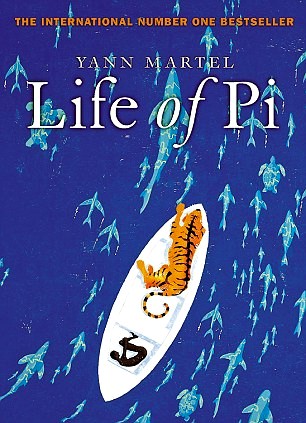
Original cover of the Yann Martel book
Richard’s Review
There’s a scene in The Life of Pi where Pi Patel, the Indian boy who has been stranded on a lifeboat with a full-grown tiger named Richard Parker, has lost all his survival supplies after a storm, is sunburned, starving and dehydrated. He looks into the tiger’s eyes, his nemesis and friend, and says, “We are dying, Richard Parker.” He lifts up a prayer to God and says he is ready to accept whatever will happen to him during or after his death.
The scene was inevitable from the moment Pi ended up on that boat. What is it about faith that leads us to this moment, this dark night when the soul is stripped bare and all pretense of human control has been lost? A valley that must be crossed again and again in the course of one’s life, until it is crossed one last time at death. We are dying, Richard Parker; Eloi, Eloi, Lamma Sabachthani.
In the frame story of the film, Pi Patel is shown as an adult, telling the story of his shipwreck survival to a Canadian author, a story Patel’s uncle has said will make the author believe in God. The film itself probably leads to more questions about God than to answers, but does so beautifully and wondrously, through the always-understated direction of Ang Lee and the magnificent visual effects of Bill Westenhofer.
The film is set up to be read as a fable. One look at the beautiful cover of Yann Martel’s original book tells you most of what you need to know about the story: a boy and a tiger are stranded on a boat. From there, it leaves the audience sieving the animals and characters out of each scene attempting to discern their symbolic meaning.
For me, the tiger represents the human shadow and the difficulty of growing up. When I was Pi’s age, I found myself storm-tossed with conflicting emotions I couldn’t handle, sexuality I didn’t understand, and the horrible realization of my own adult human agency, which had the capacity for great good or great evil.
At first, Pi can’t even exist on the same boat with this raging shadow/tiger—he forms a raft and floats next to it by an umbilical strand of rope. He attempts to avoid contact with the tiger by hoarding his supplies on the raft. The supplies are soon lost and he finds himself having to return to the boat, having to learn to fish for the tiger’s survival, so the great beast won’t, in Pi’s words, “Have for his last meal a skinny vegetarian boy.”
So it is with the human shadow—it must be wooed and trained, sometimes with a firm hand, sometimes with affection. What seems at first a monster trapped inside our psyche begins to take on an element of beauty and even reminds us of its place in our own survival.
As for God and the question of chosen narratives, I have continued to be challenged by the thought that human need for narrative points toward divine influence. Our grand narratives may be more diverse now than they were during eras of “Christendom” or “Modernity,” but we continue to seek them out. The human need for mythmaking may in fact point to a Maker who is not a myth.

The moment of surrender
Previous Post

December 6, 2012
The Best Bad Idea
Next Post
December 28, 2012 This is 40...and It Ain't Pretty
Browse Our Archives
Select a Category Classics DVD Film Music News Pop Culture Events Print Sports Television Uncategorized Video Games
Select a Month March 2017 February 2017 January 2017 December 2016 November 2016 October 2016 September 2016 August 2016 July 2016 June 2016 May 2016 April 2016 March 2016 February 2016 January 2016 December 2015 November 2015 October 2015 September 2015 August 2015 July 2015 June 2015 May 2015 April 2015 March 2015 February 2015 January 2015 December 2014 November 2014 October 2014 September 2014 August 2014 July 2014 June 2014 May 2014 April 2014 March 2014 February 2014 January 2014 December 2013 November 2013 October 2013 September 2013 August 2013 July 2013 June 2013 May 2013 April 2013 March 2013 February 2013 January 2013 December 2012 November 2012 October 2012 September 2012 August 2012 July 2012 June 2012 May 2012 April 2012 March 2012 February 2012 January 2012 December 2011 November 2011 October 2011 September 2011 August 2011 July 2011 June 2011 May 2011 April 2011 March 2011 February 2011 January 2011 December 2010 November 2010 October 2010 September 2010 August 2010 July 2010 June 2010 May 2010 April 2010 March 2010 February 2010 January 2010 December 2009 November 2009 October 2009 September 2009 August 2009 July 2009 June 2009 May 2009 April 2009 March 2009 February 2009 January 2009 December 2008 November 2008 October 2008 September 2008 August 2008 July 2008 June 2008 May 2008 April 2008 March 2008 February 2008 January 2008 December 2007 November 2007 October 2007 September 2007 August 2007 July 2007 June 2007 May 2007 April 2007 March 2007
Follow Us!
TAKE THE
Religious Wisdom Quiz
What New Testament book is known for its chapter on charity?
Select your answer to see how you score.
1 Corinthians Hebrews Romans Philippians
Related posts from Pop Theology


At SXSW2017: May It Last: A Portrait of...

At SXSW 2017: "Untold Tales of Armistead Maupin"
TRENDING AT PATHEOS Progressive Christian

Why Christians Have a Sacred Duty to Vote:...
The Bible offers strong support for the sacred duty to vote. Here...

What Being a Modern-Day Apostle Means to Me
In my last column, I discussed the ins and outs of modern-day...

Did Ancient China Once Worship the God of...
Across human history, a common thread weaves through the origins of the...

Love Your Neighbor – Including Earth-Kin: Lev. 19,...
God’s command to love your neighbor means acting in an ethical and...

Lead a Church Study of “Jesus and Lao...
Guest writer Jack Thomas (The Irreverent Reverend) reflects on leading his church...

Principles for Understanding the Apostolic Ministry Today
Whenever people discover that my formal ministry title is "apostle," as in...
view all Progressive Christian blogs
Ad-Free & Subscriber Log-In Subscription Support
- About Us
- 2026 Calendar
- Videos
- Podcasts
- Library of World Religions
- Faith In Media Tracker
- Advertise With Us
- Write for Us
- Privacy Policy
- Terms of Service
- Do Not Sell My Data
- Contact Us
- Radiant Digital
- Manage Newsletter Subscriptions
- Unsubscribe From Notifications
- Sitemap
Copyright 2008-2026, Patheos. All rights reserved.
Subscription Support Ad-Free & Subscriber Log-In
Follow Patheos