
BuddhistCatholicContemplativeEvangelicalGeneral ChristianHinduJewishLatter-day SaintMuslimNew VisionsProgressive Christian
Beliefs
- Buddhist
- Catholic
- Contemplative
- Evangelical
- General Christian
- Hindu
- Jewish
- Latter-day Saint
- More Voices
- Muslim
- New Visions
- Pagan
- Progressive Christian
Topics
- Religion News
- Food and Religion
- Sports and Religion
- Religious Art
- Religious Music and Entertainment
- Religious Events
- History and Religion
- Style and Religion
- Politics and Religion
- Women in Religion
- Recreation Outdoors and Religion
- Business Finance and Religion
- Careers Workplace and Religion
- Education and Religion
- Family Parenting and Religion
- Health Fitness and Religion
- Home and Religion
- Relationships and Religion
- Technology and Religion
- Travel and Religion
Columnists
- Buddhist Columnists
- Business Finance and Religion Columnists
- Careers Workplace and Religion Columnists
- Catholic Columnists
- Contemplative Columnists
- Education and Religion Columnists
- Evangelists Columnists
- Family Parenting and Religion Columnists
- General Christian Columnists
- Health Fitness and Religion Columnists
- Hindu Columnists
- History and Religion Columnists
- Home and Religion Columnists
- Jewish Columnists
- More Voices Columnists
- Latter Day Columnists
- Muslim Columnists
- New Visions Columnists
- Nonreligious Columnists
- Pagan Columnists
- Politics and Religion Columnists
- Progressive Columnists
- Recreation Outdoors and Religion Columnists
- Relationships and Religion Columnists
- Religion News Columnists
- Religious Art Columnists
- Religious Events Columnists
- Religious Music and Entertainment Columnists
- Sports and Religion Columnists
- Style and Religion Columnists
- Technology and Religion Columnists
- Travel and Religion Columnists
- Women in Religion Columnists
Resource Library
- 2026 Calendar
- Library of World Religions
- The 100 Most Holy Places on Earth
- Patheos Answers
- Podcasts
- Videos
- Faith Leaders Database
- Anglican Episcopalian
- Bahai
- Baptist
- Buddhism
- Christianity
- Confucianism
- Eastern Orthodoxy
- Hinduism
- Holiness and Pentecostal
- ISKCON
- Islam
- Judaism
- Lutheran
- Methodist
- The Church of Jesus Christ of Latter-day Saints
- New Age
- Paganism
- Presbytarian and Reformed
- Protestantism
- Religion Behind the Scenes
- Roman Catholic
- Scientology
- Shia Islam
- Sikhism
- Sufism
- Sunni Islam
- Taoism
- Zen
- See all religions
Research Tools
 Ad-Free & Subscriber Log-In Subscription Support
Ad-Free & Subscriber Log-In Subscription Support
Follow Patheos 

- Trending:
- Forgiveness
- |
- Marriage
- |
- Consciousness
- |
- Death Penalty
- |
- Election
- |
- Halloween
 Pop Theology
- Home
- Progressive Christian
- Religious Music & Entertainment
- We Must Protect This House!
We Must Protect This House!
Last updated on: November 19, 2012 at 8:24 am by J. Ryan Parker
We Must Protect This House! 2012-11-19T08:24:27-08:00 J. Ryan Parker
Patheos Explore the world's faith through different perspectives on religion and spirituality! Patheos has the views of the prevalent religions and spiritualities of the world.
There are movies that, intentionally or not, slip by you. There’s just too many. You’re too busy. Others demand repeated viewings. You don’t particularly love the lead actor. Parts of all of these explain my tardiness in seeing The Others (2001), a “horror” film that should go down as a contemporary classic in the vein of The Innocents or The Haunting.
The plot of The Others is so hard to summarize without giving away it’s essential punch line. On the other hand, even if you know the film’s basic premise, it’s still loads of fun to watch. So this entire post is just one big spoiler. Let me say now, if you haven’t seen The Others, go watch it ASAP.
Nicole Kidman plays Grace Stewart, the mother of two young children, Anne (Alakina Mann) and Nicholas (James Bentley) who live in a fog-enshrouded mansion in Jersey on the Channel Islands in 1945. As the film opens, three mysterious housekeepers, Mrs. Bertha Mills (Fionnula Flanagan), Mr. Edmund Tuttle (Eric Sykes), and Lydia (Elaine Cassidy), arrive seeking work. Grace believes they have answered an ad she placed in the newspaper. A few scenes later, she learns that, in fact, the ad never posted and that the three employees worked in the house some years before Grace’s family moved in.
Grace and her children are eagerly awaiting their father’s return from the war. Grace has stood firm, even guarding (?) the house from Nazis who would have once commandeered the estates. In the meantime, Grace and her children hear weird noises throughout the house. Anne, in fact, claims that she sees a young boy, Victor, roaming around the house with his family and a spooky old lady. We’re never quite sure what to think as the film progresses, especially since Grace seems to be a deeply disturbed mother who goes to great lengths to “protect” her children. In an odd bit of instruction to her new housekeeper, she tells Mrs. Bertha that no door in the house can be opened without first closing another. On top of that, all the curtains in the house must remain closed because her children have an extreme allergy to sunlight.
As the film progresses, Grace and her children confront, run from, and debate the existence of intruders in their house. Along the way, their husband and father, Charles (Christopher Eccleston), shows up, setting in motion a series of events that will reveal Grace and the children’s true identity…to both the audience and themselves. Rather than innocent victims of domestic ghostly possession, Grace, Anne, and Nicholas are (BIG SPOILER) actually ghosts themselves that haunt the house. Their intruders are nothing more than the family that hopes to move into the mansion.
Now while all of this might sound like an M. Night Shyamalan rip off, there are numerous elements that set The Others apart from its horror/thriller peers. The first is direction. In tandem with cinematographer Javier Aguirresarobe (who has gone on to shoot part of the Twilight Saga), writer and director Alejandro Amenabar knows how to visually enhance his narrative. The camera not only dictates but frustrates action and audience perception. We’re never quite sure where we stand in terms of plot, or even visuals. As soon as we think we have firm visual footing, Aguirresarobe and Amenabar pull the rug out from under us. The Others benefits from strong performances all around, but most notably from Kidman, whose over-analyzed face lends another aspect to her performance. She recalls Deborah Kerr’s borderline insane performance in The Innocents. While the children in The Others aren’t as creepy as their predecessors in the Kerr film, they are effective, particularly Alakina Mann, who goes toe-to-toe with Kidman’s Grace in numerous scenes.
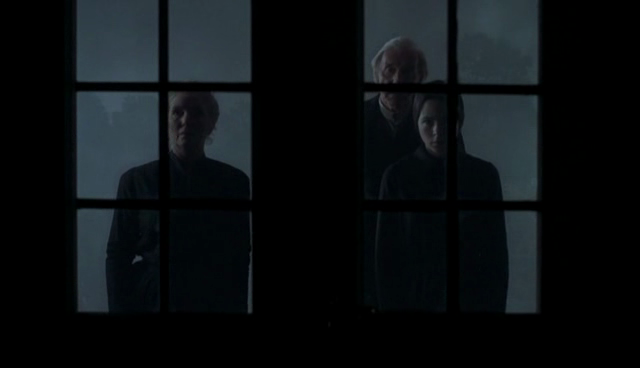
The three housekeepers who know much more about the house than Grace and her children
Like many horror/thriller films, religion plays a huge role in The Others, and it is a particularly schizophrenic one here, accounting for no less than four functions in the film narrative. First, it “orders” the world of the film. The film opens as Grace tells her children the story of creation. Throughout the course of the film, to put it broadly, Grace and her children are indeed trapped in something like an afterlife limbo…a purgatory…that echoes one of the lessons that the children must memorize in the course of their studies. Naive, ignorant, or simply in denial, Grace cannot and will not allow her children to consider the possibility of their troubled “existence.” Second, religion is a source of fear and control. Grace teaches her children to fear the four hells, the hell where the damned go, purgatory, the bosom of Abraham where the righteous go, and children’s limbo, which, according to Grace, is at the center of the earth and is very, very hot with pain forever. This fear is used to enforce appropriate “Victorian” behavior. Oddly enough, religion is, third, a source of comfort. When Nicholas is afraid, Grace tells him to squeeze his rosary tightly and to pray the “Our Father.” She repeatedly tells her children that the Lord will protect them in times of danger. Ironically, it is also this same Lord that will author their eternal damnation should they misbehave. Fourth, and less explicit, religion is also a source of frustration and confusion. Anne refuses to believe the “biblical” account of creation. When Mrs. Bertha tells her, “You shouldn’t believe everything that you read in books,” Anne responds, “That’s what our mother says. […] Then she expects us to believe everything in the Bible.” Anne tells her she doesn’t believe in the literal 6 day Creation or that Noah put all the animals in the ark or that the Holy Spirit is a Dove. When Grace realizes their ghostly state, her faith fails her, and her world crumbles around her. When Anne asks her, since they are dead, where is purgatory, Grace responds, “I don’t know. I’m no wiser than you are, but I do know that I love you. I’ve always loved you.” Grace can believe what she wants, but the reality of her experience ultimately throws all of her beliefs into confusion.
The twist of the film is handled effectively as well. I knew what I was getting into before watching the film, which actually, I think, made the film work better. You know that Amenabar is telling a ghost story from the ghosts’ perspective. So all of his edits, framing, and action sequences, events which would make a traditional horror film scary, just make this one creepy. There are hardly any jump-in-your-seat moments…if any. Aside from Kidman’s potential to overplay her hand, Amenabar trades over-the-top thrills for thought-provoking subtlety. There’s a bit of genius at work here, for example, in having Anne double as an explicitly Halloween-like ghost as she plays around in her first communion dress and veil. As Grace wrestles to keep all the doors shut and curtains closed, you just know that the “intruders” are freaking out over all these “supernatural” occurrences. Even the reveal is built around a bit of competent editing between the perspectives of the living vs. the dead.
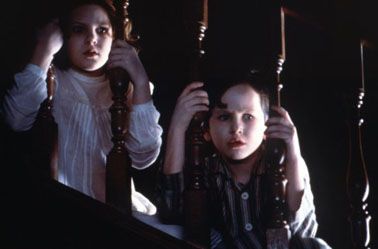
Terrified children...afraid of reality.
The Others is a great example of atmospheric horror and a film that puts religion to a multitude of uses and frustrates traditional religious thought in the process. During the film, I found myself thinking about C. S. Lewis’ The Great Divorce and the opening that he leaves for the reality of a purgatory as part of the hereafter. Like Grace, so many of us are trapped in denial or simply refuse to consider alternate possibilities for how things are or the way they will be, which might depend on new interpretations of texts taught to us as children. I imagine that lived denial can be so strong that, like Grace and her children, it accompanies us into the next world. Hopefully, there will be gentle housekeepers to guide us along the way and shed light on our situation.
The Others (101 mins.) is rated PG-13 for thematic elements and frightening moments and is available on DVD.
Previous Post

November 17, 2012
Mumford and Sons: Babel
Next Post

November 24, 2012 Good Guys vs. Bad Guys
Browse Our Archives
Select a Category Classics DVD Film Music News Pop Culture Events Print Sports Television Uncategorized Video Games
Select a Month March 2017 February 2017 January 2017 December 2016 November 2016 October 2016 September 2016 August 2016 July 2016 June 2016 May 2016 April 2016 March 2016 February 2016 January 2016 December 2015 November 2015 October 2015 September 2015 August 2015 July 2015 June 2015 May 2015 April 2015 March 2015 February 2015 January 2015 December 2014 November 2014 October 2014 September 2014 August 2014 July 2014 June 2014 May 2014 April 2014 March 2014 February 2014 January 2014 December 2013 November 2013 October 2013 September 2013 August 2013 July 2013 June 2013 May 2013 April 2013 March 2013 February 2013 January 2013 December 2012 November 2012 October 2012 September 2012 August 2012 July 2012 June 2012 May 2012 April 2012 March 2012 February 2012 January 2012 December 2011 November 2011 October 2011 September 2011 August 2011 July 2011 June 2011 May 2011 April 2011 March 2011 February 2011 January 2011 December 2010 November 2010 October 2010 September 2010 August 2010 July 2010 June 2010 May 2010 April 2010 March 2010 February 2010 January 2010 December 2009 November 2009 October 2009 September 2009 August 2009 July 2009 June 2009 May 2009 April 2009 March 2009 February 2009 January 2009 December 2008 November 2008 October 2008 September 2008 August 2008 July 2008 June 2008 May 2008 April 2008 March 2008 February 2008 January 2008 December 2007 November 2007 October 2007 September 2007 August 2007 July 2007 June 2007 May 2007 April 2007 March 2007
Follow Us!
TAKE THE
Religious Wisdom Quiz
True or False: Micah prophesied that the Messiah would be born in Bethlehem.
Select your answer to see how you score.
TRUE FALSE
Related posts from Pop Theology


At SXSW2017: May It Last: A Portrait of...

At SXSW 2017: "Untold Tales of Armistead Maupin"
TRENDING AT PATHEOS Progressive Christian

Why Christians Have a Sacred Duty to Vote:...
The Bible offers strong support for the sacred duty to vote. Here...

What Being a Modern-Day Apostle Means to Me
In my last column, I discussed the ins and outs of modern-day...

Did Ancient China Once Worship the God of...
Across human history, a common thread weaves through the origins of the...

Love Your Neighbor – Including Earth-Kin: Lev. 19,...
God’s command to love your neighbor means acting in an ethical and...

Lead a Church Study of “Jesus and Lao...
Guest writer Jack Thomas (The Irreverent Reverend) reflects on leading his church...

Principles for Understanding the Apostolic Ministry Today
Whenever people discover that my formal ministry title is "apostle," as in...
view all Progressive Christian blogs
Ad-Free & Subscriber Log-In Subscription Support
- About Us
- 2026 Calendar
- Videos
- Podcasts
- Library of World Religions
- Faith In Media Tracker
- Advertise With Us
- Write for Us
- Privacy Policy
- Terms of Service
- Do Not Sell My Data
- Contact Us
- Radiant Digital
- Manage Newsletter Subscriptions
- Unsubscribe From Notifications
- Sitemap
Copyright 2008-2026, Patheos. All rights reserved.
Subscription Support Ad-Free & Subscriber Log-In
Follow Patheos