
BuddhistCatholicContemplativeEvangelicalGeneral ChristianHinduJewishLatter-day SaintMuslimNew VisionsProgressive Christian
Beliefs
- Buddhist
- Catholic
- Contemplative
- Evangelical
- General Christian
- Hindu
- Jewish
- Latter-day Saint
- More Voices
- Muslim
- New Visions
- Pagan
- Progressive Christian
Topics
- Religion News
- Food and Religion
- Sports and Religion
- Religious Art
- Religious Music and Entertainment
- Religious Events
- History and Religion
- Style and Religion
- Politics and Religion
- Women in Religion
- Recreation Outdoors and Religion
- Business Finance and Religion
- Careers Workplace and Religion
- Education and Religion
- Family Parenting and Religion
- Health Fitness and Religion
- Home and Religion
- Relationships and Religion
- Technology and Religion
- Travel and Religion
Columnists
- Buddhist Columnists
- Business Finance and Religion Columnists
- Careers Workplace and Religion Columnists
- Catholic Columnists
- Contemplative Columnists
- Education and Religion Columnists
- Evangelists Columnists
- Family Parenting and Religion Columnists
- General Christian Columnists
- Health Fitness and Religion Columnists
- Hindu Columnists
- History and Religion Columnists
- Home and Religion Columnists
- Jewish Columnists
- More Voices Columnists
- Latter Day Columnists
- Muslim Columnists
- New Visions Columnists
- Nonreligious Columnists
- Pagan Columnists
- Politics and Religion Columnists
- Progressive Columnists
- Recreation Outdoors and Religion Columnists
- Relationships and Religion Columnists
- Religion News Columnists
- Religious Art Columnists
- Religious Events Columnists
- Religious Music and Entertainment Columnists
- Sports and Religion Columnists
- Style and Religion Columnists
- Technology and Religion Columnists
- Travel and Religion Columnists
- Women in Religion Columnists
Resource Library
- 2026 Calendar
- Library of World Religions
- The 100 Most Holy Places on Earth
- Patheos Answers
- Podcasts
- Videos
- Faith Leaders Database
- Anglican Episcopalian
- Bahai
- Baptist
- Buddhism
- Christianity
- Confucianism
- Eastern Orthodoxy
- Hinduism
- Holiness and Pentecostal
- ISKCON
- Islam
- Judaism
- Lutheran
- Methodist
- The Church of Jesus Christ of Latter-day Saints
- New Age
- Paganism
- Presbytarian and Reformed
- Protestantism
- Religion Behind the Scenes
- Roman Catholic
- Scientology
- Shia Islam
- Sikhism
- Sufism
- Sunni Islam
- Taoism
- Zen
- See all religions
Research Tools
 Ad-Free & Subscriber Log-In Subscription Support
Ad-Free & Subscriber Log-In Subscription Support
Follow Patheos 

- Trending:
- Forgiveness
- |
- Marriage
- |
- Consciousness
- |
- Death Penalty
- |
- Election
- |
- Halloween
 Pop Theology
- Home
- Progressive Christian
- Religious Music & Entertainment
- The Undead and Theology: A Review
The Undead and Theology: A Review
Last updated on: October 31, 2012 at 5:42 am by J. Ryan Parker
The Undead and Theology: A Review 2012-10-31T05:42:36-07:00 J. Ryan Parker
Patheos Explore the world's faith through different perspectives on religion and spirituality! Patheos has the views of the prevalent religions and spiritualities of the world.
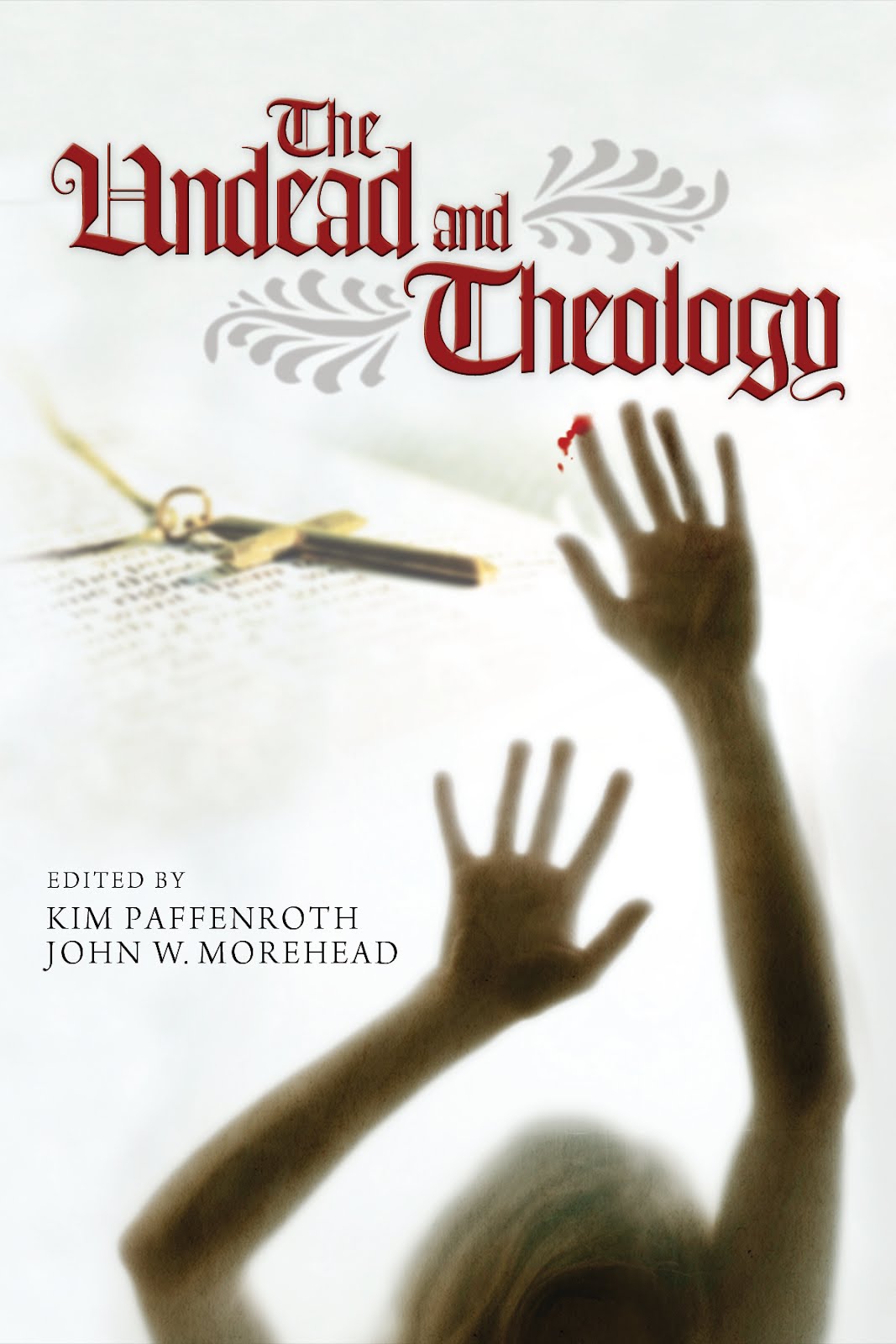
If you’re looking to celebrate Halloween with a good book, then look no further than the new release, The Undead and Theology, a collection of essays edited by Kim Paffenroth and John Morehead. Again, this is a bit of a shameless plug, in a way, because I have a chapter in it on The Walking Dead comic books. On the other hand, I’m not seeing a dime from this, so I can still say without reservation that this is a really great read with some strong contributions. Read on for a detailed summary of the offerings. Happy Halloween!
Paffenroth and Morehead organize this collection of essays around three broad themes, vampires, zombies, and “other undead.” In that last section, contributors focus on topics as diverse as the Golem, Gothic subculture, and evolving notions of hell. Each contributor offers fresh perspectives on some increasingly well-worn subject matter. A common theme that stretches across each section is the way in which these undead narratives infiltrate our real-world experiences from Arnold T. Blumberg’s discussion of the Golem of Prague to W. Scott Poole’s history of vampire scares in ’60s and ’70s Britain to Morehead’s analysis of Zombie Walks. As a result, The Undead and Theology proves to be not only a work of deeply competent academic and theological reflection on pop culture but a signpost pointing to the ways in which these narratives shape many people’s lived experiences. Read on for highlights from each essay. You can purchase a print or Kindle version of the book over at Amazon.
“Vampires and Female Spiritual Transformation: Laurel K. Hamilton’s Anita Blake, Vampire Hunter” by Vicky Gilpin
In her analysis of Anita Blake, Vampire Hunter, Vicky Gilpin shows how the series takes a rather postmodern approach to notions of good and evil, melding religious methods and complicating human and vampire identities. Paralleling the rise of SBNRs (spiritual but not religious) and Nones in American religious experience, Anita Blake, according to Gilpin, reveals that “faith, not the flavor of belief, is most important in fighting evil.” Gilpin’s reflection on Blake’s reaction to the monstrous has implications for our own experience of “the other.” She writes, “Her humanization of ‘the other,’ of vampires (and Fey, werewolves, psychics, etc.), also alters her perception of religion through the series.” Perhaps, as we dialogue with people of other faiths (or none at all) and genuinely listen to and share in their lives, we will begin to see our own faith commitments in new and fresh ways.
“Crossing the Spiritual Wasteland in Priest” by Joseph Laycock
Joseph Laycock draws inspiration from Douglas Cowan’s book, Sacred Terror: Religion and Horror on the Silver Screen, in which he outlines three narratives most often used to set up the “metataxis of horror,” inversion, invasion and insignificance. Through one or a combination of these narratives, the religious world (morals, notions of right and wrong, and authority) is turned upside down. Laycock turns his attention to the religious blockbuster, Priest (2011), to show the horror that emerges not only from “the vampires as a manifestation of demonic evil, but the possibility of an anomic world where the sacred order is undone, and good and evil are no longer meaningful categories. With the protagonist, the audience is left in a wasteland where our assumptions about the sacred appear to lie in ruins.” The question then arises as to how we move forward when notions of good and evil are no longer meaningful categories…or mean something completely different?
“Vampires are People, Too: Personalism in the Buffyverse” by Jarrod Longbons
Buffy the Vampire Slayer has been a rich source of material on which theologians and religious studies folk have reflected from a variety of perspectives. Here, Jarrod Longbons shows how “the soul in BtVS is a secular parody of a more robust Christian personalism put forward by Pope John Paul II and Pope Benedict XVI.” Longbons adds, If Stoker’s vampire is a Catholic one, and Rice’s is a secular one (with elements of Protestantism), then BtVS represents a thoroughly postmodern (and secular) vampire world.” Longbons surveys common notions of evil vampires and notes that they are often considered diabolical because they lack a soul. However, BtVS complicates these understandings of both the vampire and the soul. Longbons reveals, “In the Buffyverse, however, the soul has nothing to do with relating to the divine. […] The soul, here, is not an essentialist entity of transcendence that orientates one toward others and God; rather, as Spike shows, the soul existentially allows him to act ethically toward others.” While this might be off-putting to a number of Christian readers and viewers, Longbons continues on to show that such a notion of the soul is not devoid of redeeming and/or theological value. By bringing in Christian teachings of the Trinitarian view of God, we see that “God is not a simple ‘I’ but a self-giving ‘we.’ In like manner, human beings are not defined by strict ‘I’ and ‘you’ Cartesianism, because like God, human persons are defined, first, by their relations.” We are truly human and, some like Longbons might argue, perhaps more divine when we relate ethically and/or morally to one another.
“The Vampire that Haunts Highgate: Theological Evil, Hammer Horror, and the Highgate Vampire Panic in Britain, 1963-1974” by W. Scott Poole
W. Scott Poole’s essay is one of the most fascinating of the collection as it focuses on the ways in which religion, pop culture, and “sociophobias” combined to create the perfect storm of terror in Britain during the 1960s and 1970s. He shows how “Hammer Studio films’ use of satanic metaphors in the late 60s and early 70s reflected an increased fascination with the devil as a new kind of horror film monster, as well as anxieties about ‘real’ devil worship.” In the process, he shows how the real-world vampire panic in Highgate teaches us “much about the complex relationship between religion and popular culture in modern society, the strange alliances they sometimes forge in relation to supernatural discourses. Religious conservatives, horror films, and the disastrous state of British life in the early 70s ensured that, in the midst of an increasingly secular society, the devil got his due.” Poole’s research has so many implications for our experiences today and the ways in which we continually employ pop culture narratives to frame discussions of and reactions to real world horrors.
“The Living Christ and The Walking Dead: Karl Barth and the Theological Zombie” by Jessica DeCou
If Poole’s essay is one of the more fascinating contributions to the collection, Jessica DeCou‘s is certainly the bravest. In it, she writes from a fictional perspective of living in the The Walking Dead zombie apocalypse to reflect on eschatological hope. Placing herself in this phenomenal narrative, she asks, “What are the implications of a zombie outbreak for our understanding of fellow humanity, eschatological hope, and the doctrine of bodily resurrection? And what does our zombie test-subject reveal about our rights and duties in relation to him?” DeCou recognizes the risk that her narrative approach could “[veer] over the line into cheesy fan-fiction,” yet she continues with the conviction that it ultimately “allows for a more penetrating exploration of the complexities facing such a world than would cold academic prose.” This essay won’t necessarily be everyone’s cup of tea, but, in my opinion, DeCou nails it.
“Zombie Walks, Zombie Jesus, and the Eschatology of Postmodern Flesh” by John W. Morehead
Having participated in a Zombie Walk almost a year ago, I was eager to read John W. Morehead‘s reflection on this growing pop culture phenomenon as a “piece of eschatological theater shaped by the postmodern apocalyptic imagination.” In his essay, he explores various aspects of zombie walks including “the phenomenon as a form of postmodern apocalyptic that puts an imaginative twist on the Judeo-Christian apocalypse; attitudes toward death, the body and new concepts of the self; and how this relates to resurrection and a broader Christian eschatology of hope in the face of postmodern nihilism.” The value of Morehead’s research is in his willingness to take seriously (and, by implication, challenging us to as well) what so many people see as just a fun night out.
“When All is Lost, Gather ‘Round: Solidarity as Hope Resisting Despair in The Walking Dead” by Ashley Moyse
I appreciate Ashley Moyse‘s contribution because he offers a much-needed hopeful analysis of what, to many, might seem like a nihilistic narrative in The Walking Dead. Here, he challenges us to see that the despair of the zombie apocalypse is “opposed by a hope that may be encountered in the community of humans struggling to flourish in a world gone wrong—in a community capable of encountering hope in the joy of mutual service and faithful labor with and for each other.” Moyse makes the bold claim that “the story portrays a movement toward hope rooted in the response of some to enter the life of their neighbors (their co-survivors) in haste, without want, and out of genuine empathy.” If we pay close attention, beyond all the decapitations and blood and guts we do see this selflessness and service at work, even in the first couple of episodes of this new third season.
“Apocalyptic Images and Prophetic Function in Zombie Films” by Kim Paffenroth
I can never get enough of Kim Paffenroth‘s writings on the apocalyptic images and prophetic function of George Romero‘s zombie films. He delves deeply into this in his book, Gospel of the Living Dead: George Romero’s Visions of Hell on Earth, and also in an essay in Light Shining in a Dark Place, but this book would have been incomplete without his work. Paffenroth again encourages us to see zombies as “overwhelmingly ordinary, which is to say, they are terribly and fully human,” which accounts for their lasting appeal. Through his analysis of a handful of zombie films from 1968 to 2005, Paffenroth reveals that “Romero repeatedly returns to the current versions of those sins in modern America, usually presented as consumerism (not just the hoarding of wealth, but the definition and valuation of oneself as a consumer of goods) and racism (which may well include nationalism, similar to Israel’s discounting of other peoples as somehow less in God’s eyes, but with the added animosity and oppression of racial minorities within the United States).” As a result, he sees Romero as a modern day prophet who exposes society’s sins and warns of the disasters to come should they not right their wrongs.
“Negotiating (Non)Existence: Justifications of Violence in Robert Kirkman’s The Walking Dead” by J. Ryan Parker
Turning away from The Walking Dead television series, I turn my attention to their source, Robert Kirkman’s comics, which for many fans of the show are still relatively unexplored territory. In this essay, I consider the ways in which Kirkman uses the zombie apocalypse to explore humanity and human conflict. I argue that, in their attempts to negotiate (non)existence (i.e. survival in a zombie apocalypse through warding off zombies and survivors), the human survivors employ a variety of biological and moral and/or ethical defense strategies for their violent behavior. In the process, they become more terrifying than the zombies that haunt Kirkman’s pages and potentially shed light on our own horrific, real-world experiences and actions.
“When You’re Undead the Whole World is Jewish” by Arnold T. Blumberg
Having read Arnold T. Blumberg‘s essay while in Prague was a real treat because the Golem on which he focuses still holds a primary place in the public (or at least tourist) consciousness there. At the beginning of his essay, Blumberg asks, “Why are there no Jewish zombies (apart from a certain carpenter)?” He subsequently casts the question in broader terms, “Where is the comparable Jewish cultural tradition for all the other creatures that roam the dark corridors of our subconscious?” To help address this lack, he turns his attention to the Jewish creature of the Golem and the ways in which it both influenced other fictional monsters and continues to occupy spaces in smaller corners of contemporary pop culture and Jewish life.
“‘Eat of My Body and Drink of My Blood’: Johannine Metaphor, Gothic Subculture, and the Undead” by Beth Stovell
Beth Stovell offers an insightful comparison between metaphors in Revelation and Gothic subculture and the ways in which both communities use language as “1) a reaction against mainstream culture; 2) as a reaction against exploitation; and 3) as a form of paradox and irony that subverts expectation.” Stovell’s essay adds clarity to potentially confusing and troubling uses of Revelation in contemporary religious and political discourse and helps unpack its value for marginalized and oppressed communities. While she concludes that “Revelation itself and Gothic interpretations of Revelation force readers to rethink their place in relation to mainstream culture, in relation to the oppression and exploitation happening every day (whether seen or unseen), and in relation to the Church,” her essay also implicitly forces us to consider the ways in which we might also be sources of that oppression and exploitation.
“Fire, Brimstone and PVC: Clive Barker’s Cenobites as Agents of Hell” by Andrea Subissati
The final contributor, Andrea Subissati, has one of the coolest websites of the bunch, so check it out. Her essay provides important insights into changing perspectives of hell through an analysis of Clive Barker‘s cenobites in his The Hellbound Heart and the Hellraiser series. Subissati offers speculation as to why the hellish continues to appeal to horror fans: “Hell has captured the imagination of artists, poets, and scholars in ways the heavens could not aspire to, possibly because it is more relatable to us earthlings who know far more of suffering than of paradise.” As she begins to unpack the work of the cenobites, she concludes that “changed times have called for altered mythologies of hell and devilry in order to stay relevant to contemporary society and to maintain their role as deterrent for sin and immorality.” For Subissati, Barker’s creation fits our contemporary experience: “The idea of hell being one’s personal tailor-made torment speaks to the merging of individualism with the rise of consumer culture, where people identify strongly with material goods and seek to define themselves with as much specificity as possible. In other words, these characters do not simply experience hell as passive subjects; they are complicit in its reality.”
Previous Post

October 30, 2012
Religious Baddies
Next Post

October 31, 2012 Are you Bro Life?
Browse Our Archives
Select a Category Classics DVD Film Music News Pop Culture Events Print Sports Television Uncategorized Video Games
Select a Month March 2017 February 2017 January 2017 December 2016 November 2016 October 2016 September 2016 August 2016 July 2016 June 2016 May 2016 April 2016 March 2016 February 2016 January 2016 December 2015 November 2015 October 2015 September 2015 August 2015 July 2015 June 2015 May 2015 April 2015 March 2015 February 2015 January 2015 December 2014 November 2014 October 2014 September 2014 August 2014 July 2014 June 2014 May 2014 April 2014 March 2014 February 2014 January 2014 December 2013 November 2013 October 2013 September 2013 August 2013 July 2013 June 2013 May 2013 April 2013 March 2013 February 2013 January 2013 December 2012 November 2012 October 2012 September 2012 August 2012 July 2012 June 2012 May 2012 April 2012 March 2012 February 2012 January 2012 December 2011 November 2011 October 2011 September 2011 August 2011 July 2011 June 2011 May 2011 April 2011 March 2011 February 2011 January 2011 December 2010 November 2010 October 2010 September 2010 August 2010 July 2010 June 2010 May 2010 April 2010 March 2010 February 2010 January 2010 December 2009 November 2009 October 2009 September 2009 August 2009 July 2009 June 2009 May 2009 April 2009 March 2009 February 2009 January 2009 December 2008 November 2008 October 2008 September 2008 August 2008 July 2008 June 2008 May 2008 April 2008 March 2008 February 2008 January 2008 December 2007 November 2007 October 2007 September 2007 August 2007 July 2007 June 2007 May 2007 April 2007 March 2007
Follow Us!
TAKE THE
Religious Wisdom Quiz
I came to Jesus at night to ask about being born again. Who was this Pharisee and member of the Jewish ruling council?
Select your answer to see how you score.
Caiaphas Gamaliel Joseph of Arimathea Nicodemus
Related posts from Pop Theology


#KillerSerials: An Interview with Kutter Callaway

Book Review: MUSLIMS AND THE MAKING OF AMERICA

TRENDING AT PATHEOS Progressive Christian

Why Christians Have a Sacred Duty to Vote:...
The Bible offers strong support for the sacred duty to vote. Here...

What Being a Modern-Day Apostle Means to Me
In my last column, I discussed the ins and outs of modern-day...

Did Ancient China Once Worship the God of...
Across human history, a common thread weaves through the origins of the...

Love Your Neighbor – Including Earth-Kin: Lev. 19,...
God’s command to love your neighbor means acting in an ethical and...

Lead a Church Study of “Jesus and Lao...
Guest writer Jack Thomas (The Irreverent Reverend) reflects on leading his church...

Principles for Understanding the Apostolic Ministry Today
Whenever people discover that my formal ministry title is "apostle," as in...
view all Progressive Christian blogs
Ad-Free & Subscriber Log-In Subscription Support
- About Us
- 2026 Calendar
- Videos
- Podcasts
- Library of World Religions
- Faith In Media Tracker
- Advertise With Us
- Write for Us
- Privacy Policy
- Terms of Service
- Do Not Sell My Data
- Contact Us
- Radiant Digital
- Manage Newsletter Subscriptions
- Unsubscribe From Notifications
- Sitemap
Copyright 2008-2026, Patheos. All rights reserved.
Subscription Support Ad-Free & Subscriber Log-In
Follow Patheos