
BuddhistCatholicContemplativeEvangelicalGeneral ChristianHinduJewishLatter-day SaintMuslimNew VisionsProgressive Christian
Beliefs
- Buddhist
- Catholic
- Contemplative
- Evangelical
- General Christian
- Hindu
- Jewish
- Latter-day Saint
- More Voices
- Muslim
- New Visions
- Pagan
- Progressive Christian
Topics
- Religion News
- Food and Religion
- Sports and Religion
- Religious Art
- Religious Music and Entertainment
- Religious Events
- History and Religion
- Style and Religion
- Politics and Religion
- Women in Religion
- Recreation Outdoors and Religion
- Business Finance and Religion
- Careers Workplace and Religion
- Education and Religion
- Family Parenting and Religion
- Health Fitness and Religion
- Home and Religion
- Relationships and Religion
- Technology and Religion
- Travel and Religion
Columnists
- Buddhist Columnists
- Business Finance and Religion Columnists
- Careers Workplace and Religion Columnists
- Catholic Columnists
- Contemplative Columnists
- Education and Religion Columnists
- Evangelists Columnists
- Family Parenting and Religion Columnists
- General Christian Columnists
- Health Fitness and Religion Columnists
- Hindu Columnists
- History and Religion Columnists
- Home and Religion Columnists
- Jewish Columnists
- More Voices Columnists
- Latter Day Columnists
- Muslim Columnists
- New Visions Columnists
- Nonreligious Columnists
- Pagan Columnists
- Politics and Religion Columnists
- Progressive Columnists
- Recreation Outdoors and Religion Columnists
- Relationships and Religion Columnists
- Religion News Columnists
- Religious Art Columnists
- Religious Events Columnists
- Religious Music and Entertainment Columnists
- Sports and Religion Columnists
- Style and Religion Columnists
- Technology and Religion Columnists
- Travel and Religion Columnists
- Women in Religion Columnists
Resource Library
- 2026 Calendar
- Library of World Religions
- The 100 Most Holy Places on Earth
- Patheos Answers
- Podcasts
- Videos
- Faith Leaders Database
- Anglican Episcopalian
- Bahai
- Baptist
- Buddhism
- Christianity
- Confucianism
- Eastern Orthodoxy
- Hinduism
- Holiness and Pentecostal
- ISKCON
- Islam
- Judaism
- Lutheran
- Methodist
- The Church of Jesus Christ of Latter-day Saints
- New Age
- Paganism
- Presbytarian and Reformed
- Protestantism
- Religion Behind the Scenes
- Roman Catholic
- Scientology
- Shia Islam
- Sikhism
- Sufism
- Sunni Islam
- Taoism
- Zen
- See all religions
Research Tools
 Ad-Free & Subscriber Log-In Subscription Support
Ad-Free & Subscriber Log-In Subscription Support
Follow Patheos 

- Trending:
- Forgiveness
- |
- Marriage
- |
- Consciousness
- |
- Death Penalty
- |
- Election
- |
- Halloween
 Pop Theology
- Home
- Progressive Christian
- Religious Music & Entertainment
- Religious Baddies
Religious Baddies
Last updated on: October 30, 2012 at 2:46 pm by J. Ryan Parker
Religious Baddies 2012-10-30T14:46:19-07:00 J. Ryan Parker
Patheos Explore the world's faith through different perspectives on religion and spirituality! Patheos has the views of the prevalent religions and spiritualities of the world.
We’re having a little fun here at Pop Theology as Halloween rolls around. This time of year, we celebrate all things monstrous and horrific, and while evil comes in all shapes and sizes, many of us also know that it often comes dressed in religious garb. Below are a few of our favorite religious baddies, evil characters who are either explicitly religious or feature as the villains in explicitly religious films. These films range from the 1950s to the present day and cover genres from biblical epics to documentaries. The performances themselves are equally varied from laughter-inducing camp to spine-tingling horror. We’ve listed them in chronological order, and I know we’ve no doubt left out more than a few, so share your favorites that we missed.
 Nero (Peter Ustinov) from Quo Vadis? (1951)
In 1951, Mervyn Leroy directed a remake of Quo Vadis? for MGM. It was nominated for 8 Oscars, but won none. Consider its competition that year: The African Queen, A Place in the Sun, and A Streetcar Named Desire. The story centers on a Roman officer (Robert Taylor) who falls in love with a Christian girl (Deborah Kerr). Unfortunately, they do so during the persecution of the Christians, lead by Peter Ustinov’s diabolically brilliant turn as Nero. An infantile megalomaniac with delusions of being a great artist, he is petulant, cruel, narcissistic, perverse, hysterical – in other words, magnificent. Ustinov staggers around the set, eyes always in distant focus, braying his odes on his lyre (the famous “fiddling” of Nero.) His burning of Rome is chalked up to sheer artistic ennui—the only subject worthy of his muse is the incineration of the ancient city. Nero is, quite literally, a flaming queen. As a result, it can be hard to be angry with or fear such a character when you’re tempted to laugh so much. Consider Nero’s reaction to the survivors of the fire who rush his palace: “Who asked them to survive?”
Rev. Harry Powell (Robert Mitchum) in The Night of the Hunter (1955)
The Night of the Hunter is one of my (Ryan’s) favorite films and, perhaps, the greatest directorial one-hit-wonder of all time as it was the first and only film directed by Charles Laughton, who also had a brilliant turn as Nero in Cecil B. DeMille’s The Sign of the Cross (1932). The film contains some of the most effective cinematography and lighting in the history of American film. The centerpiece, however, is Rev. Harry Powell (Robert Mitchum), a psychopathic preacher who tries to track down the widow of a man recently hanged for murder. He is convinced that she, or her children, can show him where the proceeds of her husband’s robbery are concealed and that God has told him to use the money to build a chapel and to kill any wicked people, if necessary, who stand in his way. Thanks in no small part to Mitchum’s performance, The Night of the Hunter is a powerful film mixed with poetry and evil that conveys the brooding fanaticism of a religious maniac.
Baka (Vincent Price), Dathan (Edward G. Robinson), and Rameses (Yul Brenner) from The Ten Commandments (1956)
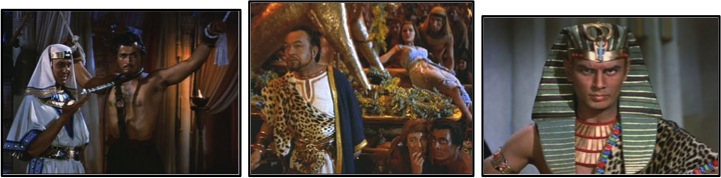
I was tempted to put Cecil B. DeMille on this list of religious baddies for all of his scandalous treatment of biblical and religious epics. Few directors in the history of the medium have walked so fine a line between the sexy and the sacred quite like DeMille. He directed two versions of The Ten Commandments, and the technicolor 1956 epic is by far the most popular.
The fearsome threesome of The Ten Commandments are the Pharaoh Rameses (Yul Brynner), the master builder Baka (Vincent Price), and Dathan (Edward G. Robinson). They’re avatars for the real bogeyman of the 1950’s – communism.
Rameses—cunning, powerful, arrogant, but ultimately insecure—plays a kind of ancient Khrushchev. He’s the leader of the world’s most hated superpower, and Moses and the Hebrews are the freedom-loving underdogs. He’s most entertainingly gruesome in his scenes with Queen Nefretiri (Anne Baxter) where he reveals a little too much about Cecil B. DeMille’s own misogyny and tendency toward S&M. “You’re a treacherous sharp-clawed little peacock,” as Rameses says, might be an insult to most women, but to Nefretiri, and the kind of women C.B. liked, it was a challenge and a turn-on.
If Rameses is the head of the Egyptian Reds, Baka, played by Price, is the party apparatchik, building massive and useless edifices to the glory of the Pharaoh. Price is entertaining as Baka because of his effeminate brand of evil. In one scene, he manages to kidnap the Hebrew water bearer Lilia (Debra Paget), presumably to sully her honor. We find him, instead, carefully dressing her in one of his favorite gowns. By the end of the scene, he has the buff Joshua (John Derek) strung up shirtless and ready to whip.
If Rameses and Baka are the party regulars, Dathan, played by former gangster movie megastar Robinson, is the mole. He sells out his people for his own gain, leaving him in a role that would have been recognizable to 1950’s Americans as a kind of Hebrew Alger Hiss. In his idolatry of riches and power, he is the one who must be destroyed by those implements of “freedom,” the Ten Commandments. In this case, quite literally, as Moses hurls the stone tablets at Dathan at the end of the film, destroying him and the Golden Calf.
Better Hebrew dead than Egyptian Red.
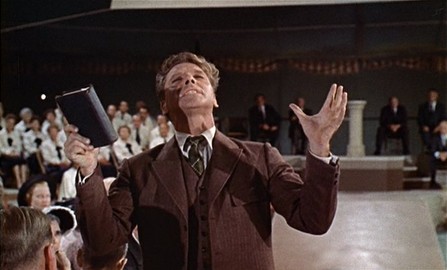 Elmer Gantry (Burt Lancaster) in Elmer Gantry (1960)
Burt Lancaster earned a Best Actor Oscar for his titular performance as Elmer Gantry, a traveling salesman who discovers the lucrative aspect of hell-fire and damnation sermonizing. An adaptation of Sinclair Lewis’ attack on commercialized, show-biz revivalism, the film exposes the fake emotionalism and financial wheeling and dealing of big business evangelism. The movie is packed with drama, emotion, and a bit of sex to boot (Shirley Jones plays a prostitute). The highlight, of course, is Lancaster’s performance, which grabs your attention from the moment he first appears and never lets go.
 Father Oliver O’Grady (himself) in Deliver Us From Evil (2006)
In this 2006 documentary about the Catholic Church’s refusal to directly and more punatively address its sex abuse scandal, we see the powers that be move known serial pedophile Father Oliver O’Grady (pictured above) from parish to parish. His is a chilling face of evil, especially because he is so completely disarming and at times acts as if he doesn’t understand what all the fuss is about. As many critics noted, it’s more terrifying than any horror film because it all actually happened. After serving seven years of a 14-year prison sentence in the United States, he returned to his home in Ireland. In January 2012, O’Grady was sentenced to three years in prison in Ireland for possession of child pornography.
Becky Fisher (herself) in Jesus Camp (2006)
Another example of religious abuse, Jesus Camp received much critical acclaim when it released in 2006. Becky Fisher was the director of the now-defunct Pentecostal youth retreat, Kids on Fire School of Ministry, which has since re-grouped as Kids in Ministry International. Her hell fire and brimstone sermonizing whipped young children into a fearful frenzy and had them tearfully confessing their sins in front of rapt congregations and movie audiences. Anyone who stirs up these kinds of emotions in children this young should certainly be brought up on charges of child abuse. As Richard Roeper said in his review, “Jesus would be appalled by what goes on in the these camps.”
 Rev. Eli Sunday (Paul Dano) in There Will Be Blood (2007)
Written and directed by P.T. Anderson, There Will Be Blood was not only one of the most critically acclaimed films of 2007 but of the entire decade. While Daniel Day-Lewis took home another Best Actor Oscar as the tough-as-nails oil man Daniel Plainview, he was surrounded by formidable talent in the form of Paul Dano, who played Rev. Eli sunday, an up-and-coming minister at the Church of the Third Revelation, who questions not Plainview’s business practices but the destination of his soul. The brilliance of Dano’s performance is in its earnest intensity; however, his financial, emotional, and physical undoing at the end of the film, in which he comes crawling back to Daniel, is the stuff of shocking, bloody legend and reveals the dangers of mixing business and religion.
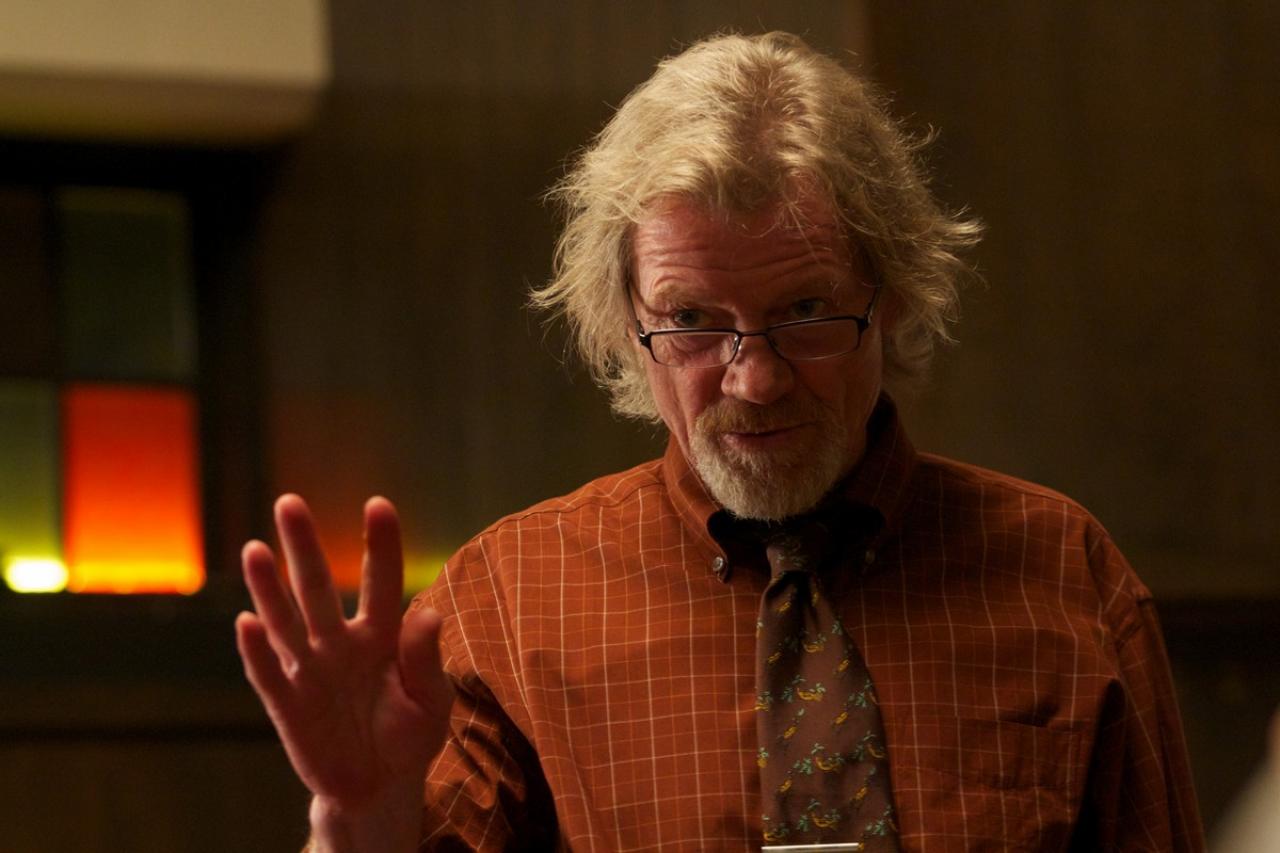 Rev. Abin Cooper (Michael Parks) in Red State (2011)
In one of the most underrated performances of 2011, Michael Parks played Rev. Abin Cooper, the leader of Five Points Trinity Church, a violent extremist Christian sect, which is a thinly-veiled stand-in for Fred Phelps and the Westboro Baptist Church in Topeka, Kansas. The members of the congregation lure and kidnap people they suspect of deviant behavior (particularly homosexuality) and use them in their horrific evening worship services. Parks plays the the part of the evil minister to the hilt. The lengthy sermon scene in which we first meet him should have landed him the nomination for Best Actor as the hymns and scriptures roll off of his tongue like poison-laced honey.
Previous Post

October 24, 2012
Innocent?
Next Post
October 31, 2012 The Undead and Theology: A Review
Browse Our Archives
Select a Category Classics DVD Film Music News Pop Culture Events Print Sports Television Uncategorized Video Games
Select a Month March 2017 February 2017 January 2017 December 2016 November 2016 October 2016 September 2016 August 2016 July 2016 June 2016 May 2016 April 2016 March 2016 February 2016 January 2016 December 2015 November 2015 October 2015 September 2015 August 2015 July 2015 June 2015 May 2015 April 2015 March 2015 February 2015 January 2015 December 2014 November 2014 October 2014 September 2014 August 2014 July 2014 June 2014 May 2014 April 2014 March 2014 February 2014 January 2014 December 2013 November 2013 October 2013 September 2013 August 2013 July 2013 June 2013 May 2013 April 2013 March 2013 February 2013 January 2013 December 2012 November 2012 October 2012 September 2012 August 2012 July 2012 June 2012 May 2012 April 2012 March 2012 February 2012 January 2012 December 2011 November 2011 October 2011 September 2011 August 2011 July 2011 June 2011 May 2011 April 2011 March 2011 February 2011 January 2011 December 2010 November 2010 October 2010 September 2010 August 2010 July 2010 June 2010 May 2010 April 2010 March 2010 February 2010 January 2010 December 2009 November 2009 October 2009 September 2009 August 2009 July 2009 June 2009 May 2009 April 2009 March 2009 February 2009 January 2009 December 2008 November 2008 October 2008 September 2008 August 2008 July 2008 June 2008 May 2008 April 2008 March 2008 February 2008 January 2008 December 2007 November 2007 October 2007 September 2007 August 2007 July 2007 June 2007 May 2007 April 2007 March 2007
Follow Us!
TAKE THE
Religious Wisdom Quiz
What did the Israelites eat in the wilderness?
Select your answer to see how you score.
Manna Honey and milk Bread and fish Grapes and figs
Related posts from Pop Theology


At SXSW2017: May It Last: A Portrait of...

At SXSW 2017: "Untold Tales of Armistead Maupin"
TRENDING AT PATHEOS Progressive Christian

Why Christians Have a Sacred Duty to Vote:...
The Bible offers strong support for the sacred duty to vote. Here...

What Being a Modern-Day Apostle Means to Me
In my last column, I discussed the ins and outs of modern-day...

Did Ancient China Once Worship the God of...
Across human history, a common thread weaves through the origins of the...

Love Your Neighbor – Including Earth-Kin: Lev. 19,...
God’s command to love your neighbor means acting in an ethical and...

Lead a Church Study of “Jesus and Lao...
Guest writer Jack Thomas (The Irreverent Reverend) reflects on leading his church...

Principles for Understanding the Apostolic Ministry Today
Whenever people discover that my formal ministry title is "apostle," as in...
view all Progressive Christian blogs
Ad-Free & Subscriber Log-In Subscription Support
- About Us
- 2026 Calendar
- Videos
- Podcasts
- Library of World Religions
- Faith In Media Tracker
- Advertise With Us
- Write for Us
- Privacy Policy
- Terms of Service
- Do Not Sell My Data
- Contact Us
- Radiant Digital
- Manage Newsletter Subscriptions
- Unsubscribe From Notifications
- Sitemap
Copyright 2008-2026, Patheos. All rights reserved.
Subscription Support Ad-Free & Subscriber Log-In
Follow Patheos