
BuddhistCatholicContemplativeEvangelicalGeneral ChristianHinduJewishLatter-day SaintMuslimNew VisionsProgressive Christian
Beliefs
- Buddhist
- Catholic
- Contemplative
- Evangelical
- General Christian
- Hindu
- Jewish
- Latter-day Saint
- More Voices
- Muslim
- New Visions
- Pagan
- Progressive Christian
Topics
- Religion News
- Food and Religion
- Sports and Religion
- Religious Art
- Religious Music and Entertainment
- Religious Events
- History and Religion
- Style and Religion
- Politics and Religion
- Women in Religion
- Recreation Outdoors and Religion
- Business Finance and Religion
- Careers Workplace and Religion
- Education and Religion
- Family Parenting and Religion
- Health Fitness and Religion
- Home and Religion
- Relationships and Religion
- Technology and Religion
- Travel and Religion
Columnists
- Buddhist Columnists
- Business Finance and Religion Columnists
- Careers Workplace and Religion Columnists
- Catholic Columnists
- Contemplative Columnists
- Education and Religion Columnists
- Evangelists Columnists
- Family Parenting and Religion Columnists
- General Christian Columnists
- Health Fitness and Religion Columnists
- Hindu Columnists
- History and Religion Columnists
- Home and Religion Columnists
- Jewish Columnists
- More Voices Columnists
- Latter Day Columnists
- Muslim Columnists
- New Visions Columnists
- Nonreligious Columnists
- Pagan Columnists
- Politics and Religion Columnists
- Progressive Columnists
- Recreation Outdoors and Religion Columnists
- Relationships and Religion Columnists
- Religion News Columnists
- Religious Art Columnists
- Religious Events Columnists
- Religious Music and Entertainment Columnists
- Sports and Religion Columnists
- Style and Religion Columnists
- Technology and Religion Columnists
- Travel and Religion Columnists
- Women in Religion Columnists
Resource Library
- 2026 Calendar
- Library of World Religions
- The 100 Most Holy Places on Earth
- Patheos Answers
- Podcasts
- Videos
- Faith Leaders Database
- Anglican Episcopalian
- Bahai
- Baptist
- Buddhism
- Christianity
- Confucianism
- Eastern Orthodoxy
- Hinduism
- Holiness and Pentecostal
- ISKCON
- Islam
- Judaism
- Lutheran
- Methodist
- The Church of Jesus Christ of Latter-day Saints
- New Age
- Paganism
- Presbytarian and Reformed
- Protestantism
- Religion Behind the Scenes
- Roman Catholic
- Scientology
- Shia Islam
- Sikhism
- Sufism
- Sunni Islam
- Taoism
- Zen
- See all religions
Research Tools
 Ad-Free & Subscriber Log-In Subscription Support
Ad-Free & Subscriber Log-In Subscription Support
Follow Patheos 

- Trending:
- Forgiveness
- |
- Marriage
- |
- Consciousness
- |
- Death Penalty
- |
- Election
- |
- Halloween
 Pop Theology
- Home
- Progressive Christian
- Religious Music & Entertainment
- Second Chances and Cycles of Violence: A Review of Looper
Second Chances and Cycles of Violence: A Review of Looper
Last updated on: October 15, 2012 at 9:49 am by J. Ryan Parker
Second Chances and Cycles of Violence: A Review of Looper 2012-10-15T09:49:52-07:00 J. Ryan Parker
Patheos Explore the world's faith through different perspectives on religion and spirituality! Patheos has the views of the prevalent religions and spiritualities of the world.
The willful suspension of disbelief. All sci-fi films demand it, and some even reward it. Few films actually address it in the narrative as explicitly, and even humorously, as Looper, the current, popular time-travel/sci-fi/crime drama. Despite the gaping plot holes and thematic schizophrenia, it’s still an engaging viewing experience…so long as you don’t think too hard or ask too many questions.
Joe (Joseph Gordon-Levitt) lives in Kansas in the year 2044. In case you’re wondering, time travel hasn’t been invented by that time, but it will be around 30 years later. He’s a Looper, a gangster hired to kill baddies sent back in time by their bosses. Everything works smoothly until your loop gets closed, that is, the boss no longer has use for the future you and sends that you back to the present you to kill you…with a rich payout. Old Joe (Bruce Willis) knows all of this, of course, and so rigs his return to throw younger Joe off his execution game. This sets in motion an elaborate, frequently mind-melting cat-and-mouse game that pits the two Joes against one another and the two of them against the kid version of “The Rainmaker,” a future bad guy (we think), who has consolidated the five major crime syndicates running the country and is currently the one responsible for all the “loop closure.” Confusing? Well, as Old Joe tells the younger version of himself: “It’s a precise description of a fuzzy mechanism.” Or is it a fuzzy description of a precise mechanism? Who cares, just go with it.
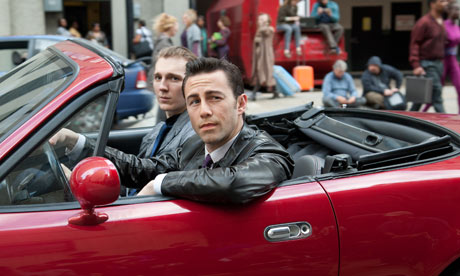
Seth (Paul Dano, left) and Joe (Joseph Gordon-Levitt, right) are young Loopers who think they have it all.
And this is one drawback to the film…or should I say an attitude that the filmmakers embrace whole-heartedly. Such narrative devil-may-care will no doubt put off viewers to varying degrees, depending on how much they care about the logistics of time travel and self-on-self violence…or how distracting Gordon-Levitt’s Bruce Willis makeup is. Personally, I went with it…thanks in no small part to fantastic performances all around, cool cinematography, and sharp editing. The film also benefits from some strong art direction and set design. Looper‘s version of a 2044 United States isn’t necessarily post-apocalyptic, but civilization does seem to be on the brink. Marshall law seems to be in place, and gangs run wild…although it seems as if things tighten up in the future (killing is outlawed, hence the need to send victims back in time for execution). I appreciated the little attention to detail that make all the atmospheric difference from the rigged exhaust pipes on the vehicles to flying crop dusting machines to way cooler cell phones.
I think I was less on board with the film upon the introduction of “kid Rainmaker,” who has a heightened sense of telekinetic power, a genetic mutation that has affected about 30-40% of the population in this not-too-distant future. Did I forget to mention that above? This kid’s like an angry Professor X ready to burst…oops, I almost gave something away. I don’t know why I give time travel a pass but get hung up on telekinesis.
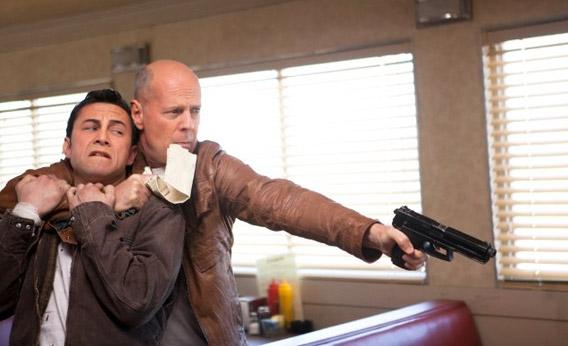
Old Joe (Bruce Willis) tries hard to teach his younger self a lesson.
Minor frustrations aside, I felt like there were points for conversation to follow up on, particularly around themes of second chances, cycles of violence, and the nature of cinematic violence. The violent directive aside, the process of closing your loop, of eventually coming into contact with your future self and all the wisdom and experience that entails, is interesting. We see loop closure twice, and each experience has drastically different results (even though both younger loopers cannot bring themselves, at first, to kill their older versions). Some of the more entertaining moments of the film take place when older Joe attempts to set younger Joe straight over cups of coffee and plates of steak and eggs. These are also the places in which the film draws attention to its own logical and narrative shortcomings. Will Younger Joe take the elder’s advice? Can they change or (re)shape the future?
The always alluring and brilliant Emily Blunt plays Sara, a walking second chance, a young woman raising her son on the outskirts of the city. She gives Young Joe a shelter, but both he and his older self are more concerned about the future of someone else on the farm. Her relationship with son Cid (Pierce Gagnon) brings up questions of nature vs. nurture and how effective positive parenting is in developing positive, future adult behavior and how much help parents need.

Sara (Emily Blunt) siezes her second chance to be a mother and does all she can to protect her son.
There are few films that reveal the cyclical nature and power of violence better than Looper. Loopers spend their lives victimizing others long enough that they eventually, inevitably enact this violence on themselves, and most of them will not have the opportunity, like Joe, to realize it before it’s too late, thus sealing their own fate. The time travel scenario, as fantastic as it may be, visualizes the effects that violence has on our pasts, presents, and futures. Young Joe makes an extreme sacrifice to break this cycle and to attempt to shape a potentially better future. However, I think the filmmakers deftly leave open the possibility that even this sacrifice might not have the effects that Young Joe intended or hoped for. Much of this depends on young Joe’s (and even old Joe’s) understanding and perception of the future. Is the Rainmaker necessarily evil? If so, from whose perspective? Still, we could ask, as a result of Young Joe’s actions, what are we willing to sacrifice to break the cycles of violence that currently plague our communities?
I feel like I should say a word about the violence here (as in the visualization of it), especially since I’m working on a book on images of violence, forgiveness, and reconciliation in film. Devin McKinney’s classification of cinematic violence as either strong or weak helps in reflecting on Looper. We don’t see much strong violence of the sort that McKinney advocates, the kind that “acts on the mind by refusing it glib comfort and immediate resolutions” and that “amounts to a rent in the curtain of rationality, a glimpse of the ultimate questions one spends a lifetime denying.” Much of what we have here, even though there are a couple of moments of intense gorish action, is cinematic violence of the weak sort. Suffering is set to a minimum, and bodies are riddled with bullets and left in heaps on the floor (Older Joe invading his past boss’ office and dispatching of dozens of goons is a typical example). This is all the more disturbing because the film also deals with extreme violence against children. I won’t say much about this to keep from spoiling it, but the violence against children component is an integral part of the story and one that raises a host of ethical and moral questions; however, the film only pays lip-service to the choices that both old and young Joe must make in this respect. Suffice it to say that older Joe crosses a line, but he and the rest of the film (brief pause aside) continue on as if nothing really serious just happened. Moreover, the camera consistently turns away from the action in the moments that would have potentially been the most unsettling had they been shown in all their offensive glory. I’m a fan of violence in films, or to put it as McKinney does, I recognize that “some nightmares are worth having.” But this violence needs to be handled maturely and realistically, and it’s just not here.
The credits start to roll to “Powerful Love” by Chuck and Mac, which includes the line, “Why do I love you like I do when you told me over and over you wouldn’t be true?” This could be a question that audiences of the film, fans and detractors alike, ask of Looper. Despite it’s shortcomings, it’s still an engaging and provocative experience. I’ve got a hunch that for fan boys and girls and geeky movie buffs, this film will inspire multiple viewings to ferret out all the Easter Eggs hidden away. In fact, director Rian Johnson has even created a commentary that you can download and listen to while watching Looper in theaters.
Looper (118 mins.) is rated R for strong violence, language, some sexuality/nudity and drug content and is currently in theaters.
FOOTNOTE
McKinney, Devin. “Violence: The Strong and the Weak,” in Screening Violence, edited by Stephen Prince. New Brunswick: Rutgers University Press, 2000.
“Powerful Love” by Chuck and Mac
Previous Post

October 10, 2012
Laughter in the Face of Fear
Next Post
October 17, 2012 A Fraternal Order of Eagles Ten Commandments Print
Browse Our Archives
Select a Category Classics DVD Film Music News Pop Culture Events Print Sports Television Uncategorized Video Games
Select a Month March 2017 February 2017 January 2017 December 2016 November 2016 October 2016 September 2016 August 2016 July 2016 June 2016 May 2016 April 2016 March 2016 February 2016 January 2016 December 2015 November 2015 October 2015 September 2015 August 2015 July 2015 June 2015 May 2015 April 2015 March 2015 February 2015 January 2015 December 2014 November 2014 October 2014 September 2014 August 2014 July 2014 June 2014 May 2014 April 2014 March 2014 February 2014 January 2014 December 2013 November 2013 October 2013 September 2013 August 2013 July 2013 June 2013 May 2013 April 2013 March 2013 February 2013 January 2013 December 2012 November 2012 October 2012 September 2012 August 2012 July 2012 June 2012 May 2012 April 2012 March 2012 February 2012 January 2012 December 2011 November 2011 October 2011 September 2011 August 2011 July 2011 June 2011 May 2011 April 2011 March 2011 February 2011 January 2011 December 2010 November 2010 October 2010 September 2010 August 2010 July 2010 June 2010 May 2010 April 2010 March 2010 February 2010 January 2010 December 2009 November 2009 October 2009 September 2009 August 2009 July 2009 June 2009 May 2009 April 2009 March 2009 February 2009 January 2009 December 2008 November 2008 October 2008 September 2008 August 2008 July 2008 June 2008 May 2008 April 2008 March 2008 February 2008 January 2008 December 2007 November 2007 October 2007 September 2007 August 2007 July 2007 June 2007 May 2007 April 2007 March 2007
Follow Us!
TAKE THE
Religious Wisdom Quiz
What Christian group is known for avoiding modern technology?
Select your answer to see how you score.
Pentecostals Baptists Methodists Amish
Related posts from Pop Theology


At SXSW2017: May It Last: A Portrait of...

At SXSW 2017: "Untold Tales of Armistead Maupin"
TRENDING AT PATHEOS Progressive Christian

Why Christians Have a Sacred Duty to Vote:...
The Bible offers strong support for the sacred duty to vote. Here...

What Being a Modern-Day Apostle Means to Me
In my last column, I discussed the ins and outs of modern-day...

Did Ancient China Once Worship the God of...
Across human history, a common thread weaves through the origins of the...

Love Your Neighbor – Including Earth-Kin: Lev. 19,...
God’s command to love your neighbor means acting in an ethical and...

Lead a Church Study of “Jesus and Lao...
Guest writer Jack Thomas (The Irreverent Reverend) reflects on leading his church...

Principles for Understanding the Apostolic Ministry Today
Whenever people discover that my formal ministry title is "apostle," as in...
view all Progressive Christian blogs
Ad-Free & Subscriber Log-In Subscription Support
- About Us
- 2026 Calendar
- Videos
- Podcasts
- Library of World Religions
- Faith In Media Tracker
- Advertise With Us
- Write for Us
- Privacy Policy
- Terms of Service
- Do Not Sell My Data
- Contact Us
- Radiant Digital
- Manage Newsletter Subscriptions
- Unsubscribe From Notifications
- Sitemap
Copyright 2008-2026, Patheos. All rights reserved.
Subscription Support Ad-Free & Subscriber Log-In
Follow Patheos