
BuddhistCatholicContemplativeEvangelicalGeneral ChristianHinduJewishLatter-day SaintMuslimNew VisionsProgressive Christian
Beliefs
- Buddhist
- Catholic
- Contemplative
- Evangelical
- General Christian
- Hindu
- Jewish
- Latter-day Saint
- More Voices
- Muslim
- New Visions
- Pagan
- Progressive Christian
Topics
- Religion News
- Food and Religion
- Sports and Religion
- Religious Art
- Religious Music and Entertainment
- Religious Events
- History and Religion
- Style and Religion
- Politics and Religion
- Women in Religion
- Recreation Outdoors and Religion
- Business Finance and Religion
- Careers Workplace and Religion
- Education and Religion
- Family Parenting and Religion
- Health Fitness and Religion
- Home and Religion
- Relationships and Religion
- Technology and Religion
- Travel and Religion
Columnists
- Buddhist Columnists
- Business Finance and Religion Columnists
- Careers Workplace and Religion Columnists
- Catholic Columnists
- Contemplative Columnists
- Education and Religion Columnists
- Evangelists Columnists
- Family Parenting and Religion Columnists
- General Christian Columnists
- Health Fitness and Religion Columnists
- Hindu Columnists
- History and Religion Columnists
- Home and Religion Columnists
- Jewish Columnists
- More Voices Columnists
- Latter Day Columnists
- Muslim Columnists
- New Visions Columnists
- Nonreligious Columnists
- Pagan Columnists
- Politics and Religion Columnists
- Progressive Columnists
- Recreation Outdoors and Religion Columnists
- Relationships and Religion Columnists
- Religion News Columnists
- Religious Art Columnists
- Religious Events Columnists
- Religious Music and Entertainment Columnists
- Sports and Religion Columnists
- Style and Religion Columnists
- Technology and Religion Columnists
- Travel and Religion Columnists
- Women in Religion Columnists
Resource Library
- 2026 Calendar
- Library of World Religions
- The 100 Most Holy Places on Earth
- Patheos Answers
- Podcasts
- Videos
- Faith Leaders Database
- Anglican Episcopalian
- Bahai
- Baptist
- Buddhism
- Christianity
- Confucianism
- Eastern Orthodoxy
- Hinduism
- Holiness and Pentecostal
- ISKCON
- Islam
- Judaism
- Lutheran
- Methodist
- The Church of Jesus Christ of Latter-day Saints
- New Age
- Paganism
- Presbytarian and Reformed
- Protestantism
- Religion Behind the Scenes
- Roman Catholic
- Scientology
- Shia Islam
- Sikhism
- Sufism
- Sunni Islam
- Taoism
- Zen
- See all religions
Research Tools
 Ad-Free & Subscriber Log-In Subscription Support
Ad-Free & Subscriber Log-In Subscription Support
Follow Patheos 

- Trending:
- Forgiveness
- |
- Marriage
- |
- Consciousness
- |
- Death Penalty
- |
- Election
- |
- Halloween
 Pop Theology
- Home
- Progressive Christian
- Religious Music & Entertainment
- A Shameless Plug and Summary!
A Shameless Plug and Summary!
Last updated on: October 1, 2012 at 1:17 pm by J. Ryan Parker
A Shameless Plug and Summary! 2012-10-01T13:17:50-07:00 J. Ryan Parker
Patheos Explore the world's faith through different perspectives on religion and spirituality! Patheos has the views of the prevalent religions and spiritualities of the world.
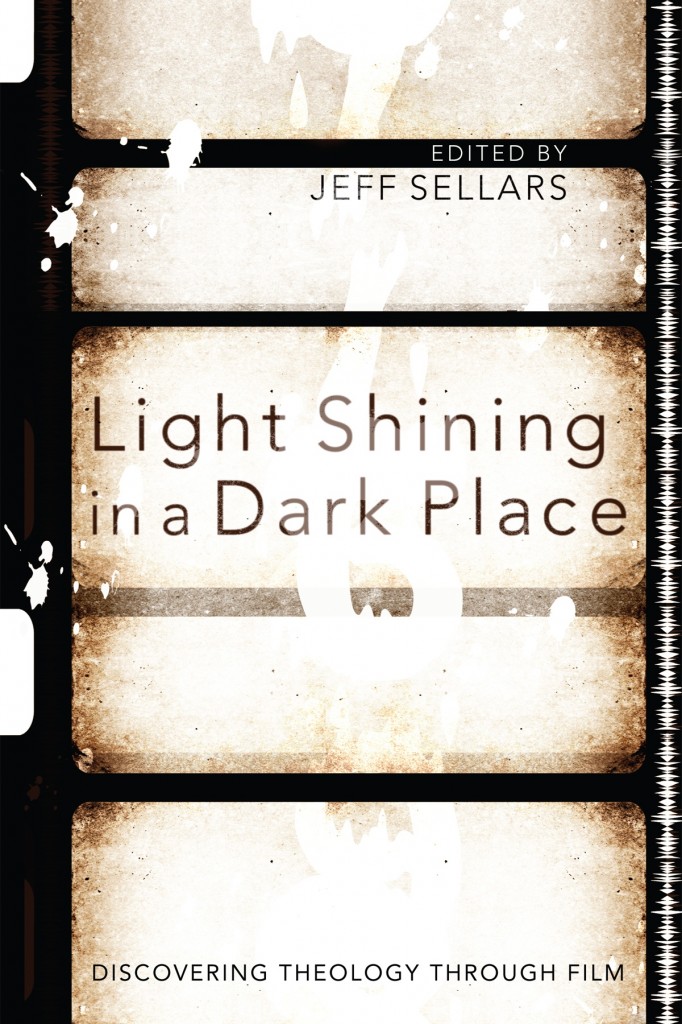
Of course, I’m biased, but I think the newest theology and film book, Light Shining in a Dark Place, is an interesting contribution to the growing hybrid study…and not just because I have a chapter in it either!
In his introduction, editor Jeff Sellars makes an impassioned argument for the importance of film in doing theology. “[…Films] have become the new meaning-giving myths of our culture. Films communicate the ‘good life’ to us–even if it is sometimes done through negative means […], and they do so with a power that often goes unrecognized” (xvii). The films discussed in Light Shining come from a variety of genres and locales. Fittingly, the contributors cover a wide range of theological perspectives. Sellars makes an important point about thinking and writing about films theologically: “It should go without saying that while the films dealt with in this volume are ‘theologically analyzed,’ not all of the films or their makers would have had such concepts and beliefs (at least consciously) in mind. Also, we certainly must be careful, when reading these essays, to be respectful of the films themselves” (xviii). Sellars built this collection of essays around themes of light and darkness, which reveals the variety of ways in which theology and film can inform one another. Having read over the book in its entirety, I’m convinced that it’s a perfect fit for theology and film courses and for church-based film discussion groups. For the latter, viewing one of the discussed films, reading the accompanying essay, and letting the conversation follow would no doubt spark lively debate about some of the themes and issues discussed. You should definitely pick this one up. And hey, that’s an honest promotion, especially since I’m not seeing any of the royalties! Read on for a brief description of each of the essays.
FROM DARKNESS INTO LIGHT
- In the first essay, “Representing Evil in Schindler’s List and Life is Beautiful,” Simon Oliver discusses the difficult task of representing unspeakable evil in film and the ways in which two films/filmmakers approach one of the most horrific events in human history. Oliver is assessing these films “in relation to a particular theological perspective on the nature of theological language and the ontological status of evil.” He writes, “[…The] delicate use of allegory and comedy in Life is Beautiful at once resists establishing the Shoah as unrepresentable and therefore definitive of history’s meaninglessness while also maintaining the devastating incoherence, and therefore ‘unspeakable,’ nature of genocide. […] By contrast, the cinematic spectacle of Schindler’s List […] renders the experience of Jews and Germans in mid-twentieth century Europe too accessible on a pietistic and literal plain, and therefore ‘comprehensible'” (6). Oliver’s essay will be important for film lovers and filmmakers who must daily respond to experiences of the horrific.
- In the next chapter, “Imagining a Better Way: Ben X and Marjorie Suchocki’s The Fall to Violence: Original Sin in Relational Theology,” I argue that Nic Balthazar’s film makes a fitting conversation partner with Suchocki’s formative (at least for me) reflection on sin and forgiveness. I argue that Ben X embodies her notions of sin as violation of creaturely and human well being and that through its narrative, it envisions her hope for imaginative/creative/non-violent responses to sin that break the violent cycles that enslave us. This film is a fitting choice for viewing and discussing with teenagers, centering on the theme of bullying as it does.
- In Chapter 3, “De Profundis…Out of the Shallows…Enter the Void,” Peter Malone writes about what he calls both “de profundis” and “shallows” films, those that either depict the depths of human misery and despair or just simply the frustrations of everyday, futile existence. While we may not all directly experience mindless acts of violence, we do know the universal pains of illness and loss, for example.
- Michael Leery provides one of my favorite chapters in our book, “Recalling Jesus: Form, Theory, and Trauma in Jesus Cinema.” He argues, quite rightly, “Excepting discussion of films like The Passion of the Christ or The Gospel According to St. Matthew, Jesus cinema is rarely subject to this kind of film-theoretical scrutiny. I think this is the case because discussion of Jesus cinema has struggled to find a point of access to actual aesthetic discourse” (54). He sets out to bridge film study, trauma studies, and Jesus films in some truly fascinating ways through analysis of films as diverse as La Vie de Jesus and Van Sant’s Last Days.
FROM LIGHT TO LIGHT
- While I am not sure I totally agree with J. Sage Ewell’s approach to social networks and media, I find her chapter, “Embracing Failure and Extending Grace in a Digital Age: Viewing The Social Network and Catfish Theologically,” to be, potentially, one of the most thought-provoking, debate-inducing chapters in the book. Ewell writes of social networks, “We have traded the holiness of human contact and the spiritual sustenance of authentic communion for the ease of constant connection and the safety of weak ties and performative identities” (64). About the films, she writes, “These two movies invite conversation and comparison. Thematically, both films are about inclusion and connection in the age of the digital network,” adding that they also feature an “absence of failure and grace” (64, 65).
- Alissa Wilkinson returns to a pop theology cinematic favorite in Chapter 6, “There Will Be Frogs: P. T. Anderson and the Strangeness of Common Grace.” In this chapter, she discusses “common grace,” that which is “bestowed on all creation [and] keeps the world from spinning into oblivion, [and] lets those who haven’t experienced […] saving grace still do good, love their spouses and children, build good businesses, wrest life-saving medications from the created world, and craft life-giving stories” (79). She argues that Anderson’s movies are “bound to one another by his continual reflections on families, and by another thing: they always go off the rails somewhere, usually in a profoundly weird way, infuriating and delighting audiences” (83). These moments of frustrating, profound weirdness just might mirror our frustrations over the fact that rain falls on the just and unjust alike.
- Sellars enters the discussion in Chapter 7 with “Solitude, Search, and Forgiveness in Paris, Texas: An Augustinian Turn.” In this essay, he builds on the “Wenders-ian” theme of the spiritual search and places it in conversation with Augustine’s suggestion that it must be undertaken in solitude, even as community must be found in the end and help will inevitably spring up to aid the searcher.
- In Chapter 8, Megan J. Robinson analyzes community, imago dei, and temptation in Zach Snyder’s 300 in an essay entitled “Graphic Theology.” She first questions if anything serious or theologically inspiring can come from viewing a “popcorn film,” even as its director points to its mythological underpinnings. My problem is not that Robinson does find something discussion-worthy in the film, but that she ignores the prevalence of violence and how it corrupts the very community that should be nourished. One community may nurture the imago dei within, but when that comes at the expense of other communities, something graphic is truly afoot.
- James H. thrall turns to a far more wholistic and wholesome view of communities in his chapter, “Making Dinner: The Artistry of Communal Meals in Babette’s Feast and Antonia’s Line.” The former film has been something of a go-to film for religious and theological reflection. While it is not a fresh film in the broader discussion, Thrall placing it in conversation with Antonia’s Line, a potentially more controversial film, is a welcome change of pace. He argues, “[…In] both films what I would call the ‘excess significance’ of food and table fellowship ultimately escapes Christian confines altogether to point toward broader and less easily defined intersections of artistry and religion” (108). He adds, “In Antonia’s Line, sharing food again encapsulates sharing love–communal, filial, and sexual” (112). Both films envision subversive acts by people often shunned by explicitly religious communities.
FROM LIGHT, INTO DARKNESS
- Travis Prinzi kicks off this devilishly delightful section with his contribution, “The Parable of the Poltergeist: Making Righteous Use of the Element of Horror.” While I question his basic assumption (I think many readers who pick up our book don’t have trouble seeing the value of horror films), perhaps he has a specific, more conservative audience in mind. His argument is that horror films (some…and perhaps just a few?) can be of good use to Christian viewers. I appreciate his assertion that filmmakers and audiences must embrace the horrific elements of cinema since they often mirror so much of our lived experiences. Prinzi ultimately argues that these films help us symbolize our fears, expose lies and corruption, and provide safe(r) avenues for conversation about them.
- In Chapter 11, Kevin C. Neece writes about the Christian’s human journey as envisioned in the Star Trek series in his essay, “The Undiscovered Country.” He argues that the intergalactic series has numerous implications for the Christian’s lived experience. Neece writes, “[…] Star Trek has always been about the pursuit of something beyond our earthbound human grasp. […] I am concerned with what it has found that perhaps our modern Christianity has failed to find or, more properly, has lost.” It is even more surprising that such insights come from a universe that is hardly a Christian allegory: “In fact, in all its incarnations, Star Trek‘s worldview has consistently and firmly rested on the philosophical foundation of a thorough-going humanism” (132). Yet a mature humanism can have profound theological implications. Neece argues, “If we can deeply explore what it means to be human, then and only then can we discover what it means to be human to the glory of God” (133).
- Many readers will likely be unfamiliar with the subject matter of our 12th chapter, Scott Shiffer’s “Theological and Philosophical Themes in the New DC Comic Films: Faith and Spirituality, Self-Identity, and Worldview through Comic Book Cartoon Movie Adaptations.” Shiffer draws our attention to a series of films (Superman: Doomsday, Justice League: The New Frontier, Wonder Woman, and Green Lantern: First Light), which are all recent, first-rate animated films that run around 80-90 minutes each in length. Many older viewers may not be attracted to such films, but Shiffer makes the case that they make good resources for younger viewers, particularly as avenues to open up theological conversations between children/teens and adults. He writes, “The films provide a plethora of situations where viewers must ask themselves how to rightly interpret someone’s actions or views on justice” (144).
- In chapter 13, Bruce L. Edwards offers a more historical approach to film and religion in “C. S. Lewis Contra Cinema,” in which he attempts to get at the religious implications of and importance of films via C. S. Lewis’ vehement rejection of (and misunderstanding of) the medium. Edwards’ contribution is one of the more intriguing chapters in the book, given his indirect approach to the theological significance of film. Edwards writes, “[…Because] Lewis had no access to the tools of the cinema, its dynamics, its logistics, and its unique schema for storytelling, he regarded its entire creative process with profound suspicion, detrimental to the individual imagination of the consumer” (160). Perhaps Lewis’ frustration and ignorance of cinema, mirror the same pop-cultural frustrations and incompetencies that so many of his conservative, evangelical fans exhibit.
- In chapter 14, Sellars returns to the discussion with an analysis of a favorite film here at Pop Theology, in “Fantasy, Escapism, and Narrative in Pan’s Labyrinth.” In this essay, Sellars considers “the way in which fantasy can get us to look at our world differently–to find something unexpected and mysterious–and open us up [to] the possibility that the world contains more than what we might normally assume.” He is also keen to debunk the”charge of escapism that is leveled against fantasy–namely, that fantasy is a retreat into wish-fulfillment or simply nonsensical play.” Finally, he examines the “notion of knowledge and its relation to narrative–by looking at what we encounter in and through narrative” (177). Sellars final contribution is an insightful analysis of the film and a testament to its greatness…certainly one of the best films of this new century.
- Our book fittingly ends with the end of the world and zombies, specifically Kim Paffenroth’s “Apocalyptic Images and Prophetic Function in Zombie Films.” Paffenroth is a leading scholar of and commentator on the religious implications of zombie films and our fascination with them. This essay is a good introduction to his work. This essay examines “how current zombie films […] frequently use that apocalypse to pass judgment on current American society and sinfulness, often sounding much like Old Testament prophets in their decrying of sins and announcement of judgment” (191). Paffenroth argues that zombies are important because they are “overwhelmingly ordinary, which is to say, they are terribly and fully human. This ultimately, I think, is their appeal, for they seem so much more ‘real’ to us than the more superhuman monsters like vampires and werewolves” (193). Paffenroth draws parallels between zombie films (especially Romero’s) and the writings of the Old Testament Prophets: “[…One] way in which [these films] consistently resemble the biblical prophets is the strong sense of moral outrage and condemnation of the society in which the filmmaker or prophet lives” (195). In his films, Paffenroth points out, Romero levels criticisms against racism and consumerism. Paffenroth concludes, “Zombie movies stand as a stark, sobering, even terrifying counterbalance to such a vision of modern Christianity. They instead offer us Amos’ bitter, disillusioned criticism of our wealth and skewed values, couched in the horrifying, monstrous terms of Ezekiel, and leading to the ultimate destruction and judgment of Revelation” (210).
Previous Post

September 18, 2012
Total Recall: Remembering It Wholesale
Next Post
October 10, 2012 Laughter in the Face of Fear
Browse Our Archives
Select a Category Classics DVD Film Music News Pop Culture Events Print Sports Television Uncategorized Video Games
Select a Month March 2017 February 2017 January 2017 December 2016 November 2016 October 2016 September 2016 August 2016 July 2016 June 2016 May 2016 April 2016 March 2016 February 2016 January 2016 December 2015 November 2015 October 2015 September 2015 August 2015 July 2015 June 2015 May 2015 April 2015 March 2015 February 2015 January 2015 December 2014 November 2014 October 2014 September 2014 August 2014 July 2014 June 2014 May 2014 April 2014 March 2014 February 2014 January 2014 December 2013 November 2013 October 2013 September 2013 August 2013 July 2013 June 2013 May 2013 April 2013 March 2013 February 2013 January 2013 December 2012 November 2012 October 2012 September 2012 August 2012 July 2012 June 2012 May 2012 April 2012 March 2012 February 2012 January 2012 December 2011 November 2011 October 2011 September 2011 August 2011 July 2011 June 2011 May 2011 April 2011 March 2011 February 2011 January 2011 December 2010 November 2010 October 2010 September 2010 August 2010 July 2010 June 2010 May 2010 April 2010 March 2010 February 2010 January 2010 December 2009 November 2009 October 2009 September 2009 August 2009 July 2009 June 2009 May 2009 April 2009 March 2009 February 2009 January 2009 December 2008 November 2008 October 2008 September 2008 August 2008 July 2008 June 2008 May 2008 April 2008 March 2008 February 2008 January 2008 December 2007 November 2007 October 2007 September 2007 August 2007 July 2007 June 2007 May 2007 April 2007 March 2007
Follow Us!
TAKE THE
Religious Wisdom Quiz
Elisha purified a pot of stew that had been poisoned with what?
Select your answer to see how you score.
Arsenic Wild Gourds Wild Mushrooms Bad Cheese
Related posts from Pop Theology


#KillerSerials: An Interview with Kutter Callaway

Book Review: MUSLIMS AND THE MAKING OF AMERICA

TRENDING AT PATHEOS Progressive Christian

Why Christians Have a Sacred Duty to Vote:...
The Bible offers strong support for the sacred duty to vote. Here...

What Being a Modern-Day Apostle Means to Me
In my last column, I discussed the ins and outs of modern-day...

Did Ancient China Once Worship the God of...
Across human history, a common thread weaves through the origins of the...

Love Your Neighbor – Including Earth-Kin: Lev. 19,...
God’s command to love your neighbor means acting in an ethical and...

Lead a Church Study of “Jesus and Lao...
Guest writer Jack Thomas (The Irreverent Reverend) reflects on leading his church...

Principles for Understanding the Apostolic Ministry Today
Whenever people discover that my formal ministry title is "apostle," as in...
view all Progressive Christian blogs
Ad-Free & Subscriber Log-In Subscription Support
- About Us
- 2026 Calendar
- Videos
- Podcasts
- Library of World Religions
- Faith In Media Tracker
- Advertise With Us
- Write for Us
- Privacy Policy
- Terms of Service
- Do Not Sell My Data
- Contact Us
- Radiant Digital
- Manage Newsletter Subscriptions
- Unsubscribe From Notifications
- Sitemap
Copyright 2008-2026, Patheos. All rights reserved.
Subscription Support Ad-Free & Subscriber Log-In
Follow Patheos