
BuddhistCatholicContemplativeEvangelicalGeneral ChristianHinduJewishLatter-day SaintMuslimNew VisionsProgressive Christian
Beliefs
- Buddhist
- Catholic
- Contemplative
- Evangelical
- General Christian
- Hindu
- Jewish
- Latter-day Saint
- More Voices
- Muslim
- New Visions
- Pagan
- Progressive Christian
Topics
- Religion News
- Food and Religion
- Sports and Religion
- Religious Art
- Religious Music and Entertainment
- Religious Events
- History and Religion
- Style and Religion
- Politics and Religion
- Women in Religion
- Recreation Outdoors and Religion
- Business Finance and Religion
- Careers Workplace and Religion
- Education and Religion
- Family Parenting and Religion
- Health Fitness and Religion
- Home and Religion
- Relationships and Religion
- Technology and Religion
- Travel and Religion
Columnists
- Buddhist Columnists
- Business Finance and Religion Columnists
- Careers Workplace and Religion Columnists
- Catholic Columnists
- Contemplative Columnists
- Education and Religion Columnists
- Evangelists Columnists
- Family Parenting and Religion Columnists
- General Christian Columnists
- Health Fitness and Religion Columnists
- Hindu Columnists
- History and Religion Columnists
- Home and Religion Columnists
- Jewish Columnists
- More Voices Columnists
- Latter Day Columnists
- Muslim Columnists
- New Visions Columnists
- Nonreligious Columnists
- Pagan Columnists
- Politics and Religion Columnists
- Progressive Columnists
- Recreation Outdoors and Religion Columnists
- Relationships and Religion Columnists
- Religion News Columnists
- Religious Art Columnists
- Religious Events Columnists
- Religious Music and Entertainment Columnists
- Sports and Religion Columnists
- Style and Religion Columnists
- Technology and Religion Columnists
- Travel and Religion Columnists
- Women in Religion Columnists
Resource Library
- 2026 Calendar
- Library of World Religions
- The 100 Most Holy Places on Earth
- Patheos Answers
- Podcasts
- Videos
- Faith Leaders Database
- Anglican Episcopalian
- Bahai
- Baptist
- Buddhism
- Christianity
- Confucianism
- Eastern Orthodoxy
- Hinduism
- Holiness and Pentecostal
- ISKCON
- Islam
- Judaism
- Lutheran
- Methodist
- The Church of Jesus Christ of Latter-day Saints
- New Age
- Paganism
- Presbytarian and Reformed
- Protestantism
- Religion Behind the Scenes
- Roman Catholic
- Scientology
- Shia Islam
- Sikhism
- Sufism
- Sunni Islam
- Taoism
- Zen
- See all religions
Research Tools
 Ad-Free & Subscriber Log-In Subscription Support
Ad-Free & Subscriber Log-In Subscription Support
Follow Patheos 

- Trending:
- Forgiveness
- |
- Marriage
- |
- Consciousness
- |
- Death Penalty
- |
- Election
- |
- Halloween
 Pop Theology
- Home
- Progressive Christian
- Religious Music & Entertainment
- An Ode to Pain
An Ode to Pain
Last updated on: August 22, 2012 at 7:37 pm by J. Ryan Parker
An Ode to Pain 2012-08-22T19:37:11-07:00 J. Ryan Parker
Patheos Explore the world's faith through different perspectives on religion and spirituality! Patheos has the views of the prevalent religions and spiritualities of the world.
When I saw the previews for Warrior, I figured it wasn’t for me, and so I really didn’t pay close attention to the reviews. I heard it was not just a good fight movie but a good movie in itself. But I’m not an MMA fan so I resisted. Well, I finally gave in and watched it, and am so glad I did because it’s one of the better films I’ve seen in a long time and a surprising fit with some of the research I’ve been doing.
Warrior tells the story of two brothers separated in their youth. Tommy Conlon (Tom Hardy) and his mother flee their abusive, alcoholic father/husband, Paddy (Nick Nolte). Sixteen year old Brendan (Joel Edgerton) sticks behind because he has fallen in love with Tess (Jennifer Morrison), who he eventually marries and with whom he has two daughters. In staying behind, he also hopes that his father will take a greater interest in his fighting/wrestling abilities now that his more gifted brother is out of the way.
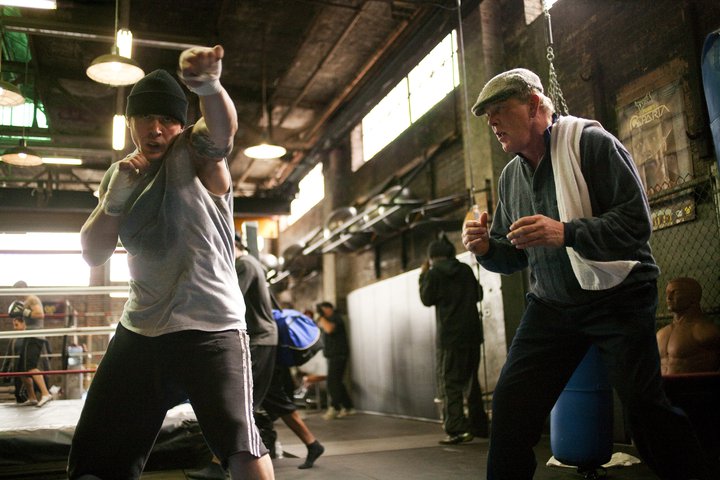
Paddy (Nick Nolte) trains estranged son Tommy (Tom Hardy).
One night, out of the blue, Tommy shows up at his father’s house unannounced. After a tense initial meeting, he asks his father to train him for Sparta, an upcoming 16-man MMA winner take all fight. At the same time Brendan and Tess are in dire financial straits…they’re upside down on their mortgage after having to spend money on one of their daughter’s medical bills. Between the two, they’re working three jobs (he’s a high school physics teacher) and still can’t cover their monthly bills. Brendan starts fighting in bush league matches and eventually persuades long-time family friend Frank (Frank Grillo) to train him for Sparta too. As Hollywood conventions have it, the two brothers, overcoming near impossible odds, eventually square off in the final.
That the two brothers make it to the end of the tournament might be enough to put some viewers off. It certainly sparks eye rolls. But like all great fight films, this isn’t the point. There are seeds of Rocky here in the gritty cinematography and down-on-its-luck fighter/city/country motif. But the closer comparison, most likely, would be Raging Bull, at least in terms of Tommy’s story line, and despite Brendan’s situation, with which most viewers might closely connect, it is Tommy’s film, thanks in large part to Tom Hardy’s miraculous performance. Here he toes the line between a crazed psychopath (echoes of his star-making turn in Bronson) and the deeply troubled, alienated son/brother. From the fight scenes alone, it is easy to see why Christopher Nolan cast him as Bane in The Dark Knight Rises.
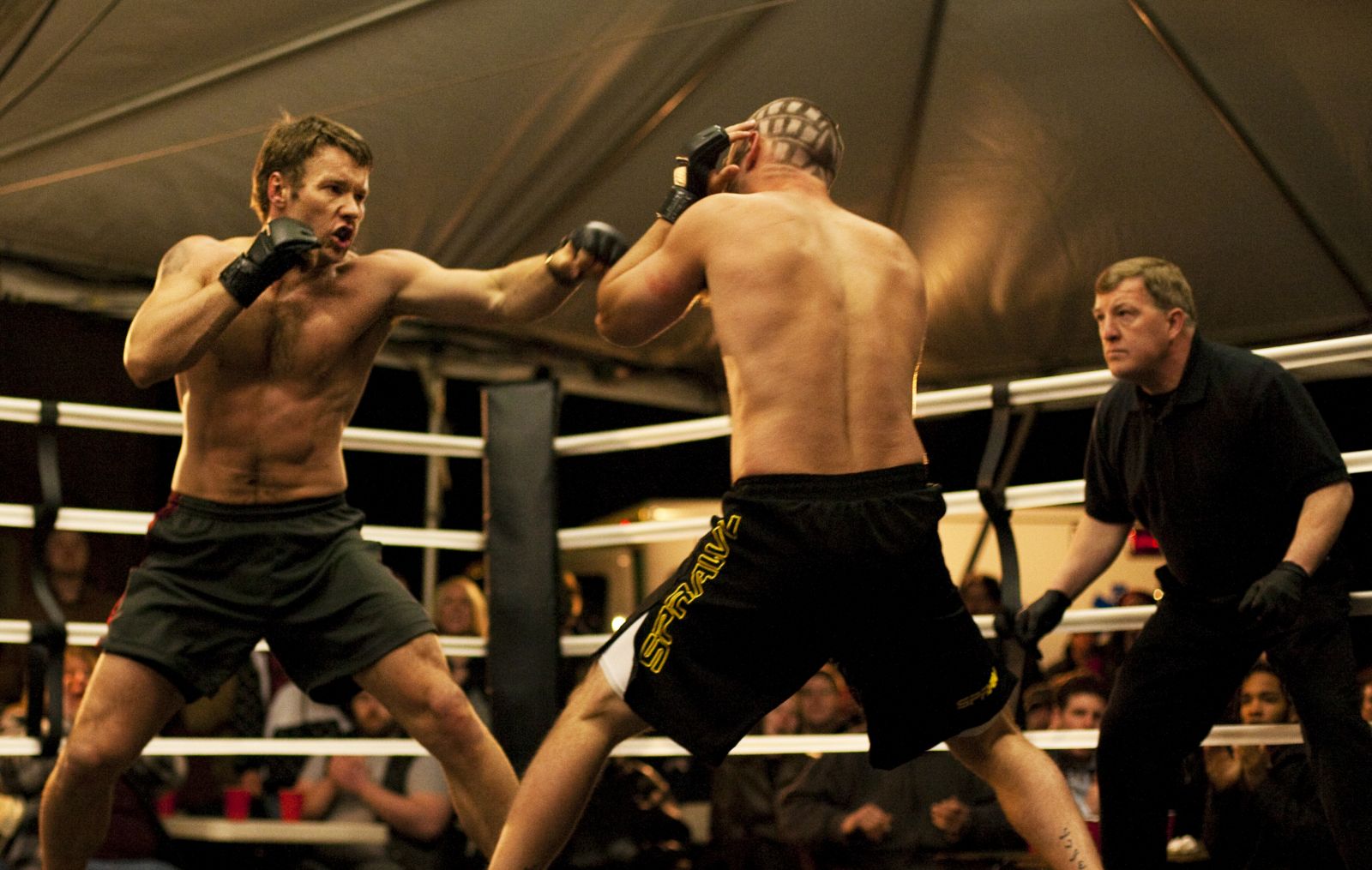
Brendan (Joel Edgerton) fights in parking lot matches to make extra money.
But Hardy’s performance is nearly matched by Nolte who taps into real life to portray Paddy. He is so sympathetic as a 1,000 days sober father trying to reconnect with his sons…like an aged version of the funnier side of Coach Pete Bell from Blue Chips. However, he really shines when he falls off the wagon, which, unfortunately puts the period on his performance, as his character essentially disappears into the background.
The strength of the film is in its smart script and its well-paced character development, thanks in large part to the work of writer/director Gavin O’Connor. Tommy is a supremely mysterious character, as shy and reserved outside the ring as he is destructive inside it. He has a tortured and heroic background that O’Connor teases out over the course of the film, adding layer upon layer to his character. Braden’s experiences are less dramatic but no less intense. He has a most important job but, like his real-world peers, is woefully under-compensated. His part time fighting to help make ends meet gets him suspended from work…without pay. He is also estranged from Paddy, even though he stayed behind, and he cannot understand why Tommy harbors so much anger and hatred towards him for a choice he made when he was sixteen.
While the fight scenes and the tournament structure do provide thrills, Tommy’s anger and the brokenness of his family is the beating heart of this film, and it is the reason I will return to it time and time again. I am reminded of the notion that the sins of the father (parents) will be visited on the children. In a most powerful way, Warrior reveals the brokenness that domestic violence and alcoholism unleashes on a family. Tommy is the chief victim (if we can actually rank them) because he chooses to be. He has bottled up his anger, rage, and resentment until it seems as if it, and not his muscles, will burst through his chiseled exterior. It is what animates his fighting, but it is also, no doubt, what helped make him a conflicted hero. It also threatens to kill him if he doesn’t address it.
Brendan seems to have made a peace, of sorts, with his family situation. He only allows Paddy to contact him by phone or mail. There is anger and resentment there too, but it is not his motivation. Instead, he finds this in his love of wife and children. The latter of which, Paddy has found in his sobriety, even though it is not reciprocated. Though Paddy finds God and cleaner living and offers heart-felt apologies to his sons, forgiveness and reconciliation lie outside of his grasp and, perhaps, this world. Here, Warrior suggests that some wounds cut too deep.
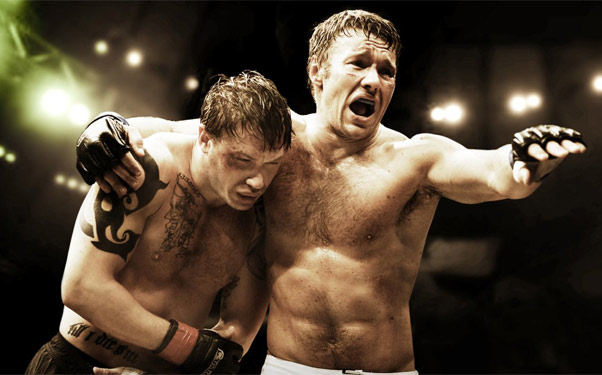
There might be more to the violence here than a championship MMA fight.
Not surprisingly, violence is at the center of the film. First, we have the violence between Paddy and his wife and children. This is the violence of both abuse and neglect, and its effects linger. Second, there is the violence of MMA and the Sparta matches, which fans in the film flock to just as fans of the real world events no doubt flocked to the film. It’s an ancient, global attraction, but one that still puzzles. But the key moment of violence in the film, for me, was the final round between Tommy and Brendan. This is where the film ventures into Raging Bull territory and suggests a possible redemptive function to violence, as Christopher Robert Deacy has written about regarding the films of Martin Scorsese. SPOILER: Deeply broken, both emotionally and physically, Tommy will not throw in the towel and forces Brendan to quite literally beat him into submission or to beat the hell out of him. The final scenes of their brutally emotional fight are stirringly edited and shot. There’s an intimacy to the fight that escapes the audience and against which Tommy fights. It’s as if he knows that he somehow deserves this beating for all the resentment and anger he has harbored, but in the end, in a submission hold, when he hears Brendan tell him he is sorry and that he loves him, he finally taps out.
One of the strengths of Warrior is its open ending. The two fighter brothers hobble out of the arena wrapped in each others’ embrace, a matter of both physical and emotional need. There are no wordy conclusions or epilogues of brighter days, but there is hope. Earlier in the film, when Paddy quite successfully falls off the wagon, he listens to Moby Dick on tape and drunkenly pleads with the captain to stop the ship. As Tommy wrestles the bottle away and Paddy into bed, the father moans, “We’re all so lost.” I imagine many viewers were so attracted to Warrior because it echoes their own feelings of being lost and frustrated. The film symbolically cries out for them in Tommy’s anguished violence and Brendan’s quiet frustrations. In this way, it is a microcosm of so much of the American experience from traumatized war veterans to high school teachers struggling to make ends meet. As part of his unorthodox regimen, Frank trains his fighters to the music of Beethoven, and Brendan enters the ring to “Ode to Joy.” Though it can be a joyful viewing experience, Warrior is an Ode to Pain, and it is equally as beautiful.
Warrior (140 mins.) is rated PG-13 for sequences of intense mixed martial arts fighting, some language, and thematic material and is available on DVD.
Previous Post

August 22, 2012
More on 'Beasts'
Next Post
August 30, 2012 Cecil B. DeMille and Roy's Rock
Browse Our Archives
Select a Category Classics DVD Film Music News Pop Culture Events Print Sports Television Uncategorized Video Games
Select a Month March 2017 February 2017 January 2017 December 2016 November 2016 October 2016 September 2016 August 2016 July 2016 June 2016 May 2016 April 2016 March 2016 February 2016 January 2016 December 2015 November 2015 October 2015 September 2015 August 2015 July 2015 June 2015 May 2015 April 2015 March 2015 February 2015 January 2015 December 2014 November 2014 October 2014 September 2014 August 2014 July 2014 June 2014 May 2014 April 2014 March 2014 February 2014 January 2014 December 2013 November 2013 October 2013 September 2013 August 2013 July 2013 June 2013 May 2013 April 2013 March 2013 February 2013 January 2013 December 2012 November 2012 October 2012 September 2012 August 2012 July 2012 June 2012 May 2012 April 2012 March 2012 February 2012 January 2012 December 2011 November 2011 October 2011 September 2011 August 2011 July 2011 June 2011 May 2011 April 2011 March 2011 February 2011 January 2011 December 2010 November 2010 October 2010 September 2010 August 2010 July 2010 June 2010 May 2010 April 2010 March 2010 February 2010 January 2010 December 2009 November 2009 October 2009 September 2009 August 2009 July 2009 June 2009 May 2009 April 2009 March 2009 February 2009 January 2009 December 2008 November 2008 October 2008 September 2008 August 2008 July 2008 June 2008 May 2008 April 2008 March 2008 February 2008 January 2008 December 2007 November 2007 October 2007 September 2007 August 2007 July 2007 June 2007 May 2007 April 2007 March 2007
Follow Us!
TAKE THE
Religious Wisdom Quiz
Who was Jochebed?
Select your answer to see how you score.
Samuel's mother Moses' mother Jesus' mother David's mother
Related posts from Pop Theology


At SXSW2017: May It Last: A Portrait of...

At SXSW 2017: "Untold Tales of Armistead Maupin"
TRENDING AT PATHEOS Progressive Christian

Why Christians Have a Sacred Duty to Vote:...
The Bible offers strong support for the sacred duty to vote. Here...

What Being a Modern-Day Apostle Means to Me
In my last column, I discussed the ins and outs of modern-day...

Did Ancient China Once Worship the God of...
Across human history, a common thread weaves through the origins of the...

Love Your Neighbor – Including Earth-Kin: Lev. 19,...
God’s command to love your neighbor means acting in an ethical and...

Lead a Church Study of “Jesus and Lao...
Guest writer Jack Thomas (The Irreverent Reverend) reflects on leading his church...

Principles for Understanding the Apostolic Ministry Today
Whenever people discover that my formal ministry title is "apostle," as in...
view all Progressive Christian blogs
Ad-Free & Subscriber Log-In Subscription Support
- About Us
- 2026 Calendar
- Videos
- Podcasts
- Library of World Religions
- Faith In Media Tracker
- Advertise With Us
- Write for Us
- Privacy Policy
- Terms of Service
- Do Not Sell My Data
- Contact Us
- Radiant Digital
- Manage Newsletter Subscriptions
- Unsubscribe From Notifications
- Sitemap
Copyright 2008-2026, Patheos. All rights reserved.
Subscription Support Ad-Free & Subscriber Log-In
Follow Patheos