
BuddhistCatholicContemplativeEvangelicalGeneral ChristianHinduJewishLatter-day SaintMuslimNew VisionsProgressive Christian
Beliefs
- Buddhist
- Catholic
- Contemplative
- Evangelical
- General Christian
- Hindu
- Jewish
- Latter-day Saint
- More Voices
- Muslim
- New Visions
- Pagan
- Progressive Christian
Topics
- Religion News
- Food and Religion
- Sports and Religion
- Religious Art
- Religious Music and Entertainment
- Religious Events
- History and Religion
- Style and Religion
- Politics and Religion
- Women in Religion
- Recreation Outdoors and Religion
- Business Finance and Religion
- Careers Workplace and Religion
- Education and Religion
- Family Parenting and Religion
- Health Fitness and Religion
- Home and Religion
- Relationships and Religion
- Technology and Religion
- Travel and Religion
Columnists
- Buddhist Columnists
- Business Finance and Religion Columnists
- Careers Workplace and Religion Columnists
- Catholic Columnists
- Contemplative Columnists
- Education and Religion Columnists
- Evangelists Columnists
- Family Parenting and Religion Columnists
- General Christian Columnists
- Health Fitness and Religion Columnists
- Hindu Columnists
- History and Religion Columnists
- Home and Religion Columnists
- Jewish Columnists
- More Voices Columnists
- Latter Day Columnists
- Muslim Columnists
- New Visions Columnists
- Nonreligious Columnists
- Pagan Columnists
- Politics and Religion Columnists
- Progressive Columnists
- Recreation Outdoors and Religion Columnists
- Relationships and Religion Columnists
- Religion News Columnists
- Religious Art Columnists
- Religious Events Columnists
- Religious Music and Entertainment Columnists
- Sports and Religion Columnists
- Style and Religion Columnists
- Technology and Religion Columnists
- Travel and Religion Columnists
- Women in Religion Columnists
Resource Library
- 2026 Calendar
- Library of World Religions
- The 100 Most Holy Places on Earth
- Patheos Answers
- Podcasts
- Videos
- Faith Leaders Database
- Anglican Episcopalian
- Bahai
- Baptist
- Buddhism
- Christianity
- Confucianism
- Eastern Orthodoxy
- Hinduism
- Holiness and Pentecostal
- ISKCON
- Islam
- Judaism
- Lutheran
- Methodist
- The Church of Jesus Christ of Latter-day Saints
- New Age
- Paganism
- Presbytarian and Reformed
- Protestantism
- Religion Behind the Scenes
- Roman Catholic
- Scientology
- Shia Islam
- Sikhism
- Sufism
- Sunni Islam
- Taoism
- Zen
- See all religions
Research Tools
 Ad-Free & Subscriber Log-In Subscription Support
Ad-Free & Subscriber Log-In Subscription Support
Follow Patheos 

- Trending:
- Forgiveness
- |
- Marriage
- |
- Consciousness
- |
- Death Penalty
- |
- Election
- |
- Halloween
 Pop Theology
- Home
- Progressive Christian
- Religious Music & Entertainment
- Traumatic Grace
Traumatic Grace
Last updated on: July 4, 2012 at 6:21 am by J. Ryan Parker
Traumatic Grace 2012-07-04T06:21:32-07:00 J. Ryan Parker
Patheos Explore the world's faith through different perspectives on religion and spirituality! Patheos has the views of the prevalent religions and spiritualities of the world.
In all my reading and research into film history, I came across a critique, can’t remember where exactly, that said we had all the means to visualize unthinkable devastation, death, and destruction but hadn’t the accompanying ability to depict the effects of such events and the feelings of brokenness and violation that follow. Precious few films adequately portray grief, anger, loss, confusion…in a word, trauma. Even fewer portray adequate responses, theological or not, to suffering. This theological inadequacy prompted Serene Jones to write Trauma and Grace: Theology in a Ruptured World. Theologians, ministers, and even filmmakers would do well to read Jones’ work.
There are two driving forces behind Trauma and Grace. First is Jones’ thinking about and research into trauma studies, the psychological, emotional, and physical effects of surviving trauma. As she covers this literature, she defines trauma and PTSD in approachable terms to which most readers should be able to relate. At the same time, Jones asks whether or not the Church is adequately equipped to minister to and share the good news of God’s love and grace with trauma victims, those lives that “had been so dramatically undone by violence that, try as they may, they could not seem to get the existential foothold on life that they needed to become active church participants and productive theology students, to say nothing of becoming generally happy people” (viii). Even more pointedly, she asks, “How do people whose hearts and minds have been wounded by violence, come to feel and know the redeeming power of God’s grace” (viii). The two responses should be “no” and “we don’t know.” That is, until Jones finished her fantastic book. Though she doesn’t intend it to be a definitive response to a theology of trauma (given the individuality of traumatic experiences there could never be one), it is a poetic vision of a way forward with glimpses of new avenues through which to minister to the broken, confused, suffering souls that wonder our world and fill our pews. She refers to her book as a “collection of epiphanic stories in which narratives of trauma, tales of grace, and the wisdom of doctrine are evocatively juxtaposed to provoke insight and stir imagination” (vii). Like the God about whom she writes, Jones’ work is full of beauty, grace, and complexity. Her descriptions of trauma victims are heart-breakingly honest and some will no doubt continue to disturb some readers even through the glimmers of hope that still shine through.
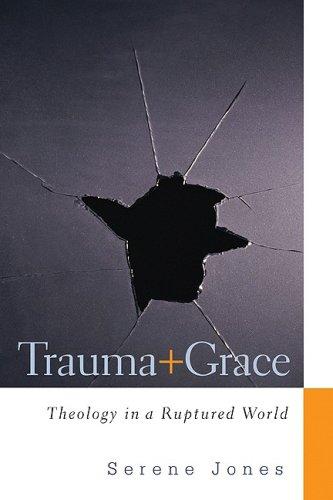
The strength of Jones’ work, one of many, is that her reflections are grounded in lived experiences of a life in ministry and theological education. It is also unfortunate that such lived experiences have yet to receive that significant scholarly, spiritual, and theological attention that they surely demand and deserve. Jones’ work has implications for individual and communal suffering, and after her description of her her research into trauma studies, she turns to individual and collective experiences of trauma, in the case a sex-abuse victim and national trauma after 9/11. She then turns to John Calvin’s commentary on the Psalms as a source of naming and beginning to heal these wounds.
In the second part of her book, Jones provides “theological poems,” brief reflections on three ways of considering the Crucifixion, (the cross as alluring, as a mirror, and as unending) that might speak a healing word to trauma victims. She begins the third part of her book by considering the Crucifixion from an creative perspective, by imagining Mary’s trauma after leaving Jesus on the cross and, on the way home, meeting a fictional character, Rachel, a mother who lost a son in the slaughter of the innocents that marked Jesus’ birth. In the imagined conversation between the two, Jones makes the bold claim that each can minister to and learn from the other.
In her next chapter, Jones considers the traumatic experience of reproductive loss. I found this to be one of the most enlightening and challenging chapters in the book as she uses this traumatic experience to shed new light on the Crucifixion and to use it as a vision to minister to women who have experienced the trauma of their bodies being a place of death. She writes, “What does it mean to know one’s self as a walking site of death itself? To have death quite literally inside you” (138). Jones then puts a theological spin on this same question: “What transpires in the Godhead when one of its members bleeds away?” Shortly after, she argues, “For the God who sent this child into the world bearing the hope of God’s eternal love, this death is a death of hope, the hope that the people who see this child will believe. It is the death of a possibility that has never been, the possibility of true human community” (148).
Jones concludes her book with a chapter on Mourning and Wonder in which she reflects on embodied responses to healing and addressing the effects of trauma. Like the rest of her book, the open conclusion is just the type of creative and care-full theologizing that our broken world needs. Trauma and Grace should be required reading for all ministers and active laity to help strengthen both the Church’s ministry to trauma victims and it’s ability to more fully understand the depths and strengths of God’s love and grace. Jones proves that the Christian tradition is full of resources to address traumatic realities if we just look closely enough. After all, Christianity is poised to be a strong voice for trauma victims founded as it is on the traumatic event of Jesus’ Crucifixion.
Previous Post

July 3, 2012
A Reasonable Reboot
Next Post
July 14, 2012 Pop Goes the Temple
Browse Our Archives
Select a Category Classics DVD Film Music News Pop Culture Events Print Sports Television Uncategorized Video Games
Select a Month March 2017 February 2017 January 2017 December 2016 November 2016 October 2016 September 2016 August 2016 July 2016 June 2016 May 2016 April 2016 March 2016 February 2016 January 2016 December 2015 November 2015 October 2015 September 2015 August 2015 July 2015 June 2015 May 2015 April 2015 March 2015 February 2015 January 2015 December 2014 November 2014 October 2014 September 2014 August 2014 July 2014 June 2014 May 2014 April 2014 March 2014 February 2014 January 2014 December 2013 November 2013 October 2013 September 2013 August 2013 July 2013 June 2013 May 2013 April 2013 March 2013 February 2013 January 2013 December 2012 November 2012 October 2012 September 2012 August 2012 July 2012 June 2012 May 2012 April 2012 March 2012 February 2012 January 2012 December 2011 November 2011 October 2011 September 2011 August 2011 July 2011 June 2011 May 2011 April 2011 March 2011 February 2011 January 2011 December 2010 November 2010 October 2010 September 2010 August 2010 July 2010 June 2010 May 2010 April 2010 March 2010 February 2010 January 2010 December 2009 November 2009 October 2009 September 2009 August 2009 July 2009 June 2009 May 2009 April 2009 March 2009 February 2009 January 2009 December 2008 November 2008 October 2008 September 2008 August 2008 July 2008 June 2008 May 2008 April 2008 March 2008 February 2008 January 2008 December 2007 November 2007 October 2007 September 2007 August 2007 July 2007 June 2007 May 2007 April 2007 March 2007
Follow Us!
TAKE THE
Religious Wisdom Quiz
True or False: Hebrews teaches that Jesus is the same yesterday, today, and forever.
Select your answer to see how you score.
FALSE TRUE
Related posts from Pop Theology


#KillerSerials: An Interview with Kutter Callaway

Book Review: MUSLIMS AND THE MAKING OF AMERICA

TRENDING AT PATHEOS Progressive Christian

Why Christians Have a Sacred Duty to Vote:...
The Bible offers strong support for the sacred duty to vote. Here...

What Being a Modern-Day Apostle Means to Me
In my last column, I discussed the ins and outs of modern-day...

Did Ancient China Once Worship the God of...
Across human history, a common thread weaves through the origins of the...

Love Your Neighbor – Including Earth-Kin: Lev. 19,...
God’s command to love your neighbor means acting in an ethical and...

Lead a Church Study of “Jesus and Lao...
Guest writer Jack Thomas (The Irreverent Reverend) reflects on leading his church...

Principles for Understanding the Apostolic Ministry Today
Whenever people discover that my formal ministry title is "apostle," as in...
view all Progressive Christian blogs
Ad-Free & Subscriber Log-In Subscription Support
- About Us
- 2026 Calendar
- Videos
- Podcasts
- Library of World Religions
- Faith In Media Tracker
- Advertise With Us
- Write for Us
- Privacy Policy
- Terms of Service
- Do Not Sell My Data
- Contact Us
- Radiant Digital
- Manage Newsletter Subscriptions
- Unsubscribe From Notifications
- Sitemap
Copyright 2008-2026, Patheos. All rights reserved.
Subscription Support Ad-Free & Subscriber Log-In
Follow Patheos