
BuddhistCatholicContemplativeEvangelicalGeneral ChristianHinduJewishLatter-day SaintMuslimNew VisionsProgressive Christian
Beliefs
- Buddhist
- Catholic
- Contemplative
- Evangelical
- General Christian
- Hindu
- Jewish
- Latter-day Saint
- More Voices
- Muslim
- New Visions
- Pagan
- Progressive Christian
Topics
- Religion News
- Food and Religion
- Sports and Religion
- Religious Art
- Religious Music and Entertainment
- Religious Events
- History and Religion
- Style and Religion
- Politics and Religion
- Women in Religion
- Recreation Outdoors and Religion
- Business Finance and Religion
- Careers Workplace and Religion
- Education and Religion
- Family Parenting and Religion
- Health Fitness and Religion
- Home and Religion
- Relationships and Religion
- Technology and Religion
- Travel and Religion
Columnists
- Buddhist Columnists
- Business Finance and Religion Columnists
- Careers Workplace and Religion Columnists
- Catholic Columnists
- Contemplative Columnists
- Education and Religion Columnists
- Evangelists Columnists
- Family Parenting and Religion Columnists
- General Christian Columnists
- Health Fitness and Religion Columnists
- Hindu Columnists
- History and Religion Columnists
- Home and Religion Columnists
- Jewish Columnists
- More Voices Columnists
- Latter Day Columnists
- Muslim Columnists
- New Visions Columnists
- Nonreligious Columnists
- Pagan Columnists
- Politics and Religion Columnists
- Progressive Columnists
- Recreation Outdoors and Religion Columnists
- Relationships and Religion Columnists
- Religion News Columnists
- Religious Art Columnists
- Religious Events Columnists
- Religious Music and Entertainment Columnists
- Sports and Religion Columnists
- Style and Religion Columnists
- Technology and Religion Columnists
- Travel and Religion Columnists
- Women in Religion Columnists
Resource Library
- 2026 Calendar
- Library of World Religions
- The 100 Most Holy Places on Earth
- Patheos Answers
- Podcasts
- Videos
- Faith Leaders Database
- Anglican Episcopalian
- Bahai
- Baptist
- Buddhism
- Christianity
- Confucianism
- Eastern Orthodoxy
- Hinduism
- Holiness and Pentecostal
- ISKCON
- Islam
- Judaism
- Lutheran
- Methodist
- The Church of Jesus Christ of Latter-day Saints
- New Age
- Paganism
- Presbytarian and Reformed
- Protestantism
- Religion Behind the Scenes
- Roman Catholic
- Scientology
- Shia Islam
- Sikhism
- Sufism
- Sunni Islam
- Taoism
- Zen
- See all religions
Research Tools
 Ad-Free & Subscriber Log-In Subscription Support
Ad-Free & Subscriber Log-In Subscription Support
Follow Patheos 

- Trending:
- Forgiveness
- |
- Marriage
- |
- Consciousness
- |
- Death Penalty
- |
- Election
- |
- Halloween
 Pop Theology
- Home
- Progressive Christian
- Religious Music & Entertainment
- Dying Multiple Deaths
Dying Multiple Deaths
Last updated on: June 7, 2012 at 1:53 am by J. Ryan Parker
Dying Multiple Deaths 2012-06-07T01:53:57-07:00 J. Ryan Parker
Patheos Explore the world's faith through different perspectives on religion and spirituality! Patheos has the views of the prevalent religions and spiritualities of the world.
I’ve been reading quite a bit lately about sin, violence, forgiveness and reconciliation for a book I’m starting to write on the portrayal of these themes in film. I’m also beginning a search for films to use in the book (suggestions are always welcome!). I just watched a 2005 Iranian film, Day Break, which has much to offer discussions of these topics as well as a host of other issues as well.
Based on true stories, Day Break tells the story of Mansour (Hosein Yari), a middle-aged man convicted of murdering his employer. Under Iranian/Islamic law, the death penalty must be ultimately handed down and enacted by the family of the victim(s). They also have the opportunity to extend forgiveness to the murderer, who will then serve out a state-mandated, lengthy jail sentence. Mansour has been scheduled for execution, but on the appointed day, the family fails to show up. Due to a death in the family, they are absent for the second scheduled execution. The film concludes with Mansour walking towards his third execution. You can find out what happens for yourself.
Directed by Hamid Rahmanian, the film is beautifully shot even in the dark despair of the prison. It is built, largely, around cuts between Mansour’s waiting in prison and memories of life before he made his fatal mistake, particularly scenes of his family life with his wife, Atifeh (Hoda Nasseh) and parents. Hosein Yari gives a fantastic performance in which he conveys just as much with his crumbling appearance as he does with his words.
It’s difficult to determine just where to begin a discussion of the film’s themes. An obvious starting point could be the relationship between Iranian and Islamic law, and their insistence on the death penalty as an appropriate form of punishment. That the role of executioner is placed on the victim’s family can be troubling, but it certainly puts the decision to execute in sharper perspective when you have to pull the lever yourself, so to speak. Also, allowing the family the opportunity to forgive their tormentor without foregoing punishment is something that would be welcome in our own experiences of “justice.”
I’m reading Serene Jones‘ Trauma and Grace and Yari’s portrayal of Mansour shows all the signs of trauma induced by facing his impending annihilation…three times. But it is a traumatic experience that he has brought, to a great degree, on himself. The judge in the film rightly names Mansour’s crime as a sin, and it is one that lands him in a variety of prisons. At the same time, the victim’s family’s refusal to make a decision in the matter intensifies his imprisonment and soon forces us to see it as nothing less than a form of torture. As the film progresses and his execution is delayed, Mansour’s fellow prisoners begin to define their own experiences in light of his.
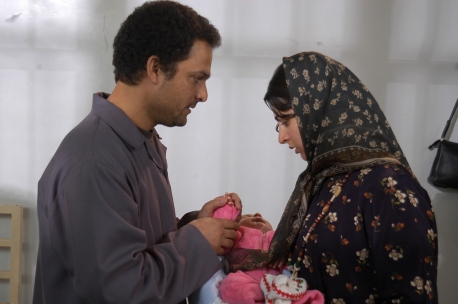
Mansour reveals his tenderness by giving his newborn daughter a pair of knit booties.
The cuts back and forth between Mansour’s imprisonment and scenes of his previous life reveal that his life (like all violators) is greater than one destructive act or a sum of them. Though most viewers will become sympathetic with Mansour’s condition, the notion that his victim’s family could be forced to forgive him or be held to some time frame for extending that gift is an impossibility. Yet the film seems to suggest that the refusal to forgive can be just as painful a violation as the act for which the tormenter needs to be forgiven. In an early scene in the film, Mansour’s second stalled execution, a fellow prisoner does make it to the gallows. However, at the last minute, his victim’s family opts to forgive him. The family breaks down in tears and the prisoner falls weeping at their feet. There is not reconciliation here, but it is a start. They forgive under one condition, that he signs over his house and property to an orphanage. As such, this contract between victim and violator begins to make right a wronged relationship and even serves the wider community that was also broken by that ruptured relationship.
Day Break reveals that forgiveness is hard work but absolutely necessary to break violent cycles. After all, what is the death penalty but a violent echo of the violent act that brought the perpetrator there. It also calls into question, quite powerfully, the appropriateness of said penalty while also giving attention to prison overcrowding and the limits of prison on individual and social reform. Day Break is a short, but effective, film that will, without a doubt, instigate fierce conversation after the credits roll.
Day Break (84 mins.) is unrated and is available on DVD.
Previous Post

June 6, 2012
Looking Forward from E3
Next Post
June 18, 2012 Dude, You Are Totally Into Religion
Browse Our Archives
Select a Category Classics DVD Film Music News Pop Culture Events Print Sports Television Uncategorized Video Games
Select a Month March 2017 February 2017 January 2017 December 2016 November 2016 October 2016 September 2016 August 2016 July 2016 June 2016 May 2016 April 2016 March 2016 February 2016 January 2016 December 2015 November 2015 October 2015 September 2015 August 2015 July 2015 June 2015 May 2015 April 2015 March 2015 February 2015 January 2015 December 2014 November 2014 October 2014 September 2014 August 2014 July 2014 June 2014 May 2014 April 2014 March 2014 February 2014 January 2014 December 2013 November 2013 October 2013 September 2013 August 2013 July 2013 June 2013 May 2013 April 2013 March 2013 February 2013 January 2013 December 2012 November 2012 October 2012 September 2012 August 2012 July 2012 June 2012 May 2012 April 2012 March 2012 February 2012 January 2012 December 2011 November 2011 October 2011 September 2011 August 2011 July 2011 June 2011 May 2011 April 2011 March 2011 February 2011 January 2011 December 2010 November 2010 October 2010 September 2010 August 2010 July 2010 June 2010 May 2010 April 2010 March 2010 February 2010 January 2010 December 2009 November 2009 October 2009 September 2009 August 2009 July 2009 June 2009 May 2009 April 2009 March 2009 February 2009 January 2009 December 2008 November 2008 October 2008 September 2008 August 2008 July 2008 June 2008 May 2008 April 2008 March 2008 February 2008 January 2008 December 2007 November 2007 October 2007 September 2007 August 2007 July 2007 June 2007 May 2007 April 2007 March 2007
Follow Us!
TAKE THE
Religious Wisdom Quiz
In Philemon, what does Paul call Onesimus?
Select your answer to see how you score.
My friend My brother My very heart My helper
Related posts from Pop Theology


At SXSW2017: May It Last: A Portrait of...

At SXSW 2017: "Untold Tales of Armistead Maupin"
TRENDING AT PATHEOS Progressive Christian

Why Christians Have a Sacred Duty to Vote:...
The Bible offers strong support for the sacred duty to vote. Here...

What Being a Modern-Day Apostle Means to Me
In my last column, I discussed the ins and outs of modern-day...

Did Ancient China Once Worship the God of...
Across human history, a common thread weaves through the origins of the...

Love Your Neighbor – Including Earth-Kin: Lev. 19,...
God’s command to love your neighbor means acting in an ethical and...

Lead a Church Study of “Jesus and Lao...
Guest writer Jack Thomas (The Irreverent Reverend) reflects on leading his church...

Principles for Understanding the Apostolic Ministry Today
Whenever people discover that my formal ministry title is "apostle," as in...
view all Progressive Christian blogs
Ad-Free & Subscriber Log-In Subscription Support
- About Us
- 2026 Calendar
- Videos
- Podcasts
- Library of World Religions
- Faith In Media Tracker
- Advertise With Us
- Write for Us
- Privacy Policy
- Terms of Service
- Do Not Sell My Data
- Contact Us
- Radiant Digital
- Manage Newsletter Subscriptions
- Unsubscribe From Notifications
- Sitemap
Copyright 2008-2026, Patheos. All rights reserved.
Subscription Support Ad-Free & Subscriber Log-In
Follow Patheos