
BuddhistCatholicContemplativeEvangelicalGeneral ChristianHinduJewishLatter-day SaintMuslimNew VisionsProgressive Christian
Beliefs
- Buddhist
- Catholic
- Contemplative
- Evangelical
- General Christian
- Hindu
- Jewish
- Latter-day Saint
- More Voices
- Muslim
- New Visions
- Pagan
- Progressive Christian
Topics
- Religion News
- Food and Religion
- Sports and Religion
- Religious Art
- Religious Music and Entertainment
- Religious Events
- History and Religion
- Style and Religion
- Politics and Religion
- Women in Religion
- Recreation Outdoors and Religion
- Business Finance and Religion
- Careers Workplace and Religion
- Education and Religion
- Family Parenting and Religion
- Health Fitness and Religion
- Home and Religion
- Relationships and Religion
- Technology and Religion
- Travel and Religion
Columnists
- Buddhist Columnists
- Business Finance and Religion Columnists
- Careers Workplace and Religion Columnists
- Catholic Columnists
- Contemplative Columnists
- Education and Religion Columnists
- Evangelists Columnists
- Family Parenting and Religion Columnists
- General Christian Columnists
- Health Fitness and Religion Columnists
- Hindu Columnists
- History and Religion Columnists
- Home and Religion Columnists
- Jewish Columnists
- More Voices Columnists
- Latter Day Columnists
- Muslim Columnists
- New Visions Columnists
- Nonreligious Columnists
- Pagan Columnists
- Politics and Religion Columnists
- Progressive Columnists
- Recreation Outdoors and Religion Columnists
- Relationships and Religion Columnists
- Religion News Columnists
- Religious Art Columnists
- Religious Events Columnists
- Religious Music and Entertainment Columnists
- Sports and Religion Columnists
- Style and Religion Columnists
- Technology and Religion Columnists
- Travel and Religion Columnists
- Women in Religion Columnists
Resource Library
- 2026 Calendar
- Library of World Religions
- The 100 Most Holy Places on Earth
- Patheos Answers
- Podcasts
- Videos
- Faith Leaders Database
- Anglican Episcopalian
- Bahai
- Baptist
- Buddhism
- Christianity
- Confucianism
- Eastern Orthodoxy
- Hinduism
- Holiness and Pentecostal
- ISKCON
- Islam
- Judaism
- Lutheran
- Methodist
- The Church of Jesus Christ of Latter-day Saints
- New Age
- Paganism
- Presbytarian and Reformed
- Protestantism
- Religion Behind the Scenes
- Roman Catholic
- Scientology
- Shia Islam
- Sikhism
- Sufism
- Sunni Islam
- Taoism
- Zen
- See all religions
Research Tools
 Ad-Free & Subscriber Log-In Subscription Support
Ad-Free & Subscriber Log-In Subscription Support
Follow Patheos 

- Trending:
- Forgiveness
- |
- Marriage
- |
- Consciousness
- |
- Death Penalty
- |
- Election
- |
- Halloween
 Pop Theology
- Home
- Progressive Christian
- Religious Music & Entertainment
- The Psychology of Joss Whedon
The Psychology of Joss Whedon
Last updated on: May 3, 2012 at 2:57 am by J. Ryan Parker
The Psychology of Joss Whedon 2012-05-03T02:57:30-07:00 J. Ryan Parker
Patheos Explore the world's faith through different perspectives on religion and spirituality! Patheos has the views of the prevalent religions and spiritualities of the world.
In a recent movie post over at Deadspin, Tim Grierson and Will Leitch posted about Joss Whedon‘s history in Hollywood and and how he’s always been more of a cult phenomenon that couldn’t quite break out into the mainstream. With the runaway success and critical acclaim surrounding last weekend’s release of The Avengers, Whedon is now (as he always has been to his followers) royalty. I’m excited to be co-editing a book on religion in the works of Joss Whedon. In researching the extant literature on the writer/director/producer, I’ve come across several books. Here is a review of one from 2007, a collection of essays edited by Joy Davidson entitled The Psychology of Joss Whedon: An Unauthorized Exploration. Though working in a different field, nearly all of the contributors’ essays wrestle with the big issues that religious students and practicioners must address.
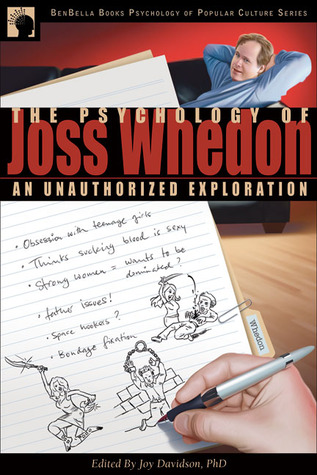 The Psychology of Joss Whedon is packed with 15 essays, each around 3,000-5,000 words in length. As such, it is a relatively quick read. Though the writing is inconsistent and sometimes distractingly conversational, the essays are suitable for congregational or classroom use, whether leading/teaching a course, section, or discussion group on religion and popular culture or multiple or single “Whedonverses.” The topics here range from neuropsychology, existential psychology, the understanding of the self, the importance of relationships in personal growth, the nature of meaning making in the human experience, and many more. The contributors are working exclusively in the Buffy, Angel, and Firefly/Serenity universes, but not their accompanying comics. This limitation is, of course, due to the book’s date of publication. Other books do consider more of Whedon’s worlds. Read on for a brief discussion of some of the highlights of The Psychology of Joss Whedon.
From a religious/theological perspective, I think a few of the essays here really stand out. In “Mal’s Morals: Evolutionary Pornography,” Robert Kurzban makes a claim for evolutionary moral pornography. That is, we “like to watch” good characters succeed and “baddies” get what’s coming to them. Through this enjoyment we learn moral behavior, and, in the process, we learn that “honor, loyalty, and morality are expensive. They cause you to make important–even life-threatening–sacrifices.” Kurzban engages Firefly and particularly the ways in which Mal acts out of loyalty, honor, and morality, and how this behavior (re)defines each.
In “Free Will in a Deterministic Whedonverse,” Thomas Flamson argues that our popular notions of free will are illusions, but important and even necessary ones for healthy development and functioning. Flamson believes that Whedon’s characters force us to ask, “Can we ever be said to be truly free? and, Do people need to be free?” He gives evidence of studies which show that “people only consciously experience choosing to do something after the neurological processes of doing so have already begun.” This is a truly important essay because of how consistently questions of free will and determinism shape our theological understandings. On the other hand, I would have liked Flamson to say a bit more about how context functions in limiting and increasing the choices we do or can make. While we might have the right to be wrong, a right that the Alliance wanted to take away in Firefly and Serenity, we still are responsible for the choices we make and the actions we take.
“An Analysis of Slayer Longevity: Relationships on the Hellmouth,” by Tracy R. Gleason and Nancy S. Weinfield, argues, essentially, that Buffy is so successful because she relies on a support groups of friends and family to make it through life, rather than following the solo slayer route that has traditionally characterized the job description. This chapter speaks volumes to the importance of community, and their references to healthy psychological development and the events in Buffy could be extended to conversations about faith communities as well. Gleason and Weinfeld argue, “Emotional distance from others creates vulnerability.” It seems to me that this essay has implications for individuals who pursue their faith and spirituality outside community. The whole “spiritual but not religious” mindset seems suddenly empty and lacking. Yet it is important that these communities (especially those of faith) be spaces in which members can express doubts and fears. In Buffy as in The Avengers, Whedon seems to assert that “the rule that someone with superhuman powers must function outside of a social context appears to be an outdated, and even dangerous, requirement.”
“More Than Entertainment: Notes on a Spiritual Recovery and What Jossverse Gave Me That Religion and Therapy Didn’t,” by Stephanie R. Deluse, is the most personal of all the essays. Deluse grew up in a violently strict religious environment that left both emotional, physical, and psychological scars. For her, the world of Buffy helped her more fully heal those wounds, even after she had fled that abusive situation. She talks about her experiences of “empathic viewing” and argues for more explicit viewing practices like that. As such, Deluse’s essay is the most specifically practical contribution to the collection. Here, she encourages viewers to take notes “on the fly” and to spend time reflecting on them after the credits roll to better understand why a particular line of dialogue or plot point grabbed their attention. Deluse points out that Whedon’s worlds contradict religious conservatism because they are often egalitarian and gray where the former are patriarchal and clearly defined. Or, as she writes, “Mal and his crew [in Firefly] offered many opportunities to reflect on shifting meanings of ethics, selfishness, and compassion. […] Every gray area I encountered in Firefly/Serenity reminded me of the black-and-white clarity I’d left behind, and made me question which way of being is better–if there is such a thing as ‘better.'”
It’s interesting to me that the themes of the essays in The Psychology of Joss Whedon find further expression in The Avengers, Whedon’s latest creation/adaptation. This shows, once again, how important Whedon’s voice is for discussions of psychology (or religion and theology) in our pop culture(s).
Previous Post

April 28, 2012
Bully
Next Post
May 9, 2012 Virtual Worlds Overtake Us
Browse Our Archives
Select a Category Classics DVD Film Music News Pop Culture Events Print Sports Television Uncategorized Video Games
Select a Month March 2017 February 2017 January 2017 December 2016 November 2016 October 2016 September 2016 August 2016 July 2016 June 2016 May 2016 April 2016 March 2016 February 2016 January 2016 December 2015 November 2015 October 2015 September 2015 August 2015 July 2015 June 2015 May 2015 April 2015 March 2015 February 2015 January 2015 December 2014 November 2014 October 2014 September 2014 August 2014 July 2014 June 2014 May 2014 April 2014 March 2014 February 2014 January 2014 December 2013 November 2013 October 2013 September 2013 August 2013 July 2013 June 2013 May 2013 April 2013 March 2013 February 2013 January 2013 December 2012 November 2012 October 2012 September 2012 August 2012 July 2012 June 2012 May 2012 April 2012 March 2012 February 2012 January 2012 December 2011 November 2011 October 2011 September 2011 August 2011 July 2011 June 2011 May 2011 April 2011 March 2011 February 2011 January 2011 December 2010 November 2010 October 2010 September 2010 August 2010 July 2010 June 2010 May 2010 April 2010 March 2010 February 2010 January 2010 December 2009 November 2009 October 2009 September 2009 August 2009 July 2009 June 2009 May 2009 April 2009 March 2009 February 2009 January 2009 December 2008 November 2008 October 2008 September 2008 August 2008 July 2008 June 2008 May 2008 April 2008 March 2008 February 2008 January 2008 December 2007 November 2007 October 2007 September 2007 August 2007 July 2007 June 2007 May 2007 April 2007 March 2007
Follow Us!
TAKE THE
Religious Wisdom Quiz
I carried a letter from the king giving me authority and resources to rebuild Jerusalem. Who am I?
Select your answer to see how you score.
Ezra Artaxerxes Nehemiah Zerubbabel
Related posts from Pop Theology


#KillerSerials: An Interview with Kutter Callaway

Book Review: MUSLIMS AND THE MAKING OF AMERICA

TRENDING AT PATHEOS Progressive Christian

Why Christians Have a Sacred Duty to Vote:...
The Bible offers strong support for the sacred duty to vote. Here...

What Being a Modern-Day Apostle Means to Me
In my last column, I discussed the ins and outs of modern-day...

Did Ancient China Once Worship the God of...
Across human history, a common thread weaves through the origins of the...

Love Your Neighbor – Including Earth-Kin: Lev. 19,...
God’s command to love your neighbor means acting in an ethical and...

Lead a Church Study of “Jesus and Lao...
Guest writer Jack Thomas (The Irreverent Reverend) reflects on leading his church...

Principles for Understanding the Apostolic Ministry Today
Whenever people discover that my formal ministry title is "apostle," as in...
view all Progressive Christian blogs
Ad-Free & Subscriber Log-In Subscription Support
- About Us
- 2026 Calendar
- Videos
- Podcasts
- Library of World Religions
- Faith In Media Tracker
- Advertise With Us
- Write for Us
- Privacy Policy
- Terms of Service
- Do Not Sell My Data
- Contact Us
- Radiant Digital
- Manage Newsletter Subscriptions
- Unsubscribe From Notifications
- Sitemap
Copyright 2008-2026, Patheos. All rights reserved.
Subscription Support Ad-Free & Subscriber Log-In
Follow Patheos