
BuddhistCatholicContemplativeEvangelicalGeneral ChristianHinduJewishLatter-day SaintMuslimNew VisionsProgressive Christian
Beliefs
- Buddhist
- Catholic
- Contemplative
- Evangelical
- General Christian
- Hindu
- Jewish
- Latter-day Saint
- More Voices
- Muslim
- New Visions
- Pagan
- Progressive Christian
Topics
- Religion News
- Food and Religion
- Sports and Religion
- Religious Art
- Religious Music and Entertainment
- Religious Events
- History and Religion
- Style and Religion
- Politics and Religion
- Women in Religion
- Recreation Outdoors and Religion
- Business Finance and Religion
- Careers Workplace and Religion
- Education and Religion
- Family Parenting and Religion
- Health Fitness and Religion
- Home and Religion
- Relationships and Religion
- Technology and Religion
- Travel and Religion
Columnists
- Buddhist Columnists
- Business Finance and Religion Columnists
- Careers Workplace and Religion Columnists
- Catholic Columnists
- Contemplative Columnists
- Education and Religion Columnists
- Evangelists Columnists
- Family Parenting and Religion Columnists
- General Christian Columnists
- Health Fitness and Religion Columnists
- Hindu Columnists
- History and Religion Columnists
- Home and Religion Columnists
- Jewish Columnists
- More Voices Columnists
- Latter Day Columnists
- Muslim Columnists
- New Visions Columnists
- Nonreligious Columnists
- Pagan Columnists
- Politics and Religion Columnists
- Progressive Columnists
- Recreation Outdoors and Religion Columnists
- Relationships and Religion Columnists
- Religion News Columnists
- Religious Art Columnists
- Religious Events Columnists
- Religious Music and Entertainment Columnists
- Sports and Religion Columnists
- Style and Religion Columnists
- Technology and Religion Columnists
- Travel and Religion Columnists
- Women in Religion Columnists
Resource Library
- 2026 Calendar
- Library of World Religions
- The 100 Most Holy Places on Earth
- Patheos Answers
- Podcasts
- Videos
- Faith Leaders Database
- Anglican Episcopalian
- Bahai
- Baptist
- Buddhism
- Christianity
- Confucianism
- Eastern Orthodoxy
- Hinduism
- Holiness and Pentecostal
- ISKCON
- Islam
- Judaism
- Lutheran
- Methodist
- The Church of Jesus Christ of Latter-day Saints
- New Age
- Paganism
- Presbytarian and Reformed
- Protestantism
- Religion Behind the Scenes
- Roman Catholic
- Scientology
- Shia Islam
- Sikhism
- Sufism
- Sunni Islam
- Taoism
- Zen
- See all religions
Research Tools
 Ad-Free & Subscriber Log-In Subscription Support
Ad-Free & Subscriber Log-In Subscription Support
Follow Patheos 

- Trending:
- Forgiveness
- |
- Marriage
- |
- Consciousness
- |
- Death Penalty
- |
- Election
- |
- Halloween
 Pop Theology
- Home
- Progressive Christian
- Religious Music & Entertainment
- The Hunger Games and the Gospel: A Review
The Hunger Games and the Gospel: A Review
Last updated on: March 26, 2012 at 11:59 pm by J. Ryan Parker
The Hunger Games and the Gospel: A Review 2012-03-26T23:59:02-07:00 J. Ryan Parker
Patheos Explore the world's faith through different perspectives on religion and spirituality! Patheos has the views of the prevalent religions and spiritualities of the world.
If you’re reading this, then you probably contributed to The Hunger Games‘ wild success at the box office this past weekend. Not only has it obviously gotten support from fans of the books, but it’s not surprisingly contributing to the on-going discussion about violence in popular culture, even as some observers are noting the ways in which it mirrors the world in which we live. Other Christian commentators are picking up on the spiritual and theological implications of the books and film. None have done so as extensively and competently as Julie Clawson (@julieclawson), in her new book The Hunger Games and the Gospel.
I’ve said it before, and I’ll say it again. I’m a bit wary of those The Gospel According to [Insert Pop Culture Phenomenon Here] books. Far too often they are trite, lack any sense of biblical scholarship or deep theological thinking, and fail to be critical of the pop culture source they are mining for religious and theological insight. I am glad to say that none of these criticisms apply to Clawson’s book. In fact, The Hunger Games and the Gospel is full of rich biblical scholarship, prophetic theological thinking, and a deep awareness of the strengths and weaknesses of the text(s) with which she is working.
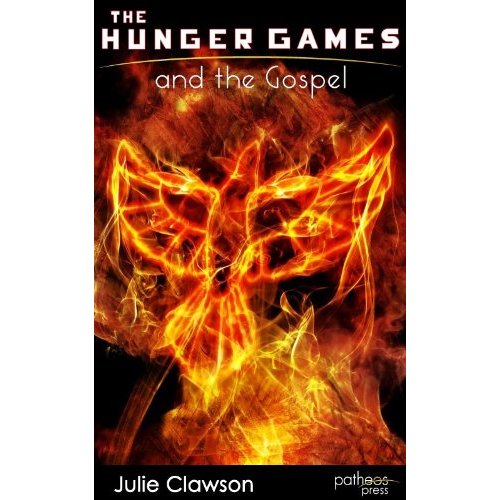 An apt title for Clawson’s book would also have been The Hunger Games and the Beatitudes. Of course, one could argue that the Beatitudes are the heart of the Gospel as they are the good news to people who suffer. Clawson recognizes that the blessings that they promise are not for the afterlife but for the here and now and that living into this beatific way of life is to participate in and to help more fully usher in the Kingdom of God. We can find such Kingdom living, Clawson argues, even in a dystopian tale about people who force teenagers to fight one another in a battle to the death for their enjoyment and the oppression of the marginalized. In the character of Katniss Everdeen, we have, though flawed, a glimpse of how to live a more beatific life in the face of grave oppression and violence.
Clawson’s writing is insightful and incisive. She cuts to the heart of the matter in prophetic fashion, calling out our popular culture, and even our churches, for mirroring far too closely and often the citizens of the Capitol and not citizens of the Kingdom of God. Clawson is keenly aware that the world that Suzanne Collins has imagined is far more similar to our own than we dare imagine. Rather than wringing her hands over the violence in the books, she turns her attention to the violence in our world, how we contribute to it, and how we might follow a more faithful path. Clawson draws from both scripture and heroes and heroines of the faith to draw out her points. With so many people seeing the film this past weekend and who have read the books, this would be a perfect resource for congregations and small groups to work through together.
My main concern when drawing parallels between The Hunger Games and the Gospels is the violence. And it’s not the hypocritical sort of many Christians who have a problem with Collins’ text but don’t bat an eye at the “war on terror.” Furthermore, Clawson adds: “Sheltering teenagers from harsh realities does them a disservice not only by making them ill-prepared when they actually do encounter such things, but also by encouraging them to assume their own comfort and ease is far more important than the well-being of others” (40). Clawson, however, does recognize that the violence in The Hunger Games presents a problematic situation when linking Katniss to the Gospels and the life of Jesus. However, she turns to Dietrich Bonhoeffer’s involvement in the plot to assassinate Hitler. Katniss only ever acted violently when she had to, but she did resort to violence. However, as a culture that is so quick to rush to violence, it is also important to remember that we can only ever count a few historical instances in which such behavior has been acceptable or at least understandable. We’ve unfortunately cast far to wide of a net to justify and explain away our violent behavior. Read on for an overview of Clawson’s important book, and then go download it here immediately, whether or not you’re a fan of the series. She might just convert you after all. Plus, it’s only $5!
In her introduction, Clawson clarifies her approach. She writes, “So while The Hunger Games is not a retelling of the Christian story, I found in it a helpful and vivid portrayal of both the struggles and blessings of pursuing the sort of life that can’t help but turn the world upside down” (6). Unfortunately, many audiences will no doubt resent having their lives turned upside down and will instead nit-pick about things that they don’t like in both Clawson’s and Collins’ books. This is a problem because, as Clawson points out, “Books like The Hunger Games create space for conersations about oppressive systems in our world, and plant seeds of hope that are different ways to exist in the world–difficult as they may be” (9). Clawson also recognizes that she is working with a difficult text, the Beatitudes not The Hunger Games: “What Jesus delivered as a transforming message of hope has been spiritualized away to nothing more than pithy sayings or pleasing rituals designed to make us feel content as we live in the ways of the world” (10). After her introduction, Clawson delves in the Beatitudes, devoting each chapter to one of the “rich statements of the Beatitudes, which serve as mini-pictures of God’s dreams realized on earth as in heaven” and how they are reflected in The Hunger Games, how they were revolutionary in Jesus’ time, and how we so desperately need to pursue them today (10).
THE POOR IN SPIRIT: This is the perfect place for Clawson to start for a variety of reasons, not the least of which are the parallels between the Capitol and the United States. It is a prophetic picture of the 1% and the 99%, or as Clawson puts it, the tension between those who “die because they cannot afford food” and those who “spend money on trivial body modifications like dying their skin green or implanting cat whiskers on their faces” (13). Our inability to see and understand the connectedness between our privileged lives and those who suffer to provide them, keep us from being poor in spirit and connecting to those who are. Hope is the strength of the oppressed, but one of oppression’s greatest resources is the crushing of that hope. Recall the scene in the film where President Snow recognizes that hope is more powerful than fear but that it must also be contained lest it spark a revolution.
THOSE WHO MOURN: Mourning contributes to healing, but it is also a subversive act that recognizes that things should not be this way. It is not enough that the Capitol physically oppresses the people in the surrounding Districts, they must also spiritually and emotionally trap them as well. Clawson writes, “Mourning the children who are chosen on Reaping Day is exactly what the Capitol doesn’t want the Districts to do. To mourn would mean tapping into the honest depth of their feelings, being truthful about how devastated they are by the Capitol’s actions–honest feelings that could foster resentment and possible rebellion.” Consider the scene in the film after Katniss mourns Rue’s death and enacts something of a burial ritual for her. District 11 immediately revolts. Mourning connects people across districts and begins to address injustice.
THE MEEK: Clawson stresses early in this chapter that meek does not equal week. In fact, it is a sign of strength under control. Katniss epitomizes it when taking Primrose’s place and, we could argue, when Thresh allows Katniss to live. To serve others with your power and not to oppress them is the height of meekness, and the Capitol knows nothing of this strength. Clawson points to the eternal implications of living in meekness: “Living as part of the body is difficult and requires sacrifice, which is why it is the meek who will inherit the earth. They are the ones who are best prepared to live in ways that create a healthy and functioning body where all the parts [are] cherished, and they have the power to inspire others to do the same” 41.
THOSE WHO HUNGER AND THIRST FOR RIGHTEOUSNESS: There are two types of hunger, one that can be filled and one that never will. The pursuit of righteousness is on-going, but a fulfilling, pursuit. The hunger for the things of this world is also on-going but ultimately self- and other-destroying. To be righteous and to hunger for righteousness is not to be self-righteous, but to be in right relation with others. This thirst and hunger can place us in precarious positions as Clawson turns to Bonhoeffer’s commitment to violence. She writes, “For Bonhoeffer, hungering and thirsting after righteousness meant his own guilt and even safety became secondary to the welfare of the community” (46).
THE MERCIFUL: Mercy might be the most difficult beatitude to flesh out, especially in a culture so hell-bent on revenge and our misguided notions of justice. As Clawson puts it, “Mercy acknowledges that by the standards of this world there may not be a good reason not to shoot, but refuses to shoot anyway” (52). Mercy requires seeing others as who they truly are, children of God, and not as some label or an idea that we can (dis)respect as we choose (54).
PURE IN HEART: Clawson makes an important claim that this does not have to do, first and foremost, with sexuality, as some conservative Christian commentators like to assert, or that we simply appear to be living “good” lives. It is much more complex than that as Clawson argues, “To be pure in heart is a dynamic vocation in which we direct all of our passions and desires after the ways of God. It is to love what God loves and care for those God cares for. It is to resist the ways of the world in favor of the ways of God” 61. If this is true, then being pure in heart is a never-ending…an inexhaustible…act for as we so often proclaim, God loves the whole world…and so should we. If consider the interior/exterior implications of being “pure in heart,” we can consider the tension between Katniss and her oppressors. Katniss may not look like much (certainly not like those citizens of the Capitol), but she has it where it counts.
PEACEMAKERS: Clawson makes the distinction between passive pacifists and active peacemakers. The latter go into violent situations to help bring about peaceful resolutions, undertaking risks that one does not often associate with pacifism. She adds, “Choosing to be a peacemaker means not just abandoning the way of violence, but deliberately living a life that seeks justice and reconciliation” (69). To be a peacemaker means, also, to call it like you see it. Clawson draws an important parallel to Katniss’ experience and the experience of so many teenagers around our world when she quotes the heroine: “‘Because something is significantly wrong with a creature that sacrifices its children’s lives to settle its differences. You can spin it any way you like'” (72).
THE PERSECUTED: Clawson wants us to get our minds right about what is and is not religious persecution. She boldly claims, “But it is not persecution to be told that your coworker or classmate doesn’t share your religious or moral convictions and yet you still have to be nice to them” (79). In fact, though there are many Christians in this world who are still persecuted for their faith, many Christians, especially those in the so called “first worlds” know little of that persecution, and there is a long history to this. Clawson writes, “Only when Christianity stopped being persecuted and became the official religion of Rome under Constantin, subsequently adopting the very ways of that world, did its counter-cultural message begin to be silenced” 85. It has been in steady counter-cultural decline ever since.
It is fitting that Clawson concludes with this passage because it is a complex one. To use a popular phrase, the Beatitudes, and Clawson’s pop cultural meditation on them, are sustainable practices. God’s Kingdom is eternal because these are life-affirming, not destroying, processes. Not surprisingly, they are often the ones most persecuted by our world and even, most disturbingly, our churches.
Previous Post

March 23, 2012
Changing the Game
Next Post
March 28, 2012 A (Post)Apocalyptic Classic
Browse Our Archives
Select a Category Classics DVD Film Music News Pop Culture Events Print Sports Television Uncategorized Video Games
Select a Month March 2017 February 2017 January 2017 December 2016 November 2016 October 2016 September 2016 August 2016 July 2016 June 2016 May 2016 April 2016 March 2016 February 2016 January 2016 December 2015 November 2015 October 2015 September 2015 August 2015 July 2015 June 2015 May 2015 April 2015 March 2015 February 2015 January 2015 December 2014 November 2014 October 2014 September 2014 August 2014 July 2014 June 2014 May 2014 April 2014 March 2014 February 2014 January 2014 December 2013 November 2013 October 2013 September 2013 August 2013 July 2013 June 2013 May 2013 April 2013 March 2013 February 2013 January 2013 December 2012 November 2012 October 2012 September 2012 August 2012 July 2012 June 2012 May 2012 April 2012 March 2012 February 2012 January 2012 December 2011 November 2011 October 2011 September 2011 August 2011 July 2011 June 2011 May 2011 April 2011 March 2011 February 2011 January 2011 December 2010 November 2010 October 2010 September 2010 August 2010 July 2010 June 2010 May 2010 April 2010 March 2010 February 2010 January 2010 December 2009 November 2009 October 2009 September 2009 August 2009 July 2009 June 2009 May 2009 April 2009 March 2009 February 2009 January 2009 December 2008 November 2008 October 2008 September 2008 August 2008 July 2008 June 2008 May 2008 April 2008 March 2008 February 2008 January 2008 December 2007 November 2007 October 2007 September 2007 August 2007 July 2007 June 2007 May 2007 April 2007 March 2007
Follow Us!
TAKE THE
Religious Wisdom Quiz
What Christian group believes in a "Memorial" instead of a traditional communion?
Select your answer to see how you score.
Lutherans Anglicans Catholics Jehovah’s Witnesses
Related posts from Pop Theology


#KillerSerials: An Interview with Kutter Callaway

Book Review: MUSLIMS AND THE MAKING OF AMERICA

TRENDING AT PATHEOS Progressive Christian

Why Christians Have a Sacred Duty to Vote:...
The Bible offers strong support for the sacred duty to vote. Here...

What Being a Modern-Day Apostle Means to Me
In my last column, I discussed the ins and outs of modern-day...

Did Ancient China Once Worship the God of...
Across human history, a common thread weaves through the origins of the...

Love Your Neighbor – Including Earth-Kin: Lev. 19,...
God’s command to love your neighbor means acting in an ethical and...

Lead a Church Study of “Jesus and Lao...
Guest writer Jack Thomas (The Irreverent Reverend) reflects on leading his church...

Principles for Understanding the Apostolic Ministry Today
Whenever people discover that my formal ministry title is "apostle," as in...
view all Progressive Christian blogs
Ad-Free & Subscriber Log-In Subscription Support
- About Us
- 2026 Calendar
- Videos
- Podcasts
- Library of World Religions
- Faith In Media Tracker
- Advertise With Us
- Write for Us
- Privacy Policy
- Terms of Service
- Do Not Sell My Data
- Contact Us
- Radiant Digital
- Manage Newsletter Subscriptions
- Unsubscribe From Notifications
- Sitemap
Copyright 2008-2026, Patheos. All rights reserved.
Subscription Support Ad-Free & Subscriber Log-In
Follow Patheos