
BuddhistCatholicContemplativeEvangelicalGeneral ChristianHinduJewishLatter-day SaintMuslimNew VisionsProgressive Christian
Beliefs
- Buddhist
- Catholic
- Contemplative
- Evangelical
- General Christian
- Hindu
- Jewish
- Latter-day Saint
- More Voices
- Muslim
- New Visions
- Pagan
- Progressive Christian
Topics
- Religion News
- Food and Religion
- Sports and Religion
- Religious Art
- Religious Music and Entertainment
- Religious Events
- History and Religion
- Style and Religion
- Politics and Religion
- Women in Religion
- Recreation Outdoors and Religion
- Business Finance and Religion
- Careers Workplace and Religion
- Education and Religion
- Family Parenting and Religion
- Health Fitness and Religion
- Home and Religion
- Relationships and Religion
- Technology and Religion
- Travel and Religion
Columnists
- Buddhist Columnists
- Business Finance and Religion Columnists
- Careers Workplace and Religion Columnists
- Catholic Columnists
- Contemplative Columnists
- Education and Religion Columnists
- Evangelists Columnists
- Family Parenting and Religion Columnists
- General Christian Columnists
- Health Fitness and Religion Columnists
- Hindu Columnists
- History and Religion Columnists
- Home and Religion Columnists
- Jewish Columnists
- More Voices Columnists
- Latter Day Columnists
- Muslim Columnists
- New Visions Columnists
- Nonreligious Columnists
- Pagan Columnists
- Politics and Religion Columnists
- Progressive Columnists
- Recreation Outdoors and Religion Columnists
- Relationships and Religion Columnists
- Religion News Columnists
- Religious Art Columnists
- Religious Events Columnists
- Religious Music and Entertainment Columnists
- Sports and Religion Columnists
- Style and Religion Columnists
- Technology and Religion Columnists
- Travel and Religion Columnists
- Women in Religion Columnists
Resource Library
- 2026 Calendar
- Library of World Religions
- The 100 Most Holy Places on Earth
- Patheos Answers
- Podcasts
- Videos
- Faith Leaders Database
- Anglican Episcopalian
- Bahai
- Baptist
- Buddhism
- Christianity
- Confucianism
- Eastern Orthodoxy
- Hinduism
- Holiness and Pentecostal
- ISKCON
- Islam
- Judaism
- Lutheran
- Methodist
- The Church of Jesus Christ of Latter-day Saints
- New Age
- Paganism
- Presbytarian and Reformed
- Protestantism
- Religion Behind the Scenes
- Roman Catholic
- Scientology
- Shia Islam
- Sikhism
- Sufism
- Sunni Islam
- Taoism
- Zen
- See all religions
Research Tools
 Ad-Free & Subscriber Log-In Subscription Support
Ad-Free & Subscriber Log-In Subscription Support
Follow Patheos 

- Trending:
- Forgiveness
- |
- Marriage
- |
- Consciousness
- |
- Death Penalty
- |
- Election
- |
- Halloween
 Pop Theology
- Home
- Progressive Christian
- Religious Music & Entertainment
- Don't Worry Donny, These Men Are Nihilists
Don't Worry Donny, These Men Are Nihilists
Last updated on: March 5, 2012 at 7:43 am by J. Ryan Parker
Don't Worry Donny, These Men Are Nihilists 2012-03-05T07:43:25-08:00 J. Ryan Parker
Patheos Explore the world's faith through different perspectives on religion and spirituality! Patheos has the views of the prevalent religions and spiritualities of the world.
If, like me, you believe that the Dude abides, then you’ll immediately recognize the quote from which I drew the title of this post. Walter’s (John Goodman) assertion to Donny (Steve Buscemi) in The Big Lebowski is one of the funniest uses of/send ups of nihilism in pop culture. A comedic ingredient in the Coen brothers‘ most delicious dish, it no doubt would have deserved a place in Thomas S. Hibbs’ new book, Shows About Nothing: Nihilism in Popular Culture, had that theme played a larger role in the film. Hibb’s book is an examination of the effects that nihilism has had throughout the history of American (popular) culture and the abundance of shows (films and television programs) that embrace or engage it. Shows About Nothing is informative, funny, and, frequently, unsettling.
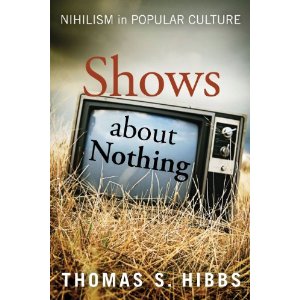 In his Preface, Hibbs poses several questions that help clarify both the perspective from which he writes and the types of shows that he will analyze. This is a welcome feature that I wish other writers would use before delving into potentially ambiguous territory. In the first chapter, he gives a rather extensive account of nihilism in American culture, both past and present. Throughout this chapter and the entire book, he heavily engages the work of Friedrich Nietzsche. Hibbs then moves into the meat of his text, a generic engagement with shows from horror to film noir to suburban melodramas to comedy and finally to fantasy.
In the second chapter, Hibbs outlines the nihilistic portrayals of evil in three films, The Exorcist, Cape Fear (both versions), and The Silence of the Lambs. In his third chapter, Hibbs tackles suburban nihilism/malaise in television programs like Mad Men and the films Revolutionary Road and American Beauty. Chapter 4 sees Hibbs taking a comedic turn in what is perhaps the most entertaining (and informative) section of the book through his analyses of films Trainspotting and Pulp Fiction and the preeminent show about nothing, Seinfeld. In Chapter 5, Hibbs presses pause on the pop culture analyses to consider the most popular reaction to nihilism in past and present American pop culture, romanticism (think Spielberg), what he considers a “simulacrum in the popular mind for orthodox Christian teaching” (156). In Chapter 6, Hibbs considers the most complex pop culture engagement with nihilism in the films Se7en, The Dark Knight, and the Harry Potter series, the latter of which provides, Hibbs suggests, the most applicable answer to the threat of nihilism in our popular culture. This is particularly ironic, in a way, given that so many Christians revile the book and film adaptations (184). In Chapter 7, Hibbs looks at the ways in which films with a heroic quest like The Book of Eli and The Lord of the Rings trilogy open up the possibility of divine providence (even in the midst of human choice) as a counter to a nihilistic worldview. Finally, Hibbs concludes with a rather hopeful reflection on the role of the arts (television and film in particular) to provide imaginative, if partial, revelations of responses to nihilism.
Hibbs’ book is a must read. Aside from some seeming editorial flaws, it is a smooth read that moves from the depressing (how will we ever get out of this mess that we’re in?!) to the uplifting (there is a way!). He’s got an impressive ability to competently move between genres from the classics to film noir to fantasy. Despite its title, the “shows” that Hibbs analyzes are really not about nothing. They are at their heart about the quest for meaning and the attempt to understand human experience of a range of emotions. In what might seem like the throw-away genres horror or comedy to so many dismissive viewers, Hibbs’ study of shows like Seinfeld or films like Se7en actually redeem them, making them continually relevant for audiences who struggle to make meaning out of similarly silly or horrific experiences. I applaud Hibbs’ subtle conclusion and conviction that self-sacrificial love and acts are the answer to the selfish and self-destructive patterns of nihilism. This is a particularly relevant message to many Christians who are engaged in the destructive practices of over-consumption that Hibbs sees as a natural result of nihilistic mindsets.

Who's funnier? This guy...

...or this guy?
Hibbs takes a more complex approach to potentially offensive elements of pop culture (sex, violence, etc.) than do most religious observers. Unlike many conservatives, Hibbs does not see a direct correlation to on-screen violence, for example, and real world violence like school shootings. What he does rightfully fear is the corrosion of the moral imagination, which is a far more dangerous effect. The fear, and likely reality, is that our younger viewers will become like so many adults in positions of authority. Rather than finding morally creative responses to violence and evil in the world, we simply repay them with violence and evil. We can bemoan the lack of moral imagination in films, but it’s not like younger viewers have better role models in our political or judicial systems to which to turn. Drawing from the work of Hannah Arendt, Hibbs argues that evil is always simple and banal, while good (and the doing of it) is much more complex. Unfortunatley, Hollywood doesn’t reflect this: Evil, as Hibbs quotes Hannah Arendt, is simple, banal. Good is complex. Hollywood doesn’t reflect this, as Hibbs argues, “The mysteries present in great filmmaking have migrated further to the margins of the industry, which itself has moved steadily in the direction of attracting a young audience for whom camp, irony, endless motion, novelty, and spectacle are the real draws. Audiences now seem enraptured by special effects, by the ‘capacity of the visible to exceed reality’ rather than illumine it” (238).
I don’t always agree with some of Hibbs’ criticisms of individual films or television programs, but I am always intrigued and challenged by them. His view of the unimaginative progression of Hollywood, particularly in the post-Exorcist horror genre, is correct. Hibbs writes:
Those scenes in The Exorcist did help spawn the endless one-upmanship among horror filmmakers, a competition in the surface aesthetics of evil to see who could produce, at a faster rate, ever more gruesome scenes of grotesque mutilation. It is important also to note that the scenes occur only sporadically and well over halfway through the film; attention to them has proven a distraction from central dramatic motifs of the story, which have more to do with goodness than evil. (48)
Unfortunately, much of the contemporary genre (and indeed most contemporary filmmaking) fails to rise to the standards that, Hibbs argues, are inherent to the genre/medium: “[The best horror films are] capable of raising all sorts of interesting questions about the nature of evil, about the unanticipated dangers that attend the human attempt to control and manipulate nature, about Enlightenment science, and even about the existence of God” (49).
For all of his praise of films that feature complex portrayals of good and evil and that creatively engage and overcome (?) a nihilistic worldview, Hibbs seems to miss out on the point that the protagonists often do so in very violent ways. He notes a comedic turn in the horror genre in which audiences have come to sympathize with the demonic in the film…or at least laugh knowingly at the behavior of John Doe (Se7en) or Hannibal Lecter (The Silence of the Lambs). But do we not also cheer the violent behavior of Batman, Aragorn, and their heroic counterparts? It would be interesting to see analyses of films that promote a non-violent response to violent nihilism. Doing so would only add to the great challenge that Hibbs lays before us, a challenge for us to (re)claim a/the language with which to effectively and morally speak to our nihilistic tendencies and to create and embody life-giving responses to them. If we don’t, then like the characters in the parking lot episode of Seinfeld, we will find that “there are no frontiers left to conquer, just fleeting appetites and residual desire for fulfillment” and that we have become “trapped in a semiotic hell, of which there is no clear diagnosis and from which there can be no escape” (129).
Previous Post

March 2, 2012
God, Godiva and Lady Gaga: A Spirituality for Lent
Next Post
March 9, 2012 It's a Work of Art...But Much More
Browse Our Archives
Select a Category Classics DVD Film Music News Pop Culture Events Print Sports Television Uncategorized Video Games
Select a Month March 2017 February 2017 January 2017 December 2016 November 2016 October 2016 September 2016 August 2016 July 2016 June 2016 May 2016 April 2016 March 2016 February 2016 January 2016 December 2015 November 2015 October 2015 September 2015 August 2015 July 2015 June 2015 May 2015 April 2015 March 2015 February 2015 January 2015 December 2014 November 2014 October 2014 September 2014 August 2014 July 2014 June 2014 May 2014 April 2014 March 2014 February 2014 January 2014 December 2013 November 2013 October 2013 September 2013 August 2013 July 2013 June 2013 May 2013 April 2013 March 2013 February 2013 January 2013 December 2012 November 2012 October 2012 September 2012 August 2012 July 2012 June 2012 May 2012 April 2012 March 2012 February 2012 January 2012 December 2011 November 2011 October 2011 September 2011 August 2011 July 2011 June 2011 May 2011 April 2011 March 2011 February 2011 January 2011 December 2010 November 2010 October 2010 September 2010 August 2010 July 2010 June 2010 May 2010 April 2010 March 2010 February 2010 January 2010 December 2009 November 2009 October 2009 September 2009 August 2009 July 2009 June 2009 May 2009 April 2009 March 2009 February 2009 January 2009 December 2008 November 2008 October 2008 September 2008 August 2008 July 2008 June 2008 May 2008 April 2008 March 2008 February 2008 January 2008 December 2007 November 2007 October 2007 September 2007 August 2007 July 2007 June 2007 May 2007 April 2007 March 2007
Follow Us!
TAKE THE
Religious Wisdom Quiz
Who was the first man created, according to the Bible?
Select your answer to see how you score.
Moses Adam Abraham Jacob
Related posts from Pop Theology


#KillerSerials: An Interview with Kutter Callaway

Book Review: MUSLIMS AND THE MAKING OF AMERICA

TRENDING AT PATHEOS Progressive Christian

Why Christians Have a Sacred Duty to Vote:...
The Bible offers strong support for the sacred duty to vote. Here...

What Being a Modern-Day Apostle Means to Me
In my last column, I discussed the ins and outs of modern-day...

Did Ancient China Once Worship the God of...
Across human history, a common thread weaves through the origins of the...

Love Your Neighbor – Including Earth-Kin: Lev. 19,...
God’s command to love your neighbor means acting in an ethical and...

Lead a Church Study of “Jesus and Lao...
Guest writer Jack Thomas (The Irreverent Reverend) reflects on leading his church...

Principles for Understanding the Apostolic Ministry Today
Whenever people discover that my formal ministry title is "apostle," as in...
view all Progressive Christian blogs
Ad-Free & Subscriber Log-In Subscription Support
- About Us
- 2026 Calendar
- Videos
- Podcasts
- Library of World Religions
- Faith In Media Tracker
- Advertise With Us
- Write for Us
- Privacy Policy
- Terms of Service
- Do Not Sell My Data
- Contact Us
- Radiant Digital
- Manage Newsletter Subscriptions
- Unsubscribe From Notifications
- Sitemap
Copyright 2008-2026, Patheos. All rights reserved.
Subscription Support Ad-Free & Subscriber Log-In
Follow Patheos