
BuddhistCatholicContemplativeEvangelicalGeneral ChristianHinduJewishLatter-day SaintMuslimNew VisionsProgressive Christian
Beliefs
- Buddhist
- Catholic
- Contemplative
- Evangelical
- General Christian
- Hindu
- Jewish
- Latter-day Saint
- More Voices
- Muslim
- New Visions
- Pagan
- Progressive Christian
Topics
- Religion News
- Food and Religion
- Sports and Religion
- Religious Art
- Religious Music and Entertainment
- Religious Events
- History and Religion
- Style and Religion
- Politics and Religion
- Women in Religion
- Recreation Outdoors and Religion
- Business Finance and Religion
- Careers Workplace and Religion
- Education and Religion
- Family Parenting and Religion
- Health Fitness and Religion
- Home and Religion
- Relationships and Religion
- Technology and Religion
- Travel and Religion
Columnists
- Buddhist Columnists
- Business Finance and Religion Columnists
- Careers Workplace and Religion Columnists
- Catholic Columnists
- Contemplative Columnists
- Education and Religion Columnists
- Evangelists Columnists
- Family Parenting and Religion Columnists
- General Christian Columnists
- Health Fitness and Religion Columnists
- Hindu Columnists
- History and Religion Columnists
- Home and Religion Columnists
- Jewish Columnists
- More Voices Columnists
- Latter Day Columnists
- Muslim Columnists
- New Visions Columnists
- Nonreligious Columnists
- Pagan Columnists
- Politics and Religion Columnists
- Progressive Columnists
- Recreation Outdoors and Religion Columnists
- Relationships and Religion Columnists
- Religion News Columnists
- Religious Art Columnists
- Religious Events Columnists
- Religious Music and Entertainment Columnists
- Sports and Religion Columnists
- Style and Religion Columnists
- Technology and Religion Columnists
- Travel and Religion Columnists
- Women in Religion Columnists
Resource Library
- 2026 Calendar
- Library of World Religions
- The 100 Most Holy Places on Earth
- Patheos Answers
- Podcasts
- Videos
- Faith Leaders Database
- Anglican Episcopalian
- Bahai
- Baptist
- Buddhism
- Christianity
- Confucianism
- Eastern Orthodoxy
- Hinduism
- Holiness and Pentecostal
- ISKCON
- Islam
- Judaism
- Lutheran
- Methodist
- The Church of Jesus Christ of Latter-day Saints
- New Age
- Paganism
- Presbytarian and Reformed
- Protestantism
- Religion Behind the Scenes
- Roman Catholic
- Scientology
- Shia Islam
- Sikhism
- Sufism
- Sunni Islam
- Taoism
- Zen
- See all religions
Research Tools
 Ad-Free & Subscriber Log-In Subscription Support
Ad-Free & Subscriber Log-In Subscription Support
Follow Patheos 

- Trending:
- Forgiveness
- |
- Marriage
- |
- Consciousness
- |
- Death Penalty
- |
- Election
- |
- Halloween
 Pop Theology
- Home
- Progressive Christian
- Religious Music & Entertainment
- Angelic Mini-Myths
Angelic Mini-Myths
Last updated on: March 16, 2012 at 5:37 am by J. Ryan Parker
Angelic Mini-Myths 2012-03-16T05:37:17-07:00 J. Ryan Parker
Patheos Explore the world's faith through different perspectives on religion and spirituality! Patheos has the views of the prevalent religions and spiritualities of the world.
A rather simple definition of myth is either an explanation of being (how and why the world and its inhabitants came to be) or the celebration or story of a hero. It’s a broad definition, but inclusive. In the graphic novel, A Flight of Angels, Rebecca Guay has posed a scenario, the mysterious fall of an angel, to a group of talented artists, Holly Black, Bill Willingham, Alisa Kwitney, Louise Hawes, and Todd Mitchell, who respond with their own unique mini-myths that explain its fall. The results are essentially short stories with, at times, broader implications for reading myth, theology, and fantasy.
Set in the modern day in the “dark forests behind every strip mall […at] the edge of every highway,” we find a collection of faeries, fauns, talking animals, and a hag who come across an unconscious and dying angel that has fallen out of the sky. Before dispatching him, as some of the gathered party wants to do, the wolf decides that each of them should come up with a story that explains how the angel got there…a mini-myth if you will. Popular opinion will rule on the story and whether it is a fair enough explanation to let him live. Though the group never decides which story is “correct” or “best,” the conclusion of the graphic novel seems to suggest that, with minor revisions, the angel is one that has fallen from “heaven” after a cosmic battle. It should sound familiar to many Christian audiences.
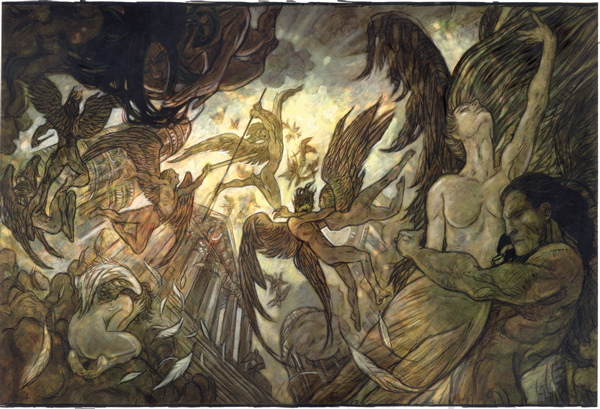
A familiar heavenly battle.
The first mini-myth, told by a troll, borrows from but changes the Adam and Eve myth and suggests that, as traditionally told, it leaves out crucial bits of information about the “fall of humankind.” Somebody might have sampled the apple before Eve. Next, a faerie prince tells a story of a death-dealing angel gone awry who is met with punishment from a fellow angel. The mean old hag then tells the story of witchcraft, immortality, and the connectedness of life, which is somewhat reminiscent of a Hellboy story by Mike Mignola. A young female faerie tells a story of self-sacrificial human love that has angelic implications (hints of Cinderella and her prince). Can unequally-yoked lovers (immortal and mortal) truly spend a lifetime together? The final story features the aforementioned heavenly battle; however, rather than pride as its central theme, it hints at the threat of nihilism…nothingness…and their ability to corrupt even angelic beings.

Lucifer becomes consumed by nothing.
There are a couple of things to pick up on upon first reading Guay et al’s work. One of the first is the importance and necessity of and, perhaps, the futility of diverse and competing interpretations and constructions of myths. Each character has their own explanation for how the fallen angel came to be, but in the end, these diverse interpretations have no concrete effect on how to proceed with treating that angel. In fact, they lead to its destruction. In a sense, just as with the final story, the overall exchange between these characters opens up the door for a discussion of nihilism and recalls Thomas S. Hibbs’ discussion of its prevalence in our pop culture in Shows About Nothing: Nihilism in Popular Culture. In the end, Lucifer’s recognition that he rules over nothing corrupts his heart: “Nothing spreads. It seeps into everything it touches. It dulls laughter. And spoils songs.” This is simultaneously the prideful and nihilistic threat. Lucifer would like to reign over something…would like for his existence to have a larger meaning. This alternative mini-myth suggests that it was a quest for meaning and significance that led to this angelic fall.
Finally, Guay and her contributors’ stories have implications for the ways we read other myths and fairy tales. That they place their narratives on the margins, in those dark spaces that we fear to tread, should encourage us to value the marginalized in our own communities and to seek the (re)enchantment of those places that we often avoid, be they forests on the edge of town or an alternate interpretation of a familiar or much-loved text.
Previous Post

March 9, 2012
It's a Work of Art...But Much More
Next Post
March 18, 2012 GCB = Great Camp Burlesque
Browse Our Archives
Select a Category Classics DVD Film Music News Pop Culture Events Print Sports Television Uncategorized Video Games
Select a Month March 2017 February 2017 January 2017 December 2016 November 2016 October 2016 September 2016 August 2016 July 2016 June 2016 May 2016 April 2016 March 2016 February 2016 January 2016 December 2015 November 2015 October 2015 September 2015 August 2015 July 2015 June 2015 May 2015 April 2015 March 2015 February 2015 January 2015 December 2014 November 2014 October 2014 September 2014 August 2014 July 2014 June 2014 May 2014 April 2014 March 2014 February 2014 January 2014 December 2013 November 2013 October 2013 September 2013 August 2013 July 2013 June 2013 May 2013 April 2013 March 2013 February 2013 January 2013 December 2012 November 2012 October 2012 September 2012 August 2012 July 2012 June 2012 May 2012 April 2012 March 2012 February 2012 January 2012 December 2011 November 2011 October 2011 September 2011 August 2011 July 2011 June 2011 May 2011 April 2011 March 2011 February 2011 January 2011 December 2010 November 2010 October 2010 September 2010 August 2010 July 2010 June 2010 May 2010 April 2010 March 2010 February 2010 January 2010 December 2009 November 2009 October 2009 September 2009 August 2009 July 2009 June 2009 May 2009 April 2009 March 2009 February 2009 January 2009 December 2008 November 2008 October 2008 September 2008 August 2008 July 2008 June 2008 May 2008 April 2008 March 2008 February 2008 January 2008 December 2007 November 2007 October 2007 September 2007 August 2007 July 2007 June 2007 May 2007 April 2007 March 2007
Follow Us!
TAKE THE
Religious Wisdom Quiz
Who did Jesus call the "greatest among those born of women"?
Select your answer to see how you score.
John the Baptist Moses Elijah Peter
Related posts from Pop Theology


#KillerSerials: An Interview with Kutter Callaway

Book Review: MUSLIMS AND THE MAKING OF AMERICA

TRENDING AT PATHEOS Progressive Christian

Why Christians Have a Sacred Duty to Vote:...
The Bible offers strong support for the sacred duty to vote. Here...

What Being a Modern-Day Apostle Means to Me
In my last column, I discussed the ins and outs of modern-day...

Did Ancient China Once Worship the God of...
Across human history, a common thread weaves through the origins of the...

Love Your Neighbor – Including Earth-Kin: Lev. 19,...
God’s command to love your neighbor means acting in an ethical and...

Lead a Church Study of “Jesus and Lao...
Guest writer Jack Thomas (The Irreverent Reverend) reflects on leading his church...

Principles for Understanding the Apostolic Ministry Today
Whenever people discover that my formal ministry title is "apostle," as in...
view all Progressive Christian blogs
Ad-Free & Subscriber Log-In Subscription Support
- About Us
- 2026 Calendar
- Videos
- Podcasts
- Library of World Religions
- Faith In Media Tracker
- Advertise With Us
- Write for Us
- Privacy Policy
- Terms of Service
- Do Not Sell My Data
- Contact Us
- Radiant Digital
- Manage Newsletter Subscriptions
- Unsubscribe From Notifications
- Sitemap
Copyright 2008-2026, Patheos. All rights reserved.
Subscription Support Ad-Free & Subscriber Log-In
Follow Patheos