
BuddhistCatholicContemplativeEvangelicalGeneral ChristianHinduJewishLatter-day SaintMuslimNew VisionsProgressive Christian
Beliefs
- Buddhist
- Catholic
- Contemplative
- Evangelical
- General Christian
- Hindu
- Jewish
- Latter-day Saint
- More Voices
- Muslim
- New Visions
- Pagan
- Progressive Christian
Topics
- Religion News
- Food and Religion
- Sports and Religion
- Religious Art
- Religious Music and Entertainment
- Religious Events
- History and Religion
- Style and Religion
- Politics and Religion
- Women in Religion
- Recreation Outdoors and Religion
- Business Finance and Religion
- Careers Workplace and Religion
- Education and Religion
- Family Parenting and Religion
- Health Fitness and Religion
- Home and Religion
- Relationships and Religion
- Technology and Religion
- Travel and Religion
Columnists
- Buddhist Columnists
- Business Finance and Religion Columnists
- Careers Workplace and Religion Columnists
- Catholic Columnists
- Contemplative Columnists
- Education and Religion Columnists
- Evangelists Columnists
- Family Parenting and Religion Columnists
- General Christian Columnists
- Health Fitness and Religion Columnists
- Hindu Columnists
- History and Religion Columnists
- Home and Religion Columnists
- Jewish Columnists
- More Voices Columnists
- Latter Day Columnists
- Muslim Columnists
- New Visions Columnists
- Nonreligious Columnists
- Pagan Columnists
- Politics and Religion Columnists
- Progressive Columnists
- Recreation Outdoors and Religion Columnists
- Relationships and Religion Columnists
- Religion News Columnists
- Religious Art Columnists
- Religious Events Columnists
- Religious Music and Entertainment Columnists
- Sports and Religion Columnists
- Style and Religion Columnists
- Technology and Religion Columnists
- Travel and Religion Columnists
- Women in Religion Columnists
Resource Library
- 2026 Calendar
- Library of World Religions
- The 100 Most Holy Places on Earth
- Patheos Answers
- Podcasts
- Videos
- Faith Leaders Database
- Anglican Episcopalian
- Bahai
- Baptist
- Buddhism
- Christianity
- Confucianism
- Eastern Orthodoxy
- Hinduism
- Holiness and Pentecostal
- ISKCON
- Islam
- Judaism
- Lutheran
- Methodist
- The Church of Jesus Christ of Latter-day Saints
- New Age
- Paganism
- Presbytarian and Reformed
- Protestantism
- Religion Behind the Scenes
- Roman Catholic
- Scientology
- Shia Islam
- Sikhism
- Sufism
- Sunni Islam
- Taoism
- Zen
- See all religions
Research Tools
 Ad-Free & Subscriber Log-In Subscription Support
Ad-Free & Subscriber Log-In Subscription Support
Follow Patheos 

- Trending:
- Forgiveness
- |
- Marriage
- |
- Consciousness
- |
- Death Penalty
- |
- Election
- |
- Halloween
 Pop Theology
- Home
- Progressive Christian
- Religious Music & Entertainment
- The Monstrous Passion
The Monstrous Passion
Last updated on: February 3, 2012 at 9:01 am by J. Ryan Parker
The Monstrous Passion 2012-02-03T09:01:10-08:00 J. Ryan Parker
Patheos Explore the world's faith through different perspectives on religion and spirituality! Patheos has the views of the prevalent religions and spiritualities of the world.
Ryan here. In a couple of weeks, I’ll be departing on a world tour of sorts (more on that in a later post). While I will still be posting on all things religious and pop cultural, Richard Lindsay, formerly unofficial but now official co-editor of Pop Theology, will take a more direct role in content creation on the site. If you have any thoughts for posts he should write or contributions you’d like to make, you can contact him at www.facebook.com/rlindsay2. For now, I wanted to provide an informal introduction to his most recent contribution. While it may initially seem soooo 2004, his recent re-examination of Mel Gibson’s The Passion of the Christ further reveals the cultural importance of that cinematic phenomenon. We have yet to exhaust its implications for the study of religion and popular culture, and Richard’s recognition of its parallels to horror genre conventions represents a key direction for further study of the film and fans’ reaction to it, particularly in a contemporary American pop cultural context with a strong penchant for violence. Check out an excerpt from his dissertation and accompanying illustrations after the jump.
The following is an excerpt from my upcoming dissertation on the uses of gay camp in biblical films. This section discusses horror movie conventions used in The Passion of the Christ*. It is my contention that Mel Gibson’s use of these strange and even humorous tropes in what is otherwise a horrific and torturous account of the last hours of Christ opens* The Passion to a broader reading—even a “camp” or “queer” reading. The illustrations are presented as visual evidence of this thesis. – Richard Lindsay
By the end of the flogging scene in Mel Gibson’s The Passion of the Christ, Jesus is a bloody pulp, and with the crown of thorns, he resembles the character Pinhead in Clive Barker’s Hellraiser series. However, there turns out to be some unintended Biblical theology behind turning Jesus into a monstrous figure. As Galatians 3:13 puts it, “Christ redeemed us from the curse of the law by becoming a curse for us—for it is written, Cursed is everyone who hangs on a tree“(NRSV). Although an incarnational, liberating theology seems farthest from the mind of Mel Gibson, we could see The Passion as Christ becoming a monster in solidarity with all others who are treated as monstrous in the world—the disabled, the sick and dying, the unfairly imprisoned and inhumanely tortured, the poor, and people of sexual or gender difference. In this way, the monstrousness of this horror story, intended to portray the kerygma of the cosmic battle of Good versus Evil, unintentionally becomes queer. What The Passion suggests through its camp kerygma, is what Paul suggests in Galatians: that Jesus was ‘queered’ on the cross.
This would not be too much of a stretch for queer writers, many of whom have described the relationship between monstrosity, queerness, and horror. In his book on monstrosity and homosexuality in film, Michael William Saunders notices what other writers like Stephen Moore have noticed about the dual nature of queerness as it applies to monstrosity:
The idea of the monster derives from two fundamental etymological myths: that monsters are anomalous creatures that serve as signs indicating the consequences of the natural order (Look what happens when you do bad things!); and that monsters are marvelous, monumental manifestations of the power of God (Look what God can do!). The monster is, by its very nature, most fundamentally an image whose purpose is to reveal the power, and more importantly, the terror, of divinity.[1]
Once again, we see the ability of queerness to simultaneously define in opposition and undermine in perversity. Jesus’ monstrosity in The Passion is both a warning (a remonstration) of the power of evil, and a sign (a monstrance) of God’s terrible power. Saunders goes on to explain the spiritual value of voyeurism as we the audience gaze on this horrible monster that Christ has become:
[The monster] is meant to be seen, but its nature as image is to discourage us, either through fear or through awe, from looking too long where we ought not to look. …If we look at such an image too long or too often, we commit a sacrilege or we endanger ourselves by presuming to look casually at what we are not meant to be able to bear. As an image, a monster functions to give power to an elect—the hierophants who are allowed to wield the image because they have proven their immunity against it….”[2]
This echoes the reactions of professors Russell Hittinger and Elizabeth Lev to Gibson’s film. They write, “We, too, have been witnessing these events, and that it is now we who are called to bear witness to what we have seen.”[3] Their call to witness initiates us into that hierophany of privileged viewers who have experienced the brutal torture of Jesus Christ, and we are called to speak about it to the world.
Taking one more queer twist, however, beyond the voyeuristic salvation offered in The Passion, is the possibility of identifying with Christ as a queer body. In his essay “Growing Up Horror,” gay writer D. Travers Scott writes about his childhood obsession with horror movies and makeup and how this became an overt expression for more covert sexual desires. As a preteen, he decorated his room with horror movie posters, rubber body parts, and wig stands decorated to look like they had deteriorating flesh and rotting eyeballs. Scott places this fascination beyond identification with outsiders, what he calls “Freddy Kruger-as-Genet.”[4]He explains that horror helped him take real pleasure in his “body’s rebellious nature.” He adds, “At a time when my body was under multiple systems of oppression—too young, too queer, too prone to disease—stories of rebellious bodies…filled me with glee.”[5]
At the same time, this body-ness serves an important function when placing Gibson’s Jesus film in the broader context of the Jesus film genre. The destruction of Jesus’ body in The Passion is perhaps more evidence of Christ having a body than any previous Jesus film had dared to portray. This is the polar opposite of Jeffrey Hunter’s pretty, barely-bruised Jesus with shaved underarms in Nicholas Ray’s King of Kings (1961), a role that earned the ire of cynical critics, who called it “I Was a Teenage Jesus.” The graphic production of The Passion creates a Christ body that is gruesome and carnal, like the “horror” bodies beloved by Scott, the young burgeoning queer. These bodies are, “Adamantly irrational. They populate a world in which common sense no longer reigns supreme, but lust, passion, frenzy, and desire erupt in swollen uprisings.”[6] Scott further describes these horror bodies as subaltern: ‘The members of these rebellions are not a downtrodden underclass but downtrodden values: passion, love, emotion, and feeling, all demanding their say, their place at the table of consciousness and reality, their recognition in the tyranny of an ascetic Puritan, rational, reproductive, sterile, and all-too-safe- world. And how queer is that?”[7]
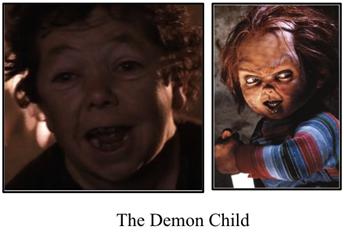
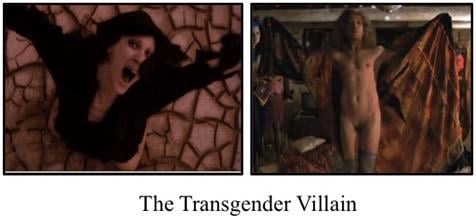
Taking Scott’s reflections a theological step further, could we dare ask: In the same way, a flayed savior who really bleeds, really suffers, and really dies an agonizing death…how queer is that?! Of course, if you don’t think that The Passion of the Christ belongs squarely in the horror film genre, consider the brief photographic argument here:

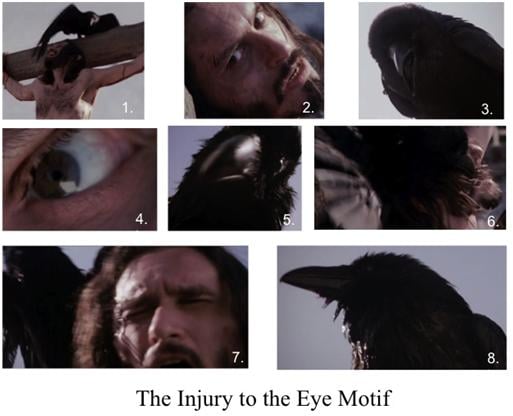
Note: Recall the shot of the elderly man with his eyes gouged out in Alfred Hitchcock’s The Birds (1963).
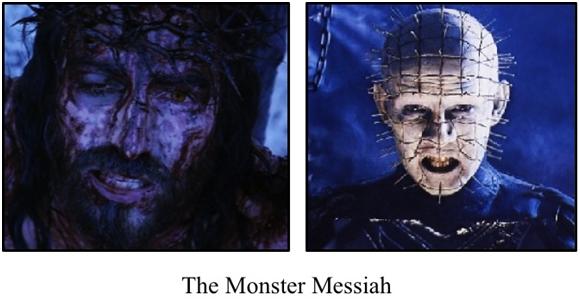
[1] Michael William Saunders, Imps of the Perverse: Gay Monsters in Film (Westport, CT: Praeger, 1998), 2.
[2] Ibid.
[3] Russell Hittinger and Elizabeth Lev, “Gibson’s Passion,” March 2004, available at http://www.firstthings.com/print.php?type=article&year=2007&month=01&title_link=gibsonrsquos-passion-36.
[4] D. Travers Scott, “Growing Up in Horror,” in From Boys to Men: Gay Men Write about Growing Up, eds. Theodore K. Gideonse and Robert R. Williams (New York: Carroll and Graf, 2006), 245.
[5] Ibid., 249.
[6] Ibid, 249.
[7] Ibid.
©Richard A. Lindsay, 2012
Previous Post

January 26, 2012
(Not So) Shockingly Bohemian
Next Post
February 6, 2012 A Family Mess
Browse Our Archives
Select a Category Classics DVD Film Music News Pop Culture Events Print Sports Television Uncategorized Video Games
Select a Month March 2017 February 2017 January 2017 December 2016 November 2016 October 2016 September 2016 August 2016 July 2016 June 2016 May 2016 April 2016 March 2016 February 2016 January 2016 December 2015 November 2015 October 2015 September 2015 August 2015 July 2015 June 2015 May 2015 April 2015 March 2015 February 2015 January 2015 December 2014 November 2014 October 2014 September 2014 August 2014 July 2014 June 2014 May 2014 April 2014 March 2014 February 2014 January 2014 December 2013 November 2013 October 2013 September 2013 August 2013 July 2013 June 2013 May 2013 April 2013 March 2013 February 2013 January 2013 December 2012 November 2012 October 2012 September 2012 August 2012 July 2012 June 2012 May 2012 April 2012 March 2012 February 2012 January 2012 December 2011 November 2011 October 2011 September 2011 August 2011 July 2011 June 2011 May 2011 April 2011 March 2011 February 2011 January 2011 December 2010 November 2010 October 2010 September 2010 August 2010 July 2010 June 2010 May 2010 April 2010 March 2010 February 2010 January 2010 December 2009 November 2009 October 2009 September 2009 August 2009 July 2009 June 2009 May 2009 April 2009 March 2009 February 2009 January 2009 December 2008 November 2008 October 2008 September 2008 August 2008 July 2008 June 2008 May 2008 April 2008 March 2008 February 2008 January 2008 December 2007 November 2007 October 2007 September 2007 August 2007 July 2007 June 2007 May 2007 April 2007 March 2007
Follow Us!
TAKE THE
Religious Wisdom Quiz
Who dreamed of a ladder reaching to heaven?
Select your answer to see how you score.
Paul Jacob Joseph Daniel
Related posts from Pop Theology


At SXSW2017: May It Last: A Portrait of...

At SXSW 2017: "Untold Tales of Armistead Maupin"
TRENDING AT PATHEOS Progressive Christian

Why Christians Have a Sacred Duty to Vote:...
The Bible offers strong support for the sacred duty to vote. Here...

What Being a Modern-Day Apostle Means to Me
In my last column, I discussed the ins and outs of modern-day...

Did Ancient China Once Worship the God of...
Across human history, a common thread weaves through the origins of the...

Love Your Neighbor – Including Earth-Kin: Lev. 19,...
God’s command to love your neighbor means acting in an ethical and...

Lead a Church Study of “Jesus and Lao...
Guest writer Jack Thomas (The Irreverent Reverend) reflects on leading his church...

Principles for Understanding the Apostolic Ministry Today
Whenever people discover that my formal ministry title is "apostle," as in...
view all Progressive Christian blogs
Ad-Free & Subscriber Log-In Subscription Support
- About Us
- 2026 Calendar
- Videos
- Podcasts
- Library of World Religions
- Faith In Media Tracker
- Advertise With Us
- Write for Us
- Privacy Policy
- Terms of Service
- Do Not Sell My Data
- Contact Us
- Radiant Digital
- Manage Newsletter Subscriptions
- Unsubscribe From Notifications
- Sitemap
Copyright 2008-2026, Patheos. All rights reserved.
Subscription Support Ad-Free & Subscriber Log-In
Follow Patheos