
BuddhistCatholicContemplativeEvangelicalGeneral ChristianHinduJewishLatter-day SaintMuslimNew VisionsProgressive Christian
Beliefs
- Buddhist
- Catholic
- Contemplative
- Evangelical
- General Christian
- Hindu
- Jewish
- Latter-day Saint
- More Voices
- Muslim
- New Visions
- Pagan
- Progressive Christian
Topics
- Religion News
- Food and Religion
- Sports and Religion
- Religious Art
- Religious Music and Entertainment
- Religious Events
- History and Religion
- Style and Religion
- Politics and Religion
- Women in Religion
- Recreation Outdoors and Religion
- Business Finance and Religion
- Careers Workplace and Religion
- Education and Religion
- Family Parenting and Religion
- Health Fitness and Religion
- Home and Religion
- Relationships and Religion
- Technology and Religion
- Travel and Religion
Columnists
- Buddhist Columnists
- Business Finance and Religion Columnists
- Careers Workplace and Religion Columnists
- Catholic Columnists
- Contemplative Columnists
- Education and Religion Columnists
- Evangelists Columnists
- Family Parenting and Religion Columnists
- General Christian Columnists
- Health Fitness and Religion Columnists
- Hindu Columnists
- History and Religion Columnists
- Home and Religion Columnists
- Jewish Columnists
- More Voices Columnists
- Latter Day Columnists
- Muslim Columnists
- New Visions Columnists
- Nonreligious Columnists
- Pagan Columnists
- Politics and Religion Columnists
- Progressive Columnists
- Recreation Outdoors and Religion Columnists
- Relationships and Religion Columnists
- Religion News Columnists
- Religious Art Columnists
- Religious Events Columnists
- Religious Music and Entertainment Columnists
- Sports and Religion Columnists
- Style and Religion Columnists
- Technology and Religion Columnists
- Travel and Religion Columnists
- Women in Religion Columnists
Resource Library
- 2026 Calendar
- Library of World Religions
- The 100 Most Holy Places on Earth
- Patheos Answers
- Podcasts
- Videos
- Faith Leaders Database
- Anglican Episcopalian
- Bahai
- Baptist
- Buddhism
- Christianity
- Confucianism
- Eastern Orthodoxy
- Hinduism
- Holiness and Pentecostal
- ISKCON
- Islam
- Judaism
- Lutheran
- Methodist
- The Church of Jesus Christ of Latter-day Saints
- New Age
- Paganism
- Presbytarian and Reformed
- Protestantism
- Religion Behind the Scenes
- Roman Catholic
- Scientology
- Shia Islam
- Sikhism
- Sufism
- Sunni Islam
- Taoism
- Zen
- See all religions
Research Tools
 Ad-Free & Subscriber Log-In Subscription Support
Ad-Free & Subscriber Log-In Subscription Support
Follow Patheos 

- Trending:
- Forgiveness
- |
- Marriage
- |
- Consciousness
- |
- Death Penalty
- |
- Election
- |
- Halloween
 Pop Theology
- Home
- Progressive Christian
- Religious Music & Entertainment
- (Not So) Shockingly Bohemian
(Not So) Shockingly Bohemian
Last updated on: January 26, 2012 at 1:31 pm by J. Ryan Parker
(Not So) Shockingly Bohemian 2012-01-26T13:31:22-08:00 J. Ryan Parker
Patheos Explore the world's faith through different perspectives on religion and spirituality! Patheos has the views of the prevalent religions and spiritualities of the world.
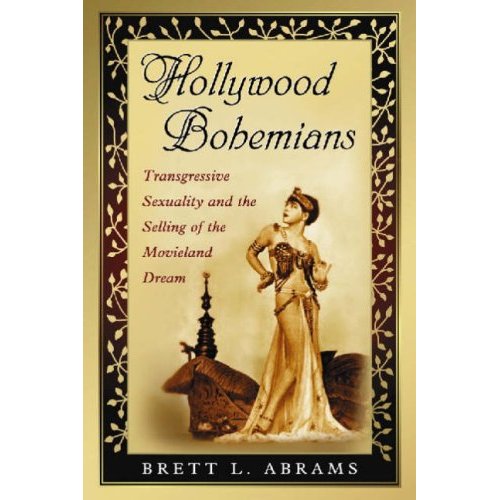
The “liberalism” of Hollywood has long been a point of discussion for cultural critics, film historians, and “conscientious objectors.” All of this has to do with the films’ depiction of violence, drug/alcohol use, religion, and, of course, sex. At the same time, the behavior of the “Hollywood elite” has also been a point of contention for outside observers. Yet as a significant audience was scandalized by offensive behavior, just as many flocked to it. In his book, Hollywood Bohemians: Transgressive Sexuality and the Selling of the Movieland Dream, Brett L. Abrams discusses how Hollywood actually marketed this scandalous sexual behavior to sell its product.
Abrams discusses three types of transgressive sexuality, adultery, cross-dressing, and homosexuality. Of course, it’s easy to see how the inclusion of the former with the latter two will be troublesome to some readers. However, Abrams is simply considering these three modes of behavior as ways in which stars and crew defied widely-accepted sexual and gender norms throughout the studio era. Abrams writes, “[…The] bohemians embodied the pleasures of the forbidden and the taboo” (4). At the same time, Abrams focuses his attention on the venues in which this transgressive behavior was often acted out: nightclubs, public Hollywood parties, private Hollywood parties, the Hollywood star’s home, and behind the scenes of Hollywood productions. Abrams contrasts coverage of these Hollywood places and events with similar accounts from locations across the country. Though these modes of transgressive behavior took place in all locations and at a variety of times, Abrams narrows his discussion of one particular mode in each location. Abrams’ book is an important contribution to the study of film history as it reveals Hollywood’s self-awareness and an eagerness on the part of many viewers and fans to participate in transgressive behavior by consuming the stories and images that Hollywood released. Abrams consults a variety of sources for his analysis of these bohemians and their behavior. He considers trade press (Photoplay, Moving Picture World), traditional print journalism, and, interestingly enough, Hollywood novels and films…that is, fictional narratives about the industry that draw from real-world parallels. One of my few concerns with Abrams’ book is his hesitation to “name names,” and by that I mean not the bohemian stars themselves but the names of the historians to which he so frequently refers, who make bold claims about the stars’ identity and sexual behavior. Far too often, I had to look back to the footnotes to see what author he was referring to. However, Abrams’ study is also important because it reveals the origins of so much of our media obsession with stars today and the value we place on sexuality. In many ways, it makes a good companion piece to Pete Wards’ Gods Behaving Badly. Read on for a further summary of the book.
 Abrams’ discussion of Hollywood nightlife in the first chapter focuses on the popularity of gender-bending cross dressers, female impersonators and women in men’s clothing. Female impersonation shows were extremely popular and highly publicized until the 1940s or so. Stars from Broadway and Vaudeville made their way to Hollywood and its nightclubs. Abrams writes, “[…Female] impersonators became one of the first groups of proven performers from another entertainment field to receive contracts and star in motion pictures” (18). Stars included Karyl Norman and Julian Eltinge. The coverage of these stars and their performances, Abrams adds, “associated Hollywood nightlife with the fantasy of seeing people who defied the typical clothing style for women” (29). What is an important reminder here is just how shocking it was for women to don pants and suits. Stars like Tallulah Bankhead and Greta Garbo quite literally paved the way for more contemporary fashions. Abrams also argues that it was an influential part of lesbian subculture as well before it became mainstream (37). Abrams’ discussion of fan reaction to female impersonators also applies to women who dressed like men: “If one of their [the fans’] favorite stars was friendly with female impersonators, the reader would continue to identify with the star, thus assuming the star’s position of friend of the female impersonator” (40). One wonders how closely the decline in the popularity of female impersonation shows was linked to the arrival of World War II and the demands of “manliness” and patriotism.
In the second chapter, Abrams discusses ways in which reporters covered stars’ behavior at public Hollywood parties and movie premiers. What were they wearing? Who did they show up with? Who did the leave with? What did they say? How did they behave? Much of their behavior (that of the bohemians) was coded and the press and the studios were more than happy to revel in that coded behavior/language. Stars that form the center of this chapter include Ramon Navarro (accusations of homosexuality) and Clark Gable and Carole Lombard (two of the most notorious adulterers in Hollywood history). Surprisingly, at this time, such behavior did not rob stars of very good salaries or big-budget movies (74).
Abrams’ third chapter analyzes private Hollywood parties and the (often) illicit sexual behavior that took place there. Here, he draws heavily on novels and films about Hollywood. Abrams writes, “This perception of the Hollywood private party as a highly sexual place was widely held. […] The images [of private parties] also provided audiences the excitement of vicariously witnessing other people experience wish fulfillment” (78, 79). Chief among the scandalous parties was the Roscoe “Fatty” Arbuckle incident in which the actor was eventually acquitted of raping and murdering Virginia Rappe. Unlike Arbuckle, who never made it back, Abrams writes, “The sexual outlaws in Hollywood private parties did not start sparks that led to significant threats to either the movie industry or to the conception of Hollywood. Instead, the images promoted the Hollywood private party as an exciting place where audience members might catch glimpses of movie stars making love in their real lives” (85). Abrams continues, “[…If] he were so inclined, a man attending a Hollywood party could leave with another man’s date. He could even leave with another woman’s date” (85). Central to his discussion in this chapter are the likes of William Randolph Hearst and Marion Davies, Spencer Tracy and Loretta Young, and Rudolph Valentino and Natacha Rambova.
In Chapter 4, Abrams analyzes portrayals of and features on stars’ homes, both their features and decorations and the ways in which the stars conducted themselves while at home. The stars entertained guests and lovers of the same and opposite sexes. Here, Abrams is concerned with “chic bachelorhood,” be it of the male or female variety, and “odd bedfellow digs.” The former deals with stars who live the single life, especially those who had little concern for living with the opposite sex, or anyone of any gender for that matter. The latter concerned wealthy same-sex stars who lived together because they either loved one another’s company or were physically attracted to each other. Abrams begins the chapter with an interesting discussion of the home in American popular culture and its ability to convey gender and social norms. Hollywood homes also conveyed the bohemians’ sexuality and relationship status (121). Abrams’ discussion of Alla Nazimova, Greta Garbo, Mercedes De Acosta, and Cary Grant and Randolph Scott‘s homes is especially telling. What is most interesting here, as in the subsequent chapter, are the ways in which female stars and behind-the-scenes crew (writers, directors, artists, etc.) earned and flaunted their wealth and fame in a male-dominated culture, even as they had to negotiate questions about their lifestyles that came from a distinctly male point-of-view.
In the fifth chapter, Abrams discusses life behind the scenes on Hollywood productions and the ways in which the bohemians (stars and crew alike) conducted themselves at the workplace. Much like nightclubs or Hollywood parties, the press and the studios would tout illicit behavior during production in the promotion of these films. Like homes, dressing rooms became places of refuge or location for “covert affairs.” Like other illicit relationships, a bohemian star often became “close” to their designers, stylists, set designers, and makeup artists. These latter technicians were often just as bohemian in their tastes and sexuality as their on-screen counterparts. Abrams adds, “Hollywood publicity materials depicted three main characteristics behind the scenes. It appeared as a place where stars lived luxuriously, where workers formed a family environment, and where a man and woman could find romance [not necessarily with each other, of course]” (165). Abrams discusses artists and crew like Orry Kelly and Dorothy Arzner at length.
Abrams concludes that these bohemians toyed with “crossing the boundaries of culturally acceptable gender and sexual interests and activities […and] associated the taboo and pleasure of experiencing the forbidden with specific places in Hollywood” (193). He also, like me, questions, the inclusion of adulterers in addition to homosexuals and cross-dressers in Hollywood’s promotion of bohemian behavior (193). Nevertheless, Abrams argues that these bohemians not only transgressed past sexual mores but have shaped current norms and practices today. He also briefly traces how portrayals of bohemians that once “praised” or “uplifted” their behavior dramatically shifted to show them as pitiful or deranged characters (196). More so than ever before, our current media provides “audiences with ever-increasing information about the romantic and sexual interests of celebrities and public figures” (197). Abrams does a most insightful job of showing us where it all began.
It doesn’t get more bohemian than this:
Previous Post

January 17, 2012
A Sacred (Version of) Hollywood?
Next Post
February 3, 2012 The Monstrous Passion
Browse Our Archives
Select a Category Classics DVD Film Music News Pop Culture Events Print Sports Television Uncategorized Video Games
Select a Month March 2017 February 2017 January 2017 December 2016 November 2016 October 2016 September 2016 August 2016 July 2016 June 2016 May 2016 April 2016 March 2016 February 2016 January 2016 December 2015 November 2015 October 2015 September 2015 August 2015 July 2015 June 2015 May 2015 April 2015 March 2015 February 2015 January 2015 December 2014 November 2014 October 2014 September 2014 August 2014 July 2014 June 2014 May 2014 April 2014 March 2014 February 2014 January 2014 December 2013 November 2013 October 2013 September 2013 August 2013 July 2013 June 2013 May 2013 April 2013 March 2013 February 2013 January 2013 December 2012 November 2012 October 2012 September 2012 August 2012 July 2012 June 2012 May 2012 April 2012 March 2012 February 2012 January 2012 December 2011 November 2011 October 2011 September 2011 August 2011 July 2011 June 2011 May 2011 April 2011 March 2011 February 2011 January 2011 December 2010 November 2010 October 2010 September 2010 August 2010 July 2010 June 2010 May 2010 April 2010 March 2010 February 2010 January 2010 December 2009 November 2009 October 2009 September 2009 August 2009 July 2009 June 2009 May 2009 April 2009 March 2009 February 2009 January 2009 December 2008 November 2008 October 2008 September 2008 August 2008 July 2008 June 2008 May 2008 April 2008 March 2008 February 2008 January 2008 December 2007 November 2007 October 2007 September 2007 August 2007 July 2007 June 2007 May 2007 April 2007 March 2007
Follow Us!
TAKE THE
Religious Wisdom Quiz
Who predicted the fall of Jerusalem?
Select your answer to see how you score.
Jesus Isaiah Jeremiah Daniel
Related posts from Pop Theology


#KillerSerials: An Interview with Kutter Callaway

Book Review: MUSLIMS AND THE MAKING OF AMERICA

TRENDING AT PATHEOS Progressive Christian

Why Christians Have a Sacred Duty to Vote:...
The Bible offers strong support for the sacred duty to vote. Here...

What Being a Modern-Day Apostle Means to Me
In my last column, I discussed the ins and outs of modern-day...

Did Ancient China Once Worship the God of...
Across human history, a common thread weaves through the origins of the...

Love Your Neighbor – Including Earth-Kin: Lev. 19,...
God’s command to love your neighbor means acting in an ethical and...

Lead a Church Study of “Jesus and Lao...
Guest writer Jack Thomas (The Irreverent Reverend) reflects on leading his church...

Principles for Understanding the Apostolic Ministry Today
Whenever people discover that my formal ministry title is "apostle," as in...
view all Progressive Christian blogs
Ad-Free & Subscriber Log-In Subscription Support
- About Us
- 2026 Calendar
- Videos
- Podcasts
- Library of World Religions
- Faith In Media Tracker
- Advertise With Us
- Write for Us
- Privacy Policy
- Terms of Service
- Do Not Sell My Data
- Contact Us
- Radiant Digital
- Manage Newsletter Subscriptions
- Unsubscribe From Notifications
- Sitemap
Copyright 2008-2026, Patheos. All rights reserved.
Subscription Support Ad-Free & Subscriber Log-In
Follow Patheos