
BuddhistCatholicContemplativeEvangelicalGeneral ChristianHinduJewishLatter-day SaintMuslimNew VisionsProgressive Christian
Beliefs
- Buddhist
- Catholic
- Contemplative
- Evangelical
- General Christian
- Hindu
- Jewish
- Latter-day Saint
- More Voices
- Muslim
- New Visions
- Pagan
- Progressive Christian
Topics
- Religion News
- Food and Religion
- Sports and Religion
- Religious Art
- Religious Music and Entertainment
- Religious Events
- History and Religion
- Style and Religion
- Politics and Religion
- Women in Religion
- Recreation Outdoors and Religion
- Business Finance and Religion
- Careers Workplace and Religion
- Education and Religion
- Family Parenting and Religion
- Health Fitness and Religion
- Home and Religion
- Relationships and Religion
- Technology and Religion
- Travel and Religion
Columnists
- Buddhist Columnists
- Business Finance and Religion Columnists
- Careers Workplace and Religion Columnists
- Catholic Columnists
- Contemplative Columnists
- Education and Religion Columnists
- Evangelists Columnists
- Family Parenting and Religion Columnists
- General Christian Columnists
- Health Fitness and Religion Columnists
- Hindu Columnists
- History and Religion Columnists
- Home and Religion Columnists
- Jewish Columnists
- More Voices Columnists
- Latter Day Columnists
- Muslim Columnists
- New Visions Columnists
- Nonreligious Columnists
- Pagan Columnists
- Politics and Religion Columnists
- Progressive Columnists
- Recreation Outdoors and Religion Columnists
- Relationships and Religion Columnists
- Religion News Columnists
- Religious Art Columnists
- Religious Events Columnists
- Religious Music and Entertainment Columnists
- Sports and Religion Columnists
- Style and Religion Columnists
- Technology and Religion Columnists
- Travel and Religion Columnists
- Women in Religion Columnists
Resource Library
- 2026 Calendar
- Library of World Religions
- The 100 Most Holy Places on Earth
- Patheos Answers
- Podcasts
- Videos
- Faith Leaders Database
- Anglican Episcopalian
- Bahai
- Baptist
- Buddhism
- Christianity
- Confucianism
- Eastern Orthodoxy
- Hinduism
- Holiness and Pentecostal
- ISKCON
- Islam
- Judaism
- Lutheran
- Methodist
- The Church of Jesus Christ of Latter-day Saints
- New Age
- Paganism
- Presbytarian and Reformed
- Protestantism
- Religion Behind the Scenes
- Roman Catholic
- Scientology
- Shia Islam
- Sikhism
- Sufism
- Sunni Islam
- Taoism
- Zen
- See all religions
Research Tools
 Ad-Free & Subscriber Log-In Subscription Support
Ad-Free & Subscriber Log-In Subscription Support
Follow Patheos 

- Trending:
- Forgiveness
- |
- Marriage
- |
- Consciousness
- |
- Death Penalty
- |
- Election
- |
- Halloween
 Pop Theology
- Home
- Progressive Christian
- Religious Music & Entertainment
- Mashup Religion: A Review
Mashup Religion: A Review
Last updated on: December 12, 2011 at 9:35 am by J. Ryan Parker
Mashup Religion: A Review 2011-12-12T09:35:17-08:00 J. Ryan Parker
Patheos Explore the world's faith through different perspectives on religion and spirituality! Patheos has the views of the prevalent religions and spiritualities of the world.
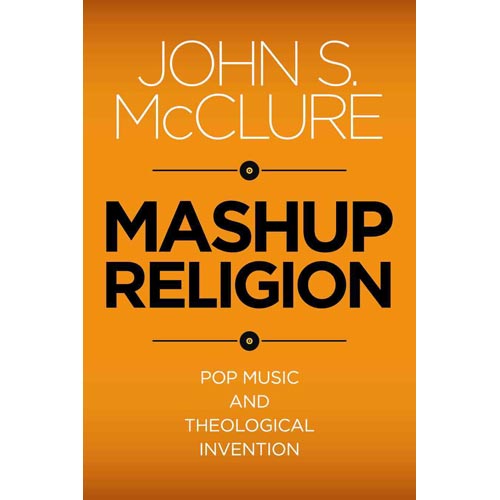
Richard Lindsay reviews John McClure’s new book, Mashup Religion. Check it out after the jump.
It was a bit of kismet that Ryan handed me John S. McClure’s Mashup Religion: Pop Music and Theological Invention to be reviewed just before I headed off to the Academy of Homiletics meeting in Austin, Texas last weekend. McClure is a professor of homiletics at Vanderbilt Divinity School and a deft theorist on the intersection of popular culture, theology, and preaching. Between bouts of reading the book while seated among the eclectic citizens of Austin on the city’s public transportation system, I was able to talk with John during breaks in the conference. On the closing Saturday, we even had a moment to sit down for a brief one-on-one to get the inside scoop on this fascinating new technique for doing theology.
 As a musician and recording studio owner in Nashville (in addition to his “day gig” as a professor) McClure is attuned to the way revolutionary changes in technology have changed the production of music. With computer-based audio editing software, the digital availability of vast libraries of songs, loops, and samples, and the rising popularity of practices like musical mashups (combining songs from different genres using a common beat) songwriting has become a collaborative process of mixture and collage.
In our conversation, McClure contrasts this radical shift in the manipulation of sound-based media to his early days working in music studios: “We were cutting tape with razor blades. Using samples, stretching a sound, or adding beats per minute would have taken days of work. What the average musician has on their home computer is hundreds of times more powerful than the tools a professional producer would have had in the 1960’s.”
In our conversation, McClure pointed out that music recording and theological education have much in common these days, as both are experiencing a “radical decentering of the industry.” Doing music no longer requires the cultural gatekeepers of recording studios and record labels, just as doing theology no longer requires the gatekeepers of seminaries and churches. With this in mind, “There has to be quantum cultural shift that accompanies these changes”— changes in technology and availability of information.
In Mashup Religion, McClure begins with the still-necessary, but familiar to our readers, defense of using popular culture as a text for theological reflection: “For many people in developed nations, the religious life takes place at the intersection between religious traditions, religious or quasi-religious ideologies, and popular culture.” Using Tillich’s language of religion as “ultimate concern,” McClure suggests that music, as an aural and kinesthetic medium, often reaches listeners at a deeper level of ultimate concern than speech. Songwriters in particular have become adept at crystallizing the essential elements of human living— states of love, loneliness, loss, joy, anger, and cycles of death and rebirth. As McClure writes, “For many, the song-maker is a kind of mediator or priest who uses new technologies of recording and mass media to produce meanings, worldviews, and moral soundscapes for our lives.”
McClure’s thesis is that like songwriters, theologians must take cues from changes in technology and learn to “mashup” their writing, teaching, and preaching. McClure spells out a methodology of “tracking” theological writing or preaching along the lines of a four-track recording, including the “tracks” of theology, scripture, culture, and message (which has to do with the arrangement or structure of the theology being presented). Furthermore, he suggests “sampling” or “looping”—a kind of theological bricolage that takes ideas from multiple theological sources and brings them into the mix. Finally, in “mashing up” a theological argument, one may begin to combine contrasting styles of theology—a fundamentalist piece with a liberationist piece, or a neo-orthodox piece with a classic liberal Christian argument. This would also allow for collaboration—more than one contributor working on a single theological piece of writing or teaching. McClure offers case studies of how this process might work in the composition of a sermon, as well as helpful charts and organizational ideas for those of us who have trouble keeping our tracks synced and our loops in line.
Most interesting from our Pop Theology standpoint are some of the ways McClure experiments with this style of doing theology in relation to popular music. He explores the contrasting (progressive/conservative) patriotic theologies of John Mellencamp and Toby Keith. He writes about Johnny Cash’s role as prophetic truth-teller about human troubles of poverty, addiction and crime. He explains Madonna and Sinead O’Connor’s roles as practitioners of an erotic theology of love. He reaches similar conclusions to my review of Eminem about the rapper’s simultaneous talent for capturing a generation’s theology of negation and aggravating tendency to add to that social nihilism through his own homophobic and misogynistic lyrics. In exploring these artists, McClure draws on theologians as wide-ranging as Barth, Tillich, Calvin, Julian of Norwich, Marjorie Suchocki, Tom Beaudoin, and Kelton Cobb.
McClure describes this system of bricolage and appropriation as “post-semiotic,” by which I think he means outside the usual sequential and linguistic structures of theology. I wonder, though, if he has not explored the full implications of what he is proposing in terms of mixture of different forms of media. There is still an assumption in Mashup Religion that theologians will continue with word-based structures of meaning, whether through writing or speaking. This revolution of media and mashup, however, has not just happened in music production. The media are pushing us to compose hybrid constructions of words, sounds, and images. The average YouTube video is more semiotically complex (and more relevant to culture) than most sermons—combining verbal, musical, and visual/filmmaking language into seamless multimedia messages. In this sense, McClure’s book may be a good first step in providing theory behind postmodern development of theological communication. But if the “medium is the message,” the message of theology is going to have to use the media more creatively if it is going to speak to contemporary culture.
Nevertheless, McClure’s book is an exciting and challenging read. I sense in the book and in my conversations with him a mind that is continually exploring the contours of culture, looking to make theology more real and more relevant. McClure is someone who lives and breathes his faith, and is interested in finding theological explanations not just for Jesus Christ, but for Jay-Z and J-Lo. In this regard, those of us who look for spiritual meaning not just in the elevated culture of the church, but in the culture of everyday life, have found a fellow traveler.
For more on Mashup Religion, see John McClure’s Web site: http://mashupreligion.blogspot.com/
Previous Post

November 29, 2011
Dinosaurs, Time Travel, and the Sovereignty of God
Next Post
December 14, 2011 Joss Whedon Call for Papers
Browse Our Archives
Select a Category Classics DVD Film Music News Pop Culture Events Print Sports Television Uncategorized Video Games
Select a Month March 2017 February 2017 January 2017 December 2016 November 2016 October 2016 September 2016 August 2016 July 2016 June 2016 May 2016 April 2016 March 2016 February 2016 January 2016 December 2015 November 2015 October 2015 September 2015 August 2015 July 2015 June 2015 May 2015 April 2015 March 2015 February 2015 January 2015 December 2014 November 2014 October 2014 September 2014 August 2014 July 2014 June 2014 May 2014 April 2014 March 2014 February 2014 January 2014 December 2013 November 2013 October 2013 September 2013 August 2013 July 2013 June 2013 May 2013 April 2013 March 2013 February 2013 January 2013 December 2012 November 2012 October 2012 September 2012 August 2012 July 2012 June 2012 May 2012 April 2012 March 2012 February 2012 January 2012 December 2011 November 2011 October 2011 September 2011 August 2011 July 2011 June 2011 May 2011 April 2011 March 2011 February 2011 January 2011 December 2010 November 2010 October 2010 September 2010 August 2010 July 2010 June 2010 May 2010 April 2010 March 2010 February 2010 January 2010 December 2009 November 2009 October 2009 September 2009 August 2009 July 2009 June 2009 May 2009 April 2009 March 2009 February 2009 January 2009 December 2008 November 2008 October 2008 September 2008 August 2008 July 2008 June 2008 May 2008 April 2008 March 2008 February 2008 January 2008 December 2007 November 2007 October 2007 September 2007 August 2007 July 2007 June 2007 May 2007 April 2007 March 2007
Follow Us!
TAKE THE
Religious Wisdom Quiz
What was Barnabas' original name?
Select your answer to see how you score.
Silas Mark Timothy Joseph
Related posts from Pop Theology


#KillerSerials: An Interview with Kutter Callaway

Book Review: MUSLIMS AND THE MAKING OF AMERICA

TRENDING AT PATHEOS Progressive Christian

Why Christians Have a Sacred Duty to Vote:...
The Bible offers strong support for the sacred duty to vote. Here...

What Being a Modern-Day Apostle Means to Me
In my last column, I discussed the ins and outs of modern-day...

Did Ancient China Once Worship the God of...
Across human history, a common thread weaves through the origins of the...

Love Your Neighbor – Including Earth-Kin: Lev. 19,...
God’s command to love your neighbor means acting in an ethical and...

Lead a Church Study of “Jesus and Lao...
Guest writer Jack Thomas (The Irreverent Reverend) reflects on leading his church...

Principles for Understanding the Apostolic Ministry Today
Whenever people discover that my formal ministry title is "apostle," as in...
view all Progressive Christian blogs
Ad-Free & Subscriber Log-In Subscription Support
- About Us
- 2026 Calendar
- Videos
- Podcasts
- Library of World Religions
- Faith In Media Tracker
- Advertise With Us
- Write for Us
- Privacy Policy
- Terms of Service
- Do Not Sell My Data
- Contact Us
- Radiant Digital
- Manage Newsletter Subscriptions
- Unsubscribe From Notifications
- Sitemap
Copyright 2008-2026, Patheos. All rights reserved.
Subscription Support Ad-Free & Subscriber Log-In
Follow Patheos