
BuddhistCatholicContemplativeEvangelicalGeneral ChristianHinduJewishLatter-day SaintMuslimNew VisionsProgressive Christian
Beliefs
- Buddhist
- Catholic
- Contemplative
- Evangelical
- General Christian
- Hindu
- Jewish
- Latter-day Saint
- More Voices
- Muslim
- New Visions
- Pagan
- Progressive Christian
Topics
- Religion News
- Food and Religion
- Sports and Religion
- Religious Art
- Religious Music and Entertainment
- Religious Events
- History and Religion
- Style and Religion
- Politics and Religion
- Women in Religion
- Recreation Outdoors and Religion
- Business Finance and Religion
- Careers Workplace and Religion
- Education and Religion
- Family Parenting and Religion
- Health Fitness and Religion
- Home and Religion
- Relationships and Religion
- Technology and Religion
- Travel and Religion
Columnists
- Buddhist Columnists
- Business Finance and Religion Columnists
- Careers Workplace and Religion Columnists
- Catholic Columnists
- Contemplative Columnists
- Education and Religion Columnists
- Evangelists Columnists
- Family Parenting and Religion Columnists
- General Christian Columnists
- Health Fitness and Religion Columnists
- Hindu Columnists
- History and Religion Columnists
- Home and Religion Columnists
- Jewish Columnists
- More Voices Columnists
- Latter Day Columnists
- Muslim Columnists
- New Visions Columnists
- Nonreligious Columnists
- Pagan Columnists
- Politics and Religion Columnists
- Progressive Columnists
- Recreation Outdoors and Religion Columnists
- Relationships and Religion Columnists
- Religion News Columnists
- Religious Art Columnists
- Religious Events Columnists
- Religious Music and Entertainment Columnists
- Sports and Religion Columnists
- Style and Religion Columnists
- Technology and Religion Columnists
- Travel and Religion Columnists
- Women in Religion Columnists
Resource Library
- 2026 Calendar
- Library of World Religions
- The 100 Most Holy Places on Earth
- Patheos Answers
- Podcasts
- Videos
- Faith Leaders Database
- Anglican Episcopalian
- Bahai
- Baptist
- Buddhism
- Christianity
- Confucianism
- Eastern Orthodoxy
- Hinduism
- Holiness and Pentecostal
- ISKCON
- Islam
- Judaism
- Lutheran
- Methodist
- The Church of Jesus Christ of Latter-day Saints
- New Age
- Paganism
- Presbytarian and Reformed
- Protestantism
- Religion Behind the Scenes
- Roman Catholic
- Scientology
- Shia Islam
- Sikhism
- Sufism
- Sunni Islam
- Taoism
- Zen
- See all religions
Research Tools
 Ad-Free & Subscriber Log-In Subscription Support
Ad-Free & Subscriber Log-In Subscription Support
Follow Patheos 

- Trending:
- Forgiveness
- |
- Marriage
- |
- Consciousness
- |
- Death Penalty
- |
- Election
- |
- Halloween
 Pop Theology
- Home
- Progressive Christian
- Religious Music & Entertainment
- Faithful Doubt
Faithful Doubt
Last updated on: December 21, 2011 at 9:45 am by J. Ryan Parker
Faithful Doubt 2011-12-21T09:45:36-08:00 J. Ryan Parker
Patheos Explore the world's faith through different perspectives on religion and spirituality! Patheos has the views of the prevalent religions and spiritualities of the world.
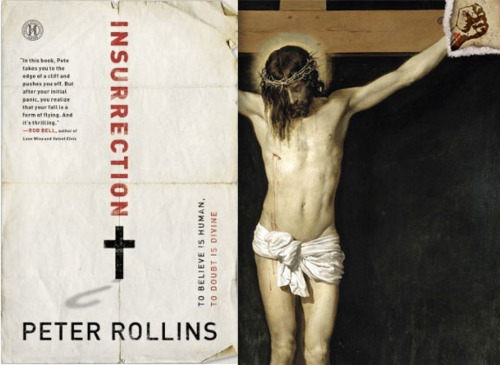
Reading Peter Rollins‘ latest book, Insurrection, is kind of like watching someone dance on a high wire. I don’t say this often (if ever), but Rollins has provided a thrilling work of theology that, while brief, has volumes of implications for the way we think about Christian history, contemporary religious practices, and the future of the church.
In Insurrection, Rollins undertakes what he calls “pyro-theology” in an effort to burn away theological chaff and religion itself. He is introducing us to and calling us toward a post-religious Christian experience. Unlike some of his contemporaries, Rollins is not concerned with getting back to the “glory days” of the Christian faith (if indeed there ever were any). Rollins argues that the church should ever be in flux, responding in love to the time and place in which it finds itself. Attempts to re-enact the “early church,” for example, are flawed because that model was appropriate for that time and place. What Rollins desperately wants his audience to return to and ground their experiences of Christianity in are the two central elements of the Christian story, the Crucifixion and Resurrection of Jesus.
Rollins bemoans the fact that the contemporary church, as most people know it, has de-scandalized the Crucifixion of Jesus and robbed it of one of its key messages. In the Crucifixion, Rollins argues, we have both the death of religion and the absence of God. These are earth-shattering and doubt inducing experiences that most Christians gloss over or rush past to bask in the (re)assurance of Jesus’ Resurrection. Rollins’ assumption of religion, which could certainly be up for debate, is that religion, by nature, cannot co-exist with doubt. As a result, most of our religious communities, in their lived expressions of faith (liturgy, rituals, etc.) do not make space for expressions of doubt, confusion, anger, fear, anxiety, and the like. Rollins boldly claims that the intellectual certainty that some expressions of religion require is antithetical to the message of the Crucifixion, which is itself a moment of doubt and fear. Rollins writes, “It is only when we see the Crucifixion as the moment where God loses everything that we begin to glimpse the true theological significance of the event. What we witness here is a form of atheism: not intellectual […] but a felt loss of God” (21). He continues, “[…A] properly Christological reflection should lead us to see the felt experience of God’s absence as the fundamental way of entering into the presence of God” (24).
 Rollins claims that we cannot rightly understand the Crucifixion without the Resurrection, but at the same time, we cannot understand the latter without the former. As such, the Resurrection is not a white-washing of the Crucifixion or a means by which we simply overcome the fears and pains of life, but a means of living with them. The Resurrection is life- and world-affirming, an invitation to turn towards the world in love, not despite its blemishes but because of them. For it is in the act of loving, Rollins argues, that we experience God, who is not an object to be pursued and obtained but the very act of loving itself. The Crucifixion and Resurrection of Jesus are events that took place over 2,000 years ago, however, they are also events that are present here and now. Rollins asserts that these are ways of being that we are to enact here and now if we are to experience the Kingdom of God and eternal life. Rollins writes, “[…The] New Testament writers are clear that they are not speaking of the prolonging of our present life but rather about our entry into an utterly new mode of life, one that starts right here, right now. Eternal life is thus fundamentally a transformation in the very way that we exist in the present” (111). Part of the beauty and hope of this message is that we are called and allowed to take responsibility for our own actions and for shaping our own destinies and the future of our world.
The parables that Rollins includes at the beginning of each chapter make his book accessible; however, his discussion and arguments require some deeper engagement on the part of the reader. Few books have had me leaning forward in anticipation of where the author was going quite like this one. Rollins moves back and forth between Scripture, Bonhoeffer, and Batman with graceful ease. Insurrection is something that every person of faith (or none at all) should read and re-read. I imagine that Rollins will have his “enemies,” like all prophets do. However, they will most likely come from the ranks of the religious professionals, those fundamentalists, be they liberal or conservative, who benefit from having a firm grasp on truth. Rollins seems to be calling out the liberal theological establishment when he writes about “a new kind of fundamentalism, one that is rarely noticed or talked about […], a fundamentalism that continues to operate in the very place where it is directly ridiculed and rejected” (51).
The implications for enacting Insurrection in our communities of faith are nearly endless because Rollins is not giving us a twelve-step checklist, but is rather calling us to use our imaginations…to think creatively and liberatingly about how we move through our world. He does claim that pastors should endeavor to express doubts, fears, and uncertainties from the pulpit and that churches should employ elements in music and liturgy that allow for expressions of those feelings. What Rollins understands about pop culture that so many churches and ministers fail to grasp is that it is so appealing to so many people because through film,s, television, music, etc., they see their own experiences played out before them. Lady Gaga, for example, is so threatening to the church because these are the spaces that she inhabits with her music.
There are countless questions that remain after reading Insurrection…as there should be. Chief among them would be where we go from here. Other questions center on Christian identity and the necessity of it. One thing is certain, enacting Insurrection is not easy and it will be painful. But for a fearful and broken world, it seems to be one of the most hopeful and healing ways forward.
Here’s a video of Rob Bell talking with Rollins about pyro-theology:
Previous Post

December 19, 2011
A Beautiful Connection to the Past
Next Post
December 29, 2011 Mad Men: Dream Come True TV (Review)
Browse Our Archives
Select a Category Classics DVD Film Music News Pop Culture Events Print Sports Television Uncategorized Video Games
Select a Month March 2017 February 2017 January 2017 December 2016 November 2016 October 2016 September 2016 August 2016 July 2016 June 2016 May 2016 April 2016 March 2016 February 2016 January 2016 December 2015 November 2015 October 2015 September 2015 August 2015 July 2015 June 2015 May 2015 April 2015 March 2015 February 2015 January 2015 December 2014 November 2014 October 2014 September 2014 August 2014 July 2014 June 2014 May 2014 April 2014 March 2014 February 2014 January 2014 December 2013 November 2013 October 2013 September 2013 August 2013 July 2013 June 2013 May 2013 April 2013 March 2013 February 2013 January 2013 December 2012 November 2012 October 2012 September 2012 August 2012 July 2012 June 2012 May 2012 April 2012 March 2012 February 2012 January 2012 December 2011 November 2011 October 2011 September 2011 August 2011 July 2011 June 2011 May 2011 April 2011 March 2011 February 2011 January 2011 December 2010 November 2010 October 2010 September 2010 August 2010 July 2010 June 2010 May 2010 April 2010 March 2010 February 2010 January 2010 December 2009 November 2009 October 2009 September 2009 August 2009 July 2009 June 2009 May 2009 April 2009 March 2009 February 2009 January 2009 December 2008 November 2008 October 2008 September 2008 August 2008 July 2008 June 2008 May 2008 April 2008 March 2008 February 2008 January 2008 December 2007 November 2007 October 2007 September 2007 August 2007 July 2007 June 2007 May 2007 April 2007 March 2007
Follow Us!
TAKE THE
Religious Wisdom Quiz
What is the first book of the Bible?
Select your answer to see how you score.
Matthew Genesis Exodus Psalms
Related posts from Pop Theology


#KillerSerials: An Interview with Kutter Callaway

Book Review: MUSLIMS AND THE MAKING OF AMERICA

TRENDING AT PATHEOS Progressive Christian

Why Christians Have a Sacred Duty to Vote:...
The Bible offers strong support for the sacred duty to vote. Here...

What Being a Modern-Day Apostle Means to Me
In my last column, I discussed the ins and outs of modern-day...

Did Ancient China Once Worship the God of...
Across human history, a common thread weaves through the origins of the...

Love Your Neighbor – Including Earth-Kin: Lev. 19,...
God’s command to love your neighbor means acting in an ethical and...

Lead a Church Study of “Jesus and Lao...
Guest writer Jack Thomas (The Irreverent Reverend) reflects on leading his church...

Principles for Understanding the Apostolic Ministry Today
Whenever people discover that my formal ministry title is "apostle," as in...
view all Progressive Christian blogs
Ad-Free & Subscriber Log-In Subscription Support
- About Us
- 2026 Calendar
- Videos
- Podcasts
- Library of World Religions
- Faith In Media Tracker
- Advertise With Us
- Write for Us
- Privacy Policy
- Terms of Service
- Do Not Sell My Data
- Contact Us
- Radiant Digital
- Manage Newsletter Subscriptions
- Unsubscribe From Notifications
- Sitemap
Copyright 2008-2026, Patheos. All rights reserved.
Subscription Support Ad-Free & Subscriber Log-In
Follow Patheos