
BuddhistCatholicContemplativeEvangelicalGeneral ChristianHinduJewishLatter-day SaintMuslimNew VisionsProgressive Christian
Beliefs
- Buddhist
- Catholic
- Contemplative
- Evangelical
- General Christian
- Hindu
- Jewish
- Latter-day Saint
- More Voices
- Muslim
- New Visions
- Pagan
- Progressive Christian
Topics
- Religion News
- Food and Religion
- Sports and Religion
- Religious Art
- Religious Music and Entertainment
- Religious Events
- History and Religion
- Style and Religion
- Politics and Religion
- Women in Religion
- Recreation Outdoors and Religion
- Business Finance and Religion
- Careers Workplace and Religion
- Education and Religion
- Family Parenting and Religion
- Health Fitness and Religion
- Home and Religion
- Relationships and Religion
- Technology and Religion
- Travel and Religion
Columnists
- Buddhist Columnists
- Business Finance and Religion Columnists
- Careers Workplace and Religion Columnists
- Catholic Columnists
- Contemplative Columnists
- Education and Religion Columnists
- Evangelists Columnists
- Family Parenting and Religion Columnists
- General Christian Columnists
- Health Fitness and Religion Columnists
- Hindu Columnists
- History and Religion Columnists
- Home and Religion Columnists
- Jewish Columnists
- More Voices Columnists
- Latter Day Columnists
- Muslim Columnists
- New Visions Columnists
- Nonreligious Columnists
- Pagan Columnists
- Politics and Religion Columnists
- Progressive Columnists
- Recreation Outdoors and Religion Columnists
- Relationships and Religion Columnists
- Religion News Columnists
- Religious Art Columnists
- Religious Events Columnists
- Religious Music and Entertainment Columnists
- Sports and Religion Columnists
- Style and Religion Columnists
- Technology and Religion Columnists
- Travel and Religion Columnists
- Women in Religion Columnists
Resource Library
- 2026 Calendar
- Library of World Religions
- The 100 Most Holy Places on Earth
- Patheos Answers
- Podcasts
- Videos
- Faith Leaders Database
- Anglican Episcopalian
- Bahai
- Baptist
- Buddhism
- Christianity
- Confucianism
- Eastern Orthodoxy
- Hinduism
- Holiness and Pentecostal
- ISKCON
- Islam
- Judaism
- Lutheran
- Methodist
- The Church of Jesus Christ of Latter-day Saints
- New Age
- Paganism
- Presbytarian and Reformed
- Protestantism
- Religion Behind the Scenes
- Roman Catholic
- Scientology
- Shia Islam
- Sikhism
- Sufism
- Sunni Islam
- Taoism
- Zen
- See all religions
Research Tools
 Ad-Free & Subscriber Log-In Subscription Support
Ad-Free & Subscriber Log-In Subscription Support
Follow Patheos 

- Trending:
- Forgiveness
- |
- Marriage
- |
- Consciousness
- |
- Death Penalty
- |
- Election
- |
- Halloween
 Pop Theology
- Home
- Progressive Christian
- Religious Music & Entertainment
- A Beautiful Connection to the Past
A Beautiful Connection to the Past
Last updated on: December 19, 2011 at 8:42 am by J. Ryan Parker
A Beautiful Connection to the Past 2011-12-19T08:42:48-08:00 J. Ryan Parker
Patheos Explore the world's faith through different perspectives on religion and spirituality! Patheos has the views of the prevalent religions and spiritualities of the world.
Thirty-two thousand years is certainly a difficult length of time for us short-lived creatures to grasp. A central event that helps many people order time, the life of Jesus, only happened just over 2,000 years ago. Yet in his own inimitable way, Werner Herzog connects us with fellow human beings who lived 32,000 years ago in his most recent documentary, Cave of Forgotten Dreams. Though it is an informative look back to a distant time and place, it is simultaneously a timeless, contemplative reflection on the nature of human identity.
In 1994, three independent explorers discovered a cave in southern France, the entrance of which had collapsed some 20,000 years ago keeping both it and its hidden treasures preserved all along. The cave houses some of the oldest, if not the oldest, works of art known to humanity. The prehistoric drawings in Chauvet Cave feature images of bison, mammoths, lions, deer, rhinoceroses, and even a bison/woman hybrid. The cave walls also feature (seemingly) sporadic hand prints throughout its various rooms by an artist with a crooked little finger. Alongside these images lie the bones of various now-extinct animals and beautiful, glittering calcium deposits. Scientists suspect that early humans did not live in the cave but perhaps used it for painting, ritual, or religious purposes. Long-preserved footprints of both humans and animals weave their way throughout the cave. Again, through various dating practices (some of which are under debate), scientists date these drawings to as far back as 32,000 years ago with some of the drawings taking place over 5,000 years apart.
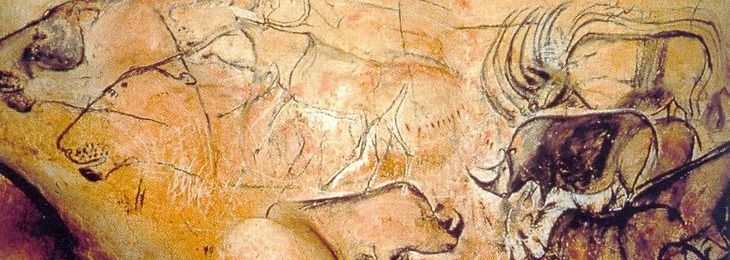
The multiple images of the rhinoceros on the right suggest an attempt to capture movement.
The first striking feature of the Chauvet Cave drawings are their beauty and symmetry, both of which stand in stark contrast to any sort of evolutionary notion of art history. These artists may have been prehistoric, but they were not simple-minded. Second, is the reality that these artists attempted to capture motion in their drawings. An animal with six legs or multiple heads is not some extinct species with which they would have been familiar, but rather an animal running. Herzog refers to these images a proto-cinema. Whatever you call them, they shed light on the intelligence, conscience, experience, and shared meaning among some of our most distant ancestors.
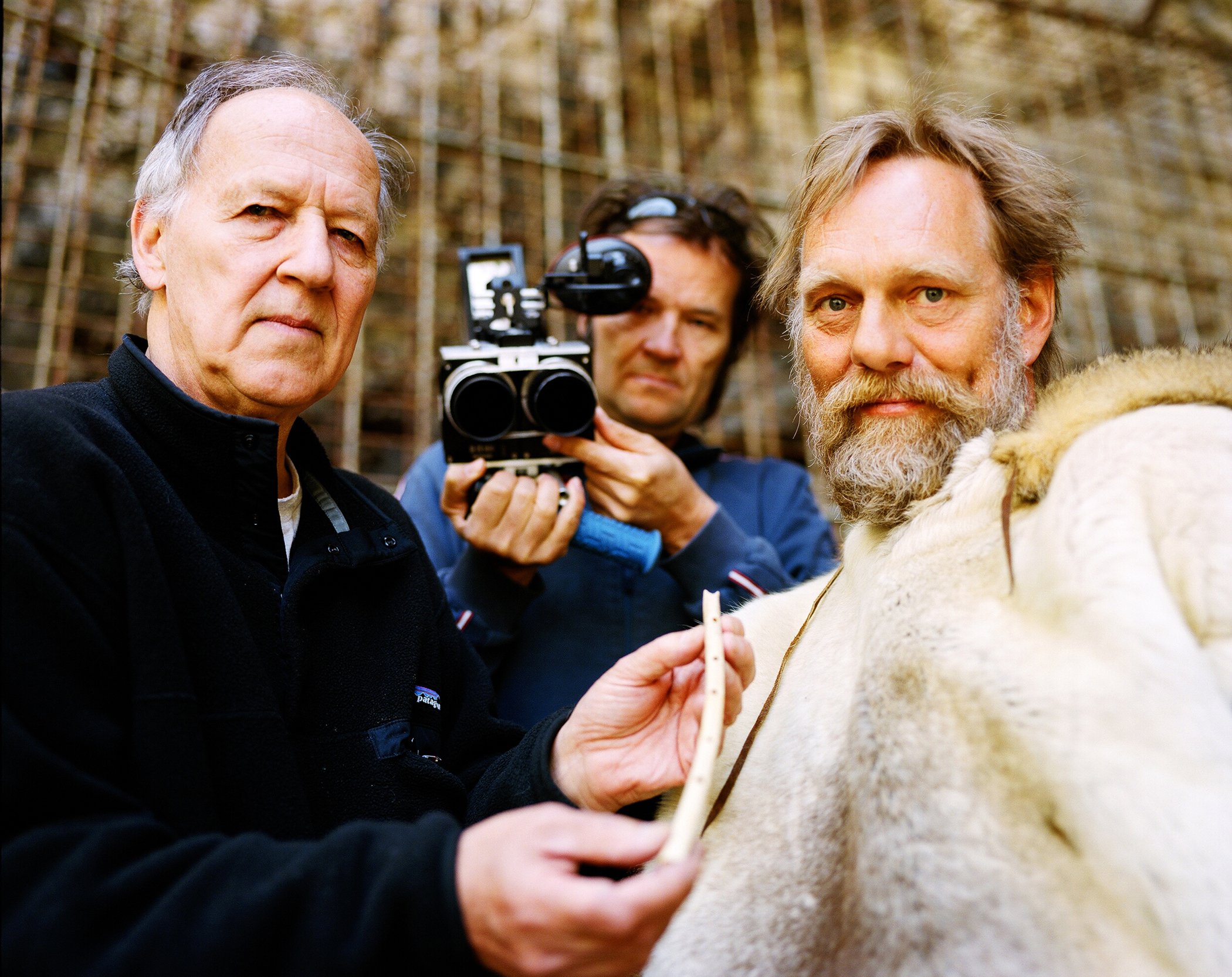
Herzog's (left) documentaries are not immune to his idiosyncracies. Here he is displaying a prehistoric flute alongside an experimental archaeologist.
In conversation with geologists, archaeologists, scientists, and the like, Herzog speculates on what life might have been like for these artists. While certain geographical realities like a glacier-covered Europe (in some places as thick as 2,500 meters) give us an idea of their day to day existence, Herzog is more concerned with the unknowable and hence dwells in a creative agnosticism. These dreams are forgotten after all. What these images do point towards is prehistoric humans with, perhaps, a better understanding of the interconnectedness of all of life than we more evolved iterations of the species could ever have.
In conversation with the documentarian, Jean Clottes, one of the earliest scientists to study the caves, tells Herzog that he feels like homo-sapien (the man who knows) is a far too inadequate description of the human species. Rather, he argues, we might best be described as homo-spiritualis (you define it). He also argues that two things are apparent from his studies of the Chauvet Cave drawings: these prehistoric humans understood fluidity and permeability. That is, distinctions like male and female or person and animal or human and nature or even this world and the spiritual did not matter. Humans could “communicate” with the “other side” and with nature. Hybrid artworks like the partial bison/woman figure at Chauvet point to a blurring of the lines…or a fluidity of life that escapes most of us today. Of course, the spiritual and/or religious assumptions about that time can run in countless directions.
This is the beauty of Herzog’s film…as it is with most of his documentaries…which feels more like a lingering question(s) rather than definitive statements (e.g. Michael Moore‘s documentaries). In often humorous and always sincere ways, Herzog makes a handful of observations and poses a series of questions that inevitably beg more. While he is of course concerned with the Chauvet Cave drawings (and other prehistoric artifacts in surrounding areas), he is pointing his camera at nothing less that the question of what it means to be human, a task for which few filmmakers are as well equipped to undertake as Herzog.
Cave of Forgotten Dreams is as beautiful a film as the drawings on which Herzog focuses. It benefits from cinematography that is as moving and haunting as the score that accompanies it. My only regret is that I missed it in 3D, a version of the film that would have no doubt lent both a sense of size and texture to the cave drawings that I missed out on by watching it at home. The medium of Herzog’s art, film, also opens up questions about the permanence of his work and, by extension, our role as observers in relation to the drawings. With a film as moving as Cave of Forgotten Dreams, one hopes that it has as permanent a place in the history of humanity as the drawings that grace its frames.
Cave of Forgotten Dreams (90 mins.) is available on DVD and streaming on Netflix.
Previous Post

December 16, 2011
Hitchens Gets What's Coming to Him
Next Post
December 21, 2011 Faithful Doubt
Browse Our Archives
Select a Category Classics DVD Film Music News Pop Culture Events Print Sports Television Uncategorized Video Games
Select a Month March 2017 February 2017 January 2017 December 2016 November 2016 October 2016 September 2016 August 2016 July 2016 June 2016 May 2016 April 2016 March 2016 February 2016 January 2016 December 2015 November 2015 October 2015 September 2015 August 2015 July 2015 June 2015 May 2015 April 2015 March 2015 February 2015 January 2015 December 2014 November 2014 October 2014 September 2014 August 2014 July 2014 June 2014 May 2014 April 2014 March 2014 February 2014 January 2014 December 2013 November 2013 October 2013 September 2013 August 2013 July 2013 June 2013 May 2013 April 2013 March 2013 February 2013 January 2013 December 2012 November 2012 October 2012 September 2012 August 2012 July 2012 June 2012 May 2012 April 2012 March 2012 February 2012 January 2012 December 2011 November 2011 October 2011 September 2011 August 2011 July 2011 June 2011 May 2011 April 2011 March 2011 February 2011 January 2011 December 2010 November 2010 October 2010 September 2010 August 2010 July 2010 June 2010 May 2010 April 2010 March 2010 February 2010 January 2010 December 2009 November 2009 October 2009 September 2009 August 2009 July 2009 June 2009 May 2009 April 2009 March 2009 February 2009 January 2009 December 2008 November 2008 October 2008 September 2008 August 2008 July 2008 June 2008 May 2008 April 2008 March 2008 February 2008 January 2008 December 2007 November 2007 October 2007 September 2007 August 2007 July 2007 June 2007 May 2007 April 2007 March 2007
Follow Us!
TAKE THE
Religious Wisdom Quiz
Which king's name appears as an author in Proverbs, apart from Solomon?
Select your answer to see how you score.
Hezekiah Saul Lemuel David
Related posts from Pop Theology


At SXSW2017: May It Last: A Portrait of...

At SXSW 2017: "Untold Tales of Armistead Maupin"
TRENDING AT PATHEOS Progressive Christian

Why Christians Have a Sacred Duty to Vote:...
The Bible offers strong support for the sacred duty to vote. Here...

What Being a Modern-Day Apostle Means to Me
In my last column, I discussed the ins and outs of modern-day...

Did Ancient China Once Worship the God of...
Across human history, a common thread weaves through the origins of the...

Love Your Neighbor – Including Earth-Kin: Lev. 19,...
God’s command to love your neighbor means acting in an ethical and...

Lead a Church Study of “Jesus and Lao...
Guest writer Jack Thomas (The Irreverent Reverend) reflects on leading his church...

Principles for Understanding the Apostolic Ministry Today
Whenever people discover that my formal ministry title is "apostle," as in...
view all Progressive Christian blogs
Ad-Free & Subscriber Log-In Subscription Support
- About Us
- 2026 Calendar
- Videos
- Podcasts
- Library of World Religions
- Faith In Media Tracker
- Advertise With Us
- Write for Us
- Privacy Policy
- Terms of Service
- Do Not Sell My Data
- Contact Us
- Radiant Digital
- Manage Newsletter Subscriptions
- Unsubscribe From Notifications
- Sitemap
Copyright 2008-2026, Patheos. All rights reserved.
Subscription Support Ad-Free & Subscriber Log-In
Follow Patheos