
BuddhistCatholicContemplativeEvangelicalGeneral ChristianHinduJewishLatter-day SaintMuslimNew VisionsProgressive Christian
Beliefs
- Buddhist
- Catholic
- Contemplative
- Evangelical
- General Christian
- Hindu
- Jewish
- Latter-day Saint
- More Voices
- Muslim
- New Visions
- Pagan
- Progressive Christian
Topics
- Religion News
- Food and Religion
- Sports and Religion
- Religious Art
- Religious Music and Entertainment
- Religious Events
- History and Religion
- Style and Religion
- Politics and Religion
- Women in Religion
- Recreation Outdoors and Religion
- Business Finance and Religion
- Careers Workplace and Religion
- Education and Religion
- Family Parenting and Religion
- Health Fitness and Religion
- Home and Religion
- Relationships and Religion
- Technology and Religion
- Travel and Religion
Columnists
- Buddhist Columnists
- Business Finance and Religion Columnists
- Careers Workplace and Religion Columnists
- Catholic Columnists
- Contemplative Columnists
- Education and Religion Columnists
- Evangelists Columnists
- Family Parenting and Religion Columnists
- General Christian Columnists
- Health Fitness and Religion Columnists
- Hindu Columnists
- History and Religion Columnists
- Home and Religion Columnists
- Jewish Columnists
- More Voices Columnists
- Latter Day Columnists
- Muslim Columnists
- New Visions Columnists
- Nonreligious Columnists
- Pagan Columnists
- Politics and Religion Columnists
- Progressive Columnists
- Recreation Outdoors and Religion Columnists
- Relationships and Religion Columnists
- Religion News Columnists
- Religious Art Columnists
- Religious Events Columnists
- Religious Music and Entertainment Columnists
- Sports and Religion Columnists
- Style and Religion Columnists
- Technology and Religion Columnists
- Travel and Religion Columnists
- Women in Religion Columnists
Resource Library
- 2026 Calendar
- Library of World Religions
- The 100 Most Holy Places on Earth
- Patheos Answers
- Podcasts
- Videos
- Faith Leaders Database
- Anglican Episcopalian
- Bahai
- Baptist
- Buddhism
- Christianity
- Confucianism
- Eastern Orthodoxy
- Hinduism
- Holiness and Pentecostal
- ISKCON
- Islam
- Judaism
- Lutheran
- Methodist
- The Church of Jesus Christ of Latter-day Saints
- New Age
- Paganism
- Presbytarian and Reformed
- Protestantism
- Religion Behind the Scenes
- Roman Catholic
- Scientology
- Shia Islam
- Sikhism
- Sufism
- Sunni Islam
- Taoism
- Zen
- See all religions
Research Tools
 Ad-Free & Subscriber Log-In Subscription Support
Ad-Free & Subscriber Log-In Subscription Support
Follow Patheos 

- Trending:
- Forgiveness
- |
- Marriage
- |
- Consciousness
- |
- Death Penalty
- |
- Election
- |
- Halloween
 Pop Theology
- Home
- Progressive Christian
- Religious Music & Entertainment
- Zombies Triumph
Zombies Triumph
Last updated on: November 10, 2011 at 2:11 pm by J. Ryan Parker
Zombies Triumph 2011-11-10T14:11:42-08:00 J. Ryan Parker
Patheos Explore the world's faith through different perspectives on religion and spirituality! Patheos has the views of the prevalent religions and spiritualities of the world.
The Walking Dead has swept across American popular culture like, well, a zombie plague. The comic book is one of the most critically acclaimed series running and the television series that it inspired is one of the most popular on cable television. Scholars of pop culture, history, religion, and hybridizations thereof have taken notice, no doubt to the chagrin of some zombie lovers. The first of, no doubt, many collected essays (I’ll be contributing to a forthcoming collection) recently released. While not the most scholarly collection, James Lowder’s Triumph of the Walking Dead: Robert Kirkman’s Zombie Epic on Page and Screen is full of contributions from die hard walking dead lovers. The essays are, most often, fun(ny) and should spark conversations about both series and the themes they address.
The contributors to Triumph of the Walking Dead cover the series from about every conceivable angle. In a way, the collection reminds me of those critical reactions to Mel Gibson’s The Passion of the Christ like Mel Gibson’s Bible, Re-Viewing The Passion, or After The Passion is Gone, although with less thematic structure. The most entertaining essays come from fans of the series who are creators of zombie content in their own way. Scott Kenemore‘s “A Zombie Among Men” considers the superiority of zombies over humans and how Rick Grimes survives (so well) because he embraces the way of the zombie. Kenemore writes, “For humans to survive in the apocalyptic wasteland, they must become killers–at least of zombies and probably also of other humans. That is, there are no longer any innocents. Nobody who has made it this far has done so without blood on his or her hands” (193). Rick recognizes this more clearly (and quickly) than anyone else.
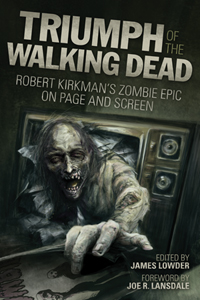 From a pop theology perspective, the most interesting essays cover morality, meaning(lessness), personhood, race and gender, and redemption. In his essay, “Take Me to Your Leader,” Jonathan Maberry examines post-zombie morality through Rick’s position of leadership among the survivors. The most fitting conclusion, it seems, is to abandon all concerns of (im)morality because existence in this world requires amorality. Craig Fischer‘s “Meaninglessness: Cause and Desire in The Birds, Shaun of the Dead, and The Walking Dead,” offers a brief but fairly brilliant comparison of the three. Examining the “cause ” of the apocalyptic events of each film and the comic book series sheds informative light on the others. While they may all be related, in varying ways, to sexual desire, they could just as easily all be meaningless. Fischer makes a great case for Hitchcock’s The Birds as a “proto-zombie film” (69).
Brendan Riley, in “Zombie People: The Complicated Nature of Personhood in The Walking Dead,” argues that the book and television series are so popular (and, by extension, the entire zombie genre) because they provide a perfect avenue through which to discuss personhood, identity, and humanness. Riley draws attention to the “situated nature of our identities” and how they change as we are faced with changing realities (83). In the series, the survivors and zombies represent different states or stages of personhood. In her essay, “No Clean Slate,” Kay Steiger addresses the critiques of The Walking Dead from race and gender perspectives and, while affirming some of them, argues (though perhaps not strongly enough) that Kirkman might be up to something different by employing racist and sexist characters in his zombie narrative. Rather than “affirming” racist or sexist positions, by including them in this post-apocalyptic setting, Kirkman shows how deeply entrenched they are in the human experience. The apocalypse doesn’t, unfortunately, re-set humanity as racism and sexism survive even as the limited number of survivors dwindles on a daily basis. This is yet another explanation for zombie superiority.
Finally, Kim Paffenroth (a co-editor of an upcoming collection of essays on theology and the undead) considers the (potentially) redemptive acts of the survivors in Kirkman’s zombie apocalypse. He argues that Kirkman’s narrative is more optimistic than Romero’s Night of the Living Dead (1968) because, for one reason, family (both nuclear and extended) plays a more morally valuable role in the former. Love, against all odds and often fleeting but never futile, serves powerful, salvific roles in Kirkman’s series.
Triumph of the Walking Dead includes a handful of other essays that cover the series from perspectives on comic book history, violence, novel writing, science, mythology, and objectivism. This is no meaty text, but there is enough meat here to whet a zombie lover’s appetite and to spark conversations about these important themes. The contributors do prove that zombie narratives, and especially The Walking Dead, deserve our critical attention and have much to contribute to our parallel “real world” discussions of life-giving…and life-draining…issues.
Previous Post

November 1, 2011
A Paranormal Reading Experience
Next Post
November 23, 2011 Intelligent Zombies
Browse Our Archives
Select a Category Classics DVD Film Music News Pop Culture Events Print Sports Television Uncategorized Video Games
Select a Month March 2017 February 2017 January 2017 December 2016 November 2016 October 2016 September 2016 August 2016 July 2016 June 2016 May 2016 April 2016 March 2016 February 2016 January 2016 December 2015 November 2015 October 2015 September 2015 August 2015 July 2015 June 2015 May 2015 April 2015 March 2015 February 2015 January 2015 December 2014 November 2014 October 2014 September 2014 August 2014 July 2014 June 2014 May 2014 April 2014 March 2014 February 2014 January 2014 December 2013 November 2013 October 2013 September 2013 August 2013 July 2013 June 2013 May 2013 April 2013 March 2013 February 2013 January 2013 December 2012 November 2012 October 2012 September 2012 August 2012 July 2012 June 2012 May 2012 April 2012 March 2012 February 2012 January 2012 December 2011 November 2011 October 2011 September 2011 August 2011 July 2011 June 2011 May 2011 April 2011 March 2011 February 2011 January 2011 December 2010 November 2010 October 2010 September 2010 August 2010 July 2010 June 2010 May 2010 April 2010 March 2010 February 2010 January 2010 December 2009 November 2009 October 2009 September 2009 August 2009 July 2009 June 2009 May 2009 April 2009 March 2009 February 2009 January 2009 December 2008 November 2008 October 2008 September 2008 August 2008 July 2008 June 2008 May 2008 April 2008 March 2008 February 2008 January 2008 December 2007 November 2007 October 2007 September 2007 August 2007 July 2007 June 2007 May 2007 April 2007 March 2007
Follow Us!
TAKE THE
Religious Wisdom Quiz
Who said, "Choose for yourselves this day whom you will serve"?
Select your answer to see how you score.
Solomon Joshua Gideon Moses
Related posts from Pop Theology


#KillerSerials: An Interview with Kutter Callaway

Book Review: MUSLIMS AND THE MAKING OF AMERICA

TRENDING AT PATHEOS Progressive Christian

Why Christians Have a Sacred Duty to Vote:...
The Bible offers strong support for the sacred duty to vote. Here...

What Being a Modern-Day Apostle Means to Me
In my last column, I discussed the ins and outs of modern-day...

Did Ancient China Once Worship the God of...
Across human history, a common thread weaves through the origins of the...

Love Your Neighbor – Including Earth-Kin: Lev. 19,...
God’s command to love your neighbor means acting in an ethical and...

Lead a Church Study of “Jesus and Lao...
Guest writer Jack Thomas (The Irreverent Reverend) reflects on leading his church...

Principles for Understanding the Apostolic Ministry Today
Whenever people discover that my formal ministry title is "apostle," as in...
view all Progressive Christian blogs
Ad-Free & Subscriber Log-In Subscription Support
- About Us
- 2026 Calendar
- Videos
- Podcasts
- Library of World Religions
- Faith In Media Tracker
- Advertise With Us
- Write for Us
- Privacy Policy
- Terms of Service
- Do Not Sell My Data
- Contact Us
- Radiant Digital
- Manage Newsletter Subscriptions
- Unsubscribe From Notifications
- Sitemap
Copyright 2008-2026, Patheos. All rights reserved.
Subscription Support Ad-Free & Subscriber Log-In
Follow Patheos