
BuddhistCatholicContemplativeEvangelicalGeneral ChristianHinduJewishLatter-day SaintMuslimNew VisionsProgressive Christian
Beliefs
- Buddhist
- Catholic
- Contemplative
- Evangelical
- General Christian
- Hindu
- Jewish
- Latter-day Saint
- More Voices
- Muslim
- New Visions
- Pagan
- Progressive Christian
Topics
- Religion News
- Food and Religion
- Sports and Religion
- Religious Art
- Religious Music and Entertainment
- Religious Events
- History and Religion
- Style and Religion
- Politics and Religion
- Women in Religion
- Recreation Outdoors and Religion
- Business Finance and Religion
- Careers Workplace and Religion
- Education and Religion
- Family Parenting and Religion
- Health Fitness and Religion
- Home and Religion
- Relationships and Religion
- Technology and Religion
- Travel and Religion
Columnists
- Buddhist Columnists
- Business Finance and Religion Columnists
- Careers Workplace and Religion Columnists
- Catholic Columnists
- Contemplative Columnists
- Education and Religion Columnists
- Evangelists Columnists
- Family Parenting and Religion Columnists
- General Christian Columnists
- Health Fitness and Religion Columnists
- Hindu Columnists
- History and Religion Columnists
- Home and Religion Columnists
- Jewish Columnists
- More Voices Columnists
- Latter Day Columnists
- Muslim Columnists
- New Visions Columnists
- Nonreligious Columnists
- Pagan Columnists
- Politics and Religion Columnists
- Progressive Columnists
- Recreation Outdoors and Religion Columnists
- Relationships and Religion Columnists
- Religion News Columnists
- Religious Art Columnists
- Religious Events Columnists
- Religious Music and Entertainment Columnists
- Sports and Religion Columnists
- Style and Religion Columnists
- Technology and Religion Columnists
- Travel and Religion Columnists
- Women in Religion Columnists
Resource Library
- 2026 Calendar
- Library of World Religions
- The 100 Most Holy Places on Earth
- Patheos Answers
- Podcasts
- Videos
- Faith Leaders Database
- Anglican Episcopalian
- Bahai
- Baptist
- Buddhism
- Christianity
- Confucianism
- Eastern Orthodoxy
- Hinduism
- Holiness and Pentecostal
- ISKCON
- Islam
- Judaism
- Lutheran
- Methodist
- The Church of Jesus Christ of Latter-day Saints
- New Age
- Paganism
- Presbytarian and Reformed
- Protestantism
- Religion Behind the Scenes
- Roman Catholic
- Scientology
- Shia Islam
- Sikhism
- Sufism
- Sunni Islam
- Taoism
- Zen
- See all religions
Research Tools
 Ad-Free & Subscriber Log-In Subscription Support
Ad-Free & Subscriber Log-In Subscription Support
Follow Patheos 

- Trending:
- Forgiveness
- |
- Marriage
- |
- Consciousness
- |
- Death Penalty
- |
- Election
- |
- Halloween
 Pop Theology
- Home
- Progressive Christian
- Religious Music & Entertainment
- A Paranormal Reading Experience
A Paranormal Reading Experience
Last updated on: November 1, 2011 at 8:16 am by J. Ryan Parker
A Paranormal Reading Experience 2011-11-01T08:16:36-07:00 J. Ryan Parker
Patheos Explore the world's faith through different perspectives on religion and spirituality! Patheos has the views of the prevalent religions and spiritualities of the world.
“If you are not really confused by now, you have not been paying very close attention.” So says Jeffrey J. Kripal towards the end of his new book, Mutants & Mystics: Science Fiction, Superhero Comics, and the Paranormal. Now I’ve never taken psychedelic drugs of any kind, but I would imagine that being on them is just a heightened sense of what it’s like to read Kripal’s book. It’s been a long time since I’ve read something as informative and challenging as this. Through Mutants & Mystics, Kripal has, at least, succeeded in getting me to view the paranormal, or the potential for it, in a whole new light.I was asked to read Mutants & Mystics as part of Patheos’ on-going book club. I probably would’ve read it anyway given its superhero focus. Kripal shared his intentions for writing the book with potential book club participants, and I think it is important to share part of them here. He says:
One of my concerns here is that the book will be read and presented as a historical reflection on religion and pop culture, when it is really about deep metaphysical issues and religious questions as these are addressed through pop culture. […My] authors and artists (and I through them) make [strong claims] about the nature of consciousness, the imagination, the paranormal, the nature of time, etc. What I am really going after here is “materialism” and “scientism.”
Readers can definitely think of Mutants and Mystics as a history of religion and popular culture, but to simply stop there would be doing the book and the reader a great disservice. In his book, Kripal shows how religious, paranormal, and mystical experiences that span centuries influence the creators of some of the most celebrated sci-fi and superhero comic series in history. At the same time, however, he demands that the reader take these events seriously (no easy task) in order to ask tough questions about reality and the (im)possible. What Kripal uncovers, broadly speaking, is a Super-Story composed of seven mythemes that organize these writers’ and artists’ experiences, the sci-fi and comic series they create, and, to an extent, our own experiences.
Kripal’s seven mythemes (which find parallels in other myth studies) include Divinization/Demonization, Orientation, Alienation, Radiation, Mutation, Realization, and Authorization. I’ll try to sum these up as quickly as possible. Divinization/Demonization is the process by which mythology and religion order society through belief systems, narratives, morals, etc. Orientation is the process by which humans make sense of that relationship, most often through the creation of “somewhere else,” i.e. heaven, hell, parallel universes, or a galaxy far, far away. Alienation, as a result of modern science, has given the “lie” to many of those stories. Radiation is the recognition of the “cosmic potential of matter itself,” which can either liberate or destroy us. Mutation is the awareness of the evolutionary nature of all of life and that humanity itself is “a transitional or temporary form.” Realization is the act of recognizing that this process of evolution is being authored by external forces (culture, family, faith, etc.). For Kripal this might also involve the awareness of paranormal influences as well. Finally, Authorization is the process by which we take control of our story and begin writing it ourselves. These aren’t necessarily a progressive series of events but weave in and around and through each other. At least I think this is what Kripal has set out for us…I’m still trying to work it all out.
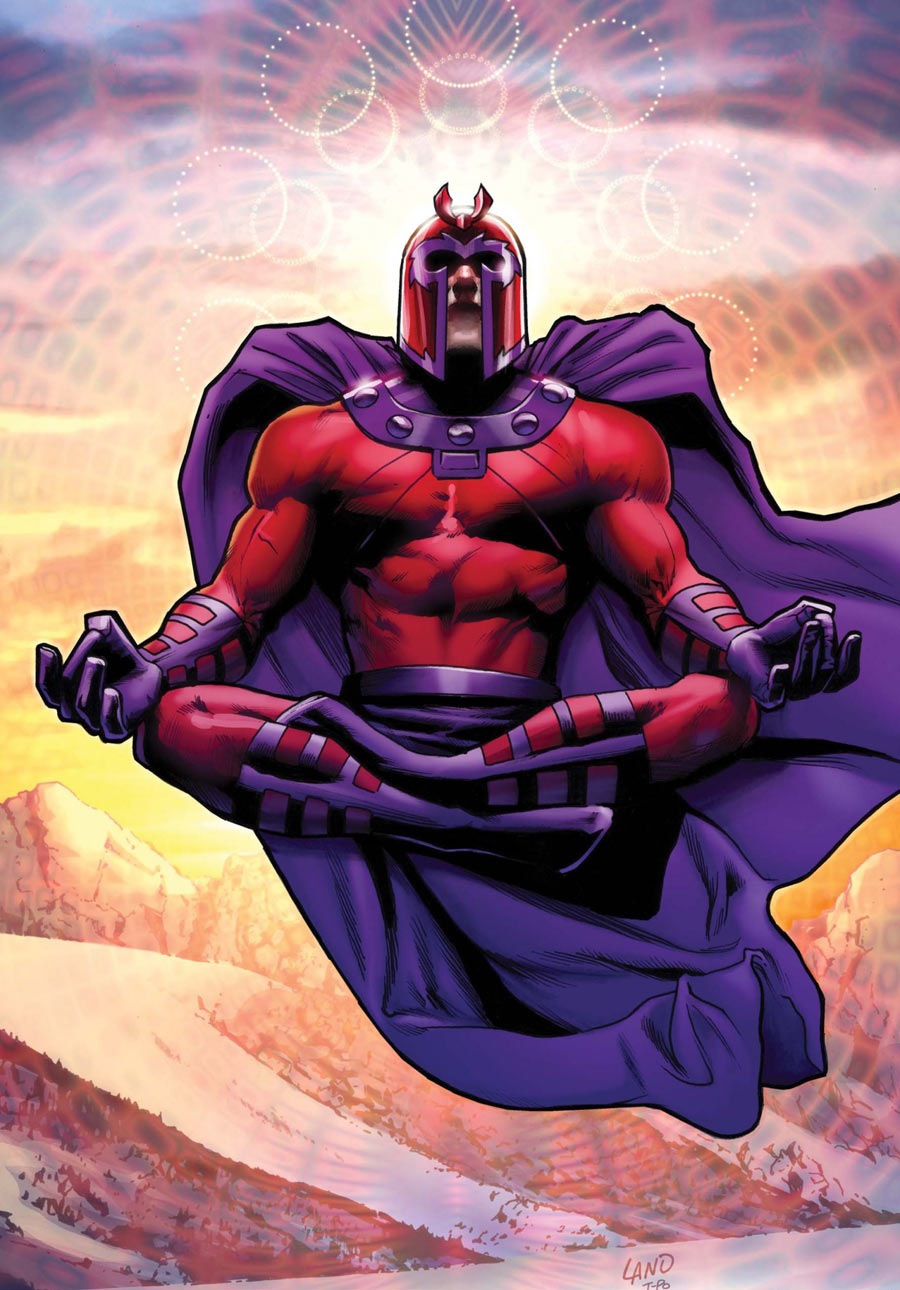
Few images reveal the influence of mysticism on contemporary popular culture as this image of a meditating Magneto from The Uncanny X-Men.
For the purpose of this response, I am particularly interested in three elements of Kirpal’s work, Realization, Authorization, and his willingness to take seriously events that so many people often dismiss as crazy, all of which have implications for communities of faith and individual believers. Many of us have experienced moments of Realization or Authorization in our own lives, albeit in less paranormal fashion than many of Kripal’s subjects. We know those moments of finding out what we have been told all our lives is simply not true. We know what it is like to be controlled by family, friends, religion, advertising, or the government. The question that Kripal implicitly asks us to consider is what to do when we experience those moments. How do we break free from those controlling forces? How do we, with integrity, live and write our own stories? In other words, how do we practice Kripal’s act of Authorization?
Kripal’s Super-Story got me to thinking about Christianity and how it can provide an alternate story to free us from the stories that imprison us here and now. At its best, Christianity has frequently done this. At its worst, however, it has proven to be the very force that imprisons people. Kripal writes, “[…You] can’t think yourself out of the story you are caught in with the rules and elements of the very story in which you are caught. You can’t free yourself with the tools that the master provides you. You need a new story and new cognitive tools” (263). What are the tools that Christianity provides us to free ourselves from controlling narratives? What are the tools that Christianity provides others to craft dominating narratives?
In Mutants & Mystics, Kripal takes seriously often derided media and the experiences that have inspired them. Writers and artists like Ray Palmer, Jack Kirby, Alan Moore, Barry Windsor-Smith, and Philip K. Dick have had unfathomable, inimitable influences on our popular culture. They’ve each had some pretty incredible experiences from remote viewing to alien abduction to visions of the future. For these artists, science fiction and comic books have been the most effective means of sharing these experiences. That they have such devoted followers reveals both their success in conveying those experiences and the effectiveness of the media in transmitting them. Kripal argues:
But just because something is encountered through the imagery of bad movies or sappy religious art does not mean that what is being encountered is a bad movie or a pious painting; it might simply mean that all religious experience is culturally conditioned, and that the human imagination often draws on the most immediate, not to mention the most colorful, to paint and frame an encounter with the sacred. (81)
At the same time, Kripal’s study calls into question his writers and artists’ experiences of psychedelic drug use, alien abduction, remote viewing and other mystical experiences. Kripal maintains that traumatic experiences, alien abduction, or psychedelic drugs use, for example, are not the experiences on which we should focus. Rather, we should consider the possibility that they create the conditions through which the victim or user becomes more open to a deeper reality behind everyday “normal” experiences. In the end, Kripal sympathizes with his subjects: “It seems important to point out that any scientific explanation of something like remote viewing must, in principle, remain an abstract, third-order account of what are, in the end, deeply personal, often fantastically meaningful states of consciousness.” (199)
Mutants & Mystics demands a particularly open-minded audience, much like the paranormal probably does. Readers who have a fixed worldview or a dogmatic hold on the way things work need not apply. Other readers who are quick to denounce people who confess to paranormal or mystical experiences as crazy should stay away too. Kripal’s best audience is one that suspects that there is more to our experience than what we see, feel, or do every day…that suspects that the truth is out there and that it is bigger, and crazier, than we can imagine. Ironically, it seems as if a Christian, or religious, audience would be the most appropriate, although I imagine that many religious readers will denounce or roll their eyes at Kripal, much like they have done with the writers and artists about which he writes.
One of Kripal’s most interesting points in Mutants & Mystics is showing how both religious and non-religious critics reject the paranormal claims of the writers and artists that he discusses. An open engagement with them is, Kripal argues, “completely impossible within our present mirrored cultures of religious fundamentalism and scientific materialism, which appear oddly united in their ferocious “damning” of the paranormal” (330). Another strength of Kripal’s book is that he takes his subject(s) seriously, but not too seriously. He is humorous but not disrespectful, sometimes skeptical but never dismissive. Fans of comics and sci-fi will no doubt be thrilled and intrigued by Kripal’s findings. Readers only slightly interested in the subject matter, be they religious or not, will certainly have their minds expanded or, if they’re lucky, completely blown away.
Mutants & Mystics (376 pages, University of Chicago Press) releases on Tuesday, November 15, in a stunning hardback version complete with full-color illustrations.
For more from Jeffrey J. Kripal and other discussions on Mutants & Mystics, visit the Patheos book club.
Previous Post

October 31, 2011
Tebowing Tebow
Next Post
November 10, 2011 Zombies Triumph
Browse Our Archives
Select a Category Classics DVD Film Music News Pop Culture Events Print Sports Television Uncategorized Video Games
Select a Month March 2017 February 2017 January 2017 December 2016 November 2016 October 2016 September 2016 August 2016 July 2016 June 2016 May 2016 April 2016 March 2016 February 2016 January 2016 December 2015 November 2015 October 2015 September 2015 August 2015 July 2015 June 2015 May 2015 April 2015 March 2015 February 2015 January 2015 December 2014 November 2014 October 2014 September 2014 August 2014 July 2014 June 2014 May 2014 April 2014 March 2014 February 2014 January 2014 December 2013 November 2013 October 2013 September 2013 August 2013 July 2013 June 2013 May 2013 April 2013 March 2013 February 2013 January 2013 December 2012 November 2012 October 2012 September 2012 August 2012 July 2012 June 2012 May 2012 April 2012 March 2012 February 2012 January 2012 December 2011 November 2011 October 2011 September 2011 August 2011 July 2011 June 2011 May 2011 April 2011 March 2011 February 2011 January 2011 December 2010 November 2010 October 2010 September 2010 August 2010 July 2010 June 2010 May 2010 April 2010 March 2010 February 2010 January 2010 December 2009 November 2009 October 2009 September 2009 August 2009 July 2009 June 2009 May 2009 April 2009 March 2009 February 2009 January 2009 December 2008 November 2008 October 2008 September 2008 August 2008 July 2008 June 2008 May 2008 April 2008 March 2008 February 2008 January 2008 December 2007 November 2007 October 2007 September 2007 August 2007 July 2007 June 2007 May 2007 April 2007 March 2007
Follow Us!
TAKE THE
Religious Wisdom Quiz
Who predicted the fall of Jerusalem?
Select your answer to see how you score.
Jesus Isaiah Jeremiah Daniel
Related posts from Pop Theology


#KillerSerials: An Interview with Kutter Callaway

Book Review: MUSLIMS AND THE MAKING OF AMERICA

TRENDING AT PATHEOS Progressive Christian

Why Christians Have a Sacred Duty to Vote:...
The Bible offers strong support for the sacred duty to vote. Here...

What Being a Modern-Day Apostle Means to Me
In my last column, I discussed the ins and outs of modern-day...

Did Ancient China Once Worship the God of...
Across human history, a common thread weaves through the origins of the...

Love Your Neighbor – Including Earth-Kin: Lev. 19,...
God’s command to love your neighbor means acting in an ethical and...

Lead a Church Study of “Jesus and Lao...
Guest writer Jack Thomas (The Irreverent Reverend) reflects on leading his church...

Principles for Understanding the Apostolic Ministry Today
Whenever people discover that my formal ministry title is "apostle," as in...
view all Progressive Christian blogs
Ad-Free & Subscriber Log-In Subscription Support
- About Us
- 2026 Calendar
- Videos
- Podcasts
- Library of World Religions
- Faith In Media Tracker
- Advertise With Us
- Write for Us
- Privacy Policy
- Terms of Service
- Do Not Sell My Data
- Contact Us
- Radiant Digital
- Manage Newsletter Subscriptions
- Unsubscribe From Notifications
- Sitemap
Copyright 2008-2026, Patheos. All rights reserved.
Subscription Support Ad-Free & Subscriber Log-In
Follow Patheos