
BuddhistCatholicContemplativeEvangelicalGeneral ChristianHinduJewishLatter-day SaintMuslimNew VisionsProgressive Christian
Beliefs
- Buddhist
- Catholic
- Contemplative
- Evangelical
- General Christian
- Hindu
- Jewish
- Latter-day Saint
- More Voices
- Muslim
- New Visions
- Pagan
- Progressive Christian
Topics
- Religion News
- Food and Religion
- Sports and Religion
- Religious Art
- Religious Music and Entertainment
- Religious Events
- History and Religion
- Style and Religion
- Politics and Religion
- Women in Religion
- Recreation Outdoors and Religion
- Business Finance and Religion
- Careers Workplace and Religion
- Education and Religion
- Family Parenting and Religion
- Health Fitness and Religion
- Home and Religion
- Relationships and Religion
- Technology and Religion
- Travel and Religion
Columnists
- Buddhist Columnists
- Business Finance and Religion Columnists
- Careers Workplace and Religion Columnists
- Catholic Columnists
- Contemplative Columnists
- Education and Religion Columnists
- Evangelists Columnists
- Family Parenting and Religion Columnists
- General Christian Columnists
- Health Fitness and Religion Columnists
- Hindu Columnists
- History and Religion Columnists
- Home and Religion Columnists
- Jewish Columnists
- More Voices Columnists
- Latter Day Columnists
- Muslim Columnists
- New Visions Columnists
- Nonreligious Columnists
- Pagan Columnists
- Politics and Religion Columnists
- Progressive Columnists
- Recreation Outdoors and Religion Columnists
- Relationships and Religion Columnists
- Religion News Columnists
- Religious Art Columnists
- Religious Events Columnists
- Religious Music and Entertainment Columnists
- Sports and Religion Columnists
- Style and Religion Columnists
- Technology and Religion Columnists
- Travel and Religion Columnists
- Women in Religion Columnists
Resource Library
- 2026 Calendar
- Library of World Religions
- The 100 Most Holy Places on Earth
- Patheos Answers
- Podcasts
- Videos
- Faith Leaders Database
- Anglican Episcopalian
- Bahai
- Baptist
- Buddhism
- Christianity
- Confucianism
- Eastern Orthodoxy
- Hinduism
- Holiness and Pentecostal
- ISKCON
- Islam
- Judaism
- Lutheran
- Methodist
- The Church of Jesus Christ of Latter-day Saints
- New Age
- Paganism
- Presbytarian and Reformed
- Protestantism
- Religion Behind the Scenes
- Roman Catholic
- Scientology
- Shia Islam
- Sikhism
- Sufism
- Sunni Islam
- Taoism
- Zen
- See all religions
Research Tools
 Ad-Free & Subscriber Log-In Subscription Support
Ad-Free & Subscriber Log-In Subscription Support
Follow Patheos 

- Trending:
- Forgiveness
- |
- Marriage
- |
- Consciousness
- |
- Death Penalty
- |
- Election
- |
- Halloween
 Pop Theology
- Home
- Progressive Christian
- Religious Music & Entertainment
- A Horrific Past
A Horrific Past
Last updated on: October 17, 2011 at 8:12 am by J. Ryan Parker
A Horrific Past 2011-10-17T08:12:42-07:00 J. Ryan Parker
Patheos Explore the world's faith through different perspectives on religion and spirituality! Patheos has the views of the prevalent religions and spiritualities of the world.
Numerous scholars explore the cultural and political implications of monster and horror films for the times from which they emerge. Through these analyses, we gain insight into seemingly distant pasts that are actually not that far removed from our own experiences now. Few scholars connect such implications across broader expanses of time to reveal how intrinsically monsters and the horrific have been bound up in the history of America. Even fewer scholars do so as adeptly and as entertainingly as W. Scott Poole in his new book, Monsters in America: Our Historical Obsession With the Hideous and the Haunting (Baylor University Press, 2011).
Just to get it out of the way, I’ll state the only “drawback” to Monsters in America. Poole knows that America(ns) didn’t invent monsters out of the blue and occasionally references their broader historical origins. My only complaint is that he doesn’t point to the breadth of that history more frequently. Of course, doing so would have distracted from his American focus. Again, this is my only “complaint” about what is an otherwise phenomenal work. In Monsters in America, Poole has provided readers, be they history or horror buffs, with what should be a foundational text for the study of both.
Without being overly cynical or too depressing, Poole argues that the history of America is one of unthinkable horror. It is hard to disagree considering the treatment of Native Americans, witch hunts, the Civil War, slavery, Jim Crow, McCarthyism, wars, and the list goes on and on. Poole writes:
The American past reads like something of a horror movie, maybe even a low-budget slasher. American history comes at us dripping with gore, victims lying scattered on the ground, eldritch moonlight revealing creeping horrors you never learned form your eighth grade history textbook. (22)
Poole claims that the oppressor and the oppressed, throughout American history, employ the monster to either justify or cope with the violence that they enact or endure. The most clear cut example is the relationship between master and slave, each viewing the other as a beast (monster) to either be conquered or feared.
Poole also shows, throughout his text, how Americans have used monsters to cope with changing socio-political realities. His approach is nearly exhaustive and includes, to name a few,
- early settlers fearing cannibalism and sexual violence among Native Americans
- witch hunts as a source of entertainment and control
- monsters as theological “enemies” necessary for a country to overcome in order to fulfill its theological destiny
- the role of the Gothic in coping with changing economic and commercial conditions
- the importance of Frankenstein at a variety of stages from the Industrial Revolution to physical damages of war to our own biomedical future
- the use of monsters to define and police respectable behavior (especially sexuality)
- atomic fears bound up in alien invasions or radioactive monsters
- body snatchers and the like and the fear of communism
- the relocation of the monster from the “exterior” to the “interior” (so to speak) and the rise of the slasher/serial killer film
- the use of slasher films as a means to negotiate the sexual revolution and the growing disillusionment over institutions from family to church to law enforcement
- the relationship between horror and the rise of the Religious Right and the ironic re-affirmation of family values
- our obsession with the body (diets, plastic surgery, and the like) and our techno/medical future.
This list just begins to scratch the surface of what Poole offers in Monsters in America. Though I could continue adding to this list, doing so would distract from the brilliant ways in which Poole weaves these events and themes together throughout American history. In doing so, he notes commonalities between both monsters and the ways in which Americans have used them. Not surprising, the similarities are often bound up with race, gender, sexuality, marginalization, religion and a host of other potentially divisive monstrous markers.
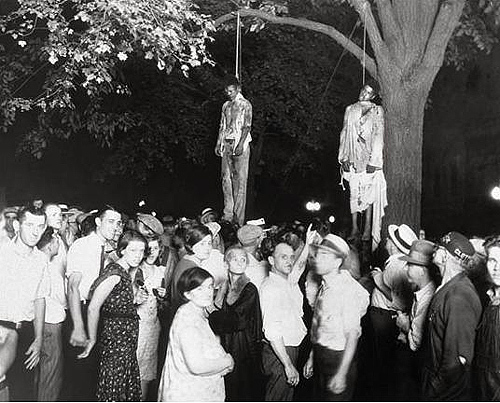
Lynching as horror and entertainment.
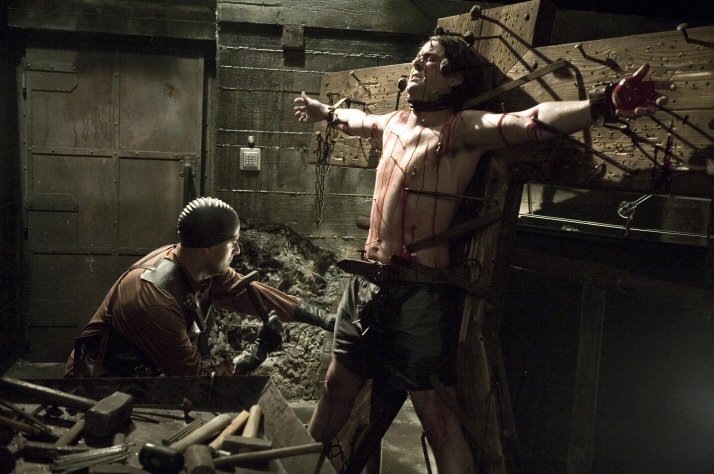
The strength of Poole’s work is his assertion that works of horror (be they books, films, or television programs) are more than escapist media. Furthermore, their connection to American history…to real, lived events…is more than coincidental or tenuous. Poole writes, “The tendency to view American monsters as primarily psychological archetypes ignores how closely they have reflected actual historical events and actual historical victims” (107). Poole also resists the temptation to follow a strict historical progression, even though he loosely moves from one decade or generation to the next. In contrast, he frequently jumps back and forth between eras of American history revealing that the horrors of slavery, for example, and the ways in which the victims and violators coped with them, are with us yet and, perhaps, always will be. Lest we bemoan the evil “recent” emergence of torture porn (the Hostel and Saw series, for example), Poole reminds us of lynching/execution films that both entertained audiences and informed them of racial hierarchies in the early 1900s. As a result, horror films reveal parts of our past and present that many of us might prefer stay hidden. On the other hand, some horror films subvert or critique the often equally horrific American past. Poole writes, “The slasher became one of the most subversive American film genres. Previous horror films had used the monstrous to picture the marginalized. Increasingly, horror imagined normalcy as the truly monstrous” (155). In his approach to these texts, Poole provides the necessary complex reading that they deserve.
So a few questions emerge, specifically for Christian…or religious…readers. What roles do monsters play…or what places do they have…in our communities of faith? In what ways do we perpetuate their existence? How do we respond to horror (both films and reality)? Remember, as Poole writes, “Monsters cannot be treated and rehabilitated, only destroyed” (151). In what ways do congregations use monsters to deflect attention from their own faults or shortcomings? Or, as Todd Snider says, “If you’re the one pointing the finger, chances are, nobody’s looking at you.” Finally, how do monsters influence our theologies, even as they draw so freely from traditional theology? That both theological education and congregations often avoid horror films and the like for a variety of reasons is, as Poole shows, an unfortunate act of cultural negligence that must be addressed.
In the end, Poole does not define what a “monster” is because it simply cannot be defined. He shows how it/they are multivalent, changing with each generation…and perhaps, now, even faster. However, at the end of the day (or at least the end of his book), it’s difficult not to see that the monster is, more often than not, us.
N.B.: Anyone as vehemently opposed to the Twilight saga as Poole is is alright with me.
For more conversation – and an interview with Scott Poole – check out the Patheos Book Club this month.
Previous Post

October 7, 2011
A Real Human Being?
Next Post
October 17, 2011 Sherwood's Best Yet...With Qualifications
Browse Our Archives
Select a Category Classics DVD Film Music News Pop Culture Events Print Sports Television Uncategorized Video Games
Select a Month March 2017 February 2017 January 2017 December 2016 November 2016 October 2016 September 2016 August 2016 July 2016 June 2016 May 2016 April 2016 March 2016 February 2016 January 2016 December 2015 November 2015 October 2015 September 2015 August 2015 July 2015 June 2015 May 2015 April 2015 March 2015 February 2015 January 2015 December 2014 November 2014 October 2014 September 2014 August 2014 July 2014 June 2014 May 2014 April 2014 March 2014 February 2014 January 2014 December 2013 November 2013 October 2013 September 2013 August 2013 July 2013 June 2013 May 2013 April 2013 March 2013 February 2013 January 2013 December 2012 November 2012 October 2012 September 2012 August 2012 July 2012 June 2012 May 2012 April 2012 March 2012 February 2012 January 2012 December 2011 November 2011 October 2011 September 2011 August 2011 July 2011 June 2011 May 2011 April 2011 March 2011 February 2011 January 2011 December 2010 November 2010 October 2010 September 2010 August 2010 July 2010 June 2010 May 2010 April 2010 March 2010 February 2010 January 2010 December 2009 November 2009 October 2009 September 2009 August 2009 July 2009 June 2009 May 2009 April 2009 March 2009 February 2009 January 2009 December 2008 November 2008 October 2008 September 2008 August 2008 July 2008 June 2008 May 2008 April 2008 March 2008 February 2008 January 2008 December 2007 November 2007 October 2007 September 2007 August 2007 July 2007 June 2007 May 2007 April 2007 March 2007
Follow Us!
TAKE THE
Religious Wisdom Quiz
An angel appeared to a priest burning incense in the temple, announcing his wife would bear a son despite her old age. Who was this priest?
Select your answer to see how you score.
Joseph Eli Zechariah Simeon
Related posts from Pop Theology


#KillerSerials: An Interview with Kutter Callaway

Book Review: MUSLIMS AND THE MAKING OF AMERICA

TRENDING AT PATHEOS Progressive Christian

Why Christians Have a Sacred Duty to Vote:...
The Bible offers strong support for the sacred duty to vote. Here...

What Being a Modern-Day Apostle Means to Me
In my last column, I discussed the ins and outs of modern-day...

Did Ancient China Once Worship the God of...
Across human history, a common thread weaves through the origins of the...

Love Your Neighbor – Including Earth-Kin: Lev. 19,...
God’s command to love your neighbor means acting in an ethical and...

Lead a Church Study of “Jesus and Lao...
Guest writer Jack Thomas (The Irreverent Reverend) reflects on leading his church...

Principles for Understanding the Apostolic Ministry Today
Whenever people discover that my formal ministry title is "apostle," as in...
view all Progressive Christian blogs
Ad-Free & Subscriber Log-In Subscription Support
- About Us
- 2026 Calendar
- Videos
- Podcasts
- Library of World Religions
- Faith In Media Tracker
- Advertise With Us
- Write for Us
- Privacy Policy
- Terms of Service
- Do Not Sell My Data
- Contact Us
- Radiant Digital
- Manage Newsletter Subscriptions
- Unsubscribe From Notifications
- Sitemap
Copyright 2008-2026, Patheos. All rights reserved.
Subscription Support Ad-Free & Subscriber Log-In
Follow Patheos