
BuddhistCatholicContemplativeEvangelicalGeneral ChristianHinduJewishLatter-day SaintMuslimNew VisionsProgressive Christian
Beliefs
- Buddhist
- Catholic
- Contemplative
- Evangelical
- General Christian
- Hindu
- Jewish
- Latter-day Saint
- More Voices
- Muslim
- New Visions
- Pagan
- Progressive Christian
Topics
- Religion News
- Food and Religion
- Sports and Religion
- Religious Art
- Religious Music and Entertainment
- Religious Events
- History and Religion
- Style and Religion
- Politics and Religion
- Women in Religion
- Recreation Outdoors and Religion
- Business Finance and Religion
- Careers Workplace and Religion
- Education and Religion
- Family Parenting and Religion
- Health Fitness and Religion
- Home and Religion
- Relationships and Religion
- Technology and Religion
- Travel and Religion
Columnists
- Buddhist Columnists
- Business Finance and Religion Columnists
- Careers Workplace and Religion Columnists
- Catholic Columnists
- Contemplative Columnists
- Education and Religion Columnists
- Evangelists Columnists
- Family Parenting and Religion Columnists
- General Christian Columnists
- Health Fitness and Religion Columnists
- Hindu Columnists
- History and Religion Columnists
- Home and Religion Columnists
- Jewish Columnists
- More Voices Columnists
- Latter Day Columnists
- Muslim Columnists
- New Visions Columnists
- Nonreligious Columnists
- Pagan Columnists
- Politics and Religion Columnists
- Progressive Columnists
- Recreation Outdoors and Religion Columnists
- Relationships and Religion Columnists
- Religion News Columnists
- Religious Art Columnists
- Religious Events Columnists
- Religious Music and Entertainment Columnists
- Sports and Religion Columnists
- Style and Religion Columnists
- Technology and Religion Columnists
- Travel and Religion Columnists
- Women in Religion Columnists
Resource Library
- 2026 Calendar
- Library of World Religions
- The 100 Most Holy Places on Earth
- Patheos Answers
- Podcasts
- Videos
- Faith Leaders Database
- Anglican Episcopalian
- Bahai
- Baptist
- Buddhism
- Christianity
- Confucianism
- Eastern Orthodoxy
- Hinduism
- Holiness and Pentecostal
- ISKCON
- Islam
- Judaism
- Lutheran
- Methodist
- The Church of Jesus Christ of Latter-day Saints
- New Age
- Paganism
- Presbytarian and Reformed
- Protestantism
- Religion Behind the Scenes
- Roman Catholic
- Scientology
- Shia Islam
- Sikhism
- Sufism
- Sunni Islam
- Taoism
- Zen
- See all religions
Research Tools
 Ad-Free & Subscriber Log-In Subscription Support
Ad-Free & Subscriber Log-In Subscription Support
Follow Patheos 

- Trending:
- Forgiveness
- |
- Marriage
- |
- Consciousness
- |
- Death Penalty
- |
- Election
- |
- Halloween
 Pop Theology
- Home
- Progressive Christian
- Religious Music & Entertainment
- It's All Over
It's All Over
Last updated on: July 27, 2011 at 7:52 am by J. Ryan Parker
It's All Over 2011-07-27T07:52:12-07:00 J. Ryan Parker
Patheos Explore the world's faith through different perspectives on religion and spirituality! Patheos has the views of the prevalent religions and spiritualities of the world.
Richard Lindsay and I finally get around to posting our thoughts on the latest Harry Potter film, Harry Potter and the Deathly Hallows: Part 2 and briefly reflect on the end of an era. We couldn’t think of a better way for the series to go out.
Ryan: So I thought the film was fantastic, and obviously, given all the rave reviews, I wasn’t alone. I thought it was the best directed and shot film of the series. The special effects did what special effects are supposed to do…augmenting the story rather than distracting from it (which I felt was something of the case in a few of the entries over the years). As everyone seems to be saying, this was about the best ending the filmmakers could have crafted. The film felt much shorter than 138 mins, perhaps because of all the action. Again, all the actors deliver perfect performances, of course, being Harry, Ron, and Hermione should feel like riding a bike for Radcliffe et al, so it will be interesting to see how they move out of those roles in the near future.
There’s not much to say in the way of plot synopsis here. Part 2 picks up immediately where Part 1 left off (poor Dobby!). Harry and friends continue the search for the remaining Horcruxes so that they may destroy them and eventually Voldemort. Hogwarts is under attack from Voldemort and his minions and is in greater danger than it ever has been before. For those of us who have not kept up with the books, some “unlikely” heroes fight alongside and for Harry, not the least of which is Neville Longbottom (more on him in a moment). Over a decade later, it’s hard to see what all the Christians were so up in arms over. Again, having not read the books and learning more about the narrative as the films released, we have, in essence, a story that should be very much familiar to Christians and indeed we have seen glimpses of it over the past four films or so.
Though many Christian viewers are quick to draw the parallel between Harry and Jesus/Christ, I am loathe to do so. He has Christ-like characteristics…if we want to go that far…but, and I’ll say this again, his resorting to violence (despite his self-sacrificial move at the end of this films) places him at supreme odds to the Prince of Peace (I’m afraid this is one point that pop-culture Christians put on the shelf when they embrace the likes of Superman or Batman as Christ figures). Harry is no doubt the main hero here, but we learn, and consistently have, what makes him so from Professor Dumbledore…this time from beyond the grave. He has told us that sacrificial love (that of Lilly for her son Harry) leaves a mark that cannot ultimately be defeated. In this film he tells us that words are our most powerful form of magic…that they can both cause damage and heal that damage. He also tells Harry that at Hogwarts, help will come to those who ask for it, but quickly amends that to say that help comes to those who deserve it. While I’d initially agree, this kind of “heaven helps those who help themselves” mentality is certainly at odds with a more traditional understanding of God’s abundant grace.
Nevertheless, I’m attracted to Dumbledore’s emphasis on words. I think we see this play out in the character of Neville Longbottom, a shy young man who we see develop into someone willing to stand up to “He Who Shall Not Be Named” for all that is good and right. SPOILER ALERT: Though Harry “rises from the dead,” from my viewing of the film, I don’t think he does so until Neville speaks up for what is right…until he speaks truth to power and names the reality of their situation/existence. I could be wrong here or reading too much into, but to me, it seems as if Neville (and his albeit faith in a rather nebulous good) speaks Harry into resurrection.
There’s so much more to discuss here, and I’m even tempted to see the film again, although not in 3D. What are your thoughts…particularly on the connection between Harry and Voldemort?
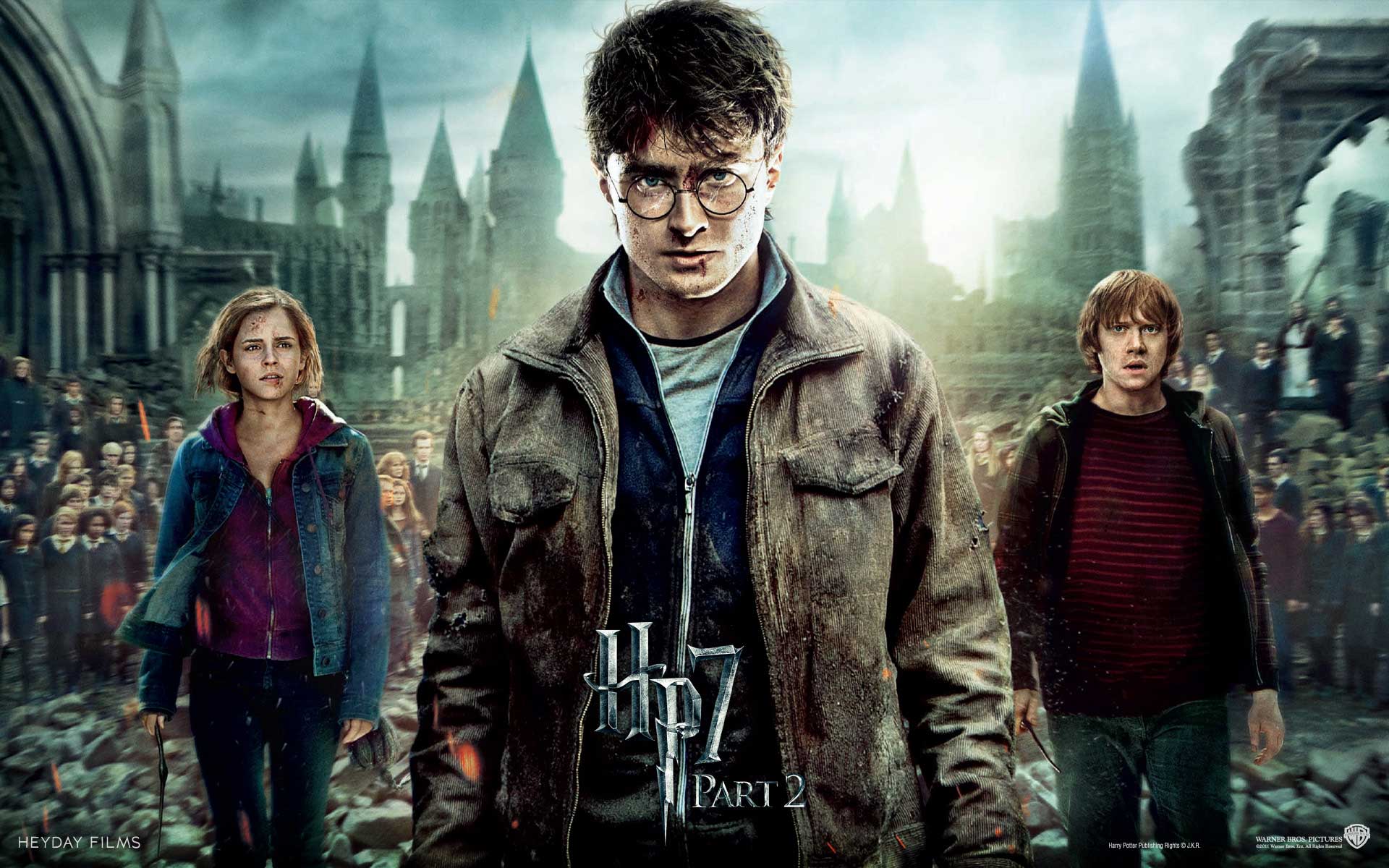
Richard: One of the best statements I read on this film said “horcruxes” are wizardspeak for “MacGuffins.”
As for Harry and Voldemort’s connection, I think J.K. Rowling has been reading her Carl Jung and Joseph Campbell. This is classic Hero’s Journey material. The hero goes “underground” and seems to have died, but then returns with the elixir, or the key, or the ring, or whatever, that brings wholeness to the community. In this case, Harry brings an awareness that death is not the last word, and that life is about living, not avoiding death. It is Voldemort’s fear of death that causes him to split his soul and become incapable of love.
Also, this is a classic conclusion to a coming-of-age story, as the Hero’s Journey ultimately represents letting go of the child and emerging as an adult. All of the amulets of Harry’s childhood, from his owl, Hedwig, to Dobby, to some of the teachers and mentors that helped him (Sirius, Lupin, Mad-Eye, Dumbledore, even Snape) and Hogwarts itself, are killed or destroyed on his journey. Eventually he must face his fate alone. (Hagrid is there but is powerless to help.) Part of this journey is also about becoming aware of, and gaining control over, the “shadow,”which is the symbol of the painful experiences of growing up that cause us to continue to act out of childish habit as adults. This is represented by the piece of Voldemort’s soul that is ejected from Harry once he faces death.
The first thing Dumbledore says to Harry in the Heaven/King’s Cross scene is “Harry, you wonderful boy, you brave, brave man,” which alludes to this transformation. A point that’s made in the book that for some reason they didn’t show in the film, and I can’t understand why, because it would have been a really good visual symbol, was that Harry’s lightning scar disappears after he is “killed” by Voldemort. As Dumbledore tells him in the book, “You are now your own man.”
As for Christian imagery, I’m a little more willing to grant Harry Christ figure status than you. He knows he has to “die,” and he goes to his death willingly for the sake of the community. The violence he uses is primarily defensive. One of the things the book is careful to show and is continued in the films is that he never uses the Avada Kedavra “killing curse,” even in defeating Voldemort.
The Deathly Hallows book and films seem to be Rowling’s way of introducing some Christian allegory into the series, albeit Christian “lite.” It’s certainly not C.S. Lewis. In the first Hallows film, they didn’t really show very closely the I Corinthians 15:26 verse that appears on Harry’s parents’ grave, “The last enemy to be destroyed is death,” but that’s made very clear and discussed in the book. There’s the Deathly Hallows symbolism itself, which has to do with resurrection or power over death. The sign, worn around the neck of “believers” includes a triangle (Trinitarian symbolism) a circle (which could be an open tomb) and a stick (because a cross would be too obvious.) The place where Harry goes when he “dies,” he says reminds him of King’s Cross station. (Hint, hint.) I don’t know if this was part of the plan all along, if it was Rowling answering her critics, or if the Christian stuff just gets tied up with the Campbell stuff and the resonance is unavoidable.
Of course, the whole thing is really about being gay. But that’s just my opinion.
As a bit of a “muggle” when it comes to reading the books, I wonder what you thought about the final scene where Harry and friends are shown as adults. I’d also like to know which one was your favorite film.
Ryan: Regarding the last scene, I was kind of anticipating it because I had read about it in some books about the series. I appreciated it and am glad they included it. I also thought they could have ended it with Ron, Hermione, and Harry standing on the bridge looking off into the distance. There was, or could have been, a sense of ambiguity there about the future…something left open to viewers’ interpretation. On the other hand, after a series of this length and the emotional investment so many readers/viewers made, the sense of closure might have been due/owed. As it stands, the concluding scene reveals, in part, that the friendly trinity have preserved “their way of life.” I mean to say that they have allowed future generations of witches and wizards the opportunity to grow in their identities (even if they remain hidden in “the real world”). Evil does not win out…although I would have liked to see more in the final two films it’s effects on the world outside of Hogwarts and the parallel wizarding world in London.
As far as my favorite film is concerned…that’s a difficult question. I’ve enjoyed them all, and there’s been something freeing about not having had to compare them to the books at every release. It’s been a while since I’ve re-watched all of the films, but I remember enjoying The Goblet of Fire. I think, for me, this is the first time where I had the sense of the direction that the story might be going…that Harry was going to have to make a supreme sacrifice at some point down the road. I think this is also the first movie where you hear Dumbledore explicitly refer to the sacrificial love that Harry’s mother bore him and the way in which it empowered him. I could be wrong here, so correct me if I’m wrong.
What do you make of fans’ rabid attraction to the series (print and film) but their reluctance to embrace religion…even as, as you have pointed out, it draws from so many similar themes/elements?
Richard: Do you mean the fans’ reluctance to embrace religion or religion’s reluctance (especially evangelical Christians) to embrace Harry Potter? In terms of a secular audience’s reluctance to embrace religion, we’ve been through this before. Harry Potter doesn’t seem like a rule-bound religious institution. You can get the benefits of religion through HP — morality, narrative, community, even a form of spirituality–without having to make a commitment to what seems like the hypocrisy of religious institutions. Hogwarts is the perfect institution because we don’t know about its inner workings — the tenure fights, the tuition raises, the political correctness run amok. Comparatively, the Ministry of Magic can take on all the evil trappings of institutions to act as a foil.
As for evangelical rejection of HP, it seems like evangelical Christians don’t like powerful narratives that can compete with their own mythology, unless it can be explicitly co-opted as a Christian narrative. (I hate to break this to them, but Starhawk, one of the world’s best-known Pagan spiritual writers, cites the Narnia series as a major influence in her spiritual development.) Evangelicals, particularly charismatics and Pentecostals, are the ones with the biggest problem with witchcraft. And that makes sense, because it competes with their own “witchcraft.” They are people who mutter incantations in strange languages and expect time and space to bend to their will. It’s all a matter of who you’re praying to.
Ryan: And, finally, your favorite book/film?
Richard: My favorite books and films are the third and fourth. Particularly the film for the third. I would have liked to see what Alfonso Cuaron could have done with the rest of the series. And let’s face it, he saved the franchise by making a movie rather than a Chris Columbus theme park attraction. The fourth book is my favorite, with the Quiddich World Cup, the Triwizard Tournament, and great supporting characters like Rita Skeeter. I thought Mike Newell did a good job with the fourth film in making it a real British “tales out of school” film. (In the extended DVD, they actually sing the Hogwarts School Song, which is, as you would imagine, atrocious.) I have never been a fan of David Yates’ direction in the last four films. I feel like the dialogue has somehow been…I don’t know…off. Like somehow it contributes to the “darkness” of the films to have long pauses in the actors’ conversations and have jokes told only in a mumbling undertone. He got better as the films went along, and I did enjoy the last two films quite a bit.
Let’s get this puppy posted!
Harry Potter and the Deathly Hallows Part 2 (130 mins) is in theaters everywhere and is rated PG-13 for fantasy violence. And if you haven’t seen it by now, what are you waiting for?!
Previous Post

July 19, 2011
They Eat their Young, Don't They?
Next Post
August 1, 2011 A Host of Horrors: A Review of Dark Dreams 2.0
Browse Our Archives
Select a Category Classics DVD Film Music News Pop Culture Events Print Sports Television Uncategorized Video Games
Select a Month March 2017 February 2017 January 2017 December 2016 November 2016 October 2016 September 2016 August 2016 July 2016 June 2016 May 2016 April 2016 March 2016 February 2016 January 2016 December 2015 November 2015 October 2015 September 2015 August 2015 July 2015 June 2015 May 2015 April 2015 March 2015 February 2015 January 2015 December 2014 November 2014 October 2014 September 2014 August 2014 July 2014 June 2014 May 2014 April 2014 March 2014 February 2014 January 2014 December 2013 November 2013 October 2013 September 2013 August 2013 July 2013 June 2013 May 2013 April 2013 March 2013 February 2013 January 2013 December 2012 November 2012 October 2012 September 2012 August 2012 July 2012 June 2012 May 2012 April 2012 March 2012 February 2012 January 2012 December 2011 November 2011 October 2011 September 2011 August 2011 July 2011 June 2011 May 2011 April 2011 March 2011 February 2011 January 2011 December 2010 November 2010 October 2010 September 2010 August 2010 July 2010 June 2010 May 2010 April 2010 March 2010 February 2010 January 2010 December 2009 November 2009 October 2009 September 2009 August 2009 July 2009 June 2009 May 2009 April 2009 March 2009 February 2009 January 2009 December 2008 November 2008 October 2008 September 2008 August 2008 July 2008 June 2008 May 2008 April 2008 March 2008 February 2008 January 2008 December 2007 November 2007 October 2007 September 2007 August 2007 July 2007 June 2007 May 2007 April 2007 March 2007
Follow Us!
TAKE THE
Religious Wisdom Quiz
Which New Testament book has the "Hall of Faith" listing heroes like Abraham and Moses?
Select your answer to see how you score.
Hebrews Galatians 1 Peter James
Related posts from Pop Theology


At SXSW2017: May It Last: A Portrait of...

At SXSW 2017: "Untold Tales of Armistead Maupin"
TRENDING AT PATHEOS Progressive Christian

Why Christians Have a Sacred Duty to Vote:...
The Bible offers strong support for the sacred duty to vote. Here...

What Being a Modern-Day Apostle Means to Me
In my last column, I discussed the ins and outs of modern-day...

Did Ancient China Once Worship the God of...
Across human history, a common thread weaves through the origins of the...

Love Your Neighbor – Including Earth-Kin: Lev. 19,...
God’s command to love your neighbor means acting in an ethical and...

Lead a Church Study of “Jesus and Lao...
Guest writer Jack Thomas (The Irreverent Reverend) reflects on leading his church...

Principles for Understanding the Apostolic Ministry Today
Whenever people discover that my formal ministry title is "apostle," as in...
view all Progressive Christian blogs
Ad-Free & Subscriber Log-In Subscription Support
- About Us
- 2026 Calendar
- Videos
- Podcasts
- Library of World Religions
- Faith In Media Tracker
- Advertise With Us
- Write for Us
- Privacy Policy
- Terms of Service
- Do Not Sell My Data
- Contact Us
- Radiant Digital
- Manage Newsletter Subscriptions
- Unsubscribe From Notifications
- Sitemap
Copyright 2008-2026, Patheos. All rights reserved.
Subscription Support Ad-Free & Subscriber Log-In
Follow Patheos