
BuddhistCatholicContemplativeEvangelicalGeneral ChristianHinduJewishLatter-day SaintMuslimNew VisionsProgressive Christian
Beliefs
- Buddhist
- Catholic
- Contemplative
- Evangelical
- General Christian
- Hindu
- Jewish
- Latter-day Saint
- More Voices
- Muslim
- New Visions
- Pagan
- Progressive Christian
Topics
- Religion News
- Food and Religion
- Sports and Religion
- Religious Art
- Religious Music and Entertainment
- Religious Events
- History and Religion
- Style and Religion
- Politics and Religion
- Women in Religion
- Recreation Outdoors and Religion
- Business Finance and Religion
- Careers Workplace and Religion
- Education and Religion
- Family Parenting and Religion
- Health Fitness and Religion
- Home and Religion
- Relationships and Religion
- Technology and Religion
- Travel and Religion
Columnists
- Buddhist Columnists
- Business Finance and Religion Columnists
- Careers Workplace and Religion Columnists
- Catholic Columnists
- Contemplative Columnists
- Education and Religion Columnists
- Evangelists Columnists
- Family Parenting and Religion Columnists
- General Christian Columnists
- Health Fitness and Religion Columnists
- Hindu Columnists
- History and Religion Columnists
- Home and Religion Columnists
- Jewish Columnists
- More Voices Columnists
- Latter Day Columnists
- Muslim Columnists
- New Visions Columnists
- Nonreligious Columnists
- Pagan Columnists
- Politics and Religion Columnists
- Progressive Columnists
- Recreation Outdoors and Religion Columnists
- Relationships and Religion Columnists
- Religion News Columnists
- Religious Art Columnists
- Religious Events Columnists
- Religious Music and Entertainment Columnists
- Sports and Religion Columnists
- Style and Religion Columnists
- Technology and Religion Columnists
- Travel and Religion Columnists
- Women in Religion Columnists
Resource Library
- 2026 Calendar
- Library of World Religions
- The 100 Most Holy Places on Earth
- Patheos Answers
- Podcasts
- Videos
- Faith Leaders Database
- Anglican Episcopalian
- Bahai
- Baptist
- Buddhism
- Christianity
- Confucianism
- Eastern Orthodoxy
- Hinduism
- Holiness and Pentecostal
- ISKCON
- Islam
- Judaism
- Lutheran
- Methodist
- The Church of Jesus Christ of Latter-day Saints
- New Age
- Paganism
- Presbytarian and Reformed
- Protestantism
- Religion Behind the Scenes
- Roman Catholic
- Scientology
- Shia Islam
- Sikhism
- Sufism
- Sunni Islam
- Taoism
- Zen
- See all religions
Research Tools
 Ad-Free & Subscriber Log-In Subscription Support
Ad-Free & Subscriber Log-In Subscription Support
Follow Patheos 

- Trending:
- Forgiveness
- |
- Marriage
- |
- Consciousness
- |
- Death Penalty
- |
- Election
- |
- Halloween
 Pop Theology
- Home
- Progressive Christian
- Religious Music & Entertainment
- They Eat their Young, Don't They?
They Eat their Young, Don't They?
Last updated on: July 19, 2011 at 9:17 am by J. Ryan Parker
They Eat their Young, Don't They? 2011-07-19T09:17:32-07:00 J. Ryan Parker
Patheos Explore the world's faith through different perspectives on religion and spirituality! Patheos has the views of the prevalent religions and spiritualities of the world.
In preparation for an upcoming sermon I’m giving on Jacob wrestling with the angel, I’ve been re-reading some Old Testament commentary. In one source, the authors claim that a central theme of the Jewish creation narrative and God’s calling out of Israel to be God’s chosen people is one of order out of chaos. This ordered universe is held together, in part, by God’s command to mankind to be stewards of the earth and God’s covenant that he establishes with Israel. Of course, as we all well know, this order was never immune to the plague of chaotic forces. This theme of an ordered universe, recognition of place in it, threats to it and transgression/transcendence of it came to mind when watching Animal Kingdom, a fantastic, recent Australian crime drama.
Animal Kingdom tells the story of the Cody family, mother Janine (Jacki Weaver), her three sons, Andrew, a.k.a. Pope (Ben Mendelsohn), Barry, a.k.a. Baz (Joel Edgerton), Craig (Sullivan Stapleton) and Darren (Luke Ford), and grandson Joshua, a.k.a. J (James Frecheville). The four brothers work together as armed robbers, but have recently gone into hiding because the police have turned up the heat in their investigations of their crimes. J, formerly alienated from the wider family because his mother and grandmother got into a fight over the rules of a card game, is reunited with the latter when the former dies of a heroin overdose. As the police begin picking off his younger brothers, elder Pope seeks out revenge on the cops and draws J into his plans. J faces the decision of whether he will follow his family or search for a new “family,” particularly in the form of would-be-father-figure Sgt. Nathan Leckie, who sees the inevitably destructive outcome that awaits him.
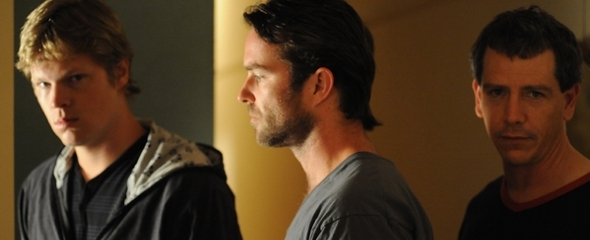
Darren (Luke Ford), Craig (Sullivan Stapleton), and Pope (Ben Mendelsohn).
The opening scene of Animal Kingdom is disturbing in its matter-of-factness. J sits on the couch watching an Australian version of Deal or No Deal next to a woman who appears to be asleep. Only when the paramedics knock on the door do we learn that she has OD’d. He calls his grandmother to come and get him, and when she does, the scene fades into images of a cheap brass relief of a pride of lions, one atop a sun-drenched rocky outcrop (think The Lion King), over which the film’s title appears. As the opening credits continue to roll, we see haunting security camera images of the brothers robbing banks (video below). J serves as the occasional narrator throughout the film, and here he tells the audience that this is just the world into which he has been thrown. He made no conscious choice to be a part of it nor directly influenced the world to turn as it has/does for him. As we see throughout the film, the world in which J moves is very much like the one depicted in the kitschy work of art mentioned above. It’s a lion-eat-lion, survival-of-the-fittest world, and his three uncles, to varying degrees, are as vicious as they come. Of course, they’ve got nothing on his grandmother.

J (James Frecheville) consults with his lawyer while Janine (Jacki Weaver) looks on.
In keeping with the theme of an ordered universe, recognizing our place in it, and our ability to transcend said place, in the last third of the film, Sgt. Leckie confronts J and offers him some advice on how the world works. Reflecting on the bush that surrounds them, he tells J that it is made up of big trees and bushes that have been there for thousands of years and pissy little bugs that will die before the minute’s up. He then asks J to if he knows where he fits in this world…his family’s of course. Sgt. Leckie seems to know what J has yet to learn, specifically that his family will turn on him just as quickly as they would the police. At the same time, however, his advice to J also carries with it the implication that J can not only recognize his place in their world, but transcend it as well. He is offering him an out.
The theme of order can be seen not only in the Cody family, but also between the Cody family and the authorities. The film provides glimpses of a breakdown of this order in both. In the process, it reveals the ways in which these ideas have been used to oppress and suppress individuals and groups throughout history. As the film progresses, J becomes both victim and violator. Sgt. Leckie might provide a means of escape for J, but the system of which he is a part frequently abuses its power (actions that stoke Pope’s anger). At the same time, the good Sgt. doesn’t seem to fully grasp the effect that chaos, or the unexpected, ambiguous experiences of life, has on an individual like J. Inexplicable events take place against which many individuals have no adequate defense. Sometimes, as in Pope’s case, they create a desire for revenge…a need to devour one’s neighbor. Sgt. Leckie fails to realize that just because someone might be able to “take the out,” doesn’t mean they always will. Furthermore, if someone does transcend an oppressive situation, it doesn’t mean that it’s easy…or safe.
Animal Kingdom is a fantastic film that represents the best of the crime genre, and while viewers might recognize similarities between the characters and others in previous crime films, Janine, Pope, and J do bring something fresh to the table. While all the actors excel in their roles, Weaver and Mendelsohn shine the brightest (or darkest). Weaver got most of the awards buzz, but Mendelsohn was equally deserving and unfortunately overlooked. That this is writer/director David Michod‘s first feature-length film is noteworthy indeed. He manages to make a brooding film devoid of any over-the-top action move rather quickly. He fills his film with scenes that ratchet up the tension and only occasionally releases it. Michod also knows how to write one helluva ending.
Animal Kingdom (118 mins.) is rated R for violence and language and is available on DVD.
Here are a couple of clips from the film. The first is of the opening credits, and the second features Janine (Jacki Weaver) in one of the film’s best scenes.
Previous Post

July 14, 2011
Quo Vadis: Forgotten Classic of the Sword-and-Sandal Genre
Next Post
July 27, 2011 It's All Over
Browse Our Archives
Select a Category Classics DVD Film Music News Pop Culture Events Print Sports Television Uncategorized Video Games
Select a Month March 2017 February 2017 January 2017 December 2016 November 2016 October 2016 September 2016 August 2016 July 2016 June 2016 May 2016 April 2016 March 2016 February 2016 January 2016 December 2015 November 2015 October 2015 September 2015 August 2015 July 2015 June 2015 May 2015 April 2015 March 2015 February 2015 January 2015 December 2014 November 2014 October 2014 September 2014 August 2014 July 2014 June 2014 May 2014 April 2014 March 2014 February 2014 January 2014 December 2013 November 2013 October 2013 September 2013 August 2013 July 2013 June 2013 May 2013 April 2013 March 2013 February 2013 January 2013 December 2012 November 2012 October 2012 September 2012 August 2012 July 2012 June 2012 May 2012 April 2012 March 2012 February 2012 January 2012 December 2011 November 2011 October 2011 September 2011 August 2011 July 2011 June 2011 May 2011 April 2011 March 2011 February 2011 January 2011 December 2010 November 2010 October 2010 September 2010 August 2010 July 2010 June 2010 May 2010 April 2010 March 2010 February 2010 January 2010 December 2009 November 2009 October 2009 September 2009 August 2009 July 2009 June 2009 May 2009 April 2009 March 2009 February 2009 January 2009 December 2008 November 2008 October 2008 September 2008 August 2008 July 2008 June 2008 May 2008 April 2008 March 2008 February 2008 January 2008 December 2007 November 2007 October 2007 September 2007 August 2007 July 2007 June 2007 May 2007 April 2007 March 2007
Follow Us!
TAKE THE
Religious Wisdom Quiz
Who said, "Lord, to whom shall we go? You have the words of eternal life"?
Select your answer to see how you score.
John Judas James Peter
Related posts from Pop Theology


At SXSW2017: May It Last: A Portrait of...

At SXSW 2017: "Untold Tales of Armistead Maupin"
TRENDING AT PATHEOS Progressive Christian

Why Christians Have a Sacred Duty to Vote:...
The Bible offers strong support for the sacred duty to vote. Here...

What Being a Modern-Day Apostle Means to Me
In my last column, I discussed the ins and outs of modern-day...

Did Ancient China Once Worship the God of...
Across human history, a common thread weaves through the origins of the...

Love Your Neighbor – Including Earth-Kin: Lev. 19,...
God’s command to love your neighbor means acting in an ethical and...

Lead a Church Study of “Jesus and Lao...
Guest writer Jack Thomas (The Irreverent Reverend) reflects on leading his church...

Principles for Understanding the Apostolic Ministry Today
Whenever people discover that my formal ministry title is "apostle," as in...
view all Progressive Christian blogs
Ad-Free & Subscriber Log-In Subscription Support
- About Us
- 2026 Calendar
- Videos
- Podcasts
- Library of World Religions
- Faith In Media Tracker
- Advertise With Us
- Write for Us
- Privacy Policy
- Terms of Service
- Do Not Sell My Data
- Contact Us
- Radiant Digital
- Manage Newsletter Subscriptions
- Unsubscribe From Notifications
- Sitemap
Copyright 2008-2026, Patheos. All rights reserved.
Subscription Support Ad-Free & Subscriber Log-In
Follow Patheos