
BuddhistCatholicContemplativeEvangelicalGeneral ChristianHinduJewishLatter-day SaintMuslimNew VisionsProgressive Christian
Beliefs
- Buddhist
- Catholic
- Contemplative
- Evangelical
- General Christian
- Hindu
- Jewish
- Latter-day Saint
- More Voices
- Muslim
- New Visions
- Pagan
- Progressive Christian
Topics
- Religion News
- Food and Religion
- Sports and Religion
- Religious Art
- Religious Music and Entertainment
- Religious Events
- History and Religion
- Style and Religion
- Politics and Religion
- Women in Religion
- Recreation Outdoors and Religion
- Business Finance and Religion
- Careers Workplace and Religion
- Education and Religion
- Family Parenting and Religion
- Health Fitness and Religion
- Home and Religion
- Relationships and Religion
- Technology and Religion
- Travel and Religion
Columnists
- Buddhist Columnists
- Business Finance and Religion Columnists
- Careers Workplace and Religion Columnists
- Catholic Columnists
- Contemplative Columnists
- Education and Religion Columnists
- Evangelists Columnists
- Family Parenting and Religion Columnists
- General Christian Columnists
- Health Fitness and Religion Columnists
- Hindu Columnists
- History and Religion Columnists
- Home and Religion Columnists
- Jewish Columnists
- More Voices Columnists
- Latter Day Columnists
- Muslim Columnists
- New Visions Columnists
- Nonreligious Columnists
- Pagan Columnists
- Politics and Religion Columnists
- Progressive Columnists
- Recreation Outdoors and Religion Columnists
- Relationships and Religion Columnists
- Religion News Columnists
- Religious Art Columnists
- Religious Events Columnists
- Religious Music and Entertainment Columnists
- Sports and Religion Columnists
- Style and Religion Columnists
- Technology and Religion Columnists
- Travel and Religion Columnists
- Women in Religion Columnists
Resource Library
- 2026 Calendar
- Library of World Religions
- The 100 Most Holy Places on Earth
- Patheos Answers
- Podcasts
- Videos
- Faith Leaders Database
- Anglican Episcopalian
- Bahai
- Baptist
- Buddhism
- Christianity
- Confucianism
- Eastern Orthodoxy
- Hinduism
- Holiness and Pentecostal
- ISKCON
- Islam
- Judaism
- Lutheran
- Methodist
- The Church of Jesus Christ of Latter-day Saints
- New Age
- Paganism
- Presbytarian and Reformed
- Protestantism
- Religion Behind the Scenes
- Roman Catholic
- Scientology
- Shia Islam
- Sikhism
- Sufism
- Sunni Islam
- Taoism
- Zen
- See all religions
Research Tools
 Ad-Free & Subscriber Log-In Subscription Support
Ad-Free & Subscriber Log-In Subscription Support
Follow Patheos 

- Trending:
- Forgiveness
- |
- Marriage
- |
- Consciousness
- |
- Death Penalty
- |
- Election
- |
- Halloween
 Pop Theology
- Home
- Progressive Christian
- Religious Music & Entertainment
- A Bio-Technological Prophet
A Bio-Technological Prophet
Last updated on: May 26, 2011 at 2:05 pm by J. Ryan Parker
A Bio-Technological Prophet 2011-05-26T14:05:41-07:00 J. Ryan Parker
Patheos Explore the world's faith through different perspectives on religion and spirituality! Patheos has the views of the prevalent religions and spiritualities of the world.
With all the talk surrounding Harold Camping, the failure of his March 21st rapture prediction, and his new sure-to-fail October 21st prediction, now is the perfect time to watch Transcendent Man, a documentary about futurist, inventor, and prophet, Raymond Kurzweil.
Ray Kurzweil, author of The Singularity is Near: When Humans Transcend Biology, founded his first company at the age of 18. He has since gone on to hold over 24 patents. Upon graduating from MIT, he told his friends that he wanted to devote his life to pursuing inventions that would help the blind see, the deaf hear, and the lame walk. He has, in part, contributed to these modern miracles and has been responsible for the creation of, among other things, the flat bed scanner and a mobile device that helps blind people read. His greatest contributions, however, might be his thoughts on the future of humanity, or at least its bio-technological potential. Contrary to Camping’s (and many Christians’) beliefs in and hopes for the future of life here on earth, Kurzweil’s are extremely optimistic. That they are devoid of any theological or religious underpinnings will no doubt unnerve members of the aforementioned religious camps. Kurzweil reflects on our biological and technological advancements in recent centuries and extrapolates out from them implications for our further progress. If, in the past 40 years, for example, computing power has decreased from building size to pocket size, in the next 25 years, it will likely go from pocket size to cellular size…as in our bloodstream. So Kurzweil believes that we will be able to implement nanotechnology to fight off illness and disease and to prolong life…indefinitely. Immortality, he argues, is within our grasp…or will soon be. These advancements will also impact the way we learn and consume entertainment (we’ll be able to Google just by thinking about it or download an entire language and speak it in minutes if not seconds).
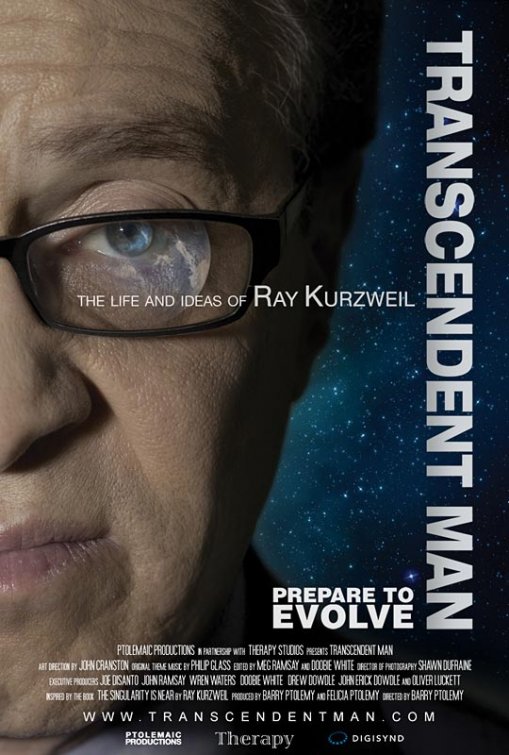 The documentary also traces several of his fellow thinkers, inventors, and scientists and the work they are doing in similar fields including Hugo De Garis, Peter Diamandis, William Hurlbut, and Kevin Kelly. Many of them express support of Kurzweil’s vision, some of whom even employ it in their work and research. For example, we see glimpses of his vision in scientists’ and designers’ work with prosthetics and robotics. Even though some of his colleagues agree with his vision, many of them believe that Kurzweil is too optimistic, specifically that the changes of which he speaks are further away from us than just a couple of decades. At the same time, some colleagues, perhaps just as seemingly fantastical as Kurzweil himself, claim that these advancements can and will have destructive tendencies (think Terminator 3: Rise of the Machines). Still others believe that he is simply just wrong and that we won’t be able to accomplish these feats (though it’s difficult to see how their skepticism is warranted in the face of the rapid advancements we have made over the past three centuries and are making now). One of his more even-handed critics, Kevin Kelly, founding executive editor of Wired magazine, calls Kurzweil a modern day prophet who just happens to be wrong. In other words, he encourages us to improve life here on earth, but the avenues through which he encourages this improvement might be misguided.
Were Transcendent Man simply an overview of Kurzweil’s work and his place in his field, the documentary would be fascinating enough. However, director Robert Barry Ptolemy also focuses on Kurzweil’s personal life, specifically his relationship with his father, his (in)ability to process his father’s death, and his own approach to mortality. From the documentary, it seems as if all of this motivates Kurzweil’s work and has become something of an obsession for him. He works vigorously on re-programming his own biology and genetics, working to find “undesirable genes” and root them out. A sign of his obsession? He takes over 200 pills a day to combat poor health and aging. There is a sense of the pathetic here, however. For all of his genius, Kurzweil does not factor in the ambiguity of life, tragedy, or all of those things that make us scratch our head with frustration due to our inability to explain or research them away.
The documentary concludes with Kurzweil saying, “Does God exist? Not yet.” This conclusion only heightens the theological and religious, not to mention sociological, implications that run throughout the film. Kurzweil’s beliefs are fascinating, but I imagine, or at least hope, that the via media between his thoughts and those of his detractors are more likely where we’re headed as a species. All sorts of questions arise: who or what is, or will be, God in the future? Can all of this technology and accompanying advancements help usher in the kingdom of God on earth? What does it mean to be human? What role will religion play in the future?
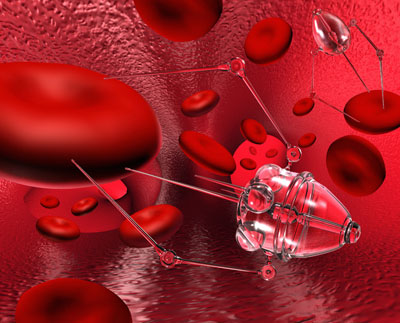
A vision of nanotechnology.
I take great joy in the technological possibilities to which Kurzweil and his colleagues point. Perhaps religion will be best suited to be both shepherd and critic. It should force us to ask ourselves to what ends we will use technology or embrace technological and biological advancements. Will they be agents of greed or benevolence? At the same time, I am highly skeptical of Kurzweil’s reflections on death. Is it always good and desirable to attempt to live forever? If a different type of existence is possible now or in the near future, why can we not accept the possibility of death as a new or next type of existence? For all of his commitment to science and technology, Kurzweil seems to be motivated by deeply spiritual and emotional factors, to which he does not devote enough attention himself as he dismisses more traditional reactions to matters of life and death.
Transcendent Man is a must watch for anyone interested in science, religion, technology, theology, medicine, or the future of these fields. Ptolemy does a fantastic job of blending all of these with Kurzweil’s personal, spiritual, and emotional experiences. In a way, the film reminds me of a particularly interesting episode of NOVA entitled “Parallel Worlds, Parallel Lives” that follows Mark Everett’s (lead singer of The Eels) efforts to learn more about his father, Hugh, a renowned, yet radical, quantum physicist, with whom he had a rocky relationship. The drawback to Transcendent Man, unfortunately, it its homogeneity. It begs for a greater diversity of voices (read more non-white males), as well as more religious voices (read more than just one white, conservative Christian male). Aside from this glaring absence, the film is perfect for individuals and groups caught up in questions about the future. At the same time, it is a prophetic call and encouragement for us to use technology (or think about using it) to improve life here on earth rather than waiting for some vengeful deity to come along and violently end it all.
Transcendent Man (83 mins.) is available on DVD and streaming through Netflix.
Previous Post

May 23, 2011
Krump Theology: Street Kingdom, Faith, and America’s Best Dance Crew
Next Post
June 13, 2011 The First (and Best) Class
Browse Our Archives
Select a Category Classics DVD Film Music News Pop Culture Events Print Sports Television Uncategorized Video Games
Select a Month March 2017 February 2017 January 2017 December 2016 November 2016 October 2016 September 2016 August 2016 July 2016 June 2016 May 2016 April 2016 March 2016 February 2016 January 2016 December 2015 November 2015 October 2015 September 2015 August 2015 July 2015 June 2015 May 2015 April 2015 March 2015 February 2015 January 2015 December 2014 November 2014 October 2014 September 2014 August 2014 July 2014 June 2014 May 2014 April 2014 March 2014 February 2014 January 2014 December 2013 November 2013 October 2013 September 2013 August 2013 July 2013 June 2013 May 2013 April 2013 March 2013 February 2013 January 2013 December 2012 November 2012 October 2012 September 2012 August 2012 July 2012 June 2012 May 2012 April 2012 March 2012 February 2012 January 2012 December 2011 November 2011 October 2011 September 2011 August 2011 July 2011 June 2011 May 2011 April 2011 March 2011 February 2011 January 2011 December 2010 November 2010 October 2010 September 2010 August 2010 July 2010 June 2010 May 2010 April 2010 March 2010 February 2010 January 2010 December 2009 November 2009 October 2009 September 2009 August 2009 July 2009 June 2009 May 2009 April 2009 March 2009 February 2009 January 2009 December 2008 November 2008 October 2008 September 2008 August 2008 July 2008 June 2008 May 2008 April 2008 March 2008 February 2008 January 2008 December 2007 November 2007 October 2007 September 2007 August 2007 July 2007 June 2007 May 2007 April 2007 March 2007
Follow Us!
TAKE THE
Religious Wisdom Quiz
What animal was most often sacrificed for a sin offering in the Old Testament?
Select your answer to see how you score.
A lamb A bull A goat A bird
Related posts from Pop Theology


At SXSW2017: May It Last: A Portrait of...

At SXSW 2017: "Untold Tales of Armistead Maupin"
TRENDING AT PATHEOS Progressive Christian

Why Christians Have a Sacred Duty to Vote:...
The Bible offers strong support for the sacred duty to vote. Here...

What Being a Modern-Day Apostle Means to Me
In my last column, I discussed the ins and outs of modern-day...

Did Ancient China Once Worship the God of...
Across human history, a common thread weaves through the origins of the...

Love Your Neighbor – Including Earth-Kin: Lev. 19,...
God’s command to love your neighbor means acting in an ethical and...

Lead a Church Study of “Jesus and Lao...
Guest writer Jack Thomas (The Irreverent Reverend) reflects on leading his church...

Principles for Understanding the Apostolic Ministry Today
Whenever people discover that my formal ministry title is "apostle," as in...
view all Progressive Christian blogs
Ad-Free & Subscriber Log-In Subscription Support
- About Us
- 2026 Calendar
- Videos
- Podcasts
- Library of World Religions
- Faith In Media Tracker
- Advertise With Us
- Write for Us
- Privacy Policy
- Terms of Service
- Do Not Sell My Data
- Contact Us
- Radiant Digital
- Manage Newsletter Subscriptions
- Unsubscribe From Notifications
- Sitemap
Copyright 2008-2026, Patheos. All rights reserved.
Subscription Support Ad-Free & Subscriber Log-In
Follow Patheos