
BuddhistCatholicContemplativeEvangelicalGeneral ChristianHinduJewishLatter-day SaintMuslimNew VisionsProgressive Christian
Beliefs
- Buddhist
- Catholic
- Contemplative
- Evangelical
- General Christian
- Hindu
- Jewish
- Latter-day Saint
- More Voices
- Muslim
- New Visions
- Pagan
- Progressive Christian
Topics
- Religion News
- Food and Religion
- Sports and Religion
- Religious Art
- Religious Music and Entertainment
- Religious Events
- History and Religion
- Style and Religion
- Politics and Religion
- Women in Religion
- Recreation Outdoors and Religion
- Business Finance and Religion
- Careers Workplace and Religion
- Education and Religion
- Family Parenting and Religion
- Health Fitness and Religion
- Home and Religion
- Relationships and Religion
- Technology and Religion
- Travel and Religion
Columnists
- Buddhist Columnists
- Business Finance and Religion Columnists
- Careers Workplace and Religion Columnists
- Catholic Columnists
- Contemplative Columnists
- Education and Religion Columnists
- Evangelists Columnists
- Family Parenting and Religion Columnists
- General Christian Columnists
- Health Fitness and Religion Columnists
- Hindu Columnists
- History and Religion Columnists
- Home and Religion Columnists
- Jewish Columnists
- More Voices Columnists
- Latter Day Columnists
- Muslim Columnists
- New Visions Columnists
- Nonreligious Columnists
- Pagan Columnists
- Politics and Religion Columnists
- Progressive Columnists
- Recreation Outdoors and Religion Columnists
- Relationships and Religion Columnists
- Religion News Columnists
- Religious Art Columnists
- Religious Events Columnists
- Religious Music and Entertainment Columnists
- Sports and Religion Columnists
- Style and Religion Columnists
- Technology and Religion Columnists
- Travel and Religion Columnists
- Women in Religion Columnists
Resource Library
- 2026 Calendar
- Library of World Religions
- The 100 Most Holy Places on Earth
- Patheos Answers
- Podcasts
- Videos
- Faith Leaders Database
- Anglican Episcopalian
- Bahai
- Baptist
- Buddhism
- Christianity
- Confucianism
- Eastern Orthodoxy
- Hinduism
- Holiness and Pentecostal
- ISKCON
- Islam
- Judaism
- Lutheran
- Methodist
- The Church of Jesus Christ of Latter-day Saints
- New Age
- Paganism
- Presbytarian and Reformed
- Protestantism
- Religion Behind the Scenes
- Roman Catholic
- Scientology
- Shia Islam
- Sikhism
- Sufism
- Sunni Islam
- Taoism
- Zen
- See all religions
Research Tools
 Ad-Free & Subscriber Log-In Subscription Support
Ad-Free & Subscriber Log-In Subscription Support
Follow Patheos 

- Trending:
- Forgiveness
- |
- Marriage
- |
- Consciousness
- |
- Death Penalty
- |
- Election
- |
- Halloween
 Pop Theology
- Home
- Progressive Christian
- Religious Music & Entertainment
- Of Gods and Leadership
Of Gods and Leadership
Last updated on: May 6, 2011 at 9:58 am by J. Ryan Parker
Of Gods and Leadership 2011-05-06T09:58:19-07:00 J. Ryan Parker
Patheos Explore the world's faith through different perspectives on religion and spirituality! Patheos has the views of the prevalent religions and spiritualities of the world.
New Pop Theology contributor Tony Mills reviews Thor, the latest Marvel single-character blockbuster leading up to next year’s hero-studded team up movie, The Avengers. Check it out after the jump…if you don’t mind spoilers.
Thor begins with astrophysicist Jane Foster (Natalie Portman) and her research associates Erik (Stellan Skarsgård) and Darcy (Kat Dennings) looking for strange astronomical signs somewhere in the New Mexico desert. They find the mother lode when warrior god Thor (Chris Hemsworth) crash lands on Earth. Immediately the film turns to Thor’s back story in his home realm of Asgard where he is set to take over the throne from his father Odin (Anthony Hopkins), who has kept their home safe, partially through a treaty with a race of warmongering Frost Giants. The Asgardians had also protected humans from destruction at the hands of these Frost Giants (hence Nordic worship of them years later). When some of these giants break in (or are let in?) to Asgard on the day of Thor’s ascension, Thor responds by taking his friends and his brother Loki (Tom Hiddleston) to the Frost Giant home of Jotunheim to teach them a lesson, entirely against his father’s commands.
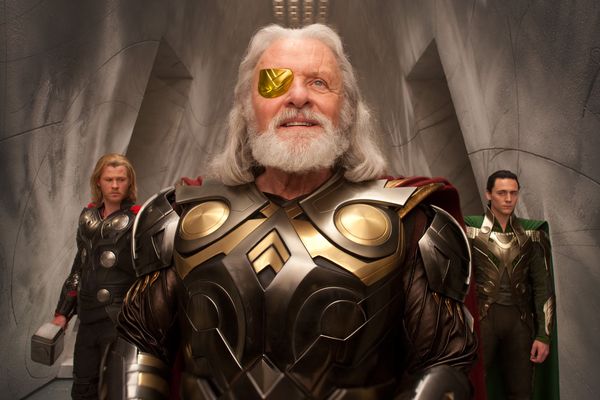
Thor (Hemsworth), Odin (Hopkins), and Loki (Hiddleston).
I don’t want to assume that director Kenneth Branagh and the writers had today’s political context in mind when highlighting the disagreement between Odin and Thor over how to respond to the potential terrorist attack of the Frost Giants (they were destroyed by a robotic guardian before they could do any harm in Asgard), but it’s difficult not to draw parallels. When he learns about the perpetrators, Thor is bent on invasion, but Odin insists that this was not an act of war, only the actions of a few rogue individuals. The wise king, Odin calmly tells Thor, knows better. Of course, a possible implication here is that Bush and Obama are not wise rulers because they mistake the actions of a few for the work of an entire nation (Afghanistan and Iraq) and proceed to war. When Thor reacts in similar fashion and invades Jotunheim with his friends, he nearly leads them to their deaths until Odin rescues them. Odin chastises Thor for his actions, strips him of his power for opening Asgard to unnecessary war, and calls him “a vain, greedy, cruel boy,” criticisms that might well apply to any number of Western leaders. Odin then banishes Thor and his hammer, Mjolnir, to Earth.
At this point, Jane and company find him, along with the secret military group S.H.I.E.L.D., who we have seen hints of in previous Marvel movies, at work assembling the Avengers. When Thor receives word from his mischievous and deceptive brother Loki that Odin is dead and that he is eternally forbidden from Asgard, he is struck with remorse over his actions and slowly resigns himself to life on Earth, which is of course made more palatable by his growing fondness for Jane. The film doesn’t take much time to register Thor’s change of heart from callous, hotheaded young man to humble and responsible adult, but it does the best with the time allotted, aided chiefly by Hemsworth’s performance. By the time his friends from Asgard come for him, followed by the giant fire-breathing metal guardian that Loki sends after them, Thor is now ready to make the ultimate sacrifice. Seeing the devastation and imminent doom of his loved ones, Thor pleads to Loki, apologizes for whatever offense he did to him, and offers his life in order to spare his friends. Loki accepts, but as Thor lies dying (or dead), he is now considered worthy of Mjolnir and its power, which leads to a potentially spiritual transfiguration sequence (shades of the events in Disney’s Hercules film).
Thor‘s ending, however, is confusing. Loki invites the leader of the Frost Giants, Laufey (Colm Feore), to kill the comatose Odin, only to double-cross him and kill Laufey instead. Loki is also, quite unexpectedly, bent on completely destroying Jotunheim for no apparent reason. Thor stops him from doing so, and although his new-found honor prohibits the killing of an entire race, any visible emotional attachment to this decision is absent. In order to prevent this destruction, Thor must even destroy the Rainbow Bridge that leads out of Asgard, which will also prevent him from reuniting with Jane. Again, a noble sacrifice, but the film does not allow us to empathize with Thor or with the Frost Giants, who are simply presented as ruthless others. On the other hand, the point might be to see the wisdom and compassion of a now humbler Thor despite the ostensible unworthiness of those he wants to save. In terms of film narrative and drama, however, it doesn’t quite work. All this leads me to my main critique of the film, which is a rare one in films of this nature. Thor is simply too short and could have easily benefited from an extra thirty minutes to develop some of the plot lines that it introduces. Nevertheless, even as an engaging popcorn flick, Thor is not a typical Hollywood glorification of violence. It benefits from solid acting and special effects and offers fresh (at least for this genre) perspectives on war and leadership that we so desperately need today.
Previous Post

May 3, 2011
Revenge on a Small (but Tragic) Scale
Next Post
May 11, 2011 BBC’s Being Human: Monsters in the Closet, Parts 2 & 3
Browse Our Archives
Select a Category Classics DVD Film Music News Pop Culture Events Print Sports Television Uncategorized Video Games
Select a Month March 2017 February 2017 January 2017 December 2016 November 2016 October 2016 September 2016 August 2016 July 2016 June 2016 May 2016 April 2016 March 2016 February 2016 January 2016 December 2015 November 2015 October 2015 September 2015 August 2015 July 2015 June 2015 May 2015 April 2015 March 2015 February 2015 January 2015 December 2014 November 2014 October 2014 September 2014 August 2014 July 2014 June 2014 May 2014 April 2014 March 2014 February 2014 January 2014 December 2013 November 2013 October 2013 September 2013 August 2013 July 2013 June 2013 May 2013 April 2013 March 2013 February 2013 January 2013 December 2012 November 2012 October 2012 September 2012 August 2012 July 2012 June 2012 May 2012 April 2012 March 2012 February 2012 January 2012 December 2011 November 2011 October 2011 September 2011 August 2011 July 2011 June 2011 May 2011 April 2011 March 2011 February 2011 January 2011 December 2010 November 2010 October 2010 September 2010 August 2010 July 2010 June 2010 May 2010 April 2010 March 2010 February 2010 January 2010 December 2009 November 2009 October 2009 September 2009 August 2009 July 2009 June 2009 May 2009 April 2009 March 2009 February 2009 January 2009 December 2008 November 2008 October 2008 September 2008 August 2008 July 2008 June 2008 May 2008 April 2008 March 2008 February 2008 January 2008 December 2007 November 2007 October 2007 September 2007 August 2007 July 2007 June 2007 May 2007 April 2007 March 2007
Follow Us!
TAKE THE
Religious Wisdom Quiz
Who was the younger brother of Moses?
Select your answer to see how you score.
Joshua Solomon David Aaron
Related posts from Pop Theology


At SXSW2017: May It Last: A Portrait of...

At SXSW 2017: "Untold Tales of Armistead Maupin"
TRENDING AT PATHEOS Progressive Christian

Why Christians Have a Sacred Duty to Vote:...
The Bible offers strong support for the sacred duty to vote. Here...

What Being a Modern-Day Apostle Means to Me
In my last column, I discussed the ins and outs of modern-day...

Did Ancient China Once Worship the God of...
Across human history, a common thread weaves through the origins of the...

Love Your Neighbor – Including Earth-Kin: Lev. 19,...
God’s command to love your neighbor means acting in an ethical and...

Lead a Church Study of “Jesus and Lao...
Guest writer Jack Thomas (The Irreverent Reverend) reflects on leading his church...

Principles for Understanding the Apostolic Ministry Today
Whenever people discover that my formal ministry title is "apostle," as in...
view all Progressive Christian blogs
Ad-Free & Subscriber Log-In Subscription Support
- About Us
- 2026 Calendar
- Videos
- Podcasts
- Library of World Religions
- Faith In Media Tracker
- Advertise With Us
- Write for Us
- Privacy Policy
- Terms of Service
- Do Not Sell My Data
- Contact Us
- Radiant Digital
- Manage Newsletter Subscriptions
- Unsubscribe From Notifications
- Sitemap
Copyright 2008-2026, Patheos. All rights reserved.
Subscription Support Ad-Free & Subscriber Log-In
Follow Patheos