
BuddhistCatholicContemplativeEvangelicalGeneral ChristianHinduJewishLatter-day SaintMuslimNew VisionsProgressive Christian
Beliefs
- Buddhist
- Catholic
- Contemplative
- Evangelical
- General Christian
- Hindu
- Jewish
- Latter-day Saint
- More Voices
- Muslim
- New Visions
- Pagan
- Progressive Christian
Topics
- Religion News
- Food and Religion
- Sports and Religion
- Religious Art
- Religious Music and Entertainment
- Religious Events
- History and Religion
- Style and Religion
- Politics and Religion
- Women in Religion
- Recreation Outdoors and Religion
- Business Finance and Religion
- Careers Workplace and Religion
- Education and Religion
- Family Parenting and Religion
- Health Fitness and Religion
- Home and Religion
- Relationships and Religion
- Technology and Religion
- Travel and Religion
Columnists
- Buddhist Columnists
- Business Finance and Religion Columnists
- Careers Workplace and Religion Columnists
- Catholic Columnists
- Contemplative Columnists
- Education and Religion Columnists
- Evangelists Columnists
- Family Parenting and Religion Columnists
- General Christian Columnists
- Health Fitness and Religion Columnists
- Hindu Columnists
- History and Religion Columnists
- Home and Religion Columnists
- Jewish Columnists
- More Voices Columnists
- Latter Day Columnists
- Muslim Columnists
- New Visions Columnists
- Nonreligious Columnists
- Pagan Columnists
- Politics and Religion Columnists
- Progressive Columnists
- Recreation Outdoors and Religion Columnists
- Relationships and Religion Columnists
- Religion News Columnists
- Religious Art Columnists
- Religious Events Columnists
- Religious Music and Entertainment Columnists
- Sports and Religion Columnists
- Style and Religion Columnists
- Technology and Religion Columnists
- Travel and Religion Columnists
- Women in Religion Columnists
Resource Library
- 2026 Calendar
- Library of World Religions
- The 100 Most Holy Places on Earth
- Patheos Answers
- Podcasts
- Videos
- Faith Leaders Database
- Anglican Episcopalian
- Bahai
- Baptist
- Buddhism
- Christianity
- Confucianism
- Eastern Orthodoxy
- Hinduism
- Holiness and Pentecostal
- ISKCON
- Islam
- Judaism
- Lutheran
- Methodist
- The Church of Jesus Christ of Latter-day Saints
- New Age
- Paganism
- Presbytarian and Reformed
- Protestantism
- Religion Behind the Scenes
- Roman Catholic
- Scientology
- Shia Islam
- Sikhism
- Sufism
- Sunni Islam
- Taoism
- Zen
- See all religions
Research Tools
 Ad-Free & Subscriber Log-In Subscription Support
Ad-Free & Subscriber Log-In Subscription Support
Follow Patheos 

- Trending:
- Forgiveness
- |
- Marriage
- |
- Consciousness
- |
- Death Penalty
- |
- Election
- |
- Halloween
 Pop Theology
- Home
- Progressive Christian
- Religious Music & Entertainment
- BBC’s Being Human: Monsters in the Closet, Parts 2 & 3
BBC’s Being Human: Monsters in the Closet, Parts 2 & 3
Last updated on: May 11, 2011 at 9:13 am by J. Ryan Parker
BBC’s Being Human: Monsters in the Closet, Parts 2 & 3 2011-05-11T09:13:40-07:00 J. Ryan Parker
Patheos Explore the world's faith through different perspectives on religion and spirituality! Patheos has the views of the prevalent religions and spiritualities of the world.
Richard Lindsay undertakes the daunting task of reviewing the entire second and third seasons of BBC’s supernatural series, Being Human.
I offer this review as part of my “Graduate Student Comes Late to what’s on Cable” series. Seasons two and three of Being Human are now available on DVD and iTunes, with series four having been greenlit for next winter. (Maybe by then I’ll have BBC America, but I doubt it.) I couldn’t care less that the show has been adapted for Syfy here in America. Like MTV’s attempt at Skins, there are certain concepts that don’t translate well culturally just because the source material is in English. There’s a Britishness to the idea of revealing what goes on behind closed doors—and beneath the “skins”—of a more private and reserved culture that makes these shows tick. In America everyone already conducts their lives as though they’re on reality TV, leaving nothing to the fervid imaginations of writers and viewers.
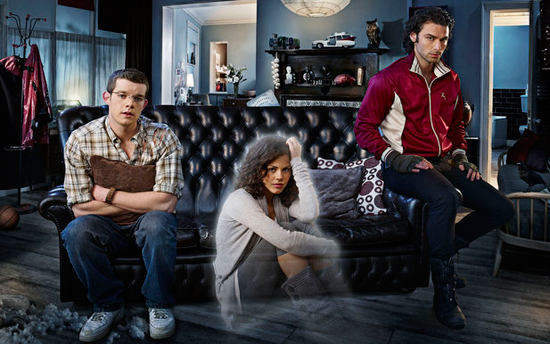
In Being Human’s second season, the wacky roommate set-up is mostly strained beyond credibility, as the supernatural narratives outstrip what can be contained in a small apartment in Bristol. George Sands’ (Russell Tovey) “infection” of his girlfriend Nina (Sinead Keenan) with the werewolf bug leads to a standard (and dull) dumped-by-girlfriend plot. Annie (Lenora Crichlow), the ghost who haunts the series, continues to struggle with not taking the Door to the Other Side, but when these doors keep popping up in the closed confines of the house, it begins to look like she’s resisting being sucked into various closets.
Mitchell (Aidan Turner), the dark-eyed Irish vampire who struggles with his blood addiction, continues to be the best character. Having destroyed the evil head vampire, Herrick, in the first series, the vampire world of Bristol is in disarray. All the careful arrangements the vampires have made to get their fix without setting off alarm bells with the local authorities begin to break down. Mitchell comes up with an ingenious and loopy solution: a twelve-step program. And for a while it works, keeping the bloodthirsty undead at bay with coffee, cigarettes, personal confession and group affirmation.
When he’s not saving the world, Mitchell checks in with his housemates, offering advice to the dumped George (“Move on, mate”) or interacting with whatever it is Annie does. There’s a rebound plot with George and a single mom, which is almost worth enduring just to get to a frightening scene where George begins his monthly conversion in the midst of a primary school parent night.
The family that scares together...
Religion finally rears its head in this series, and in the conception of the post-Christian writers, its far more monstrous than any of the roommates. We know Lucy (Lyndsey Marshal) the scientist has gone off the righteous path because she’s written a positive research paper on Intelligent Design. She’s drawn in by an undertaker-like Anglican priest, Kemp (Donald Sumpter), who wants to use her knowledge as a researcher to destroy the vampires and “cure” the werewolves. Despite a scene showing a vampire attack that killed his family, Kemp’s only real motivation is “religion” in the worst sense—his character is a bloodless stereotype of the soul-shriveled moral crusader.
Lucy is far more fascinating, and she could have benefitted from a more compelling story arc had the producers had a bit more commitment. She’s a Christian and a scientist whose interest in monsters comes from a desire to discover a genetic cause for evil. There’s something formidable about her as a character, and when she and Mitchell fall for each other, I found myself wishing for an extended romance between Christian and vampire. It was not to be, however, as she quickly descends into the character of mad scientist, poisoned further with religious zeal. After the obligatory prayer scene kneeling at an altar, she collaborates with Kemp on blowing up one of Mitchell’s twelve-step sessions. On this show, monsters get to be three-dimensional characters, but Christians don’t.
Once Mitchell realizes he’s been duped by the woman he loves, he falls off the wagon—way off the wagon. The mass slaughter of 20 people on a commuter train that Mitchell undertakes in revenge becomes a national tragedy, with the intense police and media scrutiny that follows. Although Mitchell doesn’t admit to his friends what he’s done, he persuades George, Nina, and Annie to flee Bristol for Wales.
The third season has the four of them renting a closed-down B&B in a shabby seaside town in Wales. The house is now truly haunted by Mitchell’s act of abject evil. Whatever limitations the domestic space presented before are transformed, as the housemates begin hiding their secrets not just from the world, but from each other.
This inner secrecy is amplified as each episode brings a strange new temporary visitor that the roommates must contend with. Guests include a horny vampire teenager (who’s actually 46 – they don’t physically age) who’s been living “clean” by nursing the blood of his parents, a Welsh party girl who died in a drunk driving accident and now exists as a decaying zombie, and a dorky vampire fanboy of Mitchell. Also living in town are a “respectable” middle class vampire couple that indulges their blood hunger by finding willing S&M slaves on Craigslist; a father and son werewolf team that have become crusading vampire-killers; and, touchingly, George’s father, who may well be a ghost, but whose main problem is learning how to express passion for his wife.
Before long (and not a moment too soon) the former head vampire Herrick is resurrected. (Apparently you really do have to stake them through the heart; simply having a werewolf rip out their throats isn’t enough.) Played magnificently by Jason Watkins, Herrick comes to the house dry of blood and in a state of dementia. The housemates allow him to live as the crazy uncle in the attic just to keep from drawing attention to their monster clan. But as he slowly begins to recover his faculties and his bloodlust returns, his restoration to scene-chewing evil is truly terrifying to behold.
Meanwhile, even a budding romantic relationship with Annie and friendship with George and (the now wolf-pregnant) Nina, can’t bring Mitchell to own up to the truth about committing mass murder back in Bristol. He’s a mess and a liar, and his continued descent threatens everyone around him. The program portrays with eerie accuracy the family chaos caused by an addict cut off from treatment and support. Eventually, their cozy supernatural family set-up is destroyed by his duplicity.
I closed my review of series one of Being Human series one with a reflection on the idea of human frailty as “shadow” versus “sin.” What the show captures in these latter two seasons are the “monsters” that so often get pushed to the edges of human community: the diseased and the dying, sex “perverts,” addicts, social misfits, the homeless, acne-afflicted teenagers whose horniness seems to work in inverse proportion to their attractiveness, the mentally ill; and even those who society allows to become monstrous to keep these other monsters at bay—like police, soldiers, and coroners. (A guy in my dorm in college was training to be a coroner; they’re not like you and me, these people.)
Bringing large and intractable social problems down to size in a domestic setting is the purpose of both classic melodrama and its modern equivalent, the situation comedy. Being Human straddles both genres, most successfully in the third season. But this domestic focus continues to be what separates the show from other vampire fare in television and movies. Like True Blood or even (cough) Twilight, Being Human unleashes the nightmares of the human shadow in metaphorical monster form. But here, it all happens within a house, behind closed doors, with a voyeuristic world peeping through the windows. Let’s hope the next season continues to keep the drama “all in the family.”
Previous Post

May 6, 2011
Of Gods and Leadership
Next Post
May 18, 2011 There's Beauty in those Messy Places
Browse Our Archives
Select a Category Classics DVD Film Music News Pop Culture Events Print Sports Television Uncategorized Video Games
Select a Month March 2017 February 2017 January 2017 December 2016 November 2016 October 2016 September 2016 August 2016 July 2016 June 2016 May 2016 April 2016 March 2016 February 2016 January 2016 December 2015 November 2015 October 2015 September 2015 August 2015 July 2015 June 2015 May 2015 April 2015 March 2015 February 2015 January 2015 December 2014 November 2014 October 2014 September 2014 August 2014 July 2014 June 2014 May 2014 April 2014 March 2014 February 2014 January 2014 December 2013 November 2013 October 2013 September 2013 August 2013 July 2013 June 2013 May 2013 April 2013 March 2013 February 2013 January 2013 December 2012 November 2012 October 2012 September 2012 August 2012 July 2012 June 2012 May 2012 April 2012 March 2012 February 2012 January 2012 December 2011 November 2011 October 2011 September 2011 August 2011 July 2011 June 2011 May 2011 April 2011 March 2011 February 2011 January 2011 December 2010 November 2010 October 2010 September 2010 August 2010 July 2010 June 2010 May 2010 April 2010 March 2010 February 2010 January 2010 December 2009 November 2009 October 2009 September 2009 August 2009 July 2009 June 2009 May 2009 April 2009 March 2009 February 2009 January 2009 December 2008 November 2008 October 2008 September 2008 August 2008 July 2008 June 2008 May 2008 April 2008 March 2008 February 2008 January 2008 December 2007 November 2007 October 2007 September 2007 August 2007 July 2007 June 2007 May 2007 April 2007 March 2007
Follow Us!
TAKE THE
Religious Wisdom Quiz
Who said to Jesus, "Remember me when you come into your kingdom"?
Select your answer to see how you score.
The thief on the cross Peter Thomas Mary Magdalene
Related posts from Pop Theology

#KillerSerials: THE PATH, S2 Ep. 11
#KillerSerials: THE PATH, S2 Ep. 10

#KillerSerials: THE PATH S2, E8
TRENDING AT PATHEOS Progressive Christian

Why Christians Have a Sacred Duty to Vote:...
The Bible offers strong support for the sacred duty to vote. Here...

What Being a Modern-Day Apostle Means to Me
In my last column, I discussed the ins and outs of modern-day...

Did Ancient China Once Worship the God of...
Across human history, a common thread weaves through the origins of the...

Love Your Neighbor – Including Earth-Kin: Lev. 19,...
God’s command to love your neighbor means acting in an ethical and...

Lead a Church Study of “Jesus and Lao...
Guest writer Jack Thomas (The Irreverent Reverend) reflects on leading his church...

Principles for Understanding the Apostolic Ministry Today
Whenever people discover that my formal ministry title is "apostle," as in...
view all Progressive Christian blogs
Ad-Free & Subscriber Log-In Subscription Support
- About Us
- 2026 Calendar
- Videos
- Podcasts
- Library of World Religions
- Faith In Media Tracker
- Advertise With Us
- Write for Us
- Privacy Policy
- Terms of Service
- Do Not Sell My Data
- Contact Us
- Radiant Digital
- Manage Newsletter Subscriptions
- Unsubscribe From Notifications
- Sitemap
Copyright 2008-2026, Patheos. All rights reserved.
Subscription Support Ad-Free & Subscriber Log-In
Follow Patheos