
BuddhistCatholicContemplativeEvangelicalGeneral ChristianHinduJewishLatter-day SaintMuslimNew VisionsProgressive Christian
Beliefs
- Buddhist
- Catholic
- Contemplative
- Evangelical
- General Christian
- Hindu
- Jewish
- Latter-day Saint
- More Voices
- Muslim
- New Visions
- Pagan
- Progressive Christian
Topics
- Religion News
- Food and Religion
- Sports and Religion
- Religious Art
- Religious Music and Entertainment
- Religious Events
- History and Religion
- Style and Religion
- Politics and Religion
- Women in Religion
- Recreation Outdoors and Religion
- Business Finance and Religion
- Careers Workplace and Religion
- Education and Religion
- Family Parenting and Religion
- Health Fitness and Religion
- Home and Religion
- Relationships and Religion
- Technology and Religion
- Travel and Religion
Columnists
- Buddhist Columnists
- Business Finance and Religion Columnists
- Careers Workplace and Religion Columnists
- Catholic Columnists
- Contemplative Columnists
- Education and Religion Columnists
- Evangelists Columnists
- Family Parenting and Religion Columnists
- General Christian Columnists
- Health Fitness and Religion Columnists
- Hindu Columnists
- History and Religion Columnists
- Home and Religion Columnists
- Jewish Columnists
- More Voices Columnists
- Latter Day Columnists
- Muslim Columnists
- New Visions Columnists
- Nonreligious Columnists
- Pagan Columnists
- Politics and Religion Columnists
- Progressive Columnists
- Recreation Outdoors and Religion Columnists
- Relationships and Religion Columnists
- Religion News Columnists
- Religious Art Columnists
- Religious Events Columnists
- Religious Music and Entertainment Columnists
- Sports and Religion Columnists
- Style and Religion Columnists
- Technology and Religion Columnists
- Travel and Religion Columnists
- Women in Religion Columnists
Resource Library
- 2026 Calendar
- Library of World Religions
- The 100 Most Holy Places on Earth
- Patheos Answers
- Podcasts
- Videos
- Faith Leaders Database
- Anglican Episcopalian
- Bahai
- Baptist
- Buddhism
- Christianity
- Confucianism
- Eastern Orthodoxy
- Hinduism
- Holiness and Pentecostal
- ISKCON
- Islam
- Judaism
- Lutheran
- Methodist
- The Church of Jesus Christ of Latter-day Saints
- New Age
- Paganism
- Presbytarian and Reformed
- Protestantism
- Religion Behind the Scenes
- Roman Catholic
- Scientology
- Shia Islam
- Sikhism
- Sufism
- Sunni Islam
- Taoism
- Zen
- See all religions
Research Tools
 Ad-Free & Subscriber Log-In Subscription Support
Ad-Free & Subscriber Log-In Subscription Support
Follow Patheos 

- Trending:
- Forgiveness
- |
- Marriage
- |
- Consciousness
- |
- Death Penalty
- |
- Election
- |
- Halloween
 Pop Theology
- Home
- Progressive Christian
- Religious Music & Entertainment
- OF GODS AND MEN: Loving your Neighbor—when your Neighbor is Death
OF GODS AND MEN: Loving your Neighbor—when your Neighbor is Death
Last updated on: April 11, 2011 at 8:37 am by J. Ryan Parker
OF GODS AND MEN: Loving your Neighbor—when your Neighbor is Death 2011-04-11T08:37:23-07:00 J. Ryan Parker
Patheos Explore the world's faith through different perspectives on religion and spirituality! Patheos has the views of the prevalent religions and spiritualities of the world.
In his latest article, Richard Lindsay engages in something of a review/conversation of the new film Of Gods and Men with Mike Campos, a fellow, recent PhD grad at the Graduate Theological Union.
Of Gods and Men tells the story of a group of French Trappist monks in Algeria killed by Islamic militants in 1996. Giving away the monks’ fate is not much of a spoiler, especially since the film is based on a true story which you can find online. What fascinates and moves viewers, including the jury at Cannes which gave the film the Grand Prix in 2010, is the film’s speculation on why, given ample opportunity to escape, the monks stayed in their precarious and isolated community under the continuing threat of death.
Helping me interpret the film is Mike Campos, a classmate (and recent graduate) of GTU’s doctoral program. Mike was a novice in a monastic community in Vermont before returning to his studies and career as a Catholic religious educator. The following exchange only begins to capture the intense café conversation Mike and I had after viewing this enormously moving and deeply theological film.
RL: Summarizing in brief, the film slowly and beautifully introduces us to this small order of nine men who work, eat, study, and pray together at this tiny outpost of Christianity in the Muslim world. The brothers are not closed off from the world around them; there seems to be a respectful understanding between the monks and the community that reflects a similarly devout, although culturally and religiously different, devotion to God.
The village and the monastery are soon forced to a crisis by the invasion of Islamic militants, who demand a more fundamentalist approach to the faith. Even Muslims who do not share their zeal are in danger of torture or beheading. On Christmas Eve night, the militants confront and threaten the monks, and only the quick thinking of Brother Christian, the head of the monastery, who makes an appeal to their common reverence for Jesus Christ, saves the monks from possible death. Conditions continue to deteriorate, however, bringing both continued threats from the Islamic militia and unwanted attention from the Algerian army. The brothers must then wrestle with the possibility of abandoning their monastery and the village or staying and facing almost certain death.
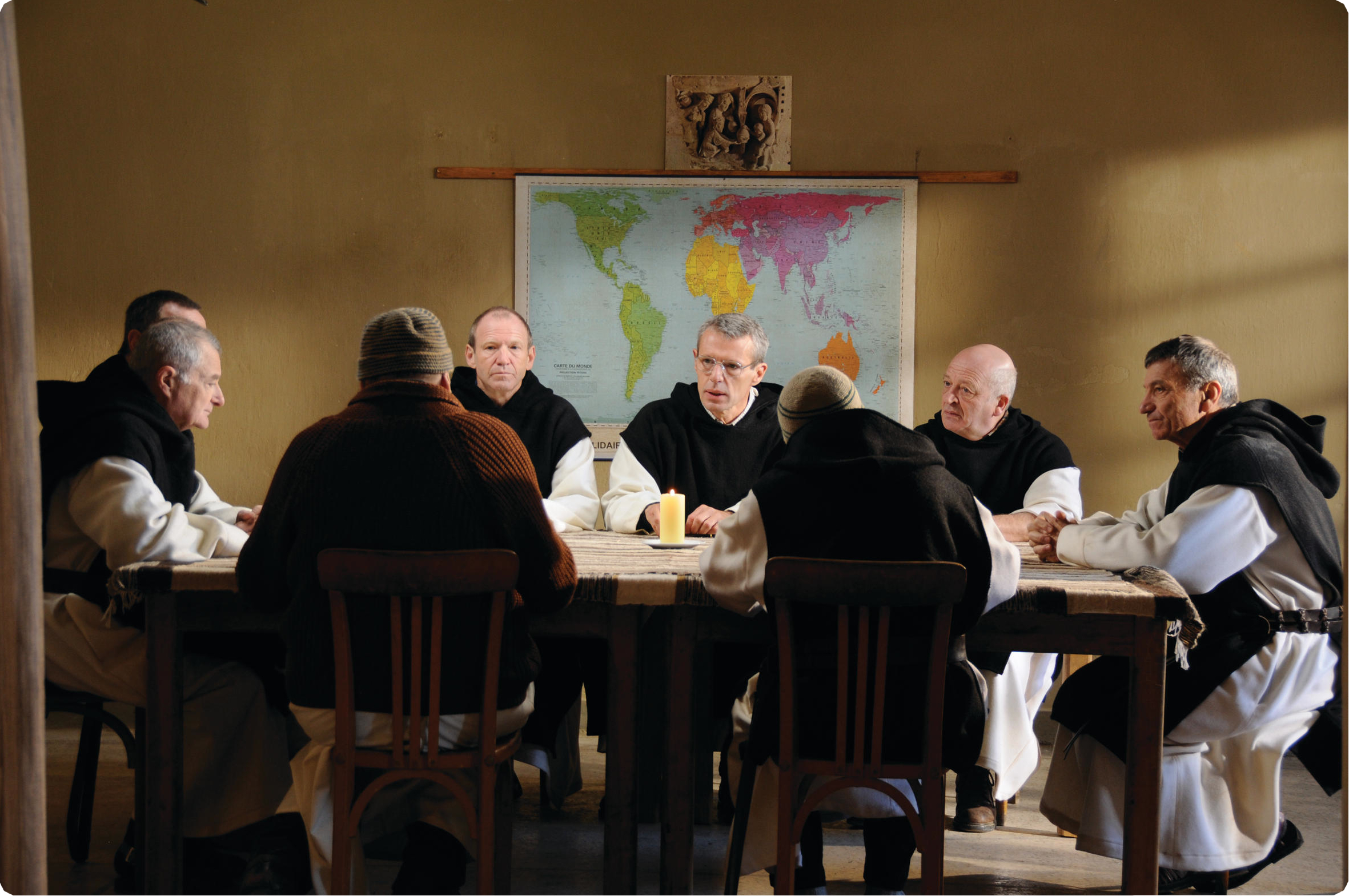
Mike, one of the things that struck me about the film was that it allowed us to get into the rhythm of daily life of the brothers before the “action” of the story started. You see how integrated they are in the life of the village, as they provide medical care and small acts of charity for the villagers. You see them attending a community religious function where the brothers are praying right alongside the villagers as they read the Koran. There’s the touching scene where one of the brothers gives grandfatherly advice about love to a teenage girl from the village. They really have become integrated into the life of the village, and the difference in faiths had been overcome by their dependence on each other.
You also see the brothers going about their daily tasks of tending the garden, gathering wood, and collecting honey to sell at the local market, punctuated by the prayers of the daily office. You said this film captured the feel of monastic life, both in the activities of the brothers and in their relationships with one another. Tell me more about that.
MC: The sense of integration you highlight resonates with my own (brief) experience of monastic life. Living in the context of an intentional community means straddling a “double rhythm” of sorts: the rhythm that develops in the embrace of the brotherhood and the larger—equally palpable—rhythm that defines a monastery’s relationship with the world. Holding both in tension is key to monastic life; one can only embrace the gift of solitary loving within community.
These tensions between the individual and the broader community, between the monastic enclosure and the world, came out in the way the film framed the monks’ daily prayers. Shuffling in the early morning darkness to chapel, the monks take their places in seats worn down by the consistency of time and place. Some sit upright, most seem ready to fall off the pews—aging bodies barely able to keep the weight of sleepiness at bay. The viewer is drawn to the immensity of silence itself; it both invites and repels. One is truly alone. There is something both beautiful and overwhelming here.
In significant ways, this framing of monastic prayer echoed the monks’ interactions with the community beyond the enclosure. The sense of peace, order and calm on the monastic grounds is heightened by the “intrusions” of the outside world: villagers seeking Brother Luc’s medical assistance, friends and workers who assist the monks in their daily work, even the Islamic militia men who force their way into the enclosure. All embody the larger political crisis of their location as French nationals living in Algiers, a colonial remnant. These intrusions define the “feel” and shapes the narrative of the film. In a sense, the entire film evokes monastic sensibility itself. It is rhythmical, punctual—and intrusive.

RL: What you’ve mentioned about your experience in the monastery was the kind of diffuse eroticism at play in the community. The natural eros of relationships is not repressed, but spread amongst the various members of the community. We saw this in the affection the monks had for one another, which was sometimes expressed physically, through greeting each other with a kiss, or massaging a tense shoulder, but never in an overtly sexual way.
Individual personalities are not destroyed by the community but heightened in community. This is particularly important as the monks go through the difficult process of discernment whether or not to stay in the face of threats of the militants and army. Each personality is allowed to go through his own doubts and fears, or to contribute his own exhortation to the community. No opinion, not even that of the abbot, Brother Christian, is allowed to decide for the group.
By the end of the film, you can begin to see why, based on their theology, they decided to stay. The imperative to continue the ministry of prayer, outreach, and daily work is heightened by the threat, until simply performing these “mundane” tasks take on great importance as acts of resistance.
I was also moved by the theology some of the monks narrated in the letters they wrote, explaining why they were continuing to stay and serve in the monastery despite the risk to their lives. One line that struck me was, “In our failure we come closer to God.” As a Protestant, I have been trained to see failure as a sign of God’s disfavor and a spur to change, reformation, and renewal. That idea of failure as a means to the divine was particularly hard for me to swallow.
MC: I think you’re onto something by describing monastic relationships as a form of “diffuse eroticism.” I understand this to mean two things: a desire or attachment that draws one to another, and the implicit sense of the other’s mystery that attends to this desire. Holding both in tension allows for a form of desire that keeps community intact and alive*.***
The kind of desire that undergirds monastic life—beautifully portrayed in the film—is apparent in the monks’ very approach to work and rhythm. Labor is not understood to be external to one’s self/body/spirit. It is integral. It is the way in which one relates with others: thus the sense of paternal love that Brother Luc’s medical service embodies, the implicit gesture of community nourishing that frames their production of honey, the attention to the fruits of their garden work. All of these evoke a type of desire that enlivens their relationships both within and outside the monastic enclosure.
If viewed in this way, desire could be said to “justify” or “explain” their decision to remain even at the threat of death. When one relates with community—each other, the villagers, the land, the government, the militia—one simply does not leave and sever. In each brother’s individual struggle over whether to leave or to remain, they reconsider what it means to relate, to love, to embody that “diffuse eroticism” you named. Their decision to stay, in a sense, exposes a deeper commitment to relationships, individuals and people that transcend the momentary crisis of politics.
One of the most moving scenes for me occurs at the moment when the Brother Christian stands toe-to-toe with the militia leader. Beyond the tense exchange of words, the prevailing threat of violence, I was moved most by the sense of “recognition” both men extend to the other. In the span of a moment, both saw each other as a person, worthy not just of respect, but of desire.
RL: The relationship and desire you mention also leads to a moving transformation of their relationships with their own lives. At one point, Brother Luc tells Brother Christian that he no longer fears death: “I am a free man.” This would seem contradictory to the Western materialist idea that true freedom can only come through unfettered individuality and a kind of grasping relationship with one’s own survival and personal fulfillment.
The most moving scene for me was near the end, when they have all decided to stay, knowing the deadly consequences of their decision. They are having dinner together, and one of the brothers puts on a recording of Swan Lake. Of course, my obsession with camp made me chuckle at this. (If you must die a martyr, make your exit with Swan Lake). But the scene was tremendously affecting as the camera focused on each person in the community as he savored his meal and dining with his brothers. You could tell the wine was somehow more fragrant and delicious. The strains of the music were more beautiful. It illuminated the great truth in the phrase from the Gospels, “Whoever tries to save his life shall lose it, and whoever loses his life shall preserve it.”
Seeing this film also makes me appreciate the rich heritage of Christianity (or Christianities) that I have been blessed to observe through my continuing study of scripture and theology. When the monks are reading that passage from Luke 17 about giving one’s life for the “Kingdom,” the community of God—about the choice to save one’s life or to preserve it— even the part which says, “on that night two people will be in one bed; one will be taken and the other left,” which becomes almost literally true for the brothers, I see the deep layers of my religion from a different perspective and life experience. The monks’ practice of Christianity is not my own, but I feel I have access to understanding it. It comes from dedicating yourself to a tradition—really studying it and letting it seep into your bones until you can see the deeper connections of theology and scripture. This is infinitely more rewarding than our culture’s ubiquitous “spiritual but not religious” stance.
MC: Of Gods and Men also touched something fundamental for me about the nature of faith itself. The awkward separation we put today between spirituality and religion is trumped in light of these monks’ illogical decision to remain—and so face the possibility of death. As I’ve said before, this choice only makes sense when we understand their sense of relationality to one another, to the community—even to the militia men—as something that arises from one’s embrace of God. In this regard, they embody the very nature of religion as truly a “re-binding” with another; the kind of commitment that allows room for the other to be. While their very commitment—to God, to each other, to the communities with whom they’ve created life—is truly embodied, it evokes that “grasping for the un-graspable” that has long been part of a believer’s way of being. Christians describe this in poetically apophatic terms—the love that comes from embracing Someone who remains complete Mystery.
Like you, I had to sit back and think a bit about Brother Luc’s notion of “freedom.” What does it mean, indeed, to allow seemingly dehumanizing circumstances take control of one’s life? What does this seeming abdication from responsibility—to one’s self, to one’s community (of accountability?)—say about one’s obligation to uphold life and meaning? In the end, these monks didn’t so much “give up” as “give themselves over” to the mystery of loving. Thus they chose to stay. They chose the possibility of death as the consequence of their larger responsibility to love. There’s great freedom in this.
Ultimately, the merit of the film lies in its ability to hold in tension themes of responsibility and letting go; of death and life; of loving and violence, without proffering the cheap resolution to these tensions of a “spiritual-but-not-religious” perspective. In doing so, the movie exposes the abundant mystery that undergirds humanity itself.
Previous Post

March 28, 2011
Finally, A Vampire that Really Sucks...
Next Post
April 20, 2011 The Newest Pop Theology Member
Browse Our Archives
Select a Category Classics DVD Film Music News Pop Culture Events Print Sports Television Uncategorized Video Games
Select a Month March 2017 February 2017 January 2017 December 2016 November 2016 October 2016 September 2016 August 2016 July 2016 June 2016 May 2016 April 2016 March 2016 February 2016 January 2016 December 2015 November 2015 October 2015 September 2015 August 2015 July 2015 June 2015 May 2015 April 2015 March 2015 February 2015 January 2015 December 2014 November 2014 October 2014 September 2014 August 2014 July 2014 June 2014 May 2014 April 2014 March 2014 February 2014 January 2014 December 2013 November 2013 October 2013 September 2013 August 2013 July 2013 June 2013 May 2013 April 2013 March 2013 February 2013 January 2013 December 2012 November 2012 October 2012 September 2012 August 2012 July 2012 June 2012 May 2012 April 2012 March 2012 February 2012 January 2012 December 2011 November 2011 October 2011 September 2011 August 2011 July 2011 June 2011 May 2011 April 2011 March 2011 February 2011 January 2011 December 2010 November 2010 October 2010 September 2010 August 2010 July 2010 June 2010 May 2010 April 2010 March 2010 February 2010 January 2010 December 2009 November 2009 October 2009 September 2009 August 2009 July 2009 June 2009 May 2009 April 2009 March 2009 February 2009 January 2009 December 2008 November 2008 October 2008 September 2008 August 2008 July 2008 June 2008 May 2008 April 2008 March 2008 February 2008 January 2008 December 2007 November 2007 October 2007 September 2007 August 2007 July 2007 June 2007 May 2007 April 2007 March 2007
Follow Us!
TAKE THE
Religious Wisdom Quiz
Place me like a seal over your heart, for love is as strong as death and burns like what?
Select your answer to see how you score.
The sun Lightning A torch A blazing flame
Related posts from Pop Theology


At SXSW2017: May It Last: A Portrait of...

At SXSW 2017: "Untold Tales of Armistead Maupin"
TRENDING AT PATHEOS Progressive Christian

Why Christians Have a Sacred Duty to Vote:...
The Bible offers strong support for the sacred duty to vote. Here...

What Being a Modern-Day Apostle Means to Me
In my last column, I discussed the ins and outs of modern-day...

Did Ancient China Once Worship the God of...
Across human history, a common thread weaves through the origins of the...

Love Your Neighbor – Including Earth-Kin: Lev. 19,...
God’s command to love your neighbor means acting in an ethical and...

Lead a Church Study of “Jesus and Lao...
Guest writer Jack Thomas (The Irreverent Reverend) reflects on leading his church...

Principles for Understanding the Apostolic Ministry Today
Whenever people discover that my formal ministry title is "apostle," as in...
view all Progressive Christian blogs
Ad-Free & Subscriber Log-In Subscription Support
- About Us
- 2026 Calendar
- Videos
- Podcasts
- Library of World Religions
- Faith In Media Tracker
- Advertise With Us
- Write for Us
- Privacy Policy
- Terms of Service
- Do Not Sell My Data
- Contact Us
- Radiant Digital
- Manage Newsletter Subscriptions
- Unsubscribe From Notifications
- Sitemap
Copyright 2008-2026, Patheos. All rights reserved.
Subscription Support Ad-Free & Subscriber Log-In
Follow Patheos