
BuddhistCatholicContemplativeEvangelicalGeneral ChristianHinduJewishLatter-day SaintMuslimNew VisionsProgressive Christian
Beliefs
- Buddhist
- Catholic
- Contemplative
- Evangelical
- General Christian
- Hindu
- Jewish
- Latter-day Saint
- More Voices
- Muslim
- New Visions
- Pagan
- Progressive Christian
Topics
- Religion News
- Food and Religion
- Sports and Religion
- Religious Art
- Religious Music and Entertainment
- Religious Events
- History and Religion
- Style and Religion
- Politics and Religion
- Women in Religion
- Recreation Outdoors and Religion
- Business Finance and Religion
- Careers Workplace and Religion
- Education and Religion
- Family Parenting and Religion
- Health Fitness and Religion
- Home and Religion
- Relationships and Religion
- Technology and Religion
- Travel and Religion
Columnists
- Buddhist Columnists
- Business Finance and Religion Columnists
- Careers Workplace and Religion Columnists
- Catholic Columnists
- Contemplative Columnists
- Education and Religion Columnists
- Evangelists Columnists
- Family Parenting and Religion Columnists
- General Christian Columnists
- Health Fitness and Religion Columnists
- Hindu Columnists
- History and Religion Columnists
- Home and Religion Columnists
- Jewish Columnists
- More Voices Columnists
- Latter Day Columnists
- Muslim Columnists
- New Visions Columnists
- Nonreligious Columnists
- Pagan Columnists
- Politics and Religion Columnists
- Progressive Columnists
- Recreation Outdoors and Religion Columnists
- Relationships and Religion Columnists
- Religion News Columnists
- Religious Art Columnists
- Religious Events Columnists
- Religious Music and Entertainment Columnists
- Sports and Religion Columnists
- Style and Religion Columnists
- Technology and Religion Columnists
- Travel and Religion Columnists
- Women in Religion Columnists
Resource Library
- 2026 Calendar
- Library of World Religions
- The 100 Most Holy Places on Earth
- Patheos Answers
- Podcasts
- Videos
- Faith Leaders Database
- Anglican Episcopalian
- Bahai
- Baptist
- Buddhism
- Christianity
- Confucianism
- Eastern Orthodoxy
- Hinduism
- Holiness and Pentecostal
- ISKCON
- Islam
- Judaism
- Lutheran
- Methodist
- The Church of Jesus Christ of Latter-day Saints
- New Age
- Paganism
- Presbytarian and Reformed
- Protestantism
- Religion Behind the Scenes
- Roman Catholic
- Scientology
- Shia Islam
- Sikhism
- Sufism
- Sunni Islam
- Taoism
- Zen
- See all religions
Research Tools
 Ad-Free & Subscriber Log-In Subscription Support
Ad-Free & Subscriber Log-In Subscription Support
Follow Patheos 

- Trending:
- Forgiveness
- |
- Marriage
- |
- Consciousness
- |
- Death Penalty
- |
- Election
- |
- Halloween
 Pop Theology
- Home
- Progressive Christian
- Religious Music & Entertainment
- The Adjustment Bureau: ‘We’re from God and We’re Here to Help’
The Adjustment Bureau: ‘We’re from God and We’re Here to Help’
Last updated on: March 21, 2011 at 9:09 am by J. Ryan Parker
The Adjustment Bureau: ‘We’re from God and We’re Here to Help’ 2011-03-21T09:09:18-07:00 J. Ryan Parker
Patheos Explore the world's faith through different perspectives on religion and spirituality! Patheos has the views of the prevalent religions and spiritualities of the world.
Pop Theology contributor Richard Lindsay reviews The Adjustment Bureau after the jump.
“God has a plan.” How many times have we heard this bit of wisdom in times of crisis or loss? There has to be some meaning in the events that shape our individual lives and mutual history. Somebody must be in charge. What happens if this is not true? How do we explain the seemingly contradictory notions of a loving God, or at least a meaningful universe, and the random accidents that cause human pain and misery—and even more inexplicably, joy and fulfillment?
The Adjustment Bureau takes this line of thinking to its logical (or absurd) conclusion. If God has a plan, and we have some level of choice, it must be possible to go “off plan.” If that’s the case, then God must be constantly making “adjustments” at the micro and macro level. Changing a few circumstances so two strangers meet and fall in love might be simple enough. Arranging things so the right person runs for president and changes the history of the world would take a lifetime of interventions, perhaps even cruel and incomprehensible actions, to pull off. Think how much the last three U.S. presidents have been shaped by a desperate need for acknowledgment from absent or disapproving fathers. If God wanted to arrange for the “right person” to be elected to this crucial office, wouldn’t the gaping emotional hole that wished to be filled by public acclaim and a guiding sense of purpose have to be engineered by the circumstances of this person’s life?
Matt Damon’s character, David Norris, is just such a figure. His rough-and-tumble upbringing in Brooklyn and loss of his family at a young age have led him against the odds to the precipice of greatness. The youngest person ever elected to Congress, he now wants to be the next Senator from New York. And from there, the sky’s the limit. He still has some rowdy tendencies that get him in trouble—a bar fight and a mooning incident cause him to lose his first Senate campaign. But then he meets this lovely woman, Elise (Emily Blunt), who inspires him to make the best concession speech in the history of politics, setting him up for his next run. There’s just one problem: she fills the emotional hole that was causing him to run for office. People who are content with life don’t generally have the megalomania required to run for the office of Most Powerful Person in the World. Congressman Norris meeting Elise and finding happiness would put him “off-plan.” An adjustment must be made. The relationship must be stopped.
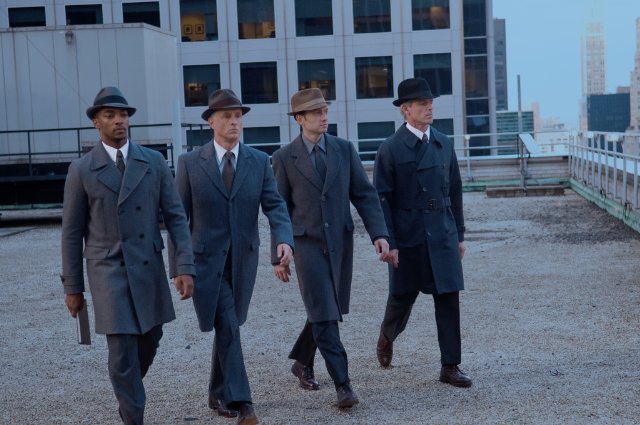
The Bureau.
Then the film takes a deliciously comic turn. What if, in order to keep the cosmic clockwork moving, God needs not miracles or angels, but something more like a bureaucracy? That’s where the Adjustment Bureau comes in. These are the men with hats and grey suits who keep history going in the right direction. And, like any bureaucracy, the underlings don’t know the whole story. They’re organization men. Their main purpose is to keep the bosses happy and move up the ladder, not to question the morality of their actions. And sometimes mistakes are made. Blame is shifted. The fixers in the corner office have to come in and clean things up.
These roles are played quite entertainingly by John Slattery (the unguinous Roger Sterling from Mad Men), Anthony Mackie, and the incomparable Terrence Stamp (who despite his penchant for playing hard-as-nails bad guys I shall always remember rouged up and in drag as Bernadette from The Adventures of Priscilla, Queen of the Desert). These boys from the Home Office are straight-laced and ruthless. Middle manager Richardson, played by Slattery, causes a potentially deadly accident to keep David Norris from taking a cab to find his girlfriend; and it’s suggested that the death of Norris’ brother and father were caused by the Bureau. At the same time, they’re comically undermanned (budget cuts, no doubt) and constantly having to bend time and space to keep their more creative human subjects from going off-plan.
The film was written and directed by George Nolfi, based on a story by master science fiction writer (and Berkeley High School’s own) Philip K. Dick. Nolfi was a screenwriter on Ocean’s Twelve and The Bourne Ultimatum, and therefore presumably has experience writing stage directions like: “Matt Damon is pursued by people trying to kill him.” The film is brilliantly balanced. It takes deft storytelling to make the men in hats simultaneously dangerous and slightly inept. The film is spare, like a short story well-adapted for the screen. The acting and dialogue are understated and efficient without being dull, and Nolfi resists the temptation to show off with special effects. There is CGI, but the film could easily have been made fifty years ago without missing a step on the visuals.
The crux of the film is free will versus predestination, Calvin versus Aquinas, Plato versus Aristotle—a romantic comedy of Western metaphysics. Even the main characters—Elise is the spontaneous dancer in love with David the calculating politician—represent the interplay of philosophical opposites.
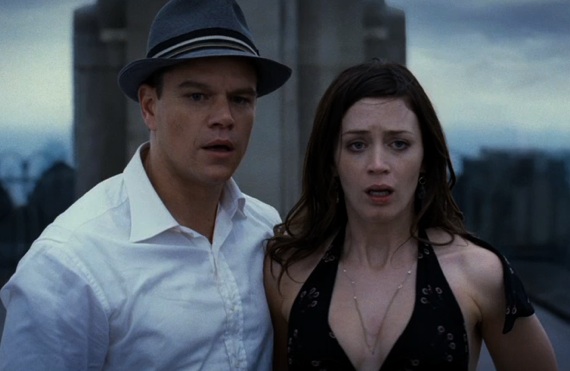
David (Matt Damon), the politician, and Elsie (Emily Blunt), the dancer.
I suspect some people may object to the sheer, brutal Calvinism of the Bureau. More “advanced” theological minds may suggest that we don’t think this way anymore, that we have matured in our view of humans as co-creators with God, or even beyond the idea of divine interference at all. But I’m not sure this is completely true. Having spent the last ten years of my life in the midst of theological education and religious leadership, the “will” of God weighs heavily on seminary students, ministers, and committed laypeople. Religious types are unfailingly intuitive, often following the dictates of their conscience against what seems logical or systematic. There are differing levels of this worldview, of course. Some of us believe in God’s will, but that our human nature and desire factor into God’s cosmic decision-making. Others feel our humanity only “gets in God’s way.” If you really want to torture an evangelical Protestant, wait until they’re making a difficult life decision and suggest, “But how do you know what you want is what God wants?”
This kind of thinking is bound up in many of our cultural and political assumptions as Americans. This country’s founders were fierce Calvinists who believed they were building a “City on a Hill.” They were elected, “called,” to this duty, and yet they were terrified of running afoul of the divine plan. Most of the current conflicts in American politics, from gay rights, to abortion, to the response to 9/11, to the “moral crisis” of the budget deficit, can be traced to the assumption—shared by liberals and conservatives—of the cosmic importance of American action and dread of running afoul of the sacred trust of our privileged position in history.
It all comes down to theodicy and theological anthropology. If you believe in a God who is present, who interferes, or has even been incarnate in human form, to some extent you believe in the Adjustment Bureau. What I like about the film is it suggests human error and random chance are the inevitable result of a species struggling to maturity. This world is all part of The Plan, not the result of The Fall. The film even suggests human beings can change God’s mind—which is not at all incompatible with Jewish and Christian scriptures.
My own belief is that God does not “cause” violent actions or purposefully deprive people of wholeness in order to keep history moving forward. But nevertheless pain, and the growth and moral evolution that comes with it, happens. God and humanity are on an adventure together in which the spiritual is becoming known in the material world. This is a messy process: at times tragic, at times joyful, at times absurd. A metaphysical romantic comedy indeed.
The Adjustment Bureau (106 mins.) is rated PG-13 for brief strong language, some sexuality and a spot of violence and is in theaters everywhere.
Previous Post

March 15, 2011
Graphic Religion
Next Post
March 25, 2011 The Lure of the Dark Side: A Review
Browse Our Archives
Select a Category Classics DVD Film Music News Pop Culture Events Print Sports Television Uncategorized Video Games
Select a Month March 2017 February 2017 January 2017 December 2016 November 2016 October 2016 September 2016 August 2016 July 2016 June 2016 May 2016 April 2016 March 2016 February 2016 January 2016 December 2015 November 2015 October 2015 September 2015 August 2015 July 2015 June 2015 May 2015 April 2015 March 2015 February 2015 January 2015 December 2014 November 2014 October 2014 September 2014 August 2014 July 2014 June 2014 May 2014 April 2014 March 2014 February 2014 January 2014 December 2013 November 2013 October 2013 September 2013 August 2013 July 2013 June 2013 May 2013 April 2013 March 2013 February 2013 January 2013 December 2012 November 2012 October 2012 September 2012 August 2012 July 2012 June 2012 May 2012 April 2012 March 2012 February 2012 January 2012 December 2011 November 2011 October 2011 September 2011 August 2011 July 2011 June 2011 May 2011 April 2011 March 2011 February 2011 January 2011 December 2010 November 2010 October 2010 September 2010 August 2010 July 2010 June 2010 May 2010 April 2010 March 2010 February 2010 January 2010 December 2009 November 2009 October 2009 September 2009 August 2009 July 2009 June 2009 May 2009 April 2009 March 2009 February 2009 January 2009 December 2008 November 2008 October 2008 September 2008 August 2008 July 2008 June 2008 May 2008 April 2008 March 2008 February 2008 January 2008 December 2007 November 2007 October 2007 September 2007 August 2007 July 2007 June 2007 May 2007 April 2007 March 2007
Follow Us!
TAKE THE
Religious Wisdom Quiz
What does James say someone who doubts is like?
Select your answer to see how you score.
A wave of the sea, blown and tossed by the wind A sheep without a shepherd A leaf falling from a tree A house built on sand
Related posts from Pop Theology


At SXSW2017: May It Last: A Portrait of...

At SXSW 2017: "Untold Tales of Armistead Maupin"
TRENDING AT PATHEOS Progressive Christian

Why Christians Have a Sacred Duty to Vote:...
The Bible offers strong support for the sacred duty to vote. Here...

What Being a Modern-Day Apostle Means to Me
In my last column, I discussed the ins and outs of modern-day...

Did Ancient China Once Worship the God of...
Across human history, a common thread weaves through the origins of the...

Love Your Neighbor – Including Earth-Kin: Lev. 19,...
God’s command to love your neighbor means acting in an ethical and...

Lead a Church Study of “Jesus and Lao...
Guest writer Jack Thomas (The Irreverent Reverend) reflects on leading his church...

Principles for Understanding the Apostolic Ministry Today
Whenever people discover that my formal ministry title is "apostle," as in...
view all Progressive Christian blogs
Ad-Free & Subscriber Log-In Subscription Support
- About Us
- 2026 Calendar
- Videos
- Podcasts
- Library of World Religions
- Faith In Media Tracker
- Advertise With Us
- Write for Us
- Privacy Policy
- Terms of Service
- Do Not Sell My Data
- Contact Us
- Radiant Digital
- Manage Newsletter Subscriptions
- Unsubscribe From Notifications
- Sitemap
Copyright 2008-2026, Patheos. All rights reserved.
Subscription Support Ad-Free & Subscriber Log-In
Follow Patheos