
BuddhistCatholicContemplativeEvangelicalGeneral ChristianHinduJewishLatter-day SaintMuslimNew VisionsProgressive Christian
Beliefs
- Buddhist
- Catholic
- Contemplative
- Evangelical
- General Christian
- Hindu
- Jewish
- Latter-day Saint
- More Voices
- Muslim
- New Visions
- Pagan
- Progressive Christian
Topics
- Religion News
- Food and Religion
- Sports and Religion
- Religious Art
- Religious Music and Entertainment
- Religious Events
- History and Religion
- Style and Religion
- Politics and Religion
- Women in Religion
- Recreation Outdoors and Religion
- Business Finance and Religion
- Careers Workplace and Religion
- Education and Religion
- Family Parenting and Religion
- Health Fitness and Religion
- Home and Religion
- Relationships and Religion
- Technology and Religion
- Travel and Religion
Columnists
- Buddhist Columnists
- Business Finance and Religion Columnists
- Careers Workplace and Religion Columnists
- Catholic Columnists
- Contemplative Columnists
- Education and Religion Columnists
- Evangelists Columnists
- Family Parenting and Religion Columnists
- General Christian Columnists
- Health Fitness and Religion Columnists
- Hindu Columnists
- History and Religion Columnists
- Home and Religion Columnists
- Jewish Columnists
- More Voices Columnists
- Latter Day Columnists
- Muslim Columnists
- New Visions Columnists
- Nonreligious Columnists
- Pagan Columnists
- Politics and Religion Columnists
- Progressive Columnists
- Recreation Outdoors and Religion Columnists
- Relationships and Religion Columnists
- Religion News Columnists
- Religious Art Columnists
- Religious Events Columnists
- Religious Music and Entertainment Columnists
- Sports and Religion Columnists
- Style and Religion Columnists
- Technology and Religion Columnists
- Travel and Religion Columnists
- Women in Religion Columnists
Resource Library
- 2026 Calendar
- Library of World Religions
- The 100 Most Holy Places on Earth
- Patheos Answers
- Podcasts
- Videos
- Faith Leaders Database
- Anglican Episcopalian
- Bahai
- Baptist
- Buddhism
- Christianity
- Confucianism
- Eastern Orthodoxy
- Hinduism
- Holiness and Pentecostal
- ISKCON
- Islam
- Judaism
- Lutheran
- Methodist
- The Church of Jesus Christ of Latter-day Saints
- New Age
- Paganism
- Presbytarian and Reformed
- Protestantism
- Religion Behind the Scenes
- Roman Catholic
- Scientology
- Shia Islam
- Sikhism
- Sufism
- Sunni Islam
- Taoism
- Zen
- See all religions
Research Tools
 Ad-Free & Subscriber Log-In Subscription Support
Ad-Free & Subscriber Log-In Subscription Support
Follow Patheos 

- Trending:
- Forgiveness
- |
- Marriage
- |
- Consciousness
- |
- Death Penalty
- |
- Election
- |
- Halloween
 Pop Theology
- Home
- Progressive Christian
- Religious Music & Entertainment
- Graphic Religion
Graphic Religion
Last updated on: March 15, 2011 at 8:06 am by J. Ryan Parker
Graphic Religion 2011-03-15T08:06:32-07:00 J. Ryan Parker
Patheos Explore the world's faith through different perspectives on religion and spirituality! Patheos has the views of the prevalent religions and spiritualities of the world.
With a dissertation dominating my time for the last year, comics and graphic novels got put on the back burner. With that beast behind me, I’m slowly returning to a realm of pop culture that I have missed. In an effort to get back into the habit of reading and critically engaging with comics and graphic novels, I recently read Graven Images: Religion in Comics and Graphic Novels, a collection of essays edited by David Lewis and Christine Hoff Kraemer. This is a fantastic work that proves not only the cultural importance of comics and graphic novels but the necessity of engaging them from theological and religious perspectives.
Douglas Rushkoff‘s forward, “Looking for God in the Gutter,” lays much of the theological and critical groundwork for the rest of the book. Rushkoff argues that the “gutters,” those spaces between panels in comics and graphic novels, is where the magic of the medium takes place. As Rushkoff puts it, “It’s the closest thing in comics to transubstantiation, and it happens between the unseen crack between two discreet moments. It is everything, yet nothing” (ix). These spaces contain all of the invisible activity that happens from one panel (scene) to the next, yet the rely on the reader to propel the story forward by filling in those blanks. In doing so, we make the invisible visible, even as the writers and artists make the invisible (superheroes, gods, monsters, other worlds, etc.) visible.
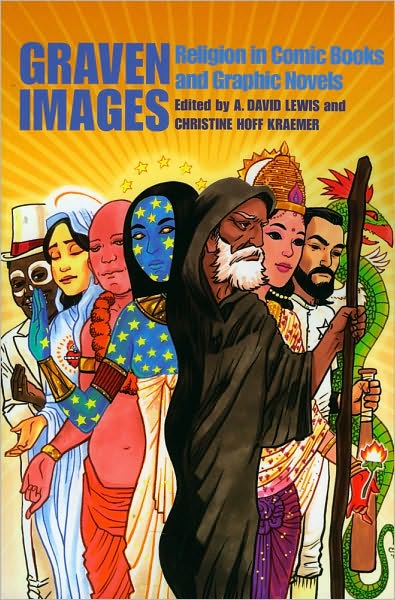
In their introduction, Kraemer and Lewis write, “While we do not necessarily wish to assert that comics are themselves a religion, they are one site where individuals grapple with issues of ethics, meaning, and values; engage in ritualized behavior; and explore both traditional and new religious traditions” (3). Here, they come very close to John Leydon’s analysis that film functions as religion. While I think Kraemer and Lewis could have gone farther here, they provide sufficient explanations of why comic books and graphic novels are important art forms and deserve theological and religious attention. The strength of their book is that they do not privilege one religion or genre over another. This is about as diverse a book on the religious and theological implications as you are likely to find. This is no “The Gospel According to…” approach to popular culture. The authors come from a variety of religious traditions and none at all. At they same time, the editors and authors avoid obsessing over popular comics series or graphic novels and address everything from Superman to Mormon comics. Graven Images also benefits from contributions to artists working in the medium who reflect on the ways in which religion and and the medium can inform and benefit from each other.
Kraemer and Lewis divide their 20+ articles into three broad topics, the ways in which comics and graphic novels become a new location for religious interpretation, the ways in which creators and readers of comics and graphic novels engage the medium as an act of religious rebellion or reification, and (closely related) how the medium evidences and advances a postmodern religiosity. The only article that seems out of place (as it should have been placed in the first, rather than the second, section is Darby Orcutt’s “Comics and Religion: Theoretical Connections,” which elaborates on the similarities between comics and religion. Orcutt argues that religion and comics/graphic novels share multiple characteristics because they are both multi-modal, iconic, immersive, and able to influence our experience of time.
It’s tempting, in a review like this, to give away all of the major points of each article, even by simply referencing what theme they address with each comic or graphic novel. I’ll provide a list of some of the topics covered below but before then I’d like to reference on particular essay that, while about a particular series, has implications for the broader field of religion and popular culture studies. In his article “Killing the Graven God: Visual Representations of the Divine in Comics,” Andrew Tripp discusses artists’ (in)ability to depict god in art, visual culture, etc. He discusses a variety of ways in which comic artists and graphic novelists have depicted God, some of which are potentially offensive. Tripp reminds us of two important points when critiquing religious art. First, “The symbols of God point to a greater understanding of what God is, a form of graphic shorthand whose alteration through the course of the narrative tells the reader not only about his or her understanding of God, but about the self-identity of the producing culture” (116). Second, “Possibly the most absurd image is the most important, however, because we can break through the symbol to see the meaning and significance instead of coming to accept the symbol in itself as God” (116). He concludes that rational displays of God are absurd and that the only logical means of depicting God is irrational and ever-changing…unknown and unknowable (118, 119).
There’s an explicitly universal implication here in Tripp’s essay, and while the other essays in Graven Images might seem more specific, they do as well. Other topics include:
Previous Post

March 14, 2011
Let It (Them) Be...
Next Post
March 21, 2011 The Adjustment Bureau: ‘We’re from God and We’re Here to Help’
Browse Our Archives
Select a Category Classics DVD Film Music News Pop Culture Events Print Sports Television Uncategorized Video Games
Select a Month March 2017 February 2017 January 2017 December 2016 November 2016 October 2016 September 2016 August 2016 July 2016 June 2016 May 2016 April 2016 March 2016 February 2016 January 2016 December 2015 November 2015 October 2015 September 2015 August 2015 July 2015 June 2015 May 2015 April 2015 March 2015 February 2015 January 2015 December 2014 November 2014 October 2014 September 2014 August 2014 July 2014 June 2014 May 2014 April 2014 March 2014 February 2014 January 2014 December 2013 November 2013 October 2013 September 2013 August 2013 July 2013 June 2013 May 2013 April 2013 March 2013 February 2013 January 2013 December 2012 November 2012 October 2012 September 2012 August 2012 July 2012 June 2012 May 2012 April 2012 March 2012 February 2012 January 2012 December 2011 November 2011 October 2011 September 2011 August 2011 July 2011 June 2011 May 2011 April 2011 March 2011 February 2011 January 2011 December 2010 November 2010 October 2010 September 2010 August 2010 July 2010 June 2010 May 2010 April 2010 March 2010 February 2010 January 2010 December 2009 November 2009 October 2009 September 2009 August 2009 July 2009 June 2009 May 2009 April 2009 March 2009 February 2009 January 2009 December 2008 November 2008 October 2008 September 2008 August 2008 July 2008 June 2008 May 2008 April 2008 March 2008 February 2008 January 2008 December 2007 November 2007 October 2007 September 2007 August 2007 July 2007 June 2007 May 2007 April 2007 March 2007
Follow Us!
TAKE THE
Religious Wisdom Quiz
What did the Israelites eat in the wilderness?
Select your answer to see how you score.
Manna Honey and milk Bread and fish Grapes and figs
Related posts from Pop Theology


#KillerSerials: An Interview with Kutter Callaway

Book Review: MUSLIMS AND THE MAKING OF AMERICA

TRENDING AT PATHEOS Progressive Christian

Why Christians Have a Sacred Duty to Vote:...
The Bible offers strong support for the sacred duty to vote. Here...

What Being a Modern-Day Apostle Means to Me
In my last column, I discussed the ins and outs of modern-day...

Did Ancient China Once Worship the God of...
Across human history, a common thread weaves through the origins of the...

Love Your Neighbor – Including Earth-Kin: Lev. 19,...
God’s command to love your neighbor means acting in an ethical and...

Lead a Church Study of “Jesus and Lao...
Guest writer Jack Thomas (The Irreverent Reverend) reflects on leading his church...

Principles for Understanding the Apostolic Ministry Today
Whenever people discover that my formal ministry title is "apostle," as in...
view all Progressive Christian blogs
Ad-Free & Subscriber Log-In Subscription Support
- About Us
- 2026 Calendar
- Videos
- Podcasts
- Library of World Religions
- Faith In Media Tracker
- Advertise With Us
- Write for Us
- Privacy Policy
- Terms of Service
- Do Not Sell My Data
- Contact Us
- Radiant Digital
- Manage Newsletter Subscriptions
- Unsubscribe From Notifications
- Sitemap
Copyright 2008-2026, Patheos. All rights reserved.
Subscription Support Ad-Free & Subscriber Log-In
Follow Patheos