
BuddhistCatholicContemplativeEvangelicalGeneral ChristianHinduJewishLatter-day SaintMuslimNew VisionsProgressive Christian
Beliefs
- Buddhist
- Catholic
- Contemplative
- Evangelical
- General Christian
- Hindu
- Jewish
- Latter-day Saint
- More Voices
- Muslim
- New Visions
- Pagan
- Progressive Christian
Topics
- Religion News
- Food and Religion
- Sports and Religion
- Religious Art
- Religious Music and Entertainment
- Religious Events
- History and Religion
- Style and Religion
- Politics and Religion
- Women in Religion
- Recreation Outdoors and Religion
- Business Finance and Religion
- Careers Workplace and Religion
- Education and Religion
- Family Parenting and Religion
- Health Fitness and Religion
- Home and Religion
- Relationships and Religion
- Technology and Religion
- Travel and Religion
Columnists
- Buddhist Columnists
- Business Finance and Religion Columnists
- Careers Workplace and Religion Columnists
- Catholic Columnists
- Contemplative Columnists
- Education and Religion Columnists
- Evangelists Columnists
- Family Parenting and Religion Columnists
- General Christian Columnists
- Health Fitness and Religion Columnists
- Hindu Columnists
- History and Religion Columnists
- Home and Religion Columnists
- Jewish Columnists
- More Voices Columnists
- Latter Day Columnists
- Muslim Columnists
- New Visions Columnists
- Nonreligious Columnists
- Pagan Columnists
- Politics and Religion Columnists
- Progressive Columnists
- Recreation Outdoors and Religion Columnists
- Relationships and Religion Columnists
- Religion News Columnists
- Religious Art Columnists
- Religious Events Columnists
- Religious Music and Entertainment Columnists
- Sports and Religion Columnists
- Style and Religion Columnists
- Technology and Religion Columnists
- Travel and Religion Columnists
- Women in Religion Columnists
Resource Library
- 2026 Calendar
- Library of World Religions
- The 100 Most Holy Places on Earth
- Patheos Answers
- Podcasts
- Videos
- Faith Leaders Database
- Anglican Episcopalian
- Bahai
- Baptist
- Buddhism
- Christianity
- Confucianism
- Eastern Orthodoxy
- Hinduism
- Holiness and Pentecostal
- ISKCON
- Islam
- Judaism
- Lutheran
- Methodist
- The Church of Jesus Christ of Latter-day Saints
- New Age
- Paganism
- Presbytarian and Reformed
- Protestantism
- Religion Behind the Scenes
- Roman Catholic
- Scientology
- Shia Islam
- Sikhism
- Sufism
- Sunni Islam
- Taoism
- Zen
- See all religions
Research Tools
 Ad-Free & Subscriber Log-In Subscription Support
Ad-Free & Subscriber Log-In Subscription Support
Follow Patheos 

- Trending:
- Forgiveness
- |
- Marriage
- |
- Consciousness
- |
- Death Penalty
- |
- Election
- |
- Halloween
 Pop Theology
- Home
- Progressive Christian
- Religious Music & Entertainment
- Enter at Your Own Risk…
Enter at Your Own Risk…
Last updated on: January 31, 2011 at 12:17 pm by J. Ryan Parker
Enter at Your Own Risk… 2011-01-31T12:17:06-08:00 J. Ryan Parker
Patheos Explore the world's faith through different perspectives on religion and spirituality! Patheos has the views of the prevalent religions and spiritualities of the world.
I hesitate to write about any film by Gaspar Noe for fear that someone might actually watch it and never forgive me for introducing them to the experience. There’s much to critique about Noe’s work, particularly his unflinching representations of sex, violence, and, at times, combination of the two. However, these are also symptoms of his daring willingness to experiment with the medium of film in ways few other, if any, filmmakers are doing. His latest film, Enter the Void, makes some interesting uses of point of view and perspective while providing another take on or view of the afterlife.
Enter the Void follows Oscar (Nathaniel Brown), a young drug dealer living in Tokyo. When a drug deal goes bad, he is killed by the police. As he dies, his soul leaves his body and hovers above and around Tokyo, observing the lives of those left behind, particularly his sister Linda (the frequently scantily clad Paz de la Huerta), his friend Alex (Cyril Roy), and Victor (Olly Alexander), the other kid in the busted drug deal. At the same time, he is able to travel back into his childhood to reflect on key experiences, particularly the death of his parents and the eventual separation from his sister (the two siblings were placed in separate foster homes until they reunited with one another as young adults in Tokyo).
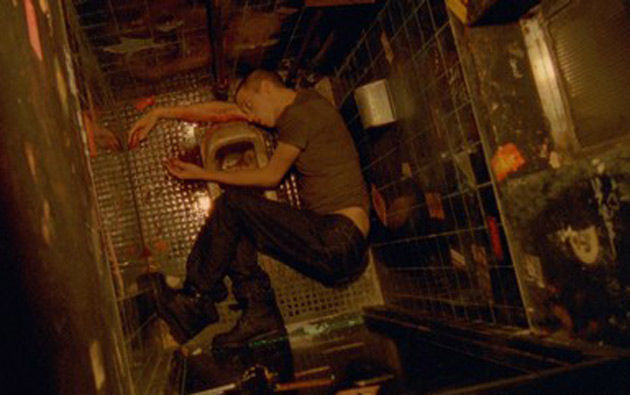
Oscar meets a rather banal ending.
This is about the extent of the events in the film. However, Noe’s strict use of first person point of view makes these rather mundane goings on even more interesting. We realize that we literally inhabit Oscar’s perspective for the first 30 minutes when the screen flickers as Oscar blinks. When he is exasperated with his sister, the screen goes darker for just a bit longer. Before going out to meet Victor, Oscar smokes some hallucinogenic drugs and begins to trip. The screen gradually fills with amorphous, beautiful, threatening, colorful images. I’ve never taken hallucinogens, but (much to the moralists chagrin) this certainly makes them seem appealing. The first person point of view combined with these wickedly cool, trippy images gives the films an interesting 3D effect without requiring the viewer to wear glasses. They also made me wish that I was watching the film on a much larger screen. After Oscar dies, Noe’s camerawork vacillates between that strict first person point of view and one slightly detached from it as he moves the camera either directly or slightly behind Oscar’s head. We frequently return to that first person perspective when Noe seemingly rams the camera lens into the back of Oscar’s head. The screen goes dark for a second and then we re-emerge, seeing what Oscar’s spirit sees.
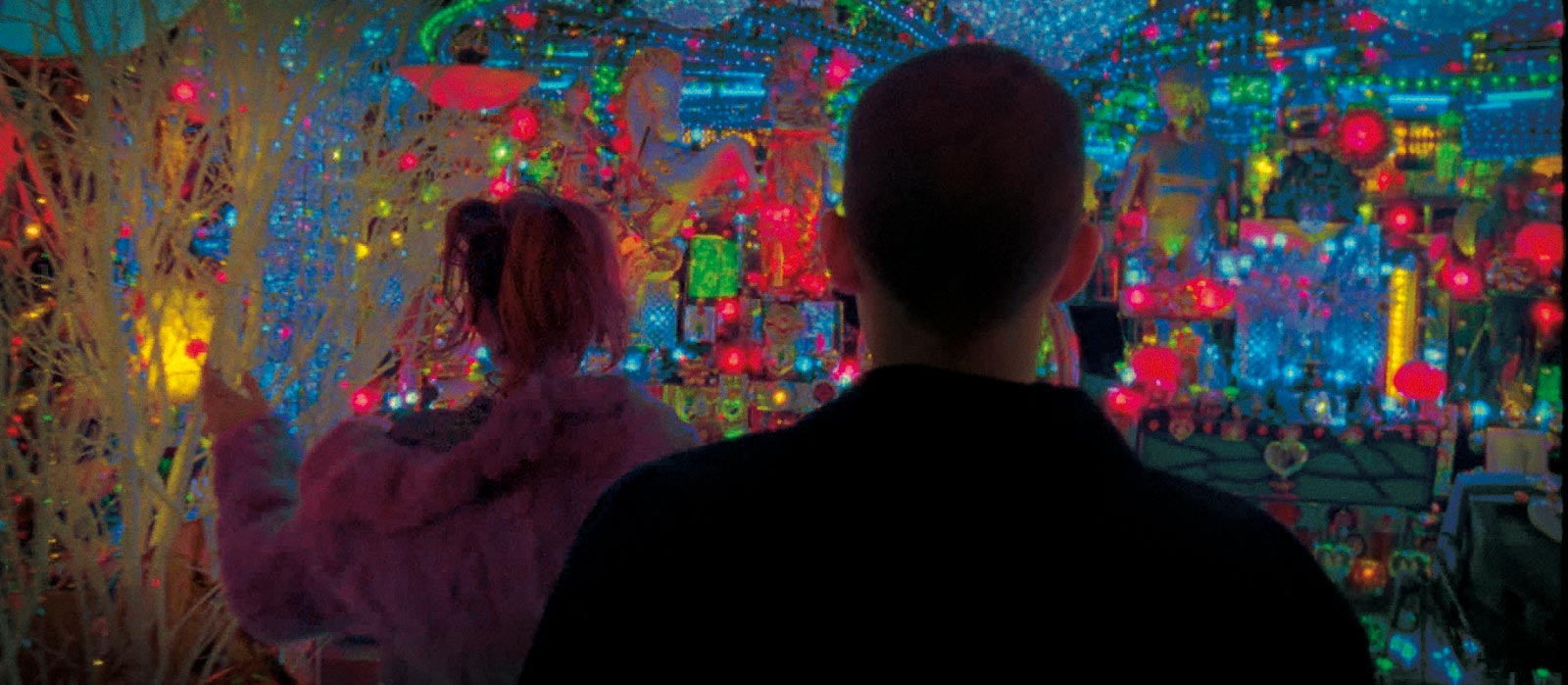
Watching Oscar with Oscar.
To move from place to place across Tokyo, Oscar’s spirit soars above the city, providing us with a bird’s eye view. However, as this is his only means of transportation, what is initially a rapturous bit of camerawork becomes a boring repetition. Far more rewarding are the shots in which Oscar settles down in one location, giving us a glimpse into a fantastical Tokyo that seems to be a mixture of the real and dream worlds.
The film draws its spiritual themes from the Tibetan Book of the Dead, which describes and guides individuals through life after death…or from one consciousness to the next. As such, Oscar becomes something like one of the ghosts in Biutiful although he seems to linger a bit longer before moving on. His ability to reflect on the loss of his parents and his childhood relationship with his sister provides interesting perspectives on both his interactions with Linda as a young adult and her emotions and actions after he dies.
Few filmmakers have come to demand an almost steely reserve when settling into watching their films quite like Noe. Enter the Void does not fail to deliver on the sensational. Yet the ways in which he juxtaposes these disturbing images and scenes with quiet moments of intimacy make it difficult for us to simply dismiss them as exploitative or pornographic. When Linda and Alex finally have sex with one another, Noe gives us, for lack of a better description, an internal point of view which is quite unsettling. Yet he then manages to make it a thing of beauty within only a few seconds.
Oscar and Linda’s relationship borders on the incestuous. As young adults they seem a little too physically close for comfort, yet Noe eases this discomfort by reminding us of their closeness as children and the traumatic experience they shared of losing their parents in a graphically portrayed car wreck. As young adults, Oscar and Linda need each other, but they need so much more and seem to mistake their ability to provide that for one another.
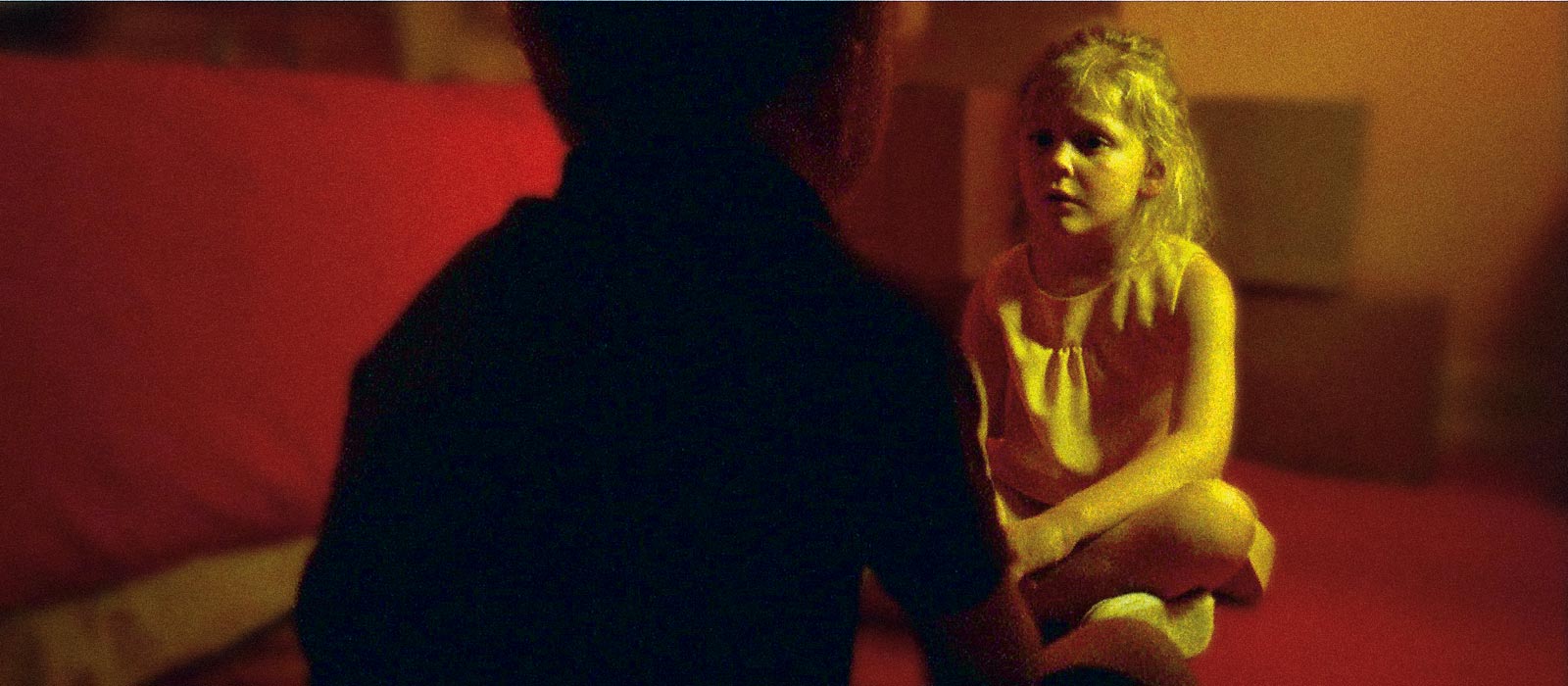
Oscar and Linda make a bond to never leave each other.
We can also question the implications of the film’s title. It is, primarily, the name of the bar where Oscar dies, yet it is the place where he transitions from this life to the next. There’s nothing optimistic or pessimistic about this space. It just is. However, the conclusion of the film, like Biutiful, hints that something lies beyond this limbo as well. For Oscar it is a re-birth…a re-incarnation…but to or from whom is open for interpretation.
Noe avoids the extreme, graphic violence characteristic of his previous film, Irreversible, and thankfully so. However, like that earlier film, Enter the Void features frank depictions of sex which, towards the end, do wander into the pornographic. Yet even these offensive elements cannot distract from what are two moving films. Love or hate Noe or his films, few filmmakers provide such unique, and occasionally rewarding, viewing experiences.
Enter the Void (161 mins.) is unrated but contains graphic images of drug use, sex, and violence. It is available on DVD and streaming from Netflix.
Previous Post

January 26, 2011
How Do You Spell Biutiful?
Next Post
February 15, 2011 The Destruction of Innocence
Browse Our Archives
Select a Category Classics DVD Film Music News Pop Culture Events Print Sports Television Uncategorized Video Games
Select a Month March 2017 February 2017 January 2017 December 2016 November 2016 October 2016 September 2016 August 2016 July 2016 June 2016 May 2016 April 2016 March 2016 February 2016 January 2016 December 2015 November 2015 October 2015 September 2015 August 2015 July 2015 June 2015 May 2015 April 2015 March 2015 February 2015 January 2015 December 2014 November 2014 October 2014 September 2014 August 2014 July 2014 June 2014 May 2014 April 2014 March 2014 February 2014 January 2014 December 2013 November 2013 October 2013 September 2013 August 2013 July 2013 June 2013 May 2013 April 2013 March 2013 February 2013 January 2013 December 2012 November 2012 October 2012 September 2012 August 2012 July 2012 June 2012 May 2012 April 2012 March 2012 February 2012 January 2012 December 2011 November 2011 October 2011 September 2011 August 2011 July 2011 June 2011 May 2011 April 2011 March 2011 February 2011 January 2011 December 2010 November 2010 October 2010 September 2010 August 2010 July 2010 June 2010 May 2010 April 2010 March 2010 February 2010 January 2010 December 2009 November 2009 October 2009 September 2009 August 2009 July 2009 June 2009 May 2009 April 2009 March 2009 February 2009 January 2009 December 2008 November 2008 October 2008 September 2008 August 2008 July 2008 June 2008 May 2008 April 2008 March 2008 February 2008 January 2008 December 2007 November 2007 October 2007 September 2007 August 2007 July 2007 June 2007 May 2007 April 2007 March 2007
Follow Us!
TAKE THE
Religious Wisdom Quiz
According to 1 John, what does perfect love do?
Select your answer to see how you score.
Drives out fear Never fails Covers a multitude of sins Fulfills all the law
Related posts from Pop Theology


At SXSW2017: May It Last: A Portrait of...

At SXSW 2017: "Untold Tales of Armistead Maupin"
TRENDING AT PATHEOS Progressive Christian

Why Christians Have a Sacred Duty to Vote:...
The Bible offers strong support for the sacred duty to vote. Here...

What Being a Modern-Day Apostle Means to Me
In my last column, I discussed the ins and outs of modern-day...

Did Ancient China Once Worship the God of...
Across human history, a common thread weaves through the origins of the...

Love Your Neighbor – Including Earth-Kin: Lev. 19,...
God’s command to love your neighbor means acting in an ethical and...

Lead a Church Study of “Jesus and Lao...
Guest writer Jack Thomas (The Irreverent Reverend) reflects on leading his church...

Principles for Understanding the Apostolic Ministry Today
Whenever people discover that my formal ministry title is "apostle," as in...
view all Progressive Christian blogs
Ad-Free & Subscriber Log-In Subscription Support
- About Us
- 2026 Calendar
- Videos
- Podcasts
- Library of World Religions
- Faith In Media Tracker
- Advertise With Us
- Write for Us
- Privacy Policy
- Terms of Service
- Do Not Sell My Data
- Contact Us
- Radiant Digital
- Manage Newsletter Subscriptions
- Unsubscribe From Notifications
- Sitemap
Copyright 2008-2026, Patheos. All rights reserved.
Subscription Support Ad-Free & Subscriber Log-In
Follow Patheos