
BuddhistCatholicContemplativeEvangelicalGeneral ChristianHinduJewishLatter-day SaintMuslimNew VisionsProgressive Christian
Beliefs
- Buddhist
- Catholic
- Contemplative
- Evangelical
- General Christian
- Hindu
- Jewish
- Latter-day Saint
- More Voices
- Muslim
- New Visions
- Pagan
- Progressive Christian
Topics
- Religion News
- Food and Religion
- Sports and Religion
- Religious Art
- Religious Music and Entertainment
- Religious Events
- History and Religion
- Style and Religion
- Politics and Religion
- Women in Religion
- Recreation Outdoors and Religion
- Business Finance and Religion
- Careers Workplace and Religion
- Education and Religion
- Family Parenting and Religion
- Health Fitness and Religion
- Home and Religion
- Relationships and Religion
- Technology and Religion
- Travel and Religion
Columnists
- Buddhist Columnists
- Business Finance and Religion Columnists
- Careers Workplace and Religion Columnists
- Catholic Columnists
- Contemplative Columnists
- Education and Religion Columnists
- Evangelists Columnists
- Family Parenting and Religion Columnists
- General Christian Columnists
- Health Fitness and Religion Columnists
- Hindu Columnists
- History and Religion Columnists
- Home and Religion Columnists
- Jewish Columnists
- More Voices Columnists
- Latter Day Columnists
- Muslim Columnists
- New Visions Columnists
- Nonreligious Columnists
- Pagan Columnists
- Politics and Religion Columnists
- Progressive Columnists
- Recreation Outdoors and Religion Columnists
- Relationships and Religion Columnists
- Religion News Columnists
- Religious Art Columnists
- Religious Events Columnists
- Religious Music and Entertainment Columnists
- Sports and Religion Columnists
- Style and Religion Columnists
- Technology and Religion Columnists
- Travel and Religion Columnists
- Women in Religion Columnists
Resource Library
- 2026 Calendar
- Library of World Religions
- The 100 Most Holy Places on Earth
- Patheos Answers
- Podcasts
- Videos
- Faith Leaders Database
- Anglican Episcopalian
- Bahai
- Baptist
- Buddhism
- Christianity
- Confucianism
- Eastern Orthodoxy
- Hinduism
- Holiness and Pentecostal
- ISKCON
- Islam
- Judaism
- Lutheran
- Methodist
- The Church of Jesus Christ of Latter-day Saints
- New Age
- Paganism
- Presbytarian and Reformed
- Protestantism
- Religion Behind the Scenes
- Roman Catholic
- Scientology
- Shia Islam
- Sikhism
- Sufism
- Sunni Islam
- Taoism
- Zen
- See all religions
Research Tools
 Ad-Free & Subscriber Log-In Subscription Support
Ad-Free & Subscriber Log-In Subscription Support
Follow Patheos 

- Trending:
- Forgiveness
- |
- Marriage
- |
- Consciousness
- |
- Death Penalty
- |
- Election
- |
- Halloween
 Pop Theology
- Home
- Progressive Christian
- Religious Music & Entertainment
- A Peaceful Hereafter Because Life is Hard Enough
A Peaceful Hereafter Because Life is Hard Enough
Last updated on: November 12, 2010 at 9:25 am by J. Ryan Parker
A Peaceful Hereafter Because Life is Hard Enough 2010-11-12T09:25:00-08:00 J. Ryan Parker
Patheos Explore the world's faith through different perspectives on religion and spirituality! Patheos has the views of the prevalent religions and spiritualities of the world.
Starting with Mystic River in 2001, Clint Eastwood has had a run of remarkable films that have all, in different ways, had death or loss as one of their major themes. His latest film, I believe, is a culmination of those films because in Hereafter he goes beyond death to speculate on the possibility of life after it.
Hereafter tells three separate stories that, through a series of coincidences, eventually connect. In the first story, Marie, (Cecil de France) a French newswoman, is on vacation with her boyfriend/co-worker when a tsunami overruns their resort. She is caught up in the wave and has a near death experience in which she has visions of something beyond this life and feelings of weightlessness and peace. This drastically affects her life, forcing her to take time off of work and to turn her attention from her book on a former French politician to a book about her experiences of the afterlife and the scientific, cultural efforts to cover-up the possibility of it. In the second story, Marcus and Jason (Frankie and George McLaren), two young British boys, live with their alcoholic, drug addicted mother. Marcus loses Jason when he dies in a tragic accident and eventually loses his mother to rehab. Marcus is placed in foster care and, desperately longing for his brother, begins to seek out information about the afterlife from a variety of religious and psychic sources. In the third story, George Lonegan (Matt Damon) is a “retired” psychic who attempts to live a normal life as a factory worker. His gift has become a burden that he can no longer bear because it prevents him from having normal relationships. He takes a cooking class at night and meets Melanie (Bryce Dallas Howard), and the two hit it off quickly. However, when she presses him to “read” her, despite his warnings of what could happen, he uncovers a painful memory from her past which pushes her away. George takes a trip to London where he crosses paths with both Marie and Marcus, the three of whom help each other heal and move forward in life.
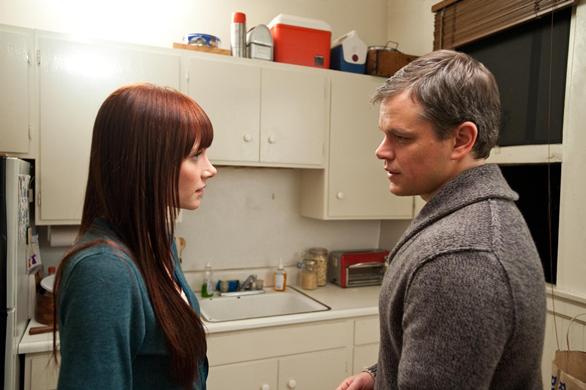
When a psychic tells you no, you listen.
As I mentioned above, Hereafter is the latest in an amazing film run a director who seems to be getting better with age. Like Gran Torino, it benefits from a fantastic score. The cinematography here is perfect, drawing heavily on low-lit scenes and often dismal, gray surroundings. The opening tsunami scene is a thrilling experience and feels as if Eastwood literally throws us into the torrential waves. The acting throughout is perfect, with Damon giving an especially moving performance, which, I think, is one of his better performances to date. Cecil de France as Marie is equally delightful to watch. Many films that employ separate but eventually converging stories aren’t often all that believable, but scriptwriter Peter Morgan manages to make the main characters’ connections quite convincing.
That the film focuses so heavily on a psychic and his ability to communicate with the dead might put off a number of viewers. However, to focus on this aspect of the film is to miss the larger point of the story. The connection between George and his “clients,” specifically their need for connection, to love and to feel loved, is what I think Eastwood is trying to get at here. The film’s limited glimpses of the hereafter, hazy visions of a dimly lit horizon populated with blurred figures, suggests not a certainty about its existence but, if I can put it this way, a hopeful uncertainty. Marie experiences feelings of weightlessness, feelings confirmed by others who have shared near-death experiences. Jason tells Marcus, through George, that you can be everything at once and that it’s really awesome. These statements are interesting because none of the characters appear to be explicitly Christian or religious. No violent tormenting hell awaits them, and this, I believe, is one of the film’s strengths. Hereafter reminds us of what we often forget, namely that for many people the human experience on earth is hell enough. From tsunamis to childhood deaths to betrayed relationships to sexual abuse to terrorist attacks, Eastwood conveys the brokenness of the human experience in vivid and painful ways. He seems to understand, like C. S. Lewis, that compared to the hereafter (if there is one), everything else is sorely lacking.
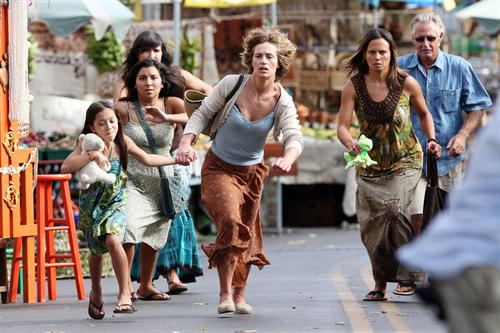
The beginning of a scene that boasts fantastic visual effects.
Another strength of Hereafter is its willingness to doubt. Through the character of Marcus, the film is skeptical of religious, New Age psychic, and nihilistic views of the afterlife, particularly ones that provide quick easy answers to what is one of life’s more taxing questions. Marcus sees through everyone who says that they “know” what lies beyond this life until he meets George. George tells him things that no one else could possibly know, yet when he begins to lose his connection with Jason, Marcus panics. George tells him that he has lost his connection with Jason and that he doesn’t know where he has gone. When Marcus presses him, reminding him of the countless readings that he has conducted, George tells him, “Yeah, but I still don’t know.” This type of uncertain humility is exactly was is needed in an age of violent (physically and verbally) religious extremism.
Hereafter (129 mins.) is rated PG-13 for mature thematic elements including disturbing disaster and accident images and for brief strong language and is in theaters everywhere.
Previous Post

November 2, 2010
Singing Out Against Hunger
Next Post
November 18, 2010 A Christ-like Wizard
Browse Our Archives
Select a Category Classics DVD Film Music News Pop Culture Events Print Sports Television Uncategorized Video Games
Select a Month March 2017 February 2017 January 2017 December 2016 November 2016 October 2016 September 2016 August 2016 July 2016 June 2016 May 2016 April 2016 March 2016 February 2016 January 2016 December 2015 November 2015 October 2015 September 2015 August 2015 July 2015 June 2015 May 2015 April 2015 March 2015 February 2015 January 2015 December 2014 November 2014 October 2014 September 2014 August 2014 July 2014 June 2014 May 2014 April 2014 March 2014 February 2014 January 2014 December 2013 November 2013 October 2013 September 2013 August 2013 July 2013 June 2013 May 2013 April 2013 March 2013 February 2013 January 2013 December 2012 November 2012 October 2012 September 2012 August 2012 July 2012 June 2012 May 2012 April 2012 March 2012 February 2012 January 2012 December 2011 November 2011 October 2011 September 2011 August 2011 July 2011 June 2011 May 2011 April 2011 March 2011 February 2011 January 2011 December 2010 November 2010 October 2010 September 2010 August 2010 July 2010 June 2010 May 2010 April 2010 March 2010 February 2010 January 2010 December 2009 November 2009 October 2009 September 2009 August 2009 July 2009 June 2009 May 2009 April 2009 March 2009 February 2009 January 2009 December 2008 November 2008 October 2008 September 2008 August 2008 July 2008 June 2008 May 2008 April 2008 March 2008 February 2008 January 2008 December 2007 November 2007 October 2007 September 2007 August 2007 July 2007 June 2007 May 2007 April 2007 March 2007
Follow Us!
TAKE THE
Religious Wisdom Quiz
How many days did God take to create the world?
Select your answer to see how you score.
Five Six Ten Seven
Related posts from Pop Theology


At SXSW2017: May It Last: A Portrait of...

At SXSW 2017: "Untold Tales of Armistead Maupin"
TRENDING AT PATHEOS Progressive Christian

Why Christians Have a Sacred Duty to Vote:...
The Bible offers strong support for the sacred duty to vote. Here...

What Being a Modern-Day Apostle Means to Me
In my last column, I discussed the ins and outs of modern-day...

Did Ancient China Once Worship the God of...
Across human history, a common thread weaves through the origins of the...

Love Your Neighbor – Including Earth-Kin: Lev. 19,...
God’s command to love your neighbor means acting in an ethical and...

Lead a Church Study of “Jesus and Lao...
Guest writer Jack Thomas (The Irreverent Reverend) reflects on leading his church...

Principles for Understanding the Apostolic Ministry Today
Whenever people discover that my formal ministry title is "apostle," as in...
view all Progressive Christian blogs
Ad-Free & Subscriber Log-In Subscription Support
- About Us
- 2026 Calendar
- Videos
- Podcasts
- Library of World Religions
- Faith In Media Tracker
- Advertise With Us
- Write for Us
- Privacy Policy
- Terms of Service
- Do Not Sell My Data
- Contact Us
- Radiant Digital
- Manage Newsletter Subscriptions
- Unsubscribe From Notifications
- Sitemap
Copyright 2008-2026, Patheos. All rights reserved.
Subscription Support Ad-Free & Subscriber Log-In
Follow Patheos