
BuddhistCatholicContemplativeEvangelicalGeneral ChristianHinduJewishLatter-day SaintMuslimNew VisionsProgressive Christian
Beliefs
- Buddhist
- Catholic
- Contemplative
- Evangelical
- General Christian
- Hindu
- Jewish
- Latter-day Saint
- More Voices
- Muslim
- New Visions
- Pagan
- Progressive Christian
Topics
- Religion News
- Food and Religion
- Sports and Religion
- Religious Art
- Religious Music and Entertainment
- Religious Events
- History and Religion
- Style and Religion
- Politics and Religion
- Women in Religion
- Recreation Outdoors and Religion
- Business Finance and Religion
- Careers Workplace and Religion
- Education and Religion
- Family Parenting and Religion
- Health Fitness and Religion
- Home and Religion
- Relationships and Religion
- Technology and Religion
- Travel and Religion
Columnists
- Buddhist Columnists
- Business Finance and Religion Columnists
- Careers Workplace and Religion Columnists
- Catholic Columnists
- Contemplative Columnists
- Education and Religion Columnists
- Evangelists Columnists
- Family Parenting and Religion Columnists
- General Christian Columnists
- Health Fitness and Religion Columnists
- Hindu Columnists
- History and Religion Columnists
- Home and Religion Columnists
- Jewish Columnists
- More Voices Columnists
- Latter Day Columnists
- Muslim Columnists
- New Visions Columnists
- Nonreligious Columnists
- Pagan Columnists
- Politics and Religion Columnists
- Progressive Columnists
- Recreation Outdoors and Religion Columnists
- Relationships and Religion Columnists
- Religion News Columnists
- Religious Art Columnists
- Religious Events Columnists
- Religious Music and Entertainment Columnists
- Sports and Religion Columnists
- Style and Religion Columnists
- Technology and Religion Columnists
- Travel and Religion Columnists
- Women in Religion Columnists
Resource Library
- 2026 Calendar
- Library of World Religions
- The 100 Most Holy Places on Earth
- Patheos Answers
- Podcasts
- Videos
- Faith Leaders Database
- Anglican Episcopalian
- Bahai
- Baptist
- Buddhism
- Christianity
- Confucianism
- Eastern Orthodoxy
- Hinduism
- Holiness and Pentecostal
- ISKCON
- Islam
- Judaism
- Lutheran
- Methodist
- The Church of Jesus Christ of Latter-day Saints
- New Age
- Paganism
- Presbytarian and Reformed
- Protestantism
- Religion Behind the Scenes
- Roman Catholic
- Scientology
- Shia Islam
- Sikhism
- Sufism
- Sunni Islam
- Taoism
- Zen
- See all religions
Research Tools
 Ad-Free & Subscriber Log-In Subscription Support
Ad-Free & Subscriber Log-In Subscription Support
Follow Patheos 

- Trending:
- Forgiveness
- |
- Marriage
- |
- Consciousness
- |
- Death Penalty
- |
- Election
- |
- Halloween
 Pop Theology
- Home
- Progressive Christian
- Religious Music & Entertainment
- Something Like a Phenomenon
Something Like a Phenomenon
Last updated on: September 10, 2010 at 8:04 am by J. Ryan Parker
Something Like a Phenomenon 2010-09-10T08:04:21-07:00 J. Ryan Parker
Patheos Explore the world's faith through different perspectives on religion and spirituality! Patheos has the views of the prevalent religions and spiritualities of the world.
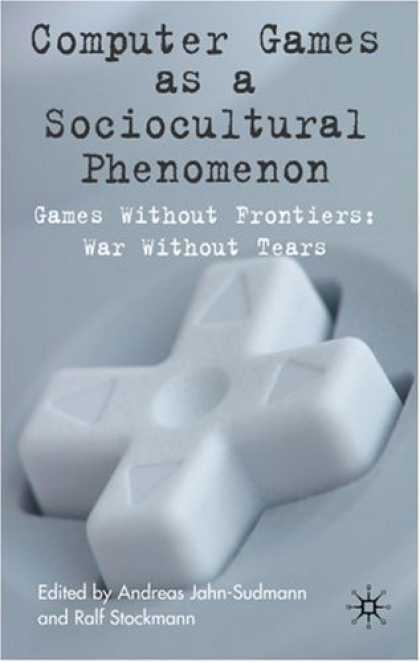
The fact that video game industry revenue has surpassed $19 billion dollars and that one on-line game commands a following of over 8 million people certainly constitutes a phenomenon. Yet until recently, few scholars, and even fewer theologians, have taken the initiative to critically engage the medium. Far more prevalent are the critics who either primarily focus on a game’s entertainment value (which essentially serves retail) or those critics who bemoan the presence of sex and violence in increasingly graphic fashion in video games with increasingly photorealistic graphics. If, as Craig Detweiler asserts, we are in a golden age of video games, I hope that a similar phase of video game criticism will not be too far behind. One fine example of the potential for in-depth critical analysis of video games is Andreas Jahn-Sudmann and Ralf Stockmann’s collection of essays is Computer Games as a Sociocultural Phenomenon: Games Without Frontiers War Without Tears.
Computer Games as a Sociocultural Phenomenon serves as a good introduction to the possible avenues that the critical study of video games can take. The book is divided into six sections that cover Game Design and Aesthetics, Space and Time, War and Violence, Ethics and Morality, Politics and Ideology, and Gamers and Cultural Identities. Though these are distinct areas of discussion, it is clear, after reading the book, that any combination of these topics will be at play together in any individual game. A really great game, game analysis, will have implications that touch on all of them at once.
The contributors to the first two sections reveal how the design and aesthetics of video games and the space and time of games and gameplay play an important role in meaning-making. In his article, “The Aesthetic Vocabulary of Video Games,” Joost van Dreunen writes about “medialect,” the intersection of medium and dialect. He comments, “The function, meaning and significance of a medium changes constantly because of its adherence to the fluid practices of both social convention and technological development” (4). This, perhaps, might be a healthy point of entry for theologians and scholars of religion to take up the conversation through an analysis of the values and meanings that undergird this “medialect.”
In terms of this site and my own research, the sections on War and Violence and Ethics and Morality, obviously closely linked, are the most interesting. Claudia Herbst reveals that violence is not just a visible component of video games but an invisible part as well…coded in the very fabric of the game. Henry Lowood looks at independent computer games in a post-9/11 world as forces or examples of impotency and agency. Perhaps the most interesting essay of this section, and the entire book, is Christoph Klimmt et al’s “‘Moral Mangement:’ Dealing with Moral Concerns to Maintain Enjoyment of Violent Video Games.” Drawing from Bandura’s moral management theory, they analyze the ways in which game designers and gamers negotiate violent acts and representations in games. These include moral justification, euphemistic labelling (using words like “neutralizing” instead of “killing”), advantageous comparison (“At least it’s not as bad as….”), displacement or diffusion of responsibility (“They made me do it.”), disregard or distortion of consequences, dehumanization (of the other), and attribution of blame (“they” deserve it) (112-113). I’ll say more on the importance of this below
The Politics and Ideology section looks at games like Grand Theft Auto: San Andreas and City of Heroes for their political or politically incorrect implications. In his article, “Preconscious Apocalypse: The Failure of Capitalism in Computer Games,” Sven O. Cavalcanti makes a crucial observation of the prophetic (?) appearances of failed capitalist societies in a number of video games. Interestingly enough, many of these games represent dystopias that result from economic/political catastrophes, ecological catastrophes, genetic engineering catastrophes, technological catastrophes, or psychological and religious catastrophes (137-138).

Also limiting his focus to games after 9/11, Nowell Marshall wonders why, “[…In] an age when technology offers vast potential for designing virtual spaces […] software engineers [have] chosen to create such dystopian national narratives” (147).
Finally, contributors look at how developers and marketers negotiate cultural identities in the production and advertising of video games while the books’ final article looks at how British teenage girls navigate identity formation while playing The Sims.
While some of the essays in Computer Games as a Sociocultural Phenomenon might be of interest to the casual or hardcore gamer, the text as a whole is geared toward college or graduate level studies of the medium. Again, perhaps the most interesting article of the lot (and the one with broader appeal) is the one on moral negotiation when playing violent video games. Klimmt et al’s discussion could easily expand to help us make sense of our consumption of violent films, television programs, and even music. We could take their research a step further and bring it to bear on a real-world political narratives which often undertake moral management in elections or leading up to violent conflicts. In his essay, Cavalcanti’s concludes one of his sections with this brief observation that he would have done well to flesh out even more: “For a short while, the player may forget civic morality, which is that murder is forbidden but breeding is permitted, while sexuality may not be depicted and murder may be shown on screens” (138). Again, another prophetic statement regarding the nature of our society that emerges from an interaction with video games, that most unlikely source of social commentary.
Previous Post

September 3, 2010
Confessing a Story
Next Post
September 15, 2010 What If...? What a Guilt Trip
Browse Our Archives
Select a Category Classics DVD Film Music News Pop Culture Events Print Sports Television Uncategorized Video Games
Select a Month March 2017 February 2017 January 2017 December 2016 November 2016 October 2016 September 2016 August 2016 July 2016 June 2016 May 2016 April 2016 March 2016 February 2016 January 2016 December 2015 November 2015 October 2015 September 2015 August 2015 July 2015 June 2015 May 2015 April 2015 March 2015 February 2015 January 2015 December 2014 November 2014 October 2014 September 2014 August 2014 July 2014 June 2014 May 2014 April 2014 March 2014 February 2014 January 2014 December 2013 November 2013 October 2013 September 2013 August 2013 July 2013 June 2013 May 2013 April 2013 March 2013 February 2013 January 2013 December 2012 November 2012 October 2012 September 2012 August 2012 July 2012 June 2012 May 2012 April 2012 March 2012 February 2012 January 2012 December 2011 November 2011 October 2011 September 2011 August 2011 July 2011 June 2011 May 2011 April 2011 March 2011 February 2011 January 2011 December 2010 November 2010 October 2010 September 2010 August 2010 July 2010 June 2010 May 2010 April 2010 March 2010 February 2010 January 2010 December 2009 November 2009 October 2009 September 2009 August 2009 July 2009 June 2009 May 2009 April 2009 March 2009 February 2009 January 2009 December 2008 November 2008 October 2008 September 2008 August 2008 July 2008 June 2008 May 2008 April 2008 March 2008 February 2008 January 2008 December 2007 November 2007 October 2007 September 2007 August 2007 July 2007 June 2007 May 2007 April 2007 March 2007
Follow Us!
TAKE THE
Religious Wisdom Quiz
What was the primary material for writing in biblical times?
Select your answer to see how you score.
Papyrus Parchment Clay tablets Stone
Related posts from Pop Theology


#KillerSerials: An Interview with Kutter Callaway

Book Review: MUSLIMS AND THE MAKING OF AMERICA

TRENDING AT PATHEOS Progressive Christian

Why Christians Have a Sacred Duty to Vote:...
The Bible offers strong support for the sacred duty to vote. Here...

What Being a Modern-Day Apostle Means to Me
In my last column, I discussed the ins and outs of modern-day...

Did Ancient China Once Worship the God of...
Across human history, a common thread weaves through the origins of the...

Love Your Neighbor – Including Earth-Kin: Lev. 19,...
God’s command to love your neighbor means acting in an ethical and...

Lead a Church Study of “Jesus and Lao...
Guest writer Jack Thomas (The Irreverent Reverend) reflects on leading his church...

Principles for Understanding the Apostolic Ministry Today
Whenever people discover that my formal ministry title is "apostle," as in...
view all Progressive Christian blogs
Ad-Free & Subscriber Log-In Subscription Support
- About Us
- 2026 Calendar
- Videos
- Podcasts
- Library of World Religions
- Faith In Media Tracker
- Advertise With Us
- Write for Us
- Privacy Policy
- Terms of Service
- Do Not Sell My Data
- Contact Us
- Radiant Digital
- Manage Newsletter Subscriptions
- Unsubscribe From Notifications
- Sitemap
Copyright 2008-2026, Patheos. All rights reserved.
Subscription Support Ad-Free & Subscriber Log-In
Follow Patheos