
BuddhistCatholicContemplativeEvangelicalGeneral ChristianHinduJewishLatter-day SaintMuslimNew VisionsProgressive Christian
Beliefs
- Buddhist
- Catholic
- Contemplative
- Evangelical
- General Christian
- Hindu
- Jewish
- Latter-day Saint
- More Voices
- Muslim
- New Visions
- Pagan
- Progressive Christian
Topics
- Religion News
- Food and Religion
- Sports and Religion
- Religious Art
- Religious Music and Entertainment
- Religious Events
- History and Religion
- Style and Religion
- Politics and Religion
- Women in Religion
- Recreation Outdoors and Religion
- Business Finance and Religion
- Careers Workplace and Religion
- Education and Religion
- Family Parenting and Religion
- Health Fitness and Religion
- Home and Religion
- Relationships and Religion
- Technology and Religion
- Travel and Religion
Columnists
- Buddhist Columnists
- Business Finance and Religion Columnists
- Careers Workplace and Religion Columnists
- Catholic Columnists
- Contemplative Columnists
- Education and Religion Columnists
- Evangelists Columnists
- Family Parenting and Religion Columnists
- General Christian Columnists
- Health Fitness and Religion Columnists
- Hindu Columnists
- History and Religion Columnists
- Home and Religion Columnists
- Jewish Columnists
- More Voices Columnists
- Latter Day Columnists
- Muslim Columnists
- New Visions Columnists
- Nonreligious Columnists
- Pagan Columnists
- Politics and Religion Columnists
- Progressive Columnists
- Recreation Outdoors and Religion Columnists
- Relationships and Religion Columnists
- Religion News Columnists
- Religious Art Columnists
- Religious Events Columnists
- Religious Music and Entertainment Columnists
- Sports and Religion Columnists
- Style and Religion Columnists
- Technology and Religion Columnists
- Travel and Religion Columnists
- Women in Religion Columnists
Resource Library
- 2026 Calendar
- Library of World Religions
- The 100 Most Holy Places on Earth
- Patheos Answers
- Podcasts
- Videos
- Faith Leaders Database
- Anglican Episcopalian
- Bahai
- Baptist
- Buddhism
- Christianity
- Confucianism
- Eastern Orthodoxy
- Hinduism
- Holiness and Pentecostal
- ISKCON
- Islam
- Judaism
- Lutheran
- Methodist
- The Church of Jesus Christ of Latter-day Saints
- New Age
- Paganism
- Presbytarian and Reformed
- Protestantism
- Religion Behind the Scenes
- Roman Catholic
- Scientology
- Shia Islam
- Sikhism
- Sufism
- Sunni Islam
- Taoism
- Zen
- See all religions
Research Tools
 Ad-Free & Subscriber Log-In Subscription Support
Ad-Free & Subscriber Log-In Subscription Support
Follow Patheos 

- Trending:
- Forgiveness
- |
- Marriage
- |
- Consciousness
- |
- Death Penalty
- |
- Election
- |
- Halloween
 Pop Theology
- Home
- Progressive Christian
- Religious Music & Entertainment
- 7 Women: A Review
7 Women: A Review
Last updated on: August 18, 2010 at 7:47 am by J. Ryan Parker
7 Women: A Review 2010-08-18T07:47:48-07:00 J. Ryan Parker
Patheos Explore the world's faith through different perspectives on religion and spirituality! Patheos has the views of the prevalent religions and spiritualities of the world.
A couple of days ago, I posted a review of Peter E. Dans’ book, Christians in the Movies: A Century of Saints and Sinners for Patheos’ Faith Forward blog. Dans traces a representational arc that reveals Hollywoods’ portrayal of Christians as gradually moving from sacred to the scandalous from the 1920s to the 2000s. Of course, there are exceptions in each decade, but in general, he makes a fairly compelling argument. However, he fails to see how more recent cinematic “attacks” on Christians might be interpreted as Christian themselves. One film that he does not discuss and which would have simultaneously supported and exposed his argument is John Ford‘s last film, 7 Women (1966).
7 Women tells the story of a group of women who work in a Christian mission in the Chinese countryside in the 1930s. They are ruled by Agatha Andrews (Margaret Leighton), a stern Christian woman who embodies a “my way or the highway” approach to running the mission. The mission also houses a pregnant couple Charles (the only man) and Florrie Pether (Eddie Albert and Betty Field), whose pregnancy is somewhat suspect. Charles wanted to be a pastor and this is close as he could get to sharing the gospel on a professional level. Emma Clark (Sue Lyon), a beautiful blonde with a promising future, is the youngest member of the mission. Jane Argent (Mildred Dunnock) is Agatha’s assistant, and Miss Russell (Anna Lee) and Miss Binns (Flora Robson) are refuges from the nearby British mission who serve to report the atrocities of attacking bandits and intensify the ominous mood surrounding Agatha’s mission. For various reasons, the women anxiously await the arrival of a new doctor. Florrie obviously needs the doctor’s assistance during her risky pregnancy (she’s a bit too old and the surroundings a bit too primitive) and the other women know that the children need good medical care as well. Charles goes into the nearest village to meet the doctor at the appointed time but doesn’t see anyone who fits the description. The next day, Dr. D. R. Cartwright arrives, but much to their surprise the doctor is a woman (a fiery performance by Anne Bancroft). Immediately, Agatha expresses disapproval of a female doctor, especially one that smokes, drinks, uses foul language, sits down to dinner before grace has been offered, and doesn’t even believe in the God to whom that grace is offered. Dr. Cartwright doesn’t tolerate Ms. Andrews’ rigid religiosity and her treatment of her fellow missionaries. However, when trouble strikes the mission, it is Dr. Cartwright, not Agatha, who makes the ultimate sacrifice for the well-being of the missionaries.
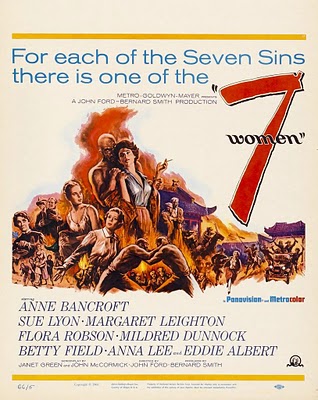
On the surface, 7 Women seems to be one of those films that simply attacks Christians and Christianity. Releasing in the 1960s as it did, it would certainly fit into Dans’ description of that decade and the tendency of films to denigrate religion/religious adherence. On one level, this is true of the film. Agatha is, as Dr. Cartwright refers to her, “a small time dictator.” She has no compassion, love, or care. When a cholera outbreak strikes the mission and Emma becomes ill, Agatha cannot even pray, as Dr. Cartwright goes to work to save her. Shortly after this, Agatha tells Dr. Cartwright that there is an emptiness in her life and that she is searching for something to fill it but that God is just not enough. When the women are trapped by invading warlords and Florrie goes into labor, her screams of pain enrage Agatha who refers to the pregnant woman as an animal. To top it all off, Agatha turns out to be a lesbian who desires Emma and cannot bear the fact that she admires and respects Dr. Cartwright. The rest of the missionaries are little more than bumbling idiots, save Emma perhaps, who evidences genuine compassion for and devotion to the children under her care. Mr. Pether places his desire for vocational ministry above the well-being of his wife, who, even when not in labor, is a loud, whiny woman that drives everyone within earshot crazy.
Yet to harp on this aspect of the film alone is to miss the deeper point that Ford, a Catholic himself, is trying to make yet again in his final film, one that he made throughout his career. While many of his films evidence a devotion to or respect of the more ritual aspects of religion, at the same time, they often feature a character or characters who buck those traditions, and that is nowhere more true than in the character of Dr. Cartwright, the obvious heroine of 7 Women. She is crass, out-spoken, and highly critical of Agatha’s beliefs. Yet she is simultaneously the embodiment of, dare I say it, a Christ figure. When we first meet Dr. Cartwright, she rides into the mission on a donkey as the children under Emma’s care sing “Jesus Loves Me.” In her leather jacket and wide-brimmed hat pulled low, we easily mistake Dr. Cartwright for a man until she dismounts and removes her hat. When cholera strikes the mission, she quarantines the area, takes care of the sick, and arranges the burial/burning of the dead. Ultimately, when the bandits invade the mission, led by Tunga Khan (Mike Mazurki), she strikes a deal with him, giving herself over to him as a concubine so that the others may go free. This sparks a divisive reaction among the missionaries. Agatha is appalled at her sexual behavior while the others see it for what it is. As the film ends, Dr. Cartwright poisons Tunga Khan (“So long ya bastard…”) and partakes of it herself, choosing death rather than torture at the hands of the surviving bandits.
Here again, in his final film, Ford seems to suggest that a legal obsession with the beliefs and strictures of religion is not what is important. On the other hand, an ability to enjoy life, to act in the face of adversity to preserve life, and, finally, to give of yourself for others, even unto death, is the true model of Christ-like behavior. Confined to the inner workings of a mission, 7 Women does not contain the stunning visuals we expect from Ford’s films, even of a set-bound film like The Man Who Shot Liberty Valance; however, Ford manages to get some strong performances from his actresses, most notably Bancroft and Leighton. Unfortunately, 7 Women is not available on DVD and only occasionally airs on TCM. Though it is far from his best, it is Ford’s last film and certainly important in that respect. You can at least watch a trailer here.
Previous Post

August 10, 2010
Saving a Genre
Next Post
August 20, 2010 Letters to God...Pornographic?
Browse Our Archives
Select a Category Classics DVD Film Music News Pop Culture Events Print Sports Television Uncategorized Video Games
Select a Month March 2017 February 2017 January 2017 December 2016 November 2016 October 2016 September 2016 August 2016 July 2016 June 2016 May 2016 April 2016 March 2016 February 2016 January 2016 December 2015 November 2015 October 2015 September 2015 August 2015 July 2015 June 2015 May 2015 April 2015 March 2015 February 2015 January 2015 December 2014 November 2014 October 2014 September 2014 August 2014 July 2014 June 2014 May 2014 April 2014 March 2014 February 2014 January 2014 December 2013 November 2013 October 2013 September 2013 August 2013 July 2013 June 2013 May 2013 April 2013 March 2013 February 2013 January 2013 December 2012 November 2012 October 2012 September 2012 August 2012 July 2012 June 2012 May 2012 April 2012 March 2012 February 2012 January 2012 December 2011 November 2011 October 2011 September 2011 August 2011 July 2011 June 2011 May 2011 April 2011 March 2011 February 2011 January 2011 December 2010 November 2010 October 2010 September 2010 August 2010 July 2010 June 2010 May 2010 April 2010 March 2010 February 2010 January 2010 December 2009 November 2009 October 2009 September 2009 August 2009 July 2009 June 2009 May 2009 April 2009 March 2009 February 2009 January 2009 December 2008 November 2008 October 2008 September 2008 August 2008 July 2008 June 2008 May 2008 April 2008 March 2008 February 2008 January 2008 December 2007 November 2007 October 2007 September 2007 August 2007 July 2007 June 2007 May 2007 April 2007 March 2007
Follow Us!
TAKE THE
Religious Wisdom Quiz
Who said, "Man shall not live on bread alone, but on every word that comes from the mouth of God"?
Select your answer to see how you score.
David Jesus Elijah Moses
Related posts from Pop Theology


At SXSW2017: May It Last: A Portrait of...

At SXSW 2017: "Untold Tales of Armistead Maupin"
TRENDING AT PATHEOS Progressive Christian

Why Christians Have a Sacred Duty to Vote:...
The Bible offers strong support for the sacred duty to vote. Here...

What Being a Modern-Day Apostle Means to Me
In my last column, I discussed the ins and outs of modern-day...

Did Ancient China Once Worship the God of...
Across human history, a common thread weaves through the origins of the...

Love Your Neighbor – Including Earth-Kin: Lev. 19,...
God’s command to love your neighbor means acting in an ethical and...

Lead a Church Study of “Jesus and Lao...
Guest writer Jack Thomas (The Irreverent Reverend) reflects on leading his church...

Principles for Understanding the Apostolic Ministry Today
Whenever people discover that my formal ministry title is "apostle," as in...
view all Progressive Christian blogs
Ad-Free & Subscriber Log-In Subscription Support
- About Us
- 2026 Calendar
- Videos
- Podcasts
- Library of World Religions
- Faith In Media Tracker
- Advertise With Us
- Write for Us
- Privacy Policy
- Terms of Service
- Do Not Sell My Data
- Contact Us
- Radiant Digital
- Manage Newsletter Subscriptions
- Unsubscribe From Notifications
- Sitemap
Copyright 2008-2026, Patheos. All rights reserved.
Subscription Support Ad-Free & Subscriber Log-In
Follow Patheos