
BuddhistCatholicContemplativeEvangelicalGeneral ChristianHinduJewishLatter-day SaintMuslimNew VisionsProgressive Christian
Beliefs
- Buddhist
- Catholic
- Contemplative
- Evangelical
- General Christian
- Hindu
- Jewish
- Latter-day Saint
- More Voices
- Muslim
- New Visions
- Pagan
- Progressive Christian
Topics
- Religion News
- Food and Religion
- Sports and Religion
- Religious Art
- Religious Music and Entertainment
- Religious Events
- History and Religion
- Style and Religion
- Politics and Religion
- Women in Religion
- Recreation Outdoors and Religion
- Business Finance and Religion
- Careers Workplace and Religion
- Education and Religion
- Family Parenting and Religion
- Health Fitness and Religion
- Home and Religion
- Relationships and Religion
- Technology and Religion
- Travel and Religion
Columnists
- Buddhist Columnists
- Business Finance and Religion Columnists
- Careers Workplace and Religion Columnists
- Catholic Columnists
- Contemplative Columnists
- Education and Religion Columnists
- Evangelists Columnists
- Family Parenting and Religion Columnists
- General Christian Columnists
- Health Fitness and Religion Columnists
- Hindu Columnists
- History and Religion Columnists
- Home and Religion Columnists
- Jewish Columnists
- More Voices Columnists
- Latter Day Columnists
- Muslim Columnists
- New Visions Columnists
- Nonreligious Columnists
- Pagan Columnists
- Politics and Religion Columnists
- Progressive Columnists
- Recreation Outdoors and Religion Columnists
- Relationships and Religion Columnists
- Religion News Columnists
- Religious Art Columnists
- Religious Events Columnists
- Religious Music and Entertainment Columnists
- Sports and Religion Columnists
- Style and Religion Columnists
- Technology and Religion Columnists
- Travel and Religion Columnists
- Women in Religion Columnists
Resource Library
- 2026 Calendar
- Library of World Religions
- The 100 Most Holy Places on Earth
- Patheos Answers
- Podcasts
- Videos
- Faith Leaders Database
- Anglican Episcopalian
- Bahai
- Baptist
- Buddhism
- Christianity
- Confucianism
- Eastern Orthodoxy
- Hinduism
- Holiness and Pentecostal
- ISKCON
- Islam
- Judaism
- Lutheran
- Methodist
- The Church of Jesus Christ of Latter-day Saints
- New Age
- Paganism
- Presbytarian and Reformed
- Protestantism
- Religion Behind the Scenes
- Roman Catholic
- Scientology
- Shia Islam
- Sikhism
- Sufism
- Sunni Islam
- Taoism
- Zen
- See all religions
Research Tools
 Ad-Free & Subscriber Log-In Subscription Support
Ad-Free & Subscriber Log-In Subscription Support
Follow Patheos 

- Trending:
- Forgiveness
- |
- Marriage
- |
- Consciousness
- |
- Death Penalty
- |
- Election
- |
- Halloween
 Pop Theology
- Home
- Progressive Christian
- Religious Music & Entertainment
- Shake It
Shake It
Last updated on: July 21, 2010 at 6:49 am by J. Ryan Parker
Shake It 2010-07-21T06:49:47-07:00 J. Ryan Parker
Patheos Explore the world's faith through different perspectives on religion and spirituality! Patheos has the views of the prevalent religions and spiritualities of the world.
Heather Hendershot‘s Shaking the World for Jesus: Media and Conservative Evangelical Culture is one of several recent books that provides an insightful analysis of evangelical Christians’ relationship with popular culture. Like her contemporary, Daniel Radosh, Hendershot also takes a sympathetic approach to the topic, recognizing that evangelicals make significant meaning out of their interactions with and consumption of popular culture, while also being highly critical of its theological and cultural shortcomings. Hendershot reveals that in this relationship both popular culture and evangelical Christianity are deeply affected by their interactions with one another.
Hendershot divides her book into three sections with two chapters each. After her introduction in which she discusses her methodology, she provides a brief historical overview of evangelical Christianity since the watershed moment of the Scopes monkey trial. She then quickly moves to a discussion of the Contemporary Christian Music (CCM) business. In her second section she examines sexuality and evangelical Christianity in two completely opposite settings, the evangelical chastity movement and the country’s largest gay and lesbian church, the Cathedral of Hope in Dallas, TX. She argues that the latter helps us better understand evangelical Christian pop culture by focusing on those Christians who have left that form of Christianity, embraced a more progressive one, yet retained elements of their conservative past in the process. In the final section, she examines the evangelical Christian film industry through a study of the Moody Institute of Science’s evangelism films from the 195os and 1960s that took a highly rational approach to their presentation of the Gospel. She concludes with a discussion of prophecy films, namely evangelical apocalyptic films like The Omega Code, Apocalypse, and Left Behind.
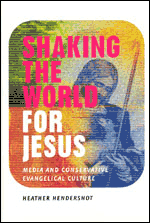
Since the Scopes monkey trial, Hendershot argues that the history of evangelical engagement with popular culture has been, largely, a search for middle-class respectability. Said another way, evangelicals have searched for ways to be in but not of the world as consumers and producers of popular culture. To that end, they have created their own pop culture artifacts…what Radosh sees as a parallel world…that has increasingly mirrored its “secular” counterpart. In each case, Hendershot reveals the scandalous reality that as evangelicals engage and employ elements of popular culture to spread their message, they necessarily tone down their exclusivist theology in an effort to reach a larger audience. Those that choose to retain a more separatist approach to popular culture often fail to reach a larger audience. In the most extreme cases, the theology in evangelical pop culture is fuzzy at best and absent at worst. Hendershot writes, “I would argue, however, that over the course of the past thirty years Christian media have become not more secular but more ambiguous” (7). This is nowhere more clear than in the world of Contemporary Christian Music. To gain air time on secular radio stations, Christian artists often have to downplay their references to Jesus or any explicitly theological lyrics. On the other hand, Christian artists hoping to reach a wider audience willingly do this. Hendershot’s critique of evangelical pop culture’s ambiguity is crystal clear in her discussion of CCM, in which lyrics have become increasingly open to broader interpretations. She writes, “Amazingly, a religious culture that shuns ‘moral relativism’ and favors literal Biblical interpretation is increasingly producing cultural artifacts with messages that are hard to pin down” (71)

Perhaps the most fascinating chapter of Shaking the World for Jesus is Hendershot’s discussion of the evangelical chastity movement. First, Hendershot discusses conservative evangelical essentialist notions of gender, boys are sexually aggressive and females are sexually passive…or should be. These, of course, mirror their proscribed notions of spirituality based on gender as well…men are the spiritual leaders and women are to be submissive to said leadership. However, she notes that evangelical chastity media challenges and restructures these gender “norms.” For evangelicals to be chaste, boys/men must rein in that aggressiveness and girls/women must overcome their passivity and reject male sexual advances. Evangelical notions of bodily control…or lack thereof…also complicate teens’ sexual maturity. Hendershot writes, “By constructing a teen body utterly lacking self-control, a body that can only be controlled or cured by a spiritual commitment to chastity, evangelical books, magazines, and videos may not only be dangerous to teen self-image but also may encourage boys to be sexually violent and girls to see submission to sexual violence as natural” (93). These are serious problems indeed, but even if it doesn’t go that far for many teens, evangelical chastity media, at least, also complicates teens’ images of their own bodies, both male and female.

The Cathedral of Hope in Dallas, TX.
Hendershot’s discussion of the Cathedral of Hope in Dallas, TX, is also an interesting look at evangelical popular culture and notions of sexuality from former practicing evangelicals who now embrace a more progressive version of the Christian faith. She notes that gay Christians face attacks from both the Christian community who denounce their homosexuality as sin and the gay community who denounces their participation in the Christian faith as selling out or assimilating to the wider culture. Like their evangelical counterparts, the members of the Cathedral of Hope make the Bible a central part of their lives (though they obviously interpret it differently), have conversion and coming out narratives as an integral part of their experience, and actively use media to share their message.

Looking for Jesus in an MIS film.
In her last section, Hendershot begins with a discussion of the Moody Institute of Science’s films that shared a Gospel message through an in-depth study of the natural world. Hendershot writes, “Rather than appealing to emotion or drawing on therapeutic ideas about self-improvement, as much of today’s evangelical media do, these midcentury films are aggressively argumentative and rational. And unlike today’s watered-down Christian pop tunes or ‘religious’ but ecumenical video series, the evangelical films of the fifties contain a salvation message that marks them as Christian” (145). It might surprise many of us but until the late ’60s, these videos were not only show in schools across the country, but even in the military as well. Far more interesting, at least to me, is Hendershot’s subsequent discussion of evangelical apocalyptic films since the 1970s, beginning with Mark IV Production’s A Thief in the Night. Hendershot argues that there is again a fuzziness about the theology in these films, especially in conversion moments when, often, the main characters relent and accept Christ after the Rapture. She argues that these films have failed to make a breakthrough into the mainstream largely because prophecy is such an extremely self-enclosed system that seems quite absurd to outsiders. Unlike many other religion and film writers, Hendershot looks at production, distribution, and exhibition, if only cursorily, rather than just content. She provides budget and revenue figures for these films, revealing that they, like most Christian films, struggle to break even at the box office but find a profit in DVD sales.
Though Hendershot is highly critical of all the media discussed above, in her introduction and throughout her book, she also recognizes that this ambiguous media serves important functions within the evangelical community itself. She writes, “Beyond providing clean-cut entertainment, such media can also help people deal with emotional crises, teach them political lessons, instruct them in chastity and other Christian modes of behavior, or provide inspirational models for praise and worship. In short, such media both reflect and construct evangelical understandings of the sacred and the profane, of the saved individual and his or her place in the wider world” (8). Moreover, she does show that evangelical Christians don’t always passively accept the messages that evangelical media present, as he examples of teens who push the boundaries of chastity literature and negative evangelical reviews of apocalyptic films show.
In the end, Hendershot’s book is a delight to read and is full of humor and incisive commentary. In a way, Shaking the World for Jesus is also an invitation for future scholars to take her findings a step further and to take an even more in-depth look at the media she covers (for example, the production, distribution, and exhibition of Christian films) or other elements of evangelical popular culture that have emerged since the time of its publication. Along with texts like Radosh’s Rapture Ready and James B. Twitchell’s Shopping for God, Hendershot’s work provides a solid foundation for a clear understanding of an important component of American Christianity and popular culture.
You can purchase Shaking the World for Jesus here.
Previous Post

July 16, 2010
Dreaming Life
Next Post
July 22, 2010 The Kids are Definitely NOT All Right
Browse Our Archives
Select a Category Classics DVD Film Music News Pop Culture Events Print Sports Television Uncategorized Video Games
Select a Month March 2017 February 2017 January 2017 December 2016 November 2016 October 2016 September 2016 August 2016 July 2016 June 2016 May 2016 April 2016 March 2016 February 2016 January 2016 December 2015 November 2015 October 2015 September 2015 August 2015 July 2015 June 2015 May 2015 April 2015 March 2015 February 2015 January 2015 December 2014 November 2014 October 2014 September 2014 August 2014 July 2014 June 2014 May 2014 April 2014 March 2014 February 2014 January 2014 December 2013 November 2013 October 2013 September 2013 August 2013 July 2013 June 2013 May 2013 April 2013 March 2013 February 2013 January 2013 December 2012 November 2012 October 2012 September 2012 August 2012 July 2012 June 2012 May 2012 April 2012 March 2012 February 2012 January 2012 December 2011 November 2011 October 2011 September 2011 August 2011 July 2011 June 2011 May 2011 April 2011 March 2011 February 2011 January 2011 December 2010 November 2010 October 2010 September 2010 August 2010 July 2010 June 2010 May 2010 April 2010 March 2010 February 2010 January 2010 December 2009 November 2009 October 2009 September 2009 August 2009 July 2009 June 2009 May 2009 April 2009 March 2009 February 2009 January 2009 December 2008 November 2008 October 2008 September 2008 August 2008 July 2008 June 2008 May 2008 April 2008 March 2008 February 2008 January 2008 December 2007 November 2007 October 2007 September 2007 August 2007 July 2007 June 2007 May 2007 April 2007 March 2007
Follow Us!
TAKE THE
Religious Wisdom Quiz
Who did Jesus call the "greatest among those born of women"?
Select your answer to see how you score.
John the Baptist Moses Elijah Peter
Related posts from Pop Theology


#KillerSerials: An Interview with Kutter Callaway

Book Review: MUSLIMS AND THE MAKING OF AMERICA

TRENDING AT PATHEOS Progressive Christian

Why Christians Have a Sacred Duty to Vote:...
The Bible offers strong support for the sacred duty to vote. Here...

What Being a Modern-Day Apostle Means to Me
In my last column, I discussed the ins and outs of modern-day...

Did Ancient China Once Worship the God of...
Across human history, a common thread weaves through the origins of the...

Love Your Neighbor – Including Earth-Kin: Lev. 19,...
God’s command to love your neighbor means acting in an ethical and...

Lead a Church Study of “Jesus and Lao...
Guest writer Jack Thomas (The Irreverent Reverend) reflects on leading his church...

Principles for Understanding the Apostolic Ministry Today
Whenever people discover that my formal ministry title is "apostle," as in...
view all Progressive Christian blogs
Ad-Free & Subscriber Log-In Subscription Support
- About Us
- 2026 Calendar
- Videos
- Podcasts
- Library of World Religions
- Faith In Media Tracker
- Advertise With Us
- Write for Us
- Privacy Policy
- Terms of Service
- Do Not Sell My Data
- Contact Us
- Radiant Digital
- Manage Newsletter Subscriptions
- Unsubscribe From Notifications
- Sitemap
Copyright 2008-2026, Patheos. All rights reserved.
Subscription Support Ad-Free & Subscriber Log-In
Follow Patheos