
BuddhistCatholicContemplativeEvangelicalGeneral ChristianHinduJewishLatter-day SaintMuslimNew VisionsProgressive Christian
Beliefs
- Buddhist
- Catholic
- Contemplative
- Evangelical
- General Christian
- Hindu
- Jewish
- Latter-day Saint
- More Voices
- Muslim
- New Visions
- Pagan
- Progressive Christian
Topics
- Religion News
- Food and Religion
- Sports and Religion
- Religious Art
- Religious Music and Entertainment
- Religious Events
- History and Religion
- Style and Religion
- Politics and Religion
- Women in Religion
- Recreation Outdoors and Religion
- Business Finance and Religion
- Careers Workplace and Religion
- Education and Religion
- Family Parenting and Religion
- Health Fitness and Religion
- Home and Religion
- Relationships and Religion
- Technology and Religion
- Travel and Religion
Columnists
- Buddhist Columnists
- Business Finance and Religion Columnists
- Careers Workplace and Religion Columnists
- Catholic Columnists
- Contemplative Columnists
- Education and Religion Columnists
- Evangelists Columnists
- Family Parenting and Religion Columnists
- General Christian Columnists
- Health Fitness and Religion Columnists
- Hindu Columnists
- History and Religion Columnists
- Home and Religion Columnists
- Jewish Columnists
- More Voices Columnists
- Latter Day Columnists
- Muslim Columnists
- New Visions Columnists
- Nonreligious Columnists
- Pagan Columnists
- Politics and Religion Columnists
- Progressive Columnists
- Recreation Outdoors and Religion Columnists
- Relationships and Religion Columnists
- Religion News Columnists
- Religious Art Columnists
- Religious Events Columnists
- Religious Music and Entertainment Columnists
- Sports and Religion Columnists
- Style and Religion Columnists
- Technology and Religion Columnists
- Travel and Religion Columnists
- Women in Religion Columnists
Resource Library
- 2026 Calendar
- Library of World Religions
- The 100 Most Holy Places on Earth
- Patheos Answers
- Podcasts
- Videos
- Faith Leaders Database
- Anglican Episcopalian
- Bahai
- Baptist
- Buddhism
- Christianity
- Confucianism
- Eastern Orthodoxy
- Hinduism
- Holiness and Pentecostal
- ISKCON
- Islam
- Judaism
- Lutheran
- Methodist
- The Church of Jesus Christ of Latter-day Saints
- New Age
- Paganism
- Presbytarian and Reformed
- Protestantism
- Religion Behind the Scenes
- Roman Catholic
- Scientology
- Shia Islam
- Sikhism
- Sufism
- Sunni Islam
- Taoism
- Zen
- See all religions
Research Tools
 Ad-Free & Subscriber Log-In Subscription Support
Ad-Free & Subscriber Log-In Subscription Support
Follow Patheos 

- Trending:
- Forgiveness
- |
- Marriage
- |
- Consciousness
- |
- Death Penalty
- |
- Election
- |
- Halloween
 Pop Theology
- Home
- Progressive Christian
- Religious Music & Entertainment
- GOD'S ECONOMY: A Review
GOD'S ECONOMY: A Review
Last updated on: July 6, 2010 at 7:27 am by J. Ryan Parker
GOD'S ECONOMY: A Review 2010-07-06T07:27:25-07:00 J. Ryan Parker
Patheos Explore the world's faith through different perspectives on religion and spirituality! Patheos has the views of the prevalent religions and spiritualities of the world.
As part of my dissertation research, I’ve been looking into the Prosperity Gospel, the Health and Wealth Gospel, or the Name It and Claim It Gospel…whatever you like to call it. For those of you who don’t know, it’s basically the notion that God wants us to be physically wealthy here and now. Ironically, those who have been the most “successful” at preaching it often require something in return from the believers who hope to attain that health and wealth. This is especially problematic for poorer believers who hope to model the middle-class lifestyle of many of their fellow mega-church congregants or the upper-class lifestyle of their ministers. It’s a dangerous theology…some would say heresy. Jonathan Wilson-Hartgrove‘s God’s Economy: Redefining the Health & Wealth Gospel is a thinly-veiled attack on such theologies and a prophetic re-imagining of how we relate to one another and God in God’s economy.
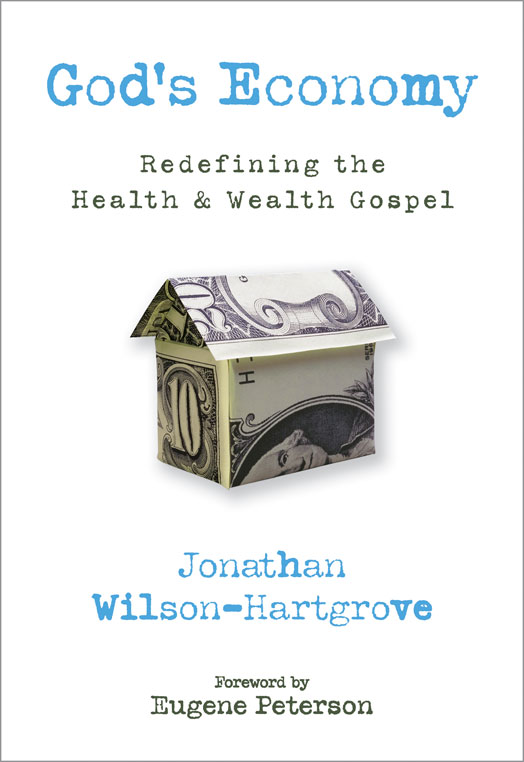
Hartgrove and the Prosperity Gospel proponents agree on one thing, God wants us to have abundant life here and now. Jesus promised as much when he claimed that he had come not just to give us life, but life abundant. However, they disagree mightily on what that abundance looks like. Hartgrove passionately argues that God’s economy is based on notions of abundance not scarcity and that the most important abundance is that of the relationality of God’s children gathered at God’s table. Rather than financial security, possessions, or wealth, true abundance lies in the healing, life-giving relationships that we cultivate and nurture with one another and particularly the people of the world that Jesus classified as the least of these. Hartgrove examines the life and teachings of Jesus and finds several tactics for implementing God’s economy in the here and now. He also warns that the notion of God’s economy is not a system to be put in place over against capitalism, socialism, communism, etc., but a radical, seemingly other-worldly, way of living that undercuts all of these flawed, earthly systems. Briefly, these tactics include Subversive Service, Eternal Investments, Economic Friendship, Relational Generosity, and Gracious Politics.
Of the first, Subversive Service, Hartgrove notes Jesus’ willingness to serve his disciples and everyone with whom he came in contact, claiming that the last shall be first. Hartgrove writes, “If our goal is to climb the ladder–to get to the top and use our influence for good–then we’ll always be stuck, in a competitive struggle for an elusive power. But if we strive to serve, our opportunities are unlimited” (86). Hartgrove’s discussion of Eternal Investments is perhaps the most challenging as he charges us to consider what we invest in financially and spiritually and what our current investments reveal about our level of trust in God. He argues, “The greatest obstacle to faith in our time may well be that most of us are too invested in securing our own futures to trust Jesus for the good life he wants to give us now” (108).
Hartgrove’s notion of Economic Friendships encourages us to use our resources to establish meaning relationships here and now. Who knows how new friends can help us in times of future need or how we could possibly help others? Hartgrove reflects on Luke 16:9 and claims that when “we spread the stuff [money] around we facilitate friendships that last forever” (147). Here, he offers a brief, but powerful encouragement to churches to engage in serious financial conversations and to consider how those with excess resources might be able to help their fellow congregants in times of financial need. Relational Generosity follows close behind Financial Friendships. Hartgrove cites the Bible’s overwhelming occupation with the poor and Jesus’ command to give to the one who asks of you. He claims that we are often plagued by a fear of (or discomfort with) the needy, but argues that in giving of our time, gifts, money, etc., in love, we drive out that fear. Hartgrove writes, “God doesn’t ask us to change people–God asks us to love people. When we share with one who asks, we are changed. Little by little, we grow into the love of our Father, whose love is perfect” (175).
Jesus’ final tactic, Hartgrove claims, is the notion of Gracious Politics, basically the tension of practicing God’s economy in a political surrounding that is often hostile to that economy. How do we render to Caesar that which is Caesar’s and to God that which is God’s, especially if we truly believe that it all belongs to God? Next to Hartgrove’s discussion of Eternal Investments, this is perhaps the second most challenging tactic that Jesus provides. Hartgrove recognizes that our money that “belongs” to the state often contributes to things antithetical to our Christian commitments. Moreover, some churches also align themselves too closely with a corrupt political system. Here, he encourages us to take up a prophetic stance to both church and state when necessary, arguing that Jesus will not be a political or material brand for our own selfish desires.
In an age of zero-sum politics and economics, God’s Economy is a much-needed, prophetic voice that contains signposts pointing to a way out of the meaningless malaise in which many of us find ourselves trapped on the road to financial stability and comfort. The book benefits from Hartgrove’s real, lived experiences in a community that practices, or attempts to practice, the tactics that he lays out here. It is full of stories of people who have found healing and wholeness in just such communities by recognizing that, from the wealthiest to the poorest, abundance is found in the community of broken believers living, working, and serving together. God’s Economy is such a spiritually challenging text and one that demands to be re-read over and over again. Ultimately, it is a rewarding experience that can radically change the ways we relate with one another and perceive our financial situation.
You can order God’s Economy here. You can also visit Jonathan’s website to learn more about his work and to view a series of discussion videos that accompany the text.
Previous Post

June 28, 2010
THE DUDE ABIDES: A REVIEW
Next Post
July 7, 2010 The Power to Unite and Divide
Browse Our Archives
Select a Category Classics DVD Film Music News Pop Culture Events Print Sports Television Uncategorized Video Games
Select a Month March 2017 February 2017 January 2017 December 2016 November 2016 October 2016 September 2016 August 2016 July 2016 June 2016 May 2016 April 2016 March 2016 February 2016 January 2016 December 2015 November 2015 October 2015 September 2015 August 2015 July 2015 June 2015 May 2015 April 2015 March 2015 February 2015 January 2015 December 2014 November 2014 October 2014 September 2014 August 2014 July 2014 June 2014 May 2014 April 2014 March 2014 February 2014 January 2014 December 2013 November 2013 October 2013 September 2013 August 2013 July 2013 June 2013 May 2013 April 2013 March 2013 February 2013 January 2013 December 2012 November 2012 October 2012 September 2012 August 2012 July 2012 June 2012 May 2012 April 2012 March 2012 February 2012 January 2012 December 2011 November 2011 October 2011 September 2011 August 2011 July 2011 June 2011 May 2011 April 2011 March 2011 February 2011 January 2011 December 2010 November 2010 October 2010 September 2010 August 2010 July 2010 June 2010 May 2010 April 2010 March 2010 February 2010 January 2010 December 2009 November 2009 October 2009 September 2009 August 2009 July 2009 June 2009 May 2009 April 2009 March 2009 February 2009 January 2009 December 2008 November 2008 October 2008 September 2008 August 2008 July 2008 June 2008 May 2008 April 2008 March 2008 February 2008 January 2008 December 2007 November 2007 October 2007 September 2007 August 2007 July 2007 June 2007 May 2007 April 2007 March 2007
Follow Us!
TAKE THE
Religious Wisdom Quiz
Who urged Esther to approach the king, saying, "For such a time as this"?
Select your answer to see how you score.
Mordecai Haggai Ezra Nehemiah
Related posts from Pop Theology


#KillerSerials: An Interview with Kutter Callaway

Book Review: MUSLIMS AND THE MAKING OF AMERICA

TRENDING AT PATHEOS Progressive Christian

Why Christians Have a Sacred Duty to Vote:...
The Bible offers strong support for the sacred duty to vote. Here...

What Being a Modern-Day Apostle Means to Me
In my last column, I discussed the ins and outs of modern-day...

Did Ancient China Once Worship the God of...
Across human history, a common thread weaves through the origins of the...

Love Your Neighbor – Including Earth-Kin: Lev. 19,...
God’s command to love your neighbor means acting in an ethical and...

Lead a Church Study of “Jesus and Lao...
Guest writer Jack Thomas (The Irreverent Reverend) reflects on leading his church...

Principles for Understanding the Apostolic Ministry Today
Whenever people discover that my formal ministry title is "apostle," as in...
view all Progressive Christian blogs
Ad-Free & Subscriber Log-In Subscription Support
- About Us
- 2026 Calendar
- Videos
- Podcasts
- Library of World Religions
- Faith In Media Tracker
- Advertise With Us
- Write for Us
- Privacy Policy
- Terms of Service
- Do Not Sell My Data
- Contact Us
- Radiant Digital
- Manage Newsletter Subscriptions
- Unsubscribe From Notifications
- Sitemap
Copyright 2008-2026, Patheos. All rights reserved.
Subscription Support Ad-Free & Subscriber Log-In
Follow Patheos