
BuddhistCatholicContemplativeEvangelicalGeneral ChristianHinduJewishLatter-day SaintMuslimNew VisionsProgressive Christian
Beliefs
- Buddhist
- Catholic
- Contemplative
- Evangelical
- General Christian
- Hindu
- Jewish
- Latter-day Saint
- More Voices
- Muslim
- New Visions
- Pagan
- Progressive Christian
Topics
- Religion News
- Food and Religion
- Sports and Religion
- Religious Art
- Religious Music and Entertainment
- Religious Events
- History and Religion
- Style and Religion
- Politics and Religion
- Women in Religion
- Recreation Outdoors and Religion
- Business Finance and Religion
- Careers Workplace and Religion
- Education and Religion
- Family Parenting and Religion
- Health Fitness and Religion
- Home and Religion
- Relationships and Religion
- Technology and Religion
- Travel and Religion
Columnists
- Buddhist Columnists
- Business Finance and Religion Columnists
- Careers Workplace and Religion Columnists
- Catholic Columnists
- Contemplative Columnists
- Education and Religion Columnists
- Evangelists Columnists
- Family Parenting and Religion Columnists
- General Christian Columnists
- Health Fitness and Religion Columnists
- Hindu Columnists
- History and Religion Columnists
- Home and Religion Columnists
- Jewish Columnists
- More Voices Columnists
- Latter Day Columnists
- Muslim Columnists
- New Visions Columnists
- Nonreligious Columnists
- Pagan Columnists
- Politics and Religion Columnists
- Progressive Columnists
- Recreation Outdoors and Religion Columnists
- Relationships and Religion Columnists
- Religion News Columnists
- Religious Art Columnists
- Religious Events Columnists
- Religious Music and Entertainment Columnists
- Sports and Religion Columnists
- Style and Religion Columnists
- Technology and Religion Columnists
- Travel and Religion Columnists
- Women in Religion Columnists
Resource Library
- 2026 Calendar
- Library of World Religions
- The 100 Most Holy Places on Earth
- Patheos Answers
- Podcasts
- Videos
- Faith Leaders Database
- Anglican Episcopalian
- Bahai
- Baptist
- Buddhism
- Christianity
- Confucianism
- Eastern Orthodoxy
- Hinduism
- Holiness and Pentecostal
- ISKCON
- Islam
- Judaism
- Lutheran
- Methodist
- The Church of Jesus Christ of Latter-day Saints
- New Age
- Paganism
- Presbytarian and Reformed
- Protestantism
- Religion Behind the Scenes
- Roman Catholic
- Scientology
- Shia Islam
- Sikhism
- Sufism
- Sunni Islam
- Taoism
- Zen
- See all religions
Research Tools
 Ad-Free & Subscriber Log-In Subscription Support
Ad-Free & Subscriber Log-In Subscription Support
Follow Patheos 

- Trending:
- Forgiveness
- |
- Marriage
- |
- Consciousness
- |
- Death Penalty
- |
- Election
- |
- Halloween
 Pop Theology
- Home
- Progressive Christian
- Religious Music & Entertainment
- The Springfield Reformation: A Review
The Springfield Reformation: A Review
Last updated on: February 2, 2010 at 11:12 am by J. Ryan Parker
The Springfield Reformation: A Review 2010-02-02T11:12:54-08:00 J. Ryan Parker
Patheos Explore the world's faith through different perspectives on religion and spirituality! Patheos has the views of the prevalent religions and spiritualities of the world.
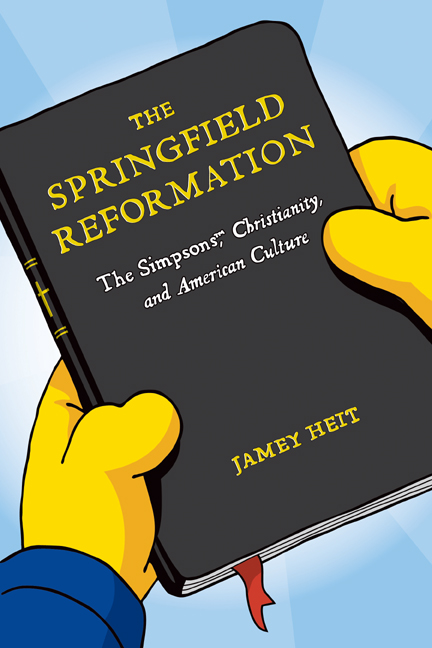
Despite a decline in the overall quality of the past several seasons, The Simpsons still manages to turn out a few funny episodes each season. Over the past decade or so, there have been a variety of texts that take a scholarly approach to the long-running series from philosophical or theological perspectives. The latest, Jamey Heit‘s The Springfield Reformation: The Simpsons, Christianity, and American Culture, offers insights into some of the series’ episodes that give a rather prophetic look at contemporary American religion.
Heit examines all 400 episodes and The Simpsons Movie (2007), but obviously centers on the episodes with more religiously themed plots like “Lisa the Skeptic,” “Homer the Heretic,” or “The Joy of Sect.” His intent is to “explore more deeply the extent to which Christianity influences the lives of Springfield’s residents,” and in so doing reveal “how Christianity has lost, or actively given away, its integrity as a socially relevant institution in contemporary American culture” (2). As such, Heit reminds us just how effectively The Simpsons has worked as scathing satire, offering different perspectives on its religious/theological implications than, say, Mark Pinsky’s The Gospel According to The Simpsons, with whom he frequently disagrees. Heit claims that contemporary American Christianity is at a critical crossroads of identity and that The Simpsons illustrates this crossroads and provides a possible way forward.
Heit’s first two chapters provides something of a general approach to the series. First, he offers a discussion of postmodernism and the series and, second, a spiritual overview of Springfield. Heit reminds us that Springfield has Christian roots, even if the majority of its citizens have remained nominally Christian but still spiritual. After these introductions, Heit continues with more specific chapters that focus on particular themes like God, biblical authority, the role of ministers, evangelical Christianity, spiritual wanderers, economics and religion, and science and faith.
Heit reveals in all of these discussions problems in the ways in which many American Christians approach their faith…reveling in a biblical illiteracy, linking economics and faith too closely, or keeping faith and  science at war with each other. In Springfield and real America, Heit writes, “The Bible ought to provide a measure of spiritual guidance and comfort, as well as serve as an authoritative moral guide, but too often it becomes a source to be massaged in order to justify personally appointed positions of authority” (63). Rather than simply passing judgment on Reverend Lovejoy, Heit portrays him as a burned-out ministers who suffers from a lackadaisical congregation. Heit adds, “In broad terms, and suported by multiple specific examples, Reverend Lovejoy embodies the way in which the church does not and seemingly cannot provide competent and legitimate leadership in contemporary American culture” (71). Heit makes sure that his readers understand that this is just as much a failing on the part of Lovejoy’s congregation as it is Lovejoy himself, or the institutional forms of Christianity of which he is a part. This discussion mirrors much of progressive theology’s fears for the future of seminaries, denominations, and local congregations, but parts company with them by emphasizing the attitudes of congregants that help keep the current denominations alive. Many congregants don’t even put for the “effort” that Homer does in cultivating their own spirituality (misguided though his occasionally may be) and are simply content to passively sit in the pew and be told what to believe or do or at least be comforted and uplifted for the week ahead.

While Heit’s critique of Ned Flanders is a bit typical, his spiritual/theological engagement with Homer is quite interesting. Heit seems to vacillate between the contrasting approaches: For Homer, spirituality always drifts away from the established church to a hackneyed notion of spirituality that endorses his lifestyle” (106). On the other hand, Heit agrees with the likes of Lisle Dalton et al that “Homer personifies precisely the tendencies that define postmodern American spirituality” (108). I wonder if, taking postmodern spirituality/theology seriously, a drift away from the established church is always hackneyed. I doubt Heit would argue this, given the seriousness with which he engages Homer’s spiritual journey.
In many ways, Heit often leaves his readers hanging. By that, I mean that he makes bold assertions and claims about aspects of contemporary American Christianity without really backing them up with statistics or examples. Nevertheless, Heit’s book is still an entertaining read and a reminder of why The Simpsons will remain relevant for quite some time to come.
Previous Post

February 1, 2010
Bad Even for Hollywood
Next Post
February 3, 2010 Pop Theology's Oscar Conversation
Browse Our Archives
Select a Category Classics DVD Film Music News Pop Culture Events Print Sports Television Uncategorized Video Games
Select a Month March 2017 February 2017 January 2017 December 2016 November 2016 October 2016 September 2016 August 2016 July 2016 June 2016 May 2016 April 2016 March 2016 February 2016 January 2016 December 2015 November 2015 October 2015 September 2015 August 2015 July 2015 June 2015 May 2015 April 2015 March 2015 February 2015 January 2015 December 2014 November 2014 October 2014 September 2014 August 2014 July 2014 June 2014 May 2014 April 2014 March 2014 February 2014 January 2014 December 2013 November 2013 October 2013 September 2013 August 2013 July 2013 June 2013 May 2013 April 2013 March 2013 February 2013 January 2013 December 2012 November 2012 October 2012 September 2012 August 2012 July 2012 June 2012 May 2012 April 2012 March 2012 February 2012 January 2012 December 2011 November 2011 October 2011 September 2011 August 2011 July 2011 June 2011 May 2011 April 2011 March 2011 February 2011 January 2011 December 2010 November 2010 October 2010 September 2010 August 2010 July 2010 June 2010 May 2010 April 2010 March 2010 February 2010 January 2010 December 2009 November 2009 October 2009 September 2009 August 2009 July 2009 June 2009 May 2009 April 2009 March 2009 February 2009 January 2009 December 2008 November 2008 October 2008 September 2008 August 2008 July 2008 June 2008 May 2008 April 2008 March 2008 February 2008 January 2008 December 2007 November 2007 October 2007 September 2007 August 2007 July 2007 June 2007 May 2007 April 2007 March 2007
Follow Us!
TAKE THE
Religious Wisdom Quiz
Who was cast into a pit by his brothers?
Select your answer to see how you score.
Daniel Moses Joseph Jacob
Related posts from Pop Theology


#KillerSerials: An Interview with Kutter Callaway

Book Review: MUSLIMS AND THE MAKING OF AMERICA

TRENDING AT PATHEOS Progressive Christian

Why Christians Have a Sacred Duty to Vote:...
The Bible offers strong support for the sacred duty to vote. Here...

What Being a Modern-Day Apostle Means to Me
In my last column, I discussed the ins and outs of modern-day...

Did Ancient China Once Worship the God of...
Across human history, a common thread weaves through the origins of the...

Love Your Neighbor – Including Earth-Kin: Lev. 19,...
God’s command to love your neighbor means acting in an ethical and...

Lead a Church Study of “Jesus and Lao...
Guest writer Jack Thomas (The Irreverent Reverend) reflects on leading his church...

Principles for Understanding the Apostolic Ministry Today
Whenever people discover that my formal ministry title is "apostle," as in...
view all Progressive Christian blogs
Ad-Free & Subscriber Log-In Subscription Support
- About Us
- 2026 Calendar
- Videos
- Podcasts
- Library of World Religions
- Faith In Media Tracker
- Advertise With Us
- Write for Us
- Privacy Policy
- Terms of Service
- Do Not Sell My Data
- Contact Us
- Radiant Digital
- Manage Newsletter Subscriptions
- Unsubscribe From Notifications
- Sitemap
Copyright 2008-2026, Patheos. All rights reserved.
Subscription Support Ad-Free & Subscriber Log-In
Follow Patheos