
BuddhistCatholicContemplativeEvangelicalGeneral ChristianHinduJewishLatter-day SaintMuslimNew VisionsProgressive Christian
Beliefs
- Buddhist
- Catholic
- Contemplative
- Evangelical
- General Christian
- Hindu
- Jewish
- Latter-day Saint
- More Voices
- Muslim
- New Visions
- Pagan
- Progressive Christian
Topics
- Religion News
- Food and Religion
- Sports and Religion
- Religious Art
- Religious Music and Entertainment
- Religious Events
- History and Religion
- Style and Religion
- Politics and Religion
- Women in Religion
- Recreation Outdoors and Religion
- Business Finance and Religion
- Careers Workplace and Religion
- Education and Religion
- Family Parenting and Religion
- Health Fitness and Religion
- Home and Religion
- Relationships and Religion
- Technology and Religion
- Travel and Religion
Columnists
- Buddhist Columnists
- Business Finance and Religion Columnists
- Careers Workplace and Religion Columnists
- Catholic Columnists
- Contemplative Columnists
- Education and Religion Columnists
- Evangelists Columnists
- Family Parenting and Religion Columnists
- General Christian Columnists
- Health Fitness and Religion Columnists
- Hindu Columnists
- History and Religion Columnists
- Home and Religion Columnists
- Jewish Columnists
- More Voices Columnists
- Latter Day Columnists
- Muslim Columnists
- New Visions Columnists
- Nonreligious Columnists
- Pagan Columnists
- Politics and Religion Columnists
- Progressive Columnists
- Recreation Outdoors and Religion Columnists
- Relationships and Religion Columnists
- Religion News Columnists
- Religious Art Columnists
- Religious Events Columnists
- Religious Music and Entertainment Columnists
- Sports and Religion Columnists
- Style and Religion Columnists
- Technology and Religion Columnists
- Travel and Religion Columnists
- Women in Religion Columnists
Resource Library
- 2026 Calendar
- Library of World Religions
- The 100 Most Holy Places on Earth
- Patheos Answers
- Podcasts
- Videos
- Faith Leaders Database
- Anglican Episcopalian
- Bahai
- Baptist
- Buddhism
- Christianity
- Confucianism
- Eastern Orthodoxy
- Hinduism
- Holiness and Pentecostal
- ISKCON
- Islam
- Judaism
- Lutheran
- Methodist
- The Church of Jesus Christ of Latter-day Saints
- New Age
- Paganism
- Presbytarian and Reformed
- Protestantism
- Religion Behind the Scenes
- Roman Catholic
- Scientology
- Shia Islam
- Sikhism
- Sufism
- Sunni Islam
- Taoism
- Zen
- See all religions
Research Tools
 Ad-Free & Subscriber Log-In Subscription Support
Ad-Free & Subscriber Log-In Subscription Support
Follow Patheos 

- Trending:
- Forgiveness
- |
- Marriage
- |
- Consciousness
- |
- Death Penalty
- |
- Election
- |
- Halloween
 Pop Theology
- Home
- Progressive Christian
- Religious Music & Entertainment
- Moments of Grace…
Moments of Grace…
Last updated on: February 9, 2010 at 9:33 am by J. Ryan Parker
Moments of Grace… 2010-02-09T09:33:41-08:00 J. Ryan Parker
Patheos Explore the world's faith through different perspectives on religion and spirituality! Patheos has the views of the prevalent religions and spiritualities of the world.

Richard Lindsay reviews A Single Man after the jump.
A Single Man is the somewhat ironic title for Christopher Isherwood’s 1964 novel, adapted and directed by Tom Ford and starring Colin Firth. Firth’s character, George Falconer, could better be described as a widower, after losing his partner Jim in a tragic accident. But in the story’s setting in the early 60’s, society considers George, even after a sixteen-year relationship, to be a “single” man. This becomes torturously clear in the scene in which Falconer learns of the death of his lover from a stranger who calls to inform him of the accident. The phone conversation plays painfully long on film, as Firth brilliantly portrays intellectual reserve fighting against inner devastation. The final indignity comes when George is informed the funeral service will be for “family only”—confirmed bachelor roommates of the deceased not included.
The film’s action takes place over the course of one day, eight months after the phone call. As George Falconer “becomes George,” a process which he narrates during his morning routine, we see in flashbacks the life he built with Jim that came to such an abrupt end. George Falconer (like Isherwood) is a Californian British expat, an English professor who teaches Huxley to bored undergrads, a man who lives in a modernist glass house. He is so weighted with grief, the most he can hope for is just to “get through the goddamned day.” Falconer—a name that suggests someone who once adventured, who went forth in the world—now seems tethered and hooded. Eight months is too short a time to recover from the loss of a spouse, but on this day, George will make a decision about whether to, in the words of a character in The Shawshank Redemption, “get busy living or get busy dying.”
George’s situation reminded me of Martin Luther’s conception of the human condition as being “Cor curvatus in se,” that is, “The heart curved in on itself.” The fundamental human sin in need of grace is self-obsession, the tendency to see one’s own problems and needs as all-important, which closes us off to God and our fellow human beings. Over the years, I’ve found the grace that unbends my own soul in the most unlikely—well at least “unchurchly”—places: art, film, music, conversations with friends and strangers, and, in ways that might make Luther blanch, the erotic.
It is through the erotic that the divine seems to be reaching out to George—three times in the course of the film. The first of God’s unlikely ministers is a humpy undergrad, a student in George’s English course. Kenny follows George out of class, filling him with the million banal philosophies of youth, and making a small gesture of kindness at the school bookstore. He finally asks George out for a drink, as much out of sexual interest as an awareness that, “You just look like someone who could use a friend.” George acknowledges as much, but has important self-pitying to do, so he declines. The second opportunity comes from a meet-cute moment in a liquor store parking lot with a Spanish hustler. Carlos is James Dean come to life—all t-shirt and rough exterior—but he offers George a smoke and a conversation that suggests his interest is in more than just a business deal. Once again, George walks away. The final opportunity comes from his long-time friend and neighbor Charley (Julianne Moore), an over-aged mod girl from London who would do anything to make George straight. They get drunk and kvetch about their lost loves, daring each other but not themselves to let go of the past and create a future. They end up in each others’ arms, but George shoots her down.
Each example of grace offered is full of flaws and objections, at least from a societal perspective. A sexually-charged drink with one of his students, half George’s age? Totally inappropriate. An immigrant sex worker who offers George carcinogens? How politically incorrect. A middle-aged alcoholic divorcee who insists on throwing herself at a gay man? How exploitative. And yet, in each person and situation, grace abounds, offering an imperfect but vital opportunity for connection to the sacred in defiance of accepted morality.
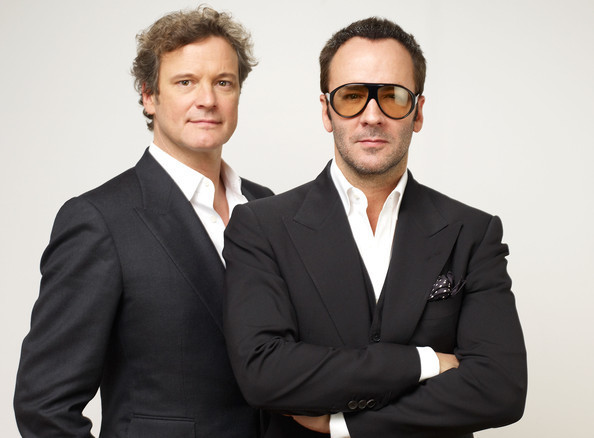
Colin Firth and Director Tom Ford
In the hands of director Tom Ford, former creative director of Gucci and the perpetrator of the “skinny suit” on an increasingly fat America, the film becomes a celebration of high modernist style. The impeccable design and cinematography mostly add to the meditative tone of the film, as long as one never thinks the words, “perfume commercial.” Ford is smart in his use of light and color to tell the story, but even smarter in leaning on his cast, training the camera on Colin Firth as the actor spins off the performance of his life.
Despite the potential dismissal of a fashion designer as a movie-making dilettante, it’s important not to underestimate the achievement of this film. As Manhola Dargis of The New York Times mentions, in the opinion of one of my favorite writers, Edmund White, Isherwood’s book was perhaps the first truly liberated gay novel. The very idea that a man could find a 16-year happiness with another man, and a deep well of grief at his loss, was unheard of at the time, and still controversial today. (As of this writing, about 52% of the California populace still believes this to be impossible.) George Falconer is perhaps most remarkable for his ordinariness.
In the end, it’s in the midst of the ordinariness of this single man that the sublime breaks in. It’s not giving away a happy ending to say that one of George’s erotic angels eventually gets through to him, if only for a moment. It’s a moment that seems no less charged with the miraculous for having come from the “mere” connection of one human being with another. The beauty of connection between these two characters, the skillful painting of tragedy in light and color, the sheer joy of watching a supremely talented actor bring a fascinating character to life—all of these elevate a highly stylized film into the realm of the spiritual.
Previous Post

February 5, 2010
The Religious Film: A Review
Next Post
February 12, 2010 Swing and a Miss...
Browse Our Archives
Select a Category Classics DVD Film Music News Pop Culture Events Print Sports Television Uncategorized Video Games
Select a Month March 2017 February 2017 January 2017 December 2016 November 2016 October 2016 September 2016 August 2016 July 2016 June 2016 May 2016 April 2016 March 2016 February 2016 January 2016 December 2015 November 2015 October 2015 September 2015 August 2015 July 2015 June 2015 May 2015 April 2015 March 2015 February 2015 January 2015 December 2014 November 2014 October 2014 September 2014 August 2014 July 2014 June 2014 May 2014 April 2014 March 2014 February 2014 January 2014 December 2013 November 2013 October 2013 September 2013 August 2013 July 2013 June 2013 May 2013 April 2013 March 2013 February 2013 January 2013 December 2012 November 2012 October 2012 September 2012 August 2012 July 2012 June 2012 May 2012 April 2012 March 2012 February 2012 January 2012 December 2011 November 2011 October 2011 September 2011 August 2011 July 2011 June 2011 May 2011 April 2011 March 2011 February 2011 January 2011 December 2010 November 2010 October 2010 September 2010 August 2010 July 2010 June 2010 May 2010 April 2010 March 2010 February 2010 January 2010 December 2009 November 2009 October 2009 September 2009 August 2009 July 2009 June 2009 May 2009 April 2009 March 2009 February 2009 January 2009 December 2008 November 2008 October 2008 September 2008 August 2008 July 2008 June 2008 May 2008 April 2008 March 2008 February 2008 January 2008 December 2007 November 2007 October 2007 September 2007 August 2007 July 2007 June 2007 May 2007 April 2007 March 2007
Follow Us!
TAKE THE
Religious Wisdom Quiz
True or False: Micah prophesied that the Messiah would be born in Bethlehem.
Select your answer to see how you score.
TRUE FALSE
Related posts from Pop Theology


At SXSW2017: May It Last: A Portrait of...

At SXSW 2017: "Untold Tales of Armistead Maupin"
TRENDING AT PATHEOS Progressive Christian

Why Christians Have a Sacred Duty to Vote:...
The Bible offers strong support for the sacred duty to vote. Here...

What Being a Modern-Day Apostle Means to Me
In my last column, I discussed the ins and outs of modern-day...

Did Ancient China Once Worship the God of...
Across human history, a common thread weaves through the origins of the...

Love Your Neighbor – Including Earth-Kin: Lev. 19,...
God’s command to love your neighbor means acting in an ethical and...

Lead a Church Study of “Jesus and Lao...
Guest writer Jack Thomas (The Irreverent Reverend) reflects on leading his church...

Principles for Understanding the Apostolic Ministry Today
Whenever people discover that my formal ministry title is "apostle," as in...
view all Progressive Christian blogs
Ad-Free & Subscriber Log-In Subscription Support
- About Us
- 2026 Calendar
- Videos
- Podcasts
- Library of World Religions
- Faith In Media Tracker
- Advertise With Us
- Write for Us
- Privacy Policy
- Terms of Service
- Do Not Sell My Data
- Contact Us
- Radiant Digital
- Manage Newsletter Subscriptions
- Unsubscribe From Notifications
- Sitemap
Copyright 2008-2026, Patheos. All rights reserved.
Subscription Support Ad-Free & Subscriber Log-In
Follow Patheos