
BuddhistCatholicContemplativeEvangelicalGeneral ChristianHinduJewishLatter-day SaintMuslimNew VisionsProgressive Christian
Beliefs
- Buddhist
- Catholic
- Contemplative
- Evangelical
- General Christian
- Hindu
- Jewish
- Latter-day Saint
- More Voices
- Muslim
- New Visions
- Pagan
- Progressive Christian
Topics
- Religion News
- Food and Religion
- Sports and Religion
- Religious Art
- Religious Music and Entertainment
- Religious Events
- History and Religion
- Style and Religion
- Politics and Religion
- Women in Religion
- Recreation Outdoors and Religion
- Business Finance and Religion
- Careers Workplace and Religion
- Education and Religion
- Family Parenting and Religion
- Health Fitness and Religion
- Home and Religion
- Relationships and Religion
- Technology and Religion
- Travel and Religion
Columnists
- Buddhist Columnists
- Business Finance and Religion Columnists
- Careers Workplace and Religion Columnists
- Catholic Columnists
- Contemplative Columnists
- Education and Religion Columnists
- Evangelists Columnists
- Family Parenting and Religion Columnists
- General Christian Columnists
- Health Fitness and Religion Columnists
- Hindu Columnists
- History and Religion Columnists
- Home and Religion Columnists
- Jewish Columnists
- More Voices Columnists
- Latter Day Columnists
- Muslim Columnists
- New Visions Columnists
- Nonreligious Columnists
- Pagan Columnists
- Politics and Religion Columnists
- Progressive Columnists
- Recreation Outdoors and Religion Columnists
- Relationships and Religion Columnists
- Religion News Columnists
- Religious Art Columnists
- Religious Events Columnists
- Religious Music and Entertainment Columnists
- Sports and Religion Columnists
- Style and Religion Columnists
- Technology and Religion Columnists
- Travel and Religion Columnists
- Women in Religion Columnists
Resource Library
- 2026 Calendar
- Library of World Religions
- The 100 Most Holy Places on Earth
- Patheos Answers
- Podcasts
- Videos
- Faith Leaders Database
- Anglican Episcopalian
- Bahai
- Baptist
- Buddhism
- Christianity
- Confucianism
- Eastern Orthodoxy
- Hinduism
- Holiness and Pentecostal
- ISKCON
- Islam
- Judaism
- Lutheran
- Methodist
- The Church of Jesus Christ of Latter-day Saints
- New Age
- Paganism
- Presbytarian and Reformed
- Protestantism
- Religion Behind the Scenes
- Roman Catholic
- Scientology
- Shia Islam
- Sikhism
- Sufism
- Sunni Islam
- Taoism
- Zen
- See all religions
Research Tools
 Ad-Free & Subscriber Log-In Subscription Support
Ad-Free & Subscriber Log-In Subscription Support
Follow Patheos 

- Trending:
- Forgiveness
- |
- Marriage
- |
- Consciousness
- |
- Death Penalty
- |
- Election
- |
- Halloween
 Pop Theology
- Home
- Progressive Christian
- Religious Music & Entertainment
- A Complex Evil
A Complex Evil
Last updated on: December 15, 2009 at 11:05 am by J. Ryan Parker
A Complex Evil 2009-12-15T11:05:22-08:00 J. Ryan Parker
Patheos Explore the world's faith through different perspectives on religion and spirituality! Patheos has the views of the prevalent religions and spiritualities of the world.

I recently took a break from my Christmas movie bonanza with all its images of love and peace and togetherness to watch Gomorrah, a brutally realistic film about the Camorra, one of the the largest criminal organizations in the world. I am well aware of the debates over and problems with violence in film, but I do believe it has a place, and Gomorrah is a perfect example of this.
Directed by Matteo Garrone, Gomorrah plops us in the middle of the criminal underbelly of Naples and the activity of the Camorra. The film opens as a group of about six gangsters tan and get their nails done at a local salon. Three of them turn on the others and gun them down at close range. We then move through the rest of the film through five interwoven vignettes. One involves Marco (Marco Macor) and Sweet Pea (Ciro Petrone) (seen in the poster above), two small-time crooks who think they can work outside the 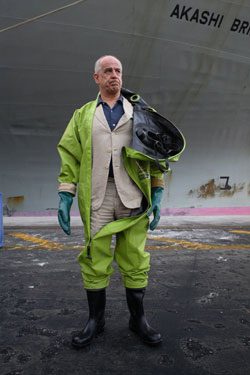 Camorra and openly defy its power. Both are attracted to the promise of wealth and power than gangster films like The Godfather and Scarface convey, all the while oblivious to the danger and sacrifices that accompany them. Toto (Salvatore Abruzzese), a young boy who stumbles into the mafia, is forced to make decisions well beyond his life experiences. Don Ciro (Gianfelice Imparato) is a money man for the mafia, paying families and retired mafia members their montly wages. An internal struggle among the mafia creates a division, and when he wants to switch sides, he realizes that he will have to pay with more than Euros. Another vignette follows Franco (Toni Servillo) and his apprentice, Roberto (Carmine Paternoster), as they travel around Europe looking for disposal sites for toxic waste, a “legitimate” branch of the mafia business. Roberto seems to be the only character in the film who exhibits any sort of guilty conscience about this lifestyle, but before he leaves it behind, Franco challenges any simplistic notions that he might have about life in the Camorra. The last vignette centers on Pasquale (Salvatore Cantalupo) a tailor who struggles to make ends meet while working oppressive hours and mistakenly believes that he can work for anyone else other than the Camorra.
What The Wire has been to the TV crime drama, Gomorrah will be to the gangster film. Both present a moral complexity not often found in either genre. Gomorrah‘s criminal life is anything but glamorous…in fact, it is downright tacky. The violence, a couple of shootings, is presented in one of three ways, up close, from afar, or immediately after the fact. In all cases it is presented as a matter-of-fact…this is daily life in that world. While occasionally frustrating, another highlight of the film is the director’s refusal to explain who people are. Instead, he lets the audience learn as we go along, much like, I would expect, the residents of that area do as well. We, of course, are free form the violent consequences of misunderstandings. Not once does it seem that we encounter the head of the Camorra as he stays hidden from the mundane activities that take place below him.

The sheer overwhelming presence of crime, injustice, and evil is almost beyond comprehension…almost too bad to be true. However, the DVD interviews with the director and the writer of the book on which the film was based, Roberto Saviano, who had to hire private security after writing it, reveal that indeed life among the Camorra is much worse than the film depicts. Some of their comments are worth quoting in full here:
We had to make people outside that world understand that as long as you imagine that that world can be divided into ‘good guys’ and ‘bad guys,’ you’ll never really understand the heart of that world. The truth is that when you are inside it, you realize there’s a vast gray zone where good and evil are all mixed together. And if you grow up inside that reality, that dynamic, it’s very easy to get caught in the gears, and if you try to get out, it’s extremely difficult not to get crushed. So the real protagonists of Gomorrah are the common people who live in this jungle and face these conflicts. –Matteo Garrone
The film concludes with this additional information:
In Europe, the Camorra has killed more people than any other criminal organization. 4,000 deaths in the last 30 years. One every three days. Scampia is the largest open-air drug market in the world. Daily sales per day run about 500,000 Euros. If clan-managed toxic waste were piled up, it would reach 47,900 feet. Mt. Everest is 29,000 feet high. Cancer rates have increased 20% in the poisoned areas. Profits from illegal activities are reinvested in legal activities worldwide. The Camorra has invested in the reconstruction of the Twin Towers.
Given such a horrific reality, it would be hard to not demonize this organization, but this is exactly what the filmmakers did not want to do. Gomorrah is neither pro-Camorra nor anti-Camorra. The filmmakers could not have made it any other way. When filming, they often had actual members of the mafia looking over their shoulders at the monitors, and just off camera, real drug deals would be taking place alongside the staged ones. When an interviewer asked Garrone what the locals thought of the film, he responded, “I don’t know, because I was in Rome. One doesn’t re-visit the scene of a crime.”
To say that Gomorrah is a violent film is to say too much and not enough. Given this complexity, few films compare to it, and, as such, it makes for a strong contribution to not only the mafia film genre, but to discussions of violence in film and the nature of evil.
Gomorrah (137 mins) is unrated and available on DVD.
Previous Post

December 14, 2009
The Rapture Exposed: A Review
Next Post
December 22, 2009 A Cinematic Game Changer?
Browse Our Archives
Select a Category Classics DVD Film Music News Pop Culture Events Print Sports Television Uncategorized Video Games
Select a Month March 2017 February 2017 January 2017 December 2016 November 2016 October 2016 September 2016 August 2016 July 2016 June 2016 May 2016 April 2016 March 2016 February 2016 January 2016 December 2015 November 2015 October 2015 September 2015 August 2015 July 2015 June 2015 May 2015 April 2015 March 2015 February 2015 January 2015 December 2014 November 2014 October 2014 September 2014 August 2014 July 2014 June 2014 May 2014 April 2014 March 2014 February 2014 January 2014 December 2013 November 2013 October 2013 September 2013 August 2013 July 2013 June 2013 May 2013 April 2013 March 2013 February 2013 January 2013 December 2012 November 2012 October 2012 September 2012 August 2012 July 2012 June 2012 May 2012 April 2012 March 2012 February 2012 January 2012 December 2011 November 2011 October 2011 September 2011 August 2011 July 2011 June 2011 May 2011 April 2011 March 2011 February 2011 January 2011 December 2010 November 2010 October 2010 September 2010 August 2010 July 2010 June 2010 May 2010 April 2010 March 2010 February 2010 January 2010 December 2009 November 2009 October 2009 September 2009 August 2009 July 2009 June 2009 May 2009 April 2009 March 2009 February 2009 January 2009 December 2008 November 2008 October 2008 September 2008 August 2008 July 2008 June 2008 May 2008 April 2008 March 2008 February 2008 January 2008 December 2007 November 2007 October 2007 September 2007 August 2007 July 2007 June 2007 May 2007 April 2007 March 2007
Follow Us!
TAKE THE
Religious Wisdom Quiz
Who was Hosea's wife, whom he redeemed from slavery?
Select your answer to see how you score.
Esther Ruth Deborah Gomer
Related posts from Pop Theology


At SXSW2017: May It Last: A Portrait of...

At SXSW 2017: "Untold Tales of Armistead Maupin"
TRENDING AT PATHEOS Progressive Christian

Why Christians Have a Sacred Duty to Vote:...
The Bible offers strong support for the sacred duty to vote. Here...

What Being a Modern-Day Apostle Means to Me
In my last column, I discussed the ins and outs of modern-day...

Did Ancient China Once Worship the God of...
Across human history, a common thread weaves through the origins of the...

Love Your Neighbor – Including Earth-Kin: Lev. 19,...
God’s command to love your neighbor means acting in an ethical and...

Lead a Church Study of “Jesus and Lao...
Guest writer Jack Thomas (The Irreverent Reverend) reflects on leading his church...

Principles for Understanding the Apostolic Ministry Today
Whenever people discover that my formal ministry title is "apostle," as in...
view all Progressive Christian blogs
Ad-Free & Subscriber Log-In Subscription Support
- About Us
- 2026 Calendar
- Videos
- Podcasts
- Library of World Religions
- Faith In Media Tracker
- Advertise With Us
- Write for Us
- Privacy Policy
- Terms of Service
- Do Not Sell My Data
- Contact Us
- Radiant Digital
- Manage Newsletter Subscriptions
- Unsubscribe From Notifications
- Sitemap
Copyright 2008-2026, Patheos. All rights reserved.
Subscription Support Ad-Free & Subscriber Log-In
Follow Patheos