
BuddhistCatholicContemplativeEvangelicalGeneral ChristianHinduJewishLatter-day SaintMuslimNew VisionsProgressive Christian
Beliefs
- Buddhist
- Catholic
- Contemplative
- Evangelical
- General Christian
- Hindu
- Jewish
- Latter-day Saint
- More Voices
- Muslim
- New Visions
- Pagan
- Progressive Christian
Topics
- Religion News
- Food and Religion
- Sports and Religion
- Religious Art
- Religious Music and Entertainment
- Religious Events
- History and Religion
- Style and Religion
- Politics and Religion
- Women in Religion
- Recreation Outdoors and Religion
- Business Finance and Religion
- Careers Workplace and Religion
- Education and Religion
- Family Parenting and Religion
- Health Fitness and Religion
- Home and Religion
- Relationships and Religion
- Technology and Religion
- Travel and Religion
Columnists
- Buddhist Columnists
- Business Finance and Religion Columnists
- Careers Workplace and Religion Columnists
- Catholic Columnists
- Contemplative Columnists
- Education and Religion Columnists
- Evangelists Columnists
- Family Parenting and Religion Columnists
- General Christian Columnists
- Health Fitness and Religion Columnists
- Hindu Columnists
- History and Religion Columnists
- Home and Religion Columnists
- Jewish Columnists
- More Voices Columnists
- Latter Day Columnists
- Muslim Columnists
- New Visions Columnists
- Nonreligious Columnists
- Pagan Columnists
- Politics and Religion Columnists
- Progressive Columnists
- Recreation Outdoors and Religion Columnists
- Relationships and Religion Columnists
- Religion News Columnists
- Religious Art Columnists
- Religious Events Columnists
- Religious Music and Entertainment Columnists
- Sports and Religion Columnists
- Style and Religion Columnists
- Technology and Religion Columnists
- Travel and Religion Columnists
- Women in Religion Columnists
Resource Library
- 2026 Calendar
- Library of World Religions
- The 100 Most Holy Places on Earth
- Patheos Answers
- Podcasts
- Videos
- Faith Leaders Database
- Anglican Episcopalian
- Bahai
- Baptist
- Buddhism
- Christianity
- Confucianism
- Eastern Orthodoxy
- Hinduism
- Holiness and Pentecostal
- ISKCON
- Islam
- Judaism
- Lutheran
- Methodist
- The Church of Jesus Christ of Latter-day Saints
- New Age
- Paganism
- Presbytarian and Reformed
- Protestantism
- Religion Behind the Scenes
- Roman Catholic
- Scientology
- Shia Islam
- Sikhism
- Sufism
- Sunni Islam
- Taoism
- Zen
- See all religions
Research Tools
 Ad-Free & Subscriber Log-In Subscription Support
Ad-Free & Subscriber Log-In Subscription Support
Follow Patheos 

- Trending:
- Forgiveness
- |
- Marriage
- |
- Consciousness
- |
- Death Penalty
- |
- Election
- |
- Halloween
 Pop Theology
- Home
- Progressive Christian
- Religious Music & Entertainment
- Jesus, This Was Boring…
Jesus, This Was Boring…
Last updated on: November 20, 2009 at 10:21 am by J. Ryan Parker
Jesus, This Was Boring… 2009-11-20T10:21:46-08:00 J. Ryan Parker
Patheos Explore the world's faith through different perspectives on religion and spirituality! Patheos has the views of the prevalent religions and spiritualities of the world.
“But whenever you pray, go into your room and shut the door and pray to your Father who is in secret; and your Father who sees in secret will reward you.” Matthew 6:6
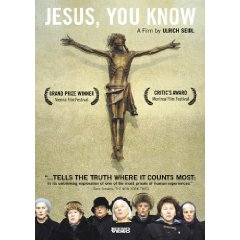
Given the above verse, I thought it was particularly interesting that conservative evangelicals got all bent out of shape over President Obama’s refusal to hold a public event around the National Day of Prayer. Something about the above verse also makes that national observance seem slightly out of place as well. I think Austrian filmmaker Ulrich Seidl also missed the memo when he made Jesus, You Know (2003), a documentary built around the prayers of six Catholics. The only thing more awkward than filming people praying is watching a film of people praying.
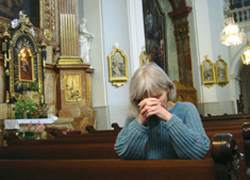 Jesus, You Know is a rather straightforward documentary of six people praying. They address the camera with their prayers, occasionally glancing away in a more penitential posture. These believers pray at great length, and as their prayers progress they seem less like prayers and more like rambling conversations with the filmmaker/audience. The “subjects,” include a middle-aged woman who prays for her family, especially her husband who is ill and tempted to return to a stressful work life that drives him to drink. There is an older man dressed in business attire who prays for a failing relationship with a woman, asking God to “show me how to start talking to her again” and ultimately borrowing Jesus’ prayer in the Garden of Gethsemane, “not my will, but yours.” We also listen to a younger man in his late teens or early 20s. He feels marginalized by his family because he is so involved in the life of the church. Another middle-aged woman prays through a crisis of faith, questioning the presence of God. There is another young woman who also has relationship problems, or rather a partner who cannot decide whether or not he will enter a monastery.
By far the most interesting of the lot is the young man who feels alienated from his family because of his beliefs. His prayers made me think of the growing notion that some people might be more naturally religious/spiritual than others, in ways that others are more artistic or mathematical than others. He wrestles with his deep spirituality yet fantasizes about physical perfection. He admits to being attracted to notions of heroism, longing to be a successful soccer player or an action hero in a film. One strength of Seidl’s film is the composition of his scenes. As the young man talks about his desires for physical perfection and strength in action, the image of the crucified Christ looms over his shoulder.
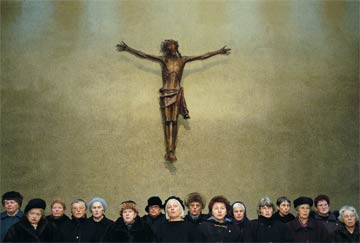 Seidl breaks up the monotony of these lengthy prayers with images of people cleaning the sanctuary, wiping floors and dusting crucifixes. He also includes beautifully-composed scenes of choirs singing hymns in front of ornate altars or below crucifixes. In this way, the film takes on the nature of a worship service, yet the untranslated hymns make it difficult to know how they fit in with the prayers. As such, Jesus, You Know might make for interesting viewing within a faith community as a form of guided spiritual practice. Unfortunately, the lengthy prayers, and the whole notion of filming prayers, might turn off even the most devout viewers.
Previous Post

November 19, 2009
Unmasking "The Enemy:" Jack G. Shaheen's "Reel Bad Arabs"
Next Post
December 2, 2009 The World's Dead, But At Least the Family Survived
Browse Our Archives
Select a Category Classics DVD Film Music News Pop Culture Events Print Sports Television Uncategorized Video Games
Select a Month March 2017 February 2017 January 2017 December 2016 November 2016 October 2016 September 2016 August 2016 July 2016 June 2016 May 2016 April 2016 March 2016 February 2016 January 2016 December 2015 November 2015 October 2015 September 2015 August 2015 July 2015 June 2015 May 2015 April 2015 March 2015 February 2015 January 2015 December 2014 November 2014 October 2014 September 2014 August 2014 July 2014 June 2014 May 2014 April 2014 March 2014 February 2014 January 2014 December 2013 November 2013 October 2013 September 2013 August 2013 July 2013 June 2013 May 2013 April 2013 March 2013 February 2013 January 2013 December 2012 November 2012 October 2012 September 2012 August 2012 July 2012 June 2012 May 2012 April 2012 March 2012 February 2012 January 2012 December 2011 November 2011 October 2011 September 2011 August 2011 July 2011 June 2011 May 2011 April 2011 March 2011 February 2011 January 2011 December 2010 November 2010 October 2010 September 2010 August 2010 July 2010 June 2010 May 2010 April 2010 March 2010 February 2010 January 2010 December 2009 November 2009 October 2009 September 2009 August 2009 July 2009 June 2009 May 2009 April 2009 March 2009 February 2009 January 2009 December 2008 November 2008 October 2008 September 2008 August 2008 July 2008 June 2008 May 2008 April 2008 March 2008 February 2008 January 2008 December 2007 November 2007 October 2007 September 2007 August 2007 July 2007 June 2007 May 2007 April 2007 March 2007
Follow Us!
TAKE THE
Religious Wisdom Quiz
What is the correct order for putting off the old self and putting on the new self as described in Colossians?
Select your answer to see how you score.
Put to death earthly nature, rid yourself of anger/rage/malice, take off the old self, put on the new self, clothe yourself with compassion Clothe yourself with compassion, put on the new self, put to death earthly nature, rid yourself of anger Rid yourself of anger, take off the old self, put to death earthly nature, put on the new self Put on the new self, put to death earthly nature, clothe yourself with compassion, rid yourself of anger
Related posts from Pop Theology


At SXSW2017: May It Last: A Portrait of...

At SXSW 2017: "Untold Tales of Armistead Maupin"
TRENDING AT PATHEOS Progressive Christian

Why Christians Have a Sacred Duty to Vote:...
The Bible offers strong support for the sacred duty to vote. Here...

What Being a Modern-Day Apostle Means to Me
In my last column, I discussed the ins and outs of modern-day...

Did Ancient China Once Worship the God of...
Across human history, a common thread weaves through the origins of the...

Love Your Neighbor – Including Earth-Kin: Lev. 19,...
God’s command to love your neighbor means acting in an ethical and...

Lead a Church Study of “Jesus and Lao...
Guest writer Jack Thomas (The Irreverent Reverend) reflects on leading his church...

Principles for Understanding the Apostolic Ministry Today
Whenever people discover that my formal ministry title is "apostle," as in...
view all Progressive Christian blogs
Ad-Free & Subscriber Log-In Subscription Support
- About Us
- 2026 Calendar
- Videos
- Podcasts
- Library of World Religions
- Faith In Media Tracker
- Advertise With Us
- Write for Us
- Privacy Policy
- Terms of Service
- Do Not Sell My Data
- Contact Us
- Radiant Digital
- Manage Newsletter Subscriptions
- Unsubscribe From Notifications
- Sitemap
Copyright 2008-2026, Patheos. All rights reserved.
Subscription Support Ad-Free & Subscriber Log-In
Follow Patheos