
BuddhistCatholicContemplativeEvangelicalGeneral ChristianHinduJewishLatter-day SaintMuslimNew VisionsProgressive Christian
Beliefs
- Buddhist
- Catholic
- Contemplative
- Evangelical
- General Christian
- Hindu
- Jewish
- Latter-day Saint
- More Voices
- Muslim
- New Visions
- Pagan
- Progressive Christian
Topics
- Religion News
- Food and Religion
- Sports and Religion
- Religious Art
- Religious Music and Entertainment
- Religious Events
- History and Religion
- Style and Religion
- Politics and Religion
- Women in Religion
- Recreation Outdoors and Religion
- Business Finance and Religion
- Careers Workplace and Religion
- Education and Religion
- Family Parenting and Religion
- Health Fitness and Religion
- Home and Religion
- Relationships and Religion
- Technology and Religion
- Travel and Religion
Columnists
- Buddhist Columnists
- Business Finance and Religion Columnists
- Careers Workplace and Religion Columnists
- Catholic Columnists
- Contemplative Columnists
- Education and Religion Columnists
- Evangelists Columnists
- Family Parenting and Religion Columnists
- General Christian Columnists
- Health Fitness and Religion Columnists
- Hindu Columnists
- History and Religion Columnists
- Home and Religion Columnists
- Jewish Columnists
- More Voices Columnists
- Latter Day Columnists
- Muslim Columnists
- New Visions Columnists
- Nonreligious Columnists
- Pagan Columnists
- Politics and Religion Columnists
- Progressive Columnists
- Recreation Outdoors and Religion Columnists
- Relationships and Religion Columnists
- Religion News Columnists
- Religious Art Columnists
- Religious Events Columnists
- Religious Music and Entertainment Columnists
- Sports and Religion Columnists
- Style and Religion Columnists
- Technology and Religion Columnists
- Travel and Religion Columnists
- Women in Religion Columnists
Resource Library
- 2026 Calendar
- Library of World Religions
- The 100 Most Holy Places on Earth
- Patheos Answers
- Podcasts
- Videos
- Faith Leaders Database
- Anglican Episcopalian
- Bahai
- Baptist
- Buddhism
- Christianity
- Confucianism
- Eastern Orthodoxy
- Hinduism
- Holiness and Pentecostal
- ISKCON
- Islam
- Judaism
- Lutheran
- Methodist
- The Church of Jesus Christ of Latter-day Saints
- New Age
- Paganism
- Presbytarian and Reformed
- Protestantism
- Religion Behind the Scenes
- Roman Catholic
- Scientology
- Shia Islam
- Sikhism
- Sufism
- Sunni Islam
- Taoism
- Zen
- See all religions
Research Tools
 Ad-Free & Subscriber Log-In Subscription Support
Ad-Free & Subscriber Log-In Subscription Support
Follow Patheos 

- Trending:
- Forgiveness
- |
- Marriage
- |
- Consciousness
- |
- Death Penalty
- |
- Election
- |
- Halloween
 Pop Theology
- Home
- Progressive Christian
- Religious Music & Entertainment
- The Times They Are A-Changin'
The Times They Are A-Changin'
Last updated on: June 23, 2009 at 9:19 am by J. Ryan Parker
The Times They Are A-Changin' 2009-06-23T09:19:50-07:00 J. Ryan Parker
Patheos Explore the world's faith through different perspectives on religion and spirituality! Patheos has the views of the prevalent religions and spiritualities of the world.
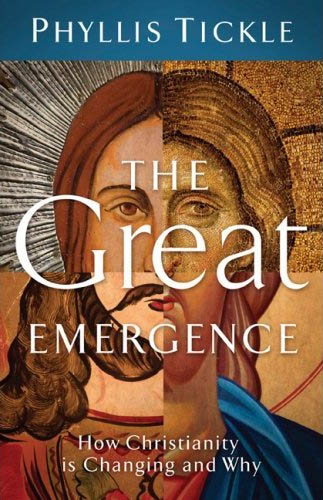
What do Buddhism, the drug age, the automobile, and Pentecostalism have in common? In different ways, they have all influenced the current state of Christianity in North America. In her latest book, The Great Emergence, Phyllis Tickle explores the challenges to and changing nature of Christianity in the 21st century.
In The Great Emergence: How Christianity is Changing and Why, Tickle argues that every 500 years or so, the Church endures a giant rummage sale and breaks from entrenched institutional and doctrinal norms. We know the names of previous rummage sales well: he Great Reformation, he Great Schism, the Council of Chalcedon…. While this new shift is Tickle’s main focus (what it is, how it has come to be, and where it is taking us), she argues very forcefully that any attempts to understand it will be incomplete without an investigation into these other great previous rummage sales.
Tickle is also very aware that these rummage sales impact not only the Church, but the wider culture as well, influencing politics, economics, etc. At the same time, the impact on the Church is informed by extra-ecclesial factors. Science, technology, media, and, most recently, a transition from money as power to information as power are the common external influences. In fact, her study also reveals that these shifts take place in the other two Abrahamic faiths as well. However, for the purposes of this book, she focuses on the Great Emergence from a Christian standpoint and considers its religious nature over against other cultural or economic realities, although these too inform her work.
In each of these upheavals, including this one, Tickle argues: “First, a new, more vital form of Christianity does indeed emerge. Second, the organized expression of Christianity which up until then had been the dominant one is reconstituted into a more pure and less ossified expression of its former self. […] The third result is of equal, if not greater, significance, though. That is, every time the incrustations of an overly established Christianity have broken open, the faith has spread–and been spread–dramatically into new geographic and demographic areas […]” (17). Shortly thereafter, she attempts to allay any fears: “”It is especially important to remember that no standing form of organized Christian faith has ever been destroyed by one of our semi-millennial eruptions. Instead, each simply has lost hegemony or pride of place to the new and not-yet-organized form that was birthing” (27). What we should fear, however, “with all our hearts and minds and souls [is] the pattern of bloodiness that has in the past characterized the separation of innovators and re-traditioners from one another” (58).
(Post)Modernity has brought countless questions. Tickle draws out two that are especially pertinent for this latest shift: “The two overarching, but complimentary questions of the Great Emergence are: (1) What is human consciousness and/or the humanness of the human? and (2) What is the relation of all religions to one another–or, put another way, how can we live responsibly as devout and faithful adherents of one religion in a world of many religions” (73). One need not think long about the various technologies and scientific advances that have given rise to these questions and complicated them almost over-night.
Though she never devotes any extended analysis to it, throughout her text, Tickle is keenly aware of the roles that technology and new forms of social media play in the Great Emergence. Drawing parallels to the Great Reformation, she writes, “It would, quite literally, be impossible to exaggerate the central importance to the Great Emergence of the Internet and the World Wide Web. By the same token and in absolutely analogous ways, it would be impossible to overstate the importance of the Great Reformation of the invention of the printing press by Gutenberg in 1440 […]” (53). The advent of television and radio, decades before the Internet, sounded the first warning shot, and Tickle recognizes that the Bill Moyers/Joseph Campbell PBS series represented a major challenge from the pew to the pulpit. Taken together, these technologies that draw us closer together and provide us with a wealth of information pose great challenges to the Church. Tickle adds, “The computer, opening up as it does, the whole of humankind’s bank of collective information, enables the priesthood of all believers in ways the Reformation could never have envisioned. It also, however, opens up all that information to anybody, but without the traditional restraints of vetting or jurying […]” (107).
Tickle also devotes an entire chapter filled with graphs that attempt to image the appearance of denominations in 21st century Christianity. Her first graph starts off with four quadrants but then spirals out of control as each quadrant overlaps the other. Tickle adds, “What is happening is something much closer to what mathematicians and physicists call network theory. That is, a vital whole–in this case, the Church, capital C–is not really a ‘thing’ or entity so much as it is a network in exactly the same way that the Internet or the World Wide Web or, for that matter, gene regulatory and metabolic networks are not ‘things’ or entities. […] The end result of this understanding of dynamic structure is the realization that no one of the member parts or connecting networks has the whole or entire ‘truth’ of anything, either as such and/or when independent of the others” (152). Lest we think this is some post-modern invention, we must listen for the echoes of Paul who talked about the church as the body of Christ with each member blessed with different talents and gifts.
Thus, like few other “liberal” theologians, Tickle recognizes the value in the conservative, fundamentalist Christians who often react so dogmatically and occasionally violently against the challenges that face the church. One cannot read Tickle’s book and not get the sense that these reactionaries are dead or dying and just don’t know it yet. Yet Tickle herself does not give up hope on them or abandon them. She writes, “In the Great Emergence, reacting Christians are the ballast. However unattractive they may seem to be to other of their fellow Christians and however unattractive nonreacting Christians may seem to be to them […]. If the boat is not to tip and swamp, the ballast that forestalls too hasty a set of movements in a stormy sea must be there. One of the great dangers of what North America is going through is that some of her Christians, of whatever stripe, may cease to honor and accept the necessary function of all her Christians” (138-139). In the end, Tickle is well aware that there is no one way to respond to the challenges that face the Church, but respond we must. She recognizes that even the Emergent Church, what some people might see as a monolithic entity, is far from that as it has taken on at least two main competing theological strands.
Though Tickle’s book is relatively brief, it is packed with thoughtful analyses of the past and the present and not at all short on controversial points that have and will no doubt continue to spark energetic discussions in congregations, classrooms, and bars across the country. I found her recognition of the importance of technology and digital media especially helpful and a welcome inclusion in a field where they are often ignored. It would be great to see her devote an entire work to that. Tickle’s book is a must-read for religious and non-religious audiences alike, but especially for those of us still interested in participating in the life of the Church.
Previous Post

June 21, 2009
Year One: In the Beginning, There Was Schtick
Next Post
June 25, 2009 R.I.P. K.o.P.
Browse Our Archives
Select a Category Classics DVD Film Music News Pop Culture Events Print Sports Television Uncategorized Video Games
Select a Month March 2017 February 2017 January 2017 December 2016 November 2016 October 2016 September 2016 August 2016 July 2016 June 2016 May 2016 April 2016 March 2016 February 2016 January 2016 December 2015 November 2015 October 2015 September 2015 August 2015 July 2015 June 2015 May 2015 April 2015 March 2015 February 2015 January 2015 December 2014 November 2014 October 2014 September 2014 August 2014 July 2014 June 2014 May 2014 April 2014 March 2014 February 2014 January 2014 December 2013 November 2013 October 2013 September 2013 August 2013 July 2013 June 2013 May 2013 April 2013 March 2013 February 2013 January 2013 December 2012 November 2012 October 2012 September 2012 August 2012 July 2012 June 2012 May 2012 April 2012 March 2012 February 2012 January 2012 December 2011 November 2011 October 2011 September 2011 August 2011 July 2011 June 2011 May 2011 April 2011 March 2011 February 2011 January 2011 December 2010 November 2010 October 2010 September 2010 August 2010 July 2010 June 2010 May 2010 April 2010 March 2010 February 2010 January 2010 December 2009 November 2009 October 2009 September 2009 August 2009 July 2009 June 2009 May 2009 April 2009 March 2009 February 2009 January 2009 December 2008 November 2008 October 2008 September 2008 August 2008 July 2008 June 2008 May 2008 April 2008 March 2008 February 2008 January 2008 December 2007 November 2007 October 2007 September 2007 August 2007 July 2007 June 2007 May 2007 April 2007 March 2007
Follow Us!
TAKE THE
Religious Wisdom Quiz
Which city did Paul describe as "a city filled with idols"?
Select your answer to see how you score.
Rome Athens Corinth Jerusalem
Related posts from Pop Theology


#KillerSerials: An Interview with Kutter Callaway

Book Review: MUSLIMS AND THE MAKING OF AMERICA

TRENDING AT PATHEOS Progressive Christian

Why Christians Have a Sacred Duty to Vote:...
The Bible offers strong support for the sacred duty to vote. Here...

What Being a Modern-Day Apostle Means to Me
In my last column, I discussed the ins and outs of modern-day...

Did Ancient China Once Worship the God of...
Across human history, a common thread weaves through the origins of the...

Love Your Neighbor – Including Earth-Kin: Lev. 19,...
God’s command to love your neighbor means acting in an ethical and...

Lead a Church Study of “Jesus and Lao...
Guest writer Jack Thomas (The Irreverent Reverend) reflects on leading his church...

Principles for Understanding the Apostolic Ministry Today
Whenever people discover that my formal ministry title is "apostle," as in...
view all Progressive Christian blogs
Ad-Free & Subscriber Log-In Subscription Support
- About Us
- 2026 Calendar
- Videos
- Podcasts
- Library of World Religions
- Faith In Media Tracker
- Advertise With Us
- Write for Us
- Privacy Policy
- Terms of Service
- Do Not Sell My Data
- Contact Us
- Radiant Digital
- Manage Newsletter Subscriptions
- Unsubscribe From Notifications
- Sitemap
Copyright 2008-2026, Patheos. All rights reserved.
Subscription Support Ad-Free & Subscriber Log-In
Follow Patheos