
BuddhistCatholicContemplativeEvangelicalGeneral ChristianHinduJewishLatter-day SaintMuslimNew VisionsProgressive Christian
Beliefs
- Buddhist
- Catholic
- Contemplative
- Evangelical
- General Christian
- Hindu
- Jewish
- Latter-day Saint
- More Voices
- Muslim
- New Visions
- Pagan
- Progressive Christian
Topics
- Religion News
- Food and Religion
- Sports and Religion
- Religious Art
- Religious Music and Entertainment
- Religious Events
- History and Religion
- Style and Religion
- Politics and Religion
- Women in Religion
- Recreation Outdoors and Religion
- Business Finance and Religion
- Careers Workplace and Religion
- Education and Religion
- Family Parenting and Religion
- Health Fitness and Religion
- Home and Religion
- Relationships and Religion
- Technology and Religion
- Travel and Religion
Columnists
- Buddhist Columnists
- Business Finance and Religion Columnists
- Careers Workplace and Religion Columnists
- Catholic Columnists
- Contemplative Columnists
- Education and Religion Columnists
- Evangelists Columnists
- Family Parenting and Religion Columnists
- General Christian Columnists
- Health Fitness and Religion Columnists
- Hindu Columnists
- History and Religion Columnists
- Home and Religion Columnists
- Jewish Columnists
- More Voices Columnists
- Latter Day Columnists
- Muslim Columnists
- New Visions Columnists
- Nonreligious Columnists
- Pagan Columnists
- Politics and Religion Columnists
- Progressive Columnists
- Recreation Outdoors and Religion Columnists
- Relationships and Religion Columnists
- Religion News Columnists
- Religious Art Columnists
- Religious Events Columnists
- Religious Music and Entertainment Columnists
- Sports and Religion Columnists
- Style and Religion Columnists
- Technology and Religion Columnists
- Travel and Religion Columnists
- Women in Religion Columnists
Resource Library
- 2026 Calendar
- Library of World Religions
- The 100 Most Holy Places on Earth
- Patheos Answers
- Podcasts
- Videos
- Faith Leaders Database
- Anglican Episcopalian
- Bahai
- Baptist
- Buddhism
- Christianity
- Confucianism
- Eastern Orthodoxy
- Hinduism
- Holiness and Pentecostal
- ISKCON
- Islam
- Judaism
- Lutheran
- Methodist
- The Church of Jesus Christ of Latter-day Saints
- New Age
- Paganism
- Presbytarian and Reformed
- Protestantism
- Religion Behind the Scenes
- Roman Catholic
- Scientology
- Shia Islam
- Sikhism
- Sufism
- Sunni Islam
- Taoism
- Zen
- See all religions
Research Tools
 Ad-Free & Subscriber Log-In Subscription Support
Ad-Free & Subscriber Log-In Subscription Support
Follow Patheos 

- Trending:
- Forgiveness
- |
- Marriage
- |
- Consciousness
- |
- Death Penalty
- |
- Election
- |
- Halloween
 Pop Theology
- Home
- Progressive Christian
- Religious Music & Entertainment
- Make Up Your Mind Already…
Make Up Your Mind Already…
Last updated on: April 6, 2009 at 9:26 am by J. Ryan Parker
Make Up Your Mind Already… 2009-04-06T09:26:07-07:00 J. Ryan Parker
Patheos Explore the world's faith through different perspectives on religion and spirituality! Patheos has the views of the prevalent religions and spiritualities of the world.

It’s not unusual for even secular apocalyptic films to have religious under/overtones. As a meteor hurdles to earth or aliens poise for attack, invariably characters utter or scream, “Oh my God!” or the president informs everyone to pray. There might even be implications that God is angry and thus causing the potential destruction, usually from the mouth of a crazy, homeless street preacher. However, in Hollywood’s latest apocalyptic blockbuster, Knowing, the religious implications play a more prominent, if still uncertain, role.
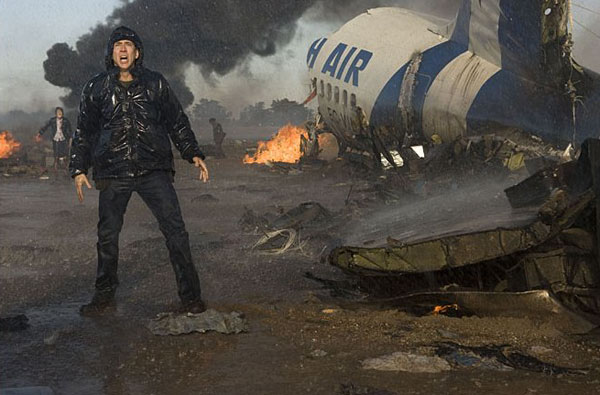 Knowing tells the story of John Koestler (Nicolas Cage), a fifty-something astrophysicist at MIT whose son receives a mysterious page full of numbers when his elementary school unearths a fifty-year-old time capsule. In a drunken stupor (John is still mourning the death of his wife), he decodes the numbers and realizes that they reveal the day, location, and body count of every major natural or man-made disaster over the past fifty years. However, a sequence of remaining numbers leads him to believe that a series of events have yet to occur, but will do so in the days ahead.
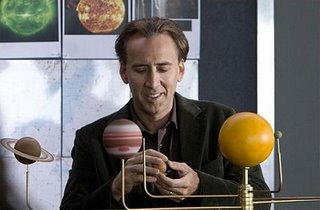 The film is laced with theological and religious implications. First, Koestler asks his students to write about determinism vs. randomness in the universe. The film lets us know that he believes “shit just happens.” Of course, this no doubt contradicts with his father’s worldview who is a minister about which we know very little. Second, the girl who left the letter in the time capsule, Lucinda Embry (Lara Robinson), grows up to be obsessed with those numbers. We also learn that she was obsessed with a picture of Ezekiel receiving a prophecy from God. Those who know their scripture will readily recall Ezekiel 33. Finally, we have these mysterious strangers who haunt John’s son, Caleb (Chandler Canterbury). Are they aliens or angels? Before I continue, a word of warning: SPOILERS ahead.
 As John continues his investigation, he realizes that the last series of numbers signals the end of the earth. He has previously predicted a heat burst from the sun that will scorch the planet. We quickly learn that the strangers/aliens are not a threat to John and his son, but are rather protecting Caleb and his friend Abby (also played by Robinson), Lucinda’s granddaughter. As the earth’s destruction approaches, the strangers/aliens shed their earthly skin to reveal their true, (literally) blue nature. A gaseous substance does everything it can to not turn into wings. They take Caleb and Abby into an orb and transport them to a new planet, dropping them off in a glowing wheat field that surrounds a radiant tree. We could debate the angelic nature of the strangers, but compounded with the orb that resembles the one in the picture of Ezekiel and God, it is hard to miss this point. Furthermore, the Edenic overtones at the end of the film make it impossible to rule out some sort of Divine presence or intention in the narrative.
The problem with Knowing is not that it uses religion, it’s that it doesn’t seem to know how to use it. The veiled references to John’s father’s vocation, the image of Ezekiel without any explanation, the pseudo-angels, and the tree of knowledge/life become distractions in a film that doesn’t necessarily need religion. Why the religious inclusions if they are not going to play a larger role in the plot…why not leave them out altogether and make it simply an alien invasion? Instead, watching the film feels as if you are wrestling with the director, Alex Proyas, for two hours as he tries to decide what role these religious elements will actually play. It seems like the director might respond to the “are you religious?” question with “I’m not religious, but I am spiritual.” Not that there’s anything wrong with that, especially if you have a well-articulated concept of spirituality and religion. Unfortunately, the film has neither.
There’s an interesting discussion taking place at Rober Ebert’s (one of the few critics who didn’t pan the film) blog about the nature of free will vs. determinism inspired by the film.
Also, check out the chapter on the apocalypse and film in Conrad Ostwalt’s Secular Steeples: Popular Culture and the Religious Imagination.
Knowing (121 mins.) is rated PG-13 for disaster sequences (fueled by great special effects), disturbing images, and brief strong language and is in theaters everywhere.
Previous Post

April 3, 2009
No Line on the Horizon Review
Next Post
April 7, 2009 Ten Questions with Brent Plate
Browse Our Archives
Select a Category Classics DVD Film Music News Pop Culture Events Print Sports Television Uncategorized Video Games
Select a Month March 2017 February 2017 January 2017 December 2016 November 2016 October 2016 September 2016 August 2016 July 2016 June 2016 May 2016 April 2016 March 2016 February 2016 January 2016 December 2015 November 2015 October 2015 September 2015 August 2015 July 2015 June 2015 May 2015 April 2015 March 2015 February 2015 January 2015 December 2014 November 2014 October 2014 September 2014 August 2014 July 2014 June 2014 May 2014 April 2014 March 2014 February 2014 January 2014 December 2013 November 2013 October 2013 September 2013 August 2013 July 2013 June 2013 May 2013 April 2013 March 2013 February 2013 January 2013 December 2012 November 2012 October 2012 September 2012 August 2012 July 2012 June 2012 May 2012 April 2012 March 2012 February 2012 January 2012 December 2011 November 2011 October 2011 September 2011 August 2011 July 2011 June 2011 May 2011 April 2011 March 2011 February 2011 January 2011 December 2010 November 2010 October 2010 September 2010 August 2010 July 2010 June 2010 May 2010 April 2010 March 2010 February 2010 January 2010 December 2009 November 2009 October 2009 September 2009 August 2009 July 2009 June 2009 May 2009 April 2009 March 2009 February 2009 January 2009 December 2008 November 2008 October 2008 September 2008 August 2008 July 2008 June 2008 May 2008 April 2008 March 2008 February 2008 January 2008 December 2007 November 2007 October 2007 September 2007 August 2007 July 2007 June 2007 May 2007 April 2007 March 2007
Follow Us!
TAKE THE
Religious Wisdom Quiz
Who said, "The Spirit of the Lord is upon me"?
Select your answer to see how you score.
Paul Elijah Jesus Isaiah
Related posts from Pop Theology


At SXSW2017: May It Last: A Portrait of...

At SXSW 2017: "Untold Tales of Armistead Maupin"
TRENDING AT PATHEOS Progressive Christian

Why Christians Have a Sacred Duty to Vote:...
The Bible offers strong support for the sacred duty to vote. Here...

What Being a Modern-Day Apostle Means to Me
In my last column, I discussed the ins and outs of modern-day...

Did Ancient China Once Worship the God of...
Across human history, a common thread weaves through the origins of the...

Love Your Neighbor – Including Earth-Kin: Lev. 19,...
God’s command to love your neighbor means acting in an ethical and...

Lead a Church Study of “Jesus and Lao...
Guest writer Jack Thomas (The Irreverent Reverend) reflects on leading his church...

Principles for Understanding the Apostolic Ministry Today
Whenever people discover that my formal ministry title is "apostle," as in...
view all Progressive Christian blogs
Ad-Free & Subscriber Log-In Subscription Support
- About Us
- 2026 Calendar
- Videos
- Podcasts
- Library of World Religions
- Faith In Media Tracker
- Advertise With Us
- Write for Us
- Privacy Policy
- Terms of Service
- Do Not Sell My Data
- Contact Us
- Radiant Digital
- Manage Newsletter Subscriptions
- Unsubscribe From Notifications
- Sitemap
Copyright 2008-2026, Patheos. All rights reserved.
Subscription Support Ad-Free & Subscriber Log-In
Follow Patheos