
BuddhistCatholicContemplativeEvangelicalGeneral ChristianHinduJewishLatter-day SaintMuslimNew VisionsProgressive Christian
Beliefs
- Buddhist
- Catholic
- Contemplative
- Evangelical
- General Christian
- Hindu
- Jewish
- Latter-day Saint
- More Voices
- Muslim
- New Visions
- Pagan
- Progressive Christian
Topics
- Religion News
- Food and Religion
- Sports and Religion
- Religious Art
- Religious Music and Entertainment
- Religious Events
- History and Religion
- Style and Religion
- Politics and Religion
- Women in Religion
- Recreation Outdoors and Religion
- Business Finance and Religion
- Careers Workplace and Religion
- Education and Religion
- Family Parenting and Religion
- Health Fitness and Religion
- Home and Religion
- Relationships and Religion
- Technology and Religion
- Travel and Religion
Columnists
- Buddhist Columnists
- Business Finance and Religion Columnists
- Careers Workplace and Religion Columnists
- Catholic Columnists
- Contemplative Columnists
- Education and Religion Columnists
- Evangelists Columnists
- Family Parenting and Religion Columnists
- General Christian Columnists
- Health Fitness and Religion Columnists
- Hindu Columnists
- History and Religion Columnists
- Home and Religion Columnists
- Jewish Columnists
- More Voices Columnists
- Latter Day Columnists
- Muslim Columnists
- New Visions Columnists
- Nonreligious Columnists
- Pagan Columnists
- Politics and Religion Columnists
- Progressive Columnists
- Recreation Outdoors and Religion Columnists
- Relationships and Religion Columnists
- Religion News Columnists
- Religious Art Columnists
- Religious Events Columnists
- Religious Music and Entertainment Columnists
- Sports and Religion Columnists
- Style and Religion Columnists
- Technology and Religion Columnists
- Travel and Religion Columnists
- Women in Religion Columnists
Resource Library
- 2026 Calendar
- Library of World Religions
- The 100 Most Holy Places on Earth
- Patheos Answers
- Podcasts
- Videos
- Faith Leaders Database
- Anglican Episcopalian
- Bahai
- Baptist
- Buddhism
- Christianity
- Confucianism
- Eastern Orthodoxy
- Hinduism
- Holiness and Pentecostal
- ISKCON
- Islam
- Judaism
- Lutheran
- Methodist
- The Church of Jesus Christ of Latter-day Saints
- New Age
- Paganism
- Presbytarian and Reformed
- Protestantism
- Religion Behind the Scenes
- Roman Catholic
- Scientology
- Shia Islam
- Sikhism
- Sufism
- Sunni Islam
- Taoism
- Zen
- See all religions
Research Tools
 Ad-Free & Subscriber Log-In Subscription Support
Ad-Free & Subscriber Log-In Subscription Support
Follow Patheos 

- Trending:
- Forgiveness
- |
- Marriage
- |
- Consciousness
- |
- Death Penalty
- |
- Election
- |
- Halloween
 Pop Theology
- Home
- Progressive Christian
- Religious Music & Entertainment
- Evangelical Media
Evangelical Media
Last updated on: March 23, 2009 at 6:30 am by J. Ryan Parker
Evangelical Media 2009-03-23T06:30:56-07:00 J. Ryan Parker
Patheos Explore the world's faith through different perspectives on religion and spirituality! Patheos has the views of the prevalent religions and spiritualities of the world.
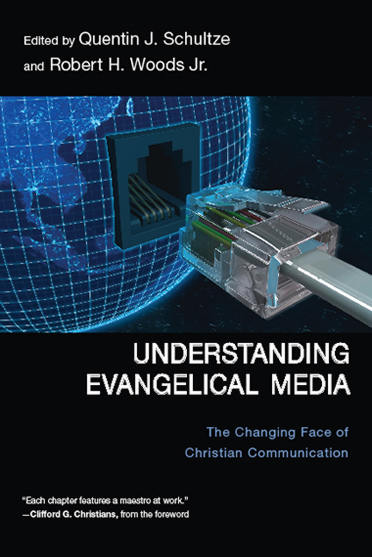
To understand the challenges that evangelical media and mainstream media pose to one another and the challenges that changing technologies pose to the evangelical community is to understand the nature of new media in a very real way. In their book, Understanding Evangelical Media: The Changing Face of Christian Communication, editors Quentin J. Schultze and Robert H. Woods Jr. compile numerous essays that address various evangelical media including radio, television, film, comics, video games, theme parks, and merchandising.
In his introduction to the collected essays, Schultze writes, “A lot has changed since 1990. The idea of mass media has been replaced by networked media. Narrowcasting has replaced broadcasting. Media power has become democratized; low-cost digital production lets younger evangelicals tell stories in multiple venues. And this only begins to scratch the surface” (15). However, he and Woods recognize that the challenges that emerge from this changing digital landscape have ancient roots, tracing back to the early church and the ways in which Christians did or did not interact with “mainstream culture.” Most importantly, this book is not an attempt to tell readers, religious or not, what to think about mainstream or evangelical media, but rather encourages faithful conversation about and production of those media. In fact, they recognize that the term evangelical itself is not easily defined. The diversity of articles and wealth of evangelical responses to and interactions with media described therein testify to this reality.
 In terms of popular culture and our discussions here at Pop Theology, a couple of the essays are worth mentioning at least briefly. In her chapter, “Thinking Outside the Tribal TV Box,” Kathy Bruner discusses evangelical television programming. She recognizes first and foremost that the main problem that many critics of the media have with it is that it preaches to the choir. Yet, when the choir is as big as the diverse evangelical community is in North America, this is a safe bet. According to various reports, “more people tune in, however briefly, to some form of Christian media than actually attend church monthly” (47). Bruner outlines several goals that supporters of Christian television hope to accomplish: fulfill the Great Commission, teach and disciple, calm believers in turbulent times, and provide wholesome, family-friendly fare (48-50). However, she notes that producers of evangelical programming do not approach these goals in any original fashion, but simply mock mainstream successes which in the end negatively affects their goals. Thus, critics cringe over evangelical media because it often embodies cheap grace, is highly politicized, turns servants into celebrities, employs questionable fund-raising practices, contrains creativity, preaches to the choir, has little impact beyond the community, and dilutes face-to-face evangelism (50-52). Yet the challenges that face mainstream television–the growing success of internet programming, YouTube, and the like–confront evangelical television as well. Yet, ironically, in these challenges might lie future success for this tribal media. Bruner writes, “[…In] an era of technological democratization […] preaching to a niche audience has become key to almost all media success. […] It is now theoretically easier to serve particular markets, both Christian and mainstream” (55).
 Paralleling many of the realities of evangelical television programming, Terry Lindvall and Andrew Quicke discuss “Moving from Film to Digital Movies,” in the evangelical film industry. As he is want to do, Lindvall pays close attention to the history of religious film and the history of religious responses to film which pave the way for contemporary iterations of both. He well knows that evangelicals have been simultaneously the strongest supporters of film and its staunchest opponents throughout the years. For the most part, throughout their history, evangelical films have sought to instruct or evangelize; however, the authors also note that contemporary productions seek to entertain as well. Films like Holes, Facing the Giants, The Lion, the Witch, and the Wardrobe, The Nativity Story, Left Behind, and One Night With the King “contributed to a revival of interest in films, providing an alternative in film viewing for evangelical families” (61). On the other hand, they also realize that evangelism might still be a key ingredient, given the success of The Passion of the Christ and evangelicals’ responses to and uses of it, all of which helped the production of some of the films listed above. Like their television counterparts, evangelical film producers also copy mainstream success like horror or action films. Yet within these mainstream successes, Lindvall and Quicke highlight the Christians who are working within Hollywood to create quality productions. They conclude their essay by highlighting the influence of The Passion and how it, at least for a time, changed Hollywood’s opinion of religious fare. As their title suggests, they are keenly aware of the doors that digital filmmaking opens for less lucrative producers, as evidenced by the success of Sherwood Pictures. They recognize that this might just be the future for religious filmmaking in the 21st century.
In his chapter, “Evangelicals’ Quest to Find God’s Place in Games,” Kevin Schut discusses the evangelical tribes’ relationship with games ranging from board games to digital games. While the controversy around RPG games like Dungeons & Dragons ignited an evangelical fury, Schut notes that Christians, from the start, wrestled with whether or not to attend or participate in games (although the Roman gladitorial arena was much more violent!). Again, this particular media mirrors television and film in that evangelicals take a variety of the same stances against games: rejection, appropriation, or imitation. However, online or real-life communities develop around games, especially board games, in ways that film and television do not easily allow. Schut notes how evangelicals have created their own versions of Dungeons & Dragons style board games, and most recently, their own version of The Sims or Grand Theft Auto in Left Behind: Eternal Forces. Schut recognizes that beyond these cheap imitations, Christians also work in and make significant contributions to mainstream video games. He notes that Robyn and Rand Miller created the mainstream blockbuster Myst, a compelling, non-violent computer game. Schut concludes that evangelicals will not continue to make successful contributions to this media until they abandon simple, moralistic concerns for the sake of creativity, originality, artistic excellence and integrity. He argues that good games can exist “with not an ounce of Scripture or explicitly religious veneer” (208).
These are just a few of the interesting essays that fill Schultze and Woods’ collection. Again, the other contributors point to similar realities in advertising, marketing, theater, publishing, and the internet. After examining all of these essays, Schultze and Woods arrive at a few unfortunate conclusions:
- Evangelicals are predictable
- Evangelicals avoid self-criticism about tribal media
- Evangelical media generally lack originality
- Evangelical media feast on the flock
- Evangelicals express narrow concerns about media morality
- Evangelical media lack ethnic diversity
- Evangelicals share mainstream society’s focus on technology over stewardship (282-285)
Ironically, however, some of these criticisms actually explain evangelical media’s success, specifically its tendency to “feast on the flock” and its predictability. Evangelical reactions to Sherwood Pictures’ productions show that this audience is perfectly happy to know what they’re going to see. Moreover, they appreciate having their theological worldview confirmed by a wholesome alternative to secular Hollywood.
Despite these faults, Schultze and Woods also outline a way forward for evangelical media in the 21st century:
- Develop informed, critical stances regarding new and older media
- Offer timely and well-deserved praise
- Think outside the tribal box
- Consider how non-Christian audiences will receive the content
- Reach out to the margins (285-286)
In the end, Schultze and Woods, along with their contributors, achieve their goals. Their introduction and conclusion do not tell us what to think about particular productions, but rather encourage us to think about the whole evangelical media endeavor. The chapters in between will certainly spark the desired conversation and critical engagement with these productions and between critics. In the end, Understanding Evangelical Media is a great resource for teachers, students, artists, and laity who are interested in the intersection of religion and popular culture.
Previous Post

March 20, 2009
Slumdog: The Little Movie That Couldn't
Next Post
March 23, 2009 Just a Reminder...
Browse Our Archives
Select a Category Classics DVD Film Music News Pop Culture Events Print Sports Television Uncategorized Video Games
Select a Month March 2017 February 2017 January 2017 December 2016 November 2016 October 2016 September 2016 August 2016 July 2016 June 2016 May 2016 April 2016 March 2016 February 2016 January 2016 December 2015 November 2015 October 2015 September 2015 August 2015 July 2015 June 2015 May 2015 April 2015 March 2015 February 2015 January 2015 December 2014 November 2014 October 2014 September 2014 August 2014 July 2014 June 2014 May 2014 April 2014 March 2014 February 2014 January 2014 December 2013 November 2013 October 2013 September 2013 August 2013 July 2013 June 2013 May 2013 April 2013 March 2013 February 2013 January 2013 December 2012 November 2012 October 2012 September 2012 August 2012 July 2012 June 2012 May 2012 April 2012 March 2012 February 2012 January 2012 December 2011 November 2011 October 2011 September 2011 August 2011 July 2011 June 2011 May 2011 April 2011 March 2011 February 2011 January 2011 December 2010 November 2010 October 2010 September 2010 August 2010 July 2010 June 2010 May 2010 April 2010 March 2010 February 2010 January 2010 December 2009 November 2009 October 2009 September 2009 August 2009 July 2009 June 2009 May 2009 April 2009 March 2009 February 2009 January 2009 December 2008 November 2008 October 2008 September 2008 August 2008 July 2008 June 2008 May 2008 April 2008 March 2008 February 2008 January 2008 December 2007 November 2007 October 2007 September 2007 August 2007 July 2007 June 2007 May 2007 April 2007 March 2007
Follow Us!
TAKE THE
Religious Wisdom Quiz
Which Christian festival begins with Ash Wednesday and ends at Easter?
Select your answer to see how you score.
Pentecost Advent Epiphany Lent
Related posts from Pop Theology


#KillerSerials: An Interview with Kutter Callaway

Book Review: MUSLIMS AND THE MAKING OF AMERICA

TRENDING AT PATHEOS Progressive Christian

Why Christians Have a Sacred Duty to Vote:...
The Bible offers strong support for the sacred duty to vote. Here...

What Being a Modern-Day Apostle Means to Me
In my last column, I discussed the ins and outs of modern-day...

Did Ancient China Once Worship the God of...
Across human history, a common thread weaves through the origins of the...

Love Your Neighbor – Including Earth-Kin: Lev. 19,...
God’s command to love your neighbor means acting in an ethical and...

Lead a Church Study of “Jesus and Lao...
Guest writer Jack Thomas (The Irreverent Reverend) reflects on leading his church...

Principles for Understanding the Apostolic Ministry Today
Whenever people discover that my formal ministry title is "apostle," as in...
view all Progressive Christian blogs
Ad-Free & Subscriber Log-In Subscription Support
- About Us
- 2026 Calendar
- Videos
- Podcasts
- Library of World Religions
- Faith In Media Tracker
- Advertise With Us
- Write for Us
- Privacy Policy
- Terms of Service
- Do Not Sell My Data
- Contact Us
- Radiant Digital
- Manage Newsletter Subscriptions
- Unsubscribe From Notifications
- Sitemap
Copyright 2008-2026, Patheos. All rights reserved.
Subscription Support Ad-Free & Subscriber Log-In
Follow Patheos