
BuddhistCatholicContemplativeEvangelicalGeneral ChristianHinduJewishLatter-day SaintMuslimNew VisionsProgressive Christian
Beliefs
- Buddhist
- Catholic
- Contemplative
- Evangelical
- General Christian
- Hindu
- Jewish
- Latter-day Saint
- More Voices
- Muslim
- New Visions
- Pagan
- Progressive Christian
Topics
- Religion News
- Food and Religion
- Sports and Religion
- Religious Art
- Religious Music and Entertainment
- Religious Events
- History and Religion
- Style and Religion
- Politics and Religion
- Women in Religion
- Recreation Outdoors and Religion
- Business Finance and Religion
- Careers Workplace and Religion
- Education and Religion
- Family Parenting and Religion
- Health Fitness and Religion
- Home and Religion
- Relationships and Religion
- Technology and Religion
- Travel and Religion
Columnists
- Buddhist Columnists
- Business Finance and Religion Columnists
- Careers Workplace and Religion Columnists
- Catholic Columnists
- Contemplative Columnists
- Education and Religion Columnists
- Evangelists Columnists
- Family Parenting and Religion Columnists
- General Christian Columnists
- Health Fitness and Religion Columnists
- Hindu Columnists
- History and Religion Columnists
- Home and Religion Columnists
- Jewish Columnists
- More Voices Columnists
- Latter Day Columnists
- Muslim Columnists
- New Visions Columnists
- Nonreligious Columnists
- Pagan Columnists
- Politics and Religion Columnists
- Progressive Columnists
- Recreation Outdoors and Religion Columnists
- Relationships and Religion Columnists
- Religion News Columnists
- Religious Art Columnists
- Religious Events Columnists
- Religious Music and Entertainment Columnists
- Sports and Religion Columnists
- Style and Religion Columnists
- Technology and Religion Columnists
- Travel and Religion Columnists
- Women in Religion Columnists
Resource Library
- 2026 Calendar
- Library of World Religions
- The 100 Most Holy Places on Earth
- Patheos Answers
- Podcasts
- Videos
- Faith Leaders Database
- Anglican Episcopalian
- Bahai
- Baptist
- Buddhism
- Christianity
- Confucianism
- Eastern Orthodoxy
- Hinduism
- Holiness and Pentecostal
- ISKCON
- Islam
- Judaism
- Lutheran
- Methodist
- The Church of Jesus Christ of Latter-day Saints
- New Age
- Paganism
- Presbytarian and Reformed
- Protestantism
- Religion Behind the Scenes
- Roman Catholic
- Scientology
- Shia Islam
- Sikhism
- Sufism
- Sunni Islam
- Taoism
- Zen
- See all religions
Research Tools
 Ad-Free & Subscriber Log-In Subscription Support
Ad-Free & Subscriber Log-In Subscription Support
Follow Patheos 

- Trending:
- Forgiveness
- |
- Marriage
- |
- Consciousness
- |
- Death Penalty
- |
- Election
- |
- Halloween
 Pop Theology
- Home
- Progressive Christian
- Religious Music & Entertainment
- Equus: A Review
Equus: A Review
Last updated on: February 12, 2009 at 8:05 am by J. Ryan Parker
Equus: A Review 2009-02-12T08:05:30-08:00 J. Ryan Parker
Patheos Explore the world's faith through different perspectives on religion and spirituality! Patheos has the views of the prevalent religions and spiritualities of the world.
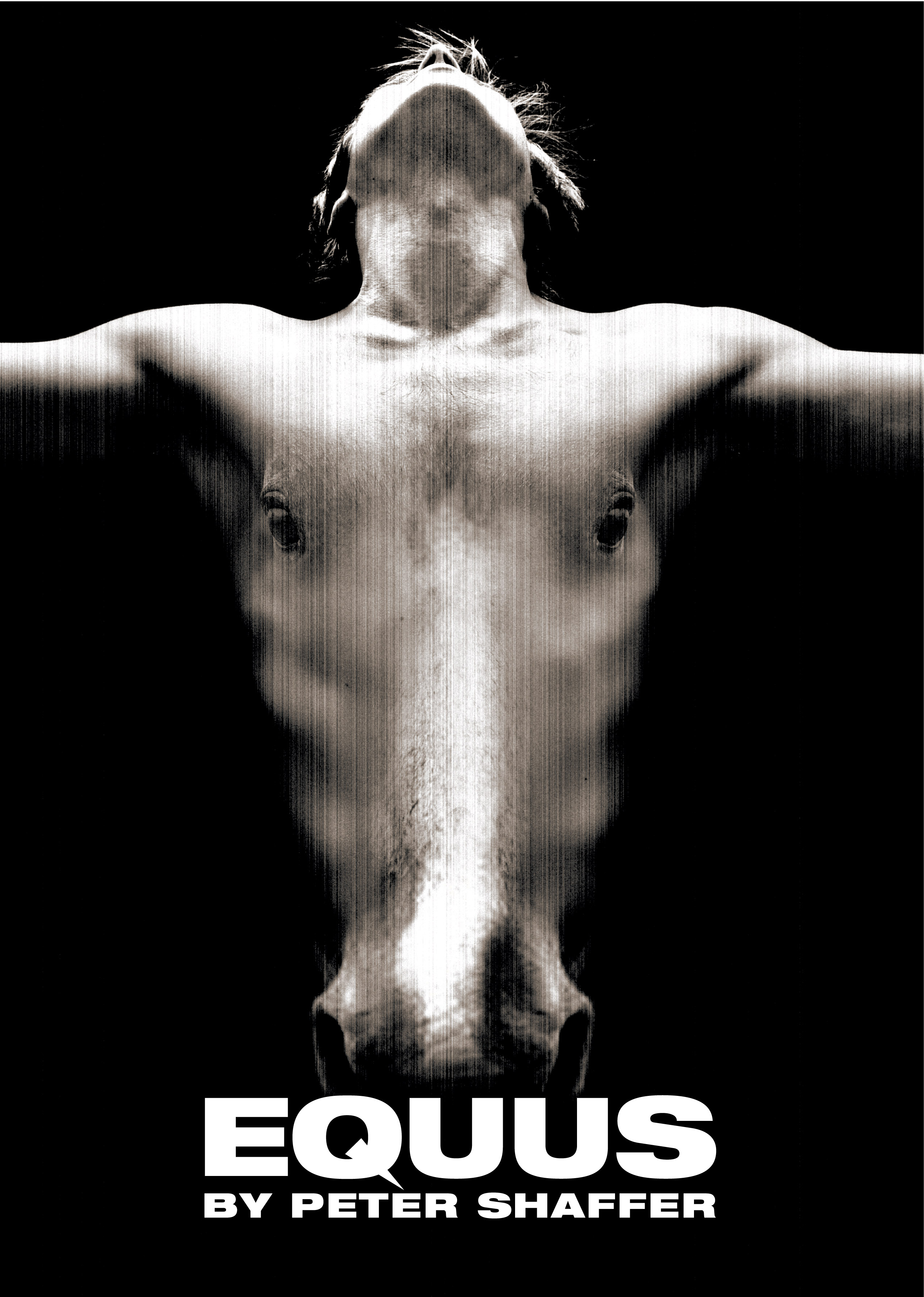
Richard Lindsay gives us another great review, but this time, he takes us to Broadway with the revival of Equus. Sounds like anyone living in/near New York City or planning a vacation should definitely see this.
London production viewed in March 2007 Gielgud Theatre
Broadway production viewed in January 2009 Broadhurst Theater
 Equus starts with the revelation of a horror: Alan Strang, a boy of seventeen, has blinded six horses with a metal spike in the stables where he works. And the heroic psychoanalyst Martin Dysart is the one, the only one, “…there really is nobody within a hundred miles of your desk…,” who can help him.
It seems a bit quaint, really. Horses? Not humans? Sick, but not the worst we’ve seen from a seventeen year-old. Psychoanalyst to the rescue? In this day and age?
The accepted line on this revival is that it’s a play past its prime: overarching theories of psychology and mythology not having aged well in a postmodern world. It’s all a little too Jungian. As I mentioned in my review of West Side Story, there’s fine line between making a piece of art relevant, and dooming it to datedness.
But I don’t think that’s the case with Equus. Strang is the classic postmodern kid. (“He can hardly read. He knows no physics or engineering to make the world real for him…no music except television jingles…”) As a character he fits in as easily with Generation Y as Daniel Radcliffe and all the Potterites, now grown, that come to the theater to watch him perform. The Millennials are a generation that, despite the blessed coddling of being Baby Boom children, have watched several of their peers carry out unspeakable acts of terror. Would that we had a Dysart to get behind the minds of the Columbine and Virginia Tech shooters, real-life Alan Strangs for whom the drugs and interventions didn’t work.
In the interim between the West End and the Broadway productions, Radcliffe has grown into the role. In London, he seemed a little like the precocious drama lab rat who’d won himself the plum part in the school play. Adolescent angst not being the hardest thing to summon at 18, Radcliffe now shows himself to be a more accomplished actor in his repression of that rage. His stage presence expands as he relishes the strangeness of Strang, stealing wild looks at the audience between lines.
Viewing the London production, I was riveted by Richard Griffiths. Seeing him again on Broadway, his world-weary psychologist seemed more nonchalant than the material demanded, especially in the first half. But as an audience we must appreciate his ability to toss off the strident and elevated language of the play as though it originated in thoughts fresh from his head – as when Dysart invokes a recurring dream in which he is a sacrificial priest, cutting out the insides of children and splattering their entrails on the ground for other priests to read as oracles. Griffiths relates this gruesome tale – a child psychologist’s midlife crisis, no doubt – with off-the-cuff irreverence and humor. I can’t imagine sitting through a bombastic performance of the same by a barely on-the-wagon Richard Burton as happened in one incarnation of the play in the 70’s.
The character study and questions of society and religion are what make the play tick. The plot itself and the process by which Dysart deduces the meaning behind the crime, based on clunky analysis of Strang’s home life, don’t do much. The hysterical parents, doomed to spend their time on stage revealing acres of Alan’s background, were unbearable to watch in both productions.
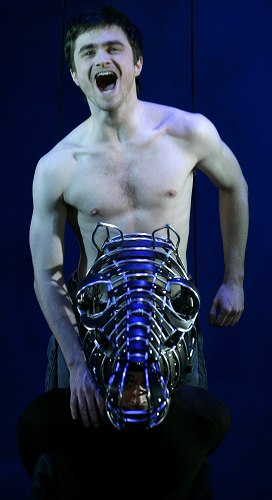 Interspersed with the psychological detective work are scenes of terrifying fantasy involving the horses. They are performed by muscular men in brown velvet suits, wearing wire horse-head masks, and balancing precariously on steel hooves. The horses act as a stamping, whinnying Greek chorus, judging Alan against some abstract standard of normalcy. Leading into the intermission, Strang re-enacts a riding scene by mounting on the back of one of the horse-men-an athletic feat accomplished with guy-wire and a spinning stage and lights. The scene ends with the shirtless Strang’s arms outstretched in orgasmic ecstasy.
Dysart concludes the boy has been worshiping these horses, and he’s beginning to get a little jealous. “That boy has known a passion more ferocious than I have felt in any second of my life. And let me tell you something: I envy it.” Dysart begins to wonder if he is really just trying to make Strang “normal” — acceptable to society, an “ardent husband – a caring citizen – a worshiper of an abstract, unifying God.” As much as he realizes the boy is in pain and must be helped, he torments himself: “Can you think of anything worse one can do to anybody than to take away their worship?
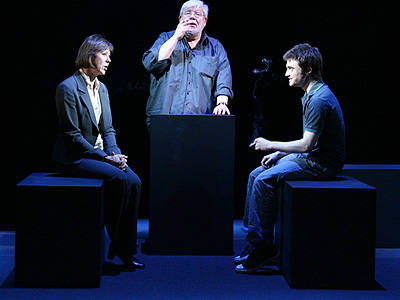
The best parts of the play come in the analyst office stand-offs between Dysart and Strang. The stage is abstract – raked, with a rotating disk, and four pillars moved as needed by the actors to evoke furniture – a bed, a desk, a consulting couch. On top of the rotating disk, the stage forms an elevated plus-sign cross, lifting up the religious nature of the agonizing struggles of the two characters. The play explores the pagan connection between religion and theater. Never have I had a more religious feeling in watching a “secular” play – audience members in their seats above and behind the stage leaning their arms on the rails like angels fascinated by the human drama unfolding below – as though the deepest demons of humanity were being exorcised there in the theater.
As Christopher Hart’s Sunday London Times review from March 4, 2007 states, “There is the added historical irony, which Shaffer could not have foreseen when the play first appeared in 1973, that our too cosily secular, materialist culture has been shaken, some three decades later, by gangs of Alan Strangs: disaffected youths who think in a religious idiom terrible and strange, and yearn to make blood sacrifices on buses and trains, with backpacks of explosives.”
But this is more than “historical irony.” Nowadays, Americans find themselves lectured by British atheists like Christopher Hitchens and Richard Dawkins for their senseless adherence to religious belief. These anti-religionists make no distinction between the demands of an animalistic Equus god and the “abstract and unifying God” that Dysart denounces. They are secure in their faith as any Southern Baptist – their materialist religion convinces them that by sheer polemic, they can eliminate whatever God-shape that has formed in the human psyche over centuries of evolution. They propose a revised history, scrubbed clean of the horrors committed in the name of religion, as though this is any more logical than history without the motivating human obsessions of hunger, sex, or fear. When the human striving for divine transcendence is repressed the result is a lot closer to Strang’s night/mare than some kind of rationalist utopia.
Previous Post

February 10, 2009
Mary, Mother of Christ!
Next Post
February 17, 2009 New On DVD Today
Browse Our Archives
Select a Category Classics DVD Film Music News Pop Culture Events Print Sports Television Uncategorized Video Games
Select a Month March 2017 February 2017 January 2017 December 2016 November 2016 October 2016 September 2016 August 2016 July 2016 June 2016 May 2016 April 2016 March 2016 February 2016 January 2016 December 2015 November 2015 October 2015 September 2015 August 2015 July 2015 June 2015 May 2015 April 2015 March 2015 February 2015 January 2015 December 2014 November 2014 October 2014 September 2014 August 2014 July 2014 June 2014 May 2014 April 2014 March 2014 February 2014 January 2014 December 2013 November 2013 October 2013 September 2013 August 2013 July 2013 June 2013 May 2013 April 2013 March 2013 February 2013 January 2013 December 2012 November 2012 October 2012 September 2012 August 2012 July 2012 June 2012 May 2012 April 2012 March 2012 February 2012 January 2012 December 2011 November 2011 October 2011 September 2011 August 2011 July 2011 June 2011 May 2011 April 2011 March 2011 February 2011 January 2011 December 2010 November 2010 October 2010 September 2010 August 2010 July 2010 June 2010 May 2010 April 2010 March 2010 February 2010 January 2010 December 2009 November 2009 October 2009 September 2009 August 2009 July 2009 June 2009 May 2009 April 2009 March 2009 February 2009 January 2009 December 2008 November 2008 October 2008 September 2008 August 2008 July 2008 June 2008 May 2008 April 2008 March 2008 February 2008 January 2008 December 2007 November 2007 October 2007 September 2007 August 2007 July 2007 June 2007 May 2007 April 2007 March 2007
Follow Us!
TAKE THE
Religious Wisdom Quiz
What Old Testament law was summarized as "love your neighbor as yourself"?
Select your answer to see how you score.
First five commandments Only 10th commandment The whole law Book of Leviticus only
Related posts from Pop Theology


TRENDING AT PATHEOS Progressive Christian

Why Christians Have a Sacred Duty to Vote:...
The Bible offers strong support for the sacred duty to vote. Here...

What Being a Modern-Day Apostle Means to Me
In my last column, I discussed the ins and outs of modern-day...

Did Ancient China Once Worship the God of...
Across human history, a common thread weaves through the origins of the...

Love Your Neighbor – Including Earth-Kin: Lev. 19,...
God’s command to love your neighbor means acting in an ethical and...

Lead a Church Study of “Jesus and Lao...
Guest writer Jack Thomas (The Irreverent Reverend) reflects on leading his church...

Principles for Understanding the Apostolic Ministry Today
Whenever people discover that my formal ministry title is "apostle," as in...
view all Progressive Christian blogs
Ad-Free & Subscriber Log-In Subscription Support
- About Us
- 2026 Calendar
- Videos
- Podcasts
- Library of World Religions
- Faith In Media Tracker
- Advertise With Us
- Write for Us
- Privacy Policy
- Terms of Service
- Do Not Sell My Data
- Contact Us
- Radiant Digital
- Manage Newsletter Subscriptions
- Unsubscribe From Notifications
- Sitemap
Copyright 2008-2026, Patheos. All rights reserved.
Subscription Support Ad-Free & Subscriber Log-In
Follow Patheos