
BuddhistCatholicContemplativeEvangelicalGeneral ChristianHinduJewishLatter-day SaintMuslimNew VisionsProgressive Christian
Beliefs
- Buddhist
- Catholic
- Contemplative
- Evangelical
- General Christian
- Hindu
- Jewish
- Latter-day Saint
- More Voices
- Muslim
- New Visions
- Pagan
- Progressive Christian
Topics
- Religion News
- Food and Religion
- Sports and Religion
- Religious Art
- Religious Music and Entertainment
- Religious Events
- History and Religion
- Style and Religion
- Politics and Religion
- Women in Religion
- Recreation Outdoors and Religion
- Business Finance and Religion
- Careers Workplace and Religion
- Education and Religion
- Family Parenting and Religion
- Health Fitness and Religion
- Home and Religion
- Relationships and Religion
- Technology and Religion
- Travel and Religion
Columnists
- Buddhist Columnists
- Business Finance and Religion Columnists
- Careers Workplace and Religion Columnists
- Catholic Columnists
- Contemplative Columnists
- Education and Religion Columnists
- Evangelists Columnists
- Family Parenting and Religion Columnists
- General Christian Columnists
- Health Fitness and Religion Columnists
- Hindu Columnists
- History and Religion Columnists
- Home and Religion Columnists
- Jewish Columnists
- More Voices Columnists
- Latter Day Columnists
- Muslim Columnists
- New Visions Columnists
- Nonreligious Columnists
- Pagan Columnists
- Politics and Religion Columnists
- Progressive Columnists
- Recreation Outdoors and Religion Columnists
- Relationships and Religion Columnists
- Religion News Columnists
- Religious Art Columnists
- Religious Events Columnists
- Religious Music and Entertainment Columnists
- Sports and Religion Columnists
- Style and Religion Columnists
- Technology and Religion Columnists
- Travel and Religion Columnists
- Women in Religion Columnists
Resource Library
- 2026 Calendar
- Library of World Religions
- The 100 Most Holy Places on Earth
- Patheos Answers
- Podcasts
- Videos
- Faith Leaders Database
- Anglican Episcopalian
- Bahai
- Baptist
- Buddhism
- Christianity
- Confucianism
- Eastern Orthodoxy
- Hinduism
- Holiness and Pentecostal
- ISKCON
- Islam
- Judaism
- Lutheran
- Methodist
- The Church of Jesus Christ of Latter-day Saints
- New Age
- Paganism
- Presbytarian and Reformed
- Protestantism
- Religion Behind the Scenes
- Roman Catholic
- Scientology
- Shia Islam
- Sikhism
- Sufism
- Sunni Islam
- Taoism
- Zen
- See all religions
Research Tools
 Ad-Free & Subscriber Log-In Subscription Support
Ad-Free & Subscriber Log-In Subscription Support
Follow Patheos 

- Trending:
- Forgiveness
- |
- Marriage
- |
- Consciousness
- |
- Death Penalty
- |
- Election
- |
- Halloween
 Pop Theology
- Home
- Progressive Christian
- Religious Music & Entertainment
- Lifeboat
Lifeboat
Last updated on: September 10, 2008 at 8:56 am by J. Ryan Parker
Lifeboat 2008-09-10T08:56:09-07:00 J. Ryan Parker
Patheos Explore the world's faith through different perspectives on religion and spirituality! Patheos has the views of the prevalent religions and spiritualities of the world.
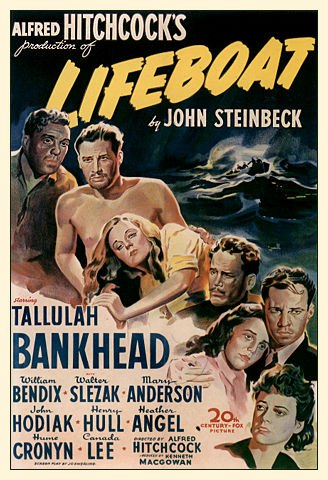
Pop Theology contributor Wendy Arce reviews a Hitchcock classic, Lifeboat.
I recently saw Alfred Hitchcock’s Lifeboat and in spite of how sleepy the Bay Area’s latest heat wave made me feel, I found it to be a very interesting film on two dimensions. Cinematically, the film takes place in a forty-foot lifeboat after a German U-Boat sinks an American freighter during WWII. The survivors must find their way to safety in the middle of the Atlantic Ocean. However, the story thickens as they take in the German U-Boat captain and introduces its second important dimension. The U.S. survivors must face the ethical issues of sharing with and caring for a human life versus maintaining a war posture and leaving the enemy for dead, afloat in the stormy Atlantic.
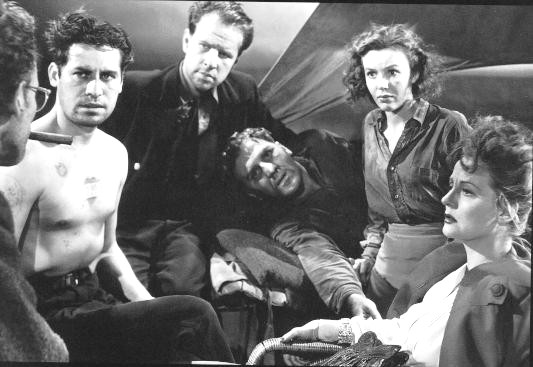 Although Lifeboat wasn’t well received in wartime U.S., Hitchcock demonstrates in this film his great vision and directorial ability. In spite of working in a tightly confined area (the lifeboat was reproduced to scale), Hitchcock makes each scene look different. In several moments, I even forgot that they were in such a confined space, but was quickly reminded when Hitchcock switched to a wide shot of the boat, reintroducing that sense of claustrophobia. Though Hitchcock created the boat to scale, he also created portions of it separately for purposes of specific scenes and perspectives, for example with romantic scenes between Stanley (Hume Cronyn) and Alice (Mary Anderson) or Connie (Tallulah Bankhead) and Kovac (John Hodiak). Hitchcock even shows a downward angle of the boat to show the area under the planks where the survivors sought shelter from the sun. Hitchcock turns what could be a boring film about a forty-foot lifeboat into a conglomeration of scenes that exhibit different angles, perspectives, backdrops and uses of props. Thus, he is able to bring this captivating story to the screen without boring us with the same visual images.
 Along with these great cinematic effects, Hitchcock also offers an interesting commentary on human nature. These eight people trapped in a lifeboat face extreme conditions that can bring out either the best or worst in them. As the people gather towards the boat and pull survivors out of the water, they pull up the German captain (Walter Slezak). The ethical question becomes: do they leave him to die or take him in and share their limited resources? They decide to keep him as a prisoner of war, but do not know whether or not they can trust his apparent nautical know-how in taking them to safety. Thus, they face another ethical question: can they trust him to lead them to safety or will he lead them straight into enemy hands and turn them into prisoners of war? After a storm pushes them off course, they opt to trust him, not know that he continuously rows them towards a Nazi supply ship. All the while, they face dehydration and starvation, with no means of acquiring fresh water or food. The German, however, who they already caught hiding a compass, also hides fresh water and energy pills. When one survivor, Gus (William Bendix), is pushed over by the German, the remaining six turn on him once again. Gus had a leg amputated on the lifeboat because of a spreading infection and was therefore vulnerable and slightly crazed by the extreme conditions they faced. Once they realized the German pushed Gus overboard and found out he hid water and nutrients from them, the remaining passengers enter a fit of rage and murder him, beating him mercilessly and throwing him into the Atlantic. His actions, and the extreme physical conditions they faced, drove them into hysterics in which they choose revenge and death over the earlier value they exhibited for human life.
The passengers lost hope as they drifted along the Atlantic Ocean, but once again, Hitchcock proves his talent. They continually row towards the Nazi supply ship, only to witness an American-launched attack. The supply ship goes down and once again, the six find another German survivor in the water. Although some want to kill him, due to the German captain’s earlier betrayal, others seek to help him. He asks: “Aren’t you going to kill me?” But they do not. Alice tends to this wounds while they await rescue. This ethical dimension of Lifeboat gets to the heart of human nature. What are we capable of doing to others? Under what circumstances will our values thrive or perish? What are our moral and ethical limitations?
In a perhaps unrelated and erroneous detail, the Nazi death scene reminded me of The Dark Knight. In Lifeboat, the “good” people turn on the “bad” and assert their judgment on him and his actions. In The Dark Knight, the Joker loads two ferryboats leaving Gotham City with explosives and places the triggers for each bomb in the opposite boat. One boat carries convicted criminals while the second carries civilians, including a number of children. The Joker says that each group has the power to blow up the other, but if they do not act before midnight, he will detonate both sets of explosives. The civilians and convicts alike face a moral dilemma: kill or be killed. Like the situation in Lifeboat, the good people are faced with the decision of killing a boatload of convicts or waiting to die at the Joker’s hands if they do not act before midnight. As a mother says: “They’ve (the convicts) have had their chance.” She and others argue that killing them would be no great societal loss, and by doing that, they would guarantee their own survival. In the end, however, neither convicts nor civilians wanted to have any more blood on their hands and exhibited a faith in humankind that they would keep each other safe. They also proved the Joker wrong by demonstrating that people can still be good when faced with extreme situations.
These two scenes come from widely different contexts but are still comparable. They are both valuable expressions of how human beings choose between right and wrong, testing their limits as they find themselves in spectacular situations of life and death.
Lifeboat (96 mins) is on DVD and is rated PG.
Previous Post

September 9, 2008
Fall TV Preview
Next Post
September 11, 2008 The Audacity of Despair
Browse Our Archives
Select a Category Classics DVD Film Music News Pop Culture Events Print Sports Television Uncategorized Video Games
Select a Month March 2017 February 2017 January 2017 December 2016 November 2016 October 2016 September 2016 August 2016 July 2016 June 2016 May 2016 April 2016 March 2016 February 2016 January 2016 December 2015 November 2015 October 2015 September 2015 August 2015 July 2015 June 2015 May 2015 April 2015 March 2015 February 2015 January 2015 December 2014 November 2014 October 2014 September 2014 August 2014 July 2014 June 2014 May 2014 April 2014 March 2014 February 2014 January 2014 December 2013 November 2013 October 2013 September 2013 August 2013 July 2013 June 2013 May 2013 April 2013 March 2013 February 2013 January 2013 December 2012 November 2012 October 2012 September 2012 August 2012 July 2012 June 2012 May 2012 April 2012 March 2012 February 2012 January 2012 December 2011 November 2011 October 2011 September 2011 August 2011 July 2011 June 2011 May 2011 April 2011 March 2011 February 2011 January 2011 December 2010 November 2010 October 2010 September 2010 August 2010 July 2010 June 2010 May 2010 April 2010 March 2010 February 2010 January 2010 December 2009 November 2009 October 2009 September 2009 August 2009 July 2009 June 2009 May 2009 April 2009 March 2009 February 2009 January 2009 December 2008 November 2008 October 2008 September 2008 August 2008 July 2008 June 2008 May 2008 April 2008 March 2008 February 2008 January 2008 December 2007 November 2007 October 2007 September 2007 August 2007 July 2007 June 2007 May 2007 April 2007 March 2007
Follow Us!
TAKE THE
Religious Wisdom Quiz
Who was the first man created, according to the Bible?
Select your answer to see how you score.
Moses Adam Abraham Jacob
Related posts from Pop Theology


At SXSW2017: May It Last: A Portrait of...

At SXSW 2017: "Untold Tales of Armistead Maupin"
TRENDING AT PATHEOS Progressive Christian

Why Christians Have a Sacred Duty to Vote:...
The Bible offers strong support for the sacred duty to vote. Here...

What Being a Modern-Day Apostle Means to Me
In my last column, I discussed the ins and outs of modern-day...

Did Ancient China Once Worship the God of...
Across human history, a common thread weaves through the origins of the...

Love Your Neighbor – Including Earth-Kin: Lev. 19,...
God’s command to love your neighbor means acting in an ethical and...

Lead a Church Study of “Jesus and Lao...
Guest writer Jack Thomas (The Irreverent Reverend) reflects on leading his church...

Principles for Understanding the Apostolic Ministry Today
Whenever people discover that my formal ministry title is "apostle," as in...
view all Progressive Christian blogs
Ad-Free & Subscriber Log-In Subscription Support
- About Us
- 2026 Calendar
- Videos
- Podcasts
- Library of World Religions
- Faith In Media Tracker
- Advertise With Us
- Write for Us
- Privacy Policy
- Terms of Service
- Do Not Sell My Data
- Contact Us
- Radiant Digital
- Manage Newsletter Subscriptions
- Unsubscribe From Notifications
- Sitemap
Copyright 2008-2026, Patheos. All rights reserved.
Subscription Support Ad-Free & Subscriber Log-In
Follow Patheos