
BuddhistCatholicContemplativeEvangelicalGeneral ChristianHinduJewishLatter-day SaintMuslimNew VisionsProgressive Christian
Beliefs
- Buddhist
- Catholic
- Contemplative
- Evangelical
- General Christian
- Hindu
- Jewish
- Latter-day Saint
- More Voices
- Muslim
- New Visions
- Pagan
- Progressive Christian
Topics
- Religion News
- Food and Religion
- Sports and Religion
- Religious Art
- Religious Music and Entertainment
- Religious Events
- History and Religion
- Style and Religion
- Politics and Religion
- Women in Religion
- Recreation Outdoors and Religion
- Business Finance and Religion
- Careers Workplace and Religion
- Education and Religion
- Family Parenting and Religion
- Health Fitness and Religion
- Home and Religion
- Relationships and Religion
- Technology and Religion
- Travel and Religion
Columnists
- Buddhist Columnists
- Business Finance and Religion Columnists
- Careers Workplace and Religion Columnists
- Catholic Columnists
- Contemplative Columnists
- Education and Religion Columnists
- Evangelists Columnists
- Family Parenting and Religion Columnists
- General Christian Columnists
- Health Fitness and Religion Columnists
- Hindu Columnists
- History and Religion Columnists
- Home and Religion Columnists
- Jewish Columnists
- More Voices Columnists
- Latter Day Columnists
- Muslim Columnists
- New Visions Columnists
- Nonreligious Columnists
- Pagan Columnists
- Politics and Religion Columnists
- Progressive Columnists
- Recreation Outdoors and Religion Columnists
- Relationships and Religion Columnists
- Religion News Columnists
- Religious Art Columnists
- Religious Events Columnists
- Religious Music and Entertainment Columnists
- Sports and Religion Columnists
- Style and Religion Columnists
- Technology and Religion Columnists
- Travel and Religion Columnists
- Women in Religion Columnists
Resource Library
- 2026 Calendar
- Library of World Religions
- The 100 Most Holy Places on Earth
- Patheos Answers
- Podcasts
- Videos
- Faith Leaders Database
- Anglican Episcopalian
- Bahai
- Baptist
- Buddhism
- Christianity
- Confucianism
- Eastern Orthodoxy
- Hinduism
- Holiness and Pentecostal
- ISKCON
- Islam
- Judaism
- Lutheran
- Methodist
- The Church of Jesus Christ of Latter-day Saints
- New Age
- Paganism
- Presbytarian and Reformed
- Protestantism
- Religion Behind the Scenes
- Roman Catholic
- Scientology
- Shia Islam
- Sikhism
- Sufism
- Sunni Islam
- Taoism
- Zen
- See all religions
Research Tools
 Ad-Free & Subscriber Log-In Subscription Support
Ad-Free & Subscriber Log-In Subscription Support
Follow Patheos 

- Trending:
- Forgiveness
- |
- Marriage
- |
- Consciousness
- |
- Death Penalty
- |
- Election
- |
- Halloween
 Pop Theology
- Home
- Progressive Christian
- Religious Music & Entertainment
- Old Time Rock-n-Roll?
Old Time Rock-n-Roll?
Last updated on: August 15, 2008 at 11:11 am by J. Ryan Parker
Old Time Rock-n-Roll? 2008-08-15T11:11:22-07:00 J. Ryan Parker
Patheos Explore the world's faith through different perspectives on religion and spirituality! Patheos has the views of the prevalent religions and spiritualities of the world.
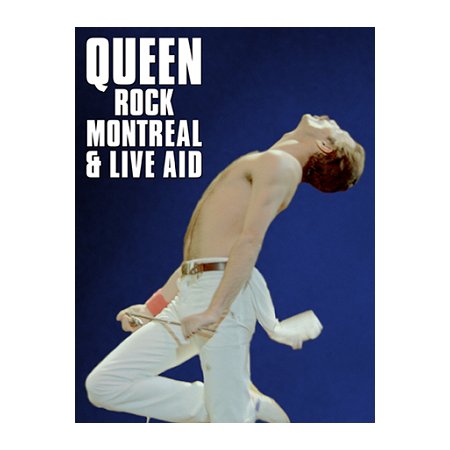
This just in from occasional, and hopefully more frequent, poptheology contributor, Richard Lindsay.
In the never-ending cycle of pop cultural regeneration, there seems to be a time and a place when everything old must be new again. Just a few days ago, I saw a young twenty-something strolling near the North Gate of U.C. Berkeley hoisting an old school ghetto blaster and spraying the street with sound. Perhaps this urban hipster, referencing a style from before his time, represents the next wave of retro music enjoyment, an anti-ipod backlash where personal music becomes communal again.
I recently came across a DVD set of two great performances by Queen entitled Queen Rock Montreal and Live Aid, and with the release of this gorgeously re-mastered set, the theatrical hard rock band may be due for a comeback. The Montreal performance was filmed by director Saul Swimmer in 1981 in a format called Mobilevision, a kind of early version of IMAX. The result is a film of pristine quality that, with digital and audio re-mastering, resurrects all the smoke effects, pyrotechnics, and thundering sound of an early eighties Queen concert. The DVD was released by Eagle Rock Entertainment in the fall of 2007, and was featured recently during pledge season on PBS.
Frontman Freddie Mercury is at his slitheringly sexiest here, having abandoned the long hair and spandex unitards of the 70’s and embracing the gay clone look, with short-cropped hair, a mustache, white jeans, and tight t-shirt. In Montreal, he takes the stage wearing a leather biker jacket over a Superman tank top, and sheds layers throughout the show, eventually going shirtless and tucking the T into the back of his jeans. Watching Queen from the 21st Century is a lesson in retro cool. Fashion has come full circle and much of what the band wears in 1981 is back in style, from skinny cut jeans to vintage (then state of the art) Adidas and Nike sneakers.
For those of the young college-age queer set adventurous enough to explore music from before their time, Mercury could become a hero, representing a kind of proto-post-gay sensibility. Unlike other androgynous rockers of the era like David Bowie, who toyed self-consciously with the swinging 70’s pretensions of bisexuality, Freddie was truly queer, but in such an obvious, and therefore unremarkable, sort of way. His sexuality didn’t fly under the radar, but soared over it, camping in the stratosphere above the heads of fans who just enjoyed the high-flying show.
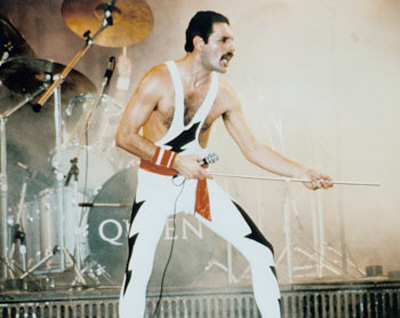 The Montreal concert starts with a blisteringly fast version of “We Will Rock You” a song that pumps with flowing hard rock fury when divorced from its famous BOOM-boom-CHACK drum riff. Mercury explodes onto stage, pumping his fist and taunting the audience, dancing leeringly in front of his bandmates and mimicking their guitar movements on his detached microphone stand. Throughout his career with Queen, Mercury relied on the stand as an air guitar, dance partner, phallus, and drum major’s baton (and famously during a Wembley performance as a scepter, while sporting an ermine cape and crown.) The appearance of the fast metal version of “We Will Rock You” at the beginning, and the original version at the end places a kind of parenthesis around the whole performance—We WILL rock you! (There, we ROCKED you!)
The band is in good voice during “Somebody to Love” and “Killer Queen,” early hits laid down using multiple vocal tracks in the studio and difficult to reproduce on stage. Lacking the funds to bring in the Metropolitan Opera chorus, Bohemian Rhapsody is performed with the middle section pre-recorded, but the band still rocks out on the ending. In “Somebody to Love,” Mercury tosses off some of his famous soaring rock vocal improvisations—part soul, part scat—while he and his band mates swing the gospel instrumentals. Mercury pounds out riffs and flourishes on the piano on these songs before taking up his mic stand to shadow box with his band mates. He pouts his lips and gallops and skips, churning his arms in a runner’s motion, then tosses the stand to a roadie and straddles the piano stool for another chorus.
The band proves its metal on a pounding medley of “Now I’m Here,” followed by “Dragon Attack.” The set begins in the dark with Freddie harmonizing with himself using vocal reverb, “Here I stand, look around,” echoes over the dark arena lit by hundreds of cigarette lighters. As the band rocks into the blues-tinged song, the lights come blindingly up. The song seemingly ends abruptly, but then Freddie makes his way to the front of the stage to lead a call and response with the audience, instructing them like a pied piping music teacher, “Come on, do it to the beat!” Without a break, the band launches into “Dragon Attack,” shifting effortlessly from rock blues to the heavy bass shuffle of the kind they made famous in “Another One Bites the Dust.” Shouting out lines like, “Take me to the room where the blacks are white, where the whites are black, take me back to the sack!”
The show takes a prog rock turn during the solo sections with Brian May on guitar and Roger Taylor on drums. Taylor does a brief standard drum set solo, but then ascends to two tympanis and proceeds to pound out tribal/symphonic rhythms while constantly changing tones using the tuning pedals. May’s solo involves some fun intertwining lines using voice delay, but doesn’t quite soar, suggesting his strength may have been a more fixed compositional style, not free-form improvisation. May is one of the original longhaired musicians—he recently completed a long-delayed PhD in Astrophysics. His musical style is symphonic, almost baroque. He shreds high and screaming on the solos and doubles the band’s famous piano and bass riffs, picking out the articulate melodies with his long skinny fingers, providing one of the most influential sounds in hard rock.
The ballad, “Love of My Life,” in which May accompanies Freddie on acoustic 12-string guitar, lends a lovely moment. Freddie and May coax the refrain line “Bring it back…bring it back,” with chant-like reverence from the singing audience. This is why Queen was always best live: somewhere at the heart of the massive circus machine of the rock-n-roll show, the band always found a way to connect with every member of the arena-sized audience.
Of course the Queen classics are all present in rocking style: “Bohemian Rhapsody,” “Under Pressure,” “We Will Rock You,” and “We Are the Champions,” which closes the concert with Mercury heartily shaking hands with the audience as though running for Parliament. An enjoyable follow-up to the Elvis-inspired “Crazy Little Thing Called Love” is a metal-inspired version of “Jailhouse Rock.” Here, Freddie’s threatens the crowd, now a fascist music teacher, when they don’t clap along loud enough, “Move it you fuckers, come on!”
The fun of every Queen performance is watching the roaring hard rock sound and down-and-dirty lyrics interpreted through the goose-stepping, macho-camp androgyny of Mercury. No greater contrast could exist between the violent butch fantasy of “Another One Bites the Dust” and the mincing reality Mercury presents on stage in Montreal. As he goads the audience to “Bite it! Bite it! Bite it!” between lyrics about machine guns and a tough guy named “Steve,” Mercury prances shirtless and barefoot, wearing a white Canadiens trucker hat, a red bandanna, and a pair of high white shorts that appear to have been borrowed from Lonnie Anderson. North American suburban teenagers pound on the stage, staring at Mercury with the stoned innocence of youth, convinced they are merely watching wholesome rock n’ roll subversion, when in fact, they’re watching their stable middle class notions of sexuality taunted, teased, and ultimately tossed away.
There was always a firewall of denial that allowed the straight male sports fans belting out the chorus of “We Will Rock You” not to admit the voice cheering their idols to greater acts of manly heroism was in fact a big fairy. The secret hidden for all to see was that the “queen” in Queen was none other than fabulous Freddie himself. Accounts of friends who knew him during his art school years in the swinging London Sixties confirm that his royal nickname came from his outrageous camp persona and habit (dating from grade school) of calling everyone “darling.”
The best example of Mercury’s queenly machismo is in the second song of the Montreal set, “Let Me Entertain You.”
“I’ve come here to sell you my body
I can show you some good merchandise
I’ll pull you and I’ll pill you
I’ll Cruella DeVille you
And to thrill you I’ll use any device…”
As always, Freddie and the boys make good on that promise.
A beautiful addition to the DVD set is Queen’s Live Aid performance from July 13, 1985. The event seems strangely transcendent even today, with the muted white and gray color palette of the hazy English summer evening, the signs held up by the audience (“Hello World”) painted on bed sheets, Mercury in his white jeans and wife beater T-shirt, a black studded leather band around his bicep, leading 75,000 people live and billions around the world to lift their arms in ecstasy and sway back and forth to “We Are the Champions”— it all seems like a kind of dirty, imperfect vision of heaven. According to a music industry poll by the BBC in 2005, Queen’s performance at Live Aid was the greatest rock-n-roll gig in history. (Perhaps the survey pool was heavily British, since it’s hard to imagine American rock musicians would have put Hendrix’s Woodstock performance second.) Regardless, Live Aid and Queen’s performance may have been the next world-embracing event after the moon landing. That cosmic event which used technology to humble humanity with an unparalleled perspective of our place in the universe, placed alongside a concert which used technology to bring worldwide attention to the twin plagues of genocide and famine. Both events compelled us to see all humanity as our common tribe. Not a bad achievement for a bunch of “Radio Ga-Ga.”
The DVD has the standard artist commentary features. May, Taylor, and Deacon provide sparse commentary, but the information may be interesting to fans. The Live Aid disc has a couple of TV featurettes, one pretty cool one showing the band rehearsing for Live Aid, and another a clip from the old infotainment schlockfest PM Magazine that’s more interesting for its retro early eighties title sequence than its tepid, Freddie-less band interviews and “Thanks Mr. Obvious” facts about Queen.
Previous Post

August 12, 2008
Two Weeks in August...
Next Post
August 17, 2008 We're Here and We're Religious, Part 2
Browse Our Archives
Select a Category Classics DVD Film Music News Pop Culture Events Print Sports Television Uncategorized Video Games
Select a Month March 2017 February 2017 January 2017 December 2016 November 2016 October 2016 September 2016 August 2016 July 2016 June 2016 May 2016 April 2016 March 2016 February 2016 January 2016 December 2015 November 2015 October 2015 September 2015 August 2015 July 2015 June 2015 May 2015 April 2015 March 2015 February 2015 January 2015 December 2014 November 2014 October 2014 September 2014 August 2014 July 2014 June 2014 May 2014 April 2014 March 2014 February 2014 January 2014 December 2013 November 2013 October 2013 September 2013 August 2013 July 2013 June 2013 May 2013 April 2013 March 2013 February 2013 January 2013 December 2012 November 2012 October 2012 September 2012 August 2012 July 2012 June 2012 May 2012 April 2012 March 2012 February 2012 January 2012 December 2011 November 2011 October 2011 September 2011 August 2011 July 2011 June 2011 May 2011 April 2011 March 2011 February 2011 January 2011 December 2010 November 2010 October 2010 September 2010 August 2010 July 2010 June 2010 May 2010 April 2010 March 2010 February 2010 January 2010 December 2009 November 2009 October 2009 September 2009 August 2009 July 2009 June 2009 May 2009 April 2009 March 2009 February 2009 January 2009 December 2008 November 2008 October 2008 September 2008 August 2008 July 2008 June 2008 May 2008 April 2008 March 2008 February 2008 January 2008 December 2007 November 2007 October 2007 September 2007 August 2007 July 2007 June 2007 May 2007 April 2007 March 2007
Follow Us!
TAKE THE
Religious Wisdom Quiz
What does the name "Israel" mean?
Select your answer to see how you score.
He struggles with God The Lord provides Father of a multitude Mountain of God
Related posts from Pop Theology
The Mastodon In The Room: A Conversation with...

At SXSW2017: Music Festival Day 5
At SXSW2017: Music Festival Day 4
At SXSW2017: Music Festival Day 3
TRENDING AT PATHEOS Progressive Christian

Why Christians Have a Sacred Duty to Vote:...
The Bible offers strong support for the sacred duty to vote. Here...

What Being a Modern-Day Apostle Means to Me
In my last column, I discussed the ins and outs of modern-day...

Did Ancient China Once Worship the God of...
Across human history, a common thread weaves through the origins of the...

Love Your Neighbor – Including Earth-Kin: Lev. 19,...
God’s command to love your neighbor means acting in an ethical and...

Lead a Church Study of “Jesus and Lao...
Guest writer Jack Thomas (The Irreverent Reverend) reflects on leading his church...

Principles for Understanding the Apostolic Ministry Today
Whenever people discover that my formal ministry title is "apostle," as in...
view all Progressive Christian blogs
Ad-Free & Subscriber Log-In Subscription Support
- About Us
- 2026 Calendar
- Videos
- Podcasts
- Library of World Religions
- Faith In Media Tracker
- Advertise With Us
- Write for Us
- Privacy Policy
- Terms of Service
- Do Not Sell My Data
- Contact Us
- Radiant Digital
- Manage Newsletter Subscriptions
- Unsubscribe From Notifications
- Sitemap
Copyright 2008-2026, Patheos. All rights reserved.
Subscription Support Ad-Free & Subscriber Log-In
Follow Patheos