
BuddhistCatholicContemplativeEvangelicalGeneral ChristianHinduJewishLatter-day SaintMuslimNew VisionsProgressive Christian
Beliefs
- Buddhist
- Catholic
- Contemplative
- Evangelical
- General Christian
- Hindu
- Jewish
- Latter-day Saint
- More Voices
- Muslim
- New Visions
- Pagan
- Progressive Christian
Topics
- Religion News
- Food and Religion
- Sports and Religion
- Religious Art
- Religious Music and Entertainment
- Religious Events
- History and Religion
- Style and Religion
- Politics and Religion
- Women in Religion
- Recreation Outdoors and Religion
- Business Finance and Religion
- Careers Workplace and Religion
- Education and Religion
- Family Parenting and Religion
- Health Fitness and Religion
- Home and Religion
- Relationships and Religion
- Technology and Religion
- Travel and Religion
Columnists
- Buddhist Columnists
- Business Finance and Religion Columnists
- Careers Workplace and Religion Columnists
- Catholic Columnists
- Contemplative Columnists
- Education and Religion Columnists
- Evangelists Columnists
- Family Parenting and Religion Columnists
- General Christian Columnists
- Health Fitness and Religion Columnists
- Hindu Columnists
- History and Religion Columnists
- Home and Religion Columnists
- Jewish Columnists
- More Voices Columnists
- Latter Day Columnists
- Muslim Columnists
- New Visions Columnists
- Nonreligious Columnists
- Pagan Columnists
- Politics and Religion Columnists
- Progressive Columnists
- Recreation Outdoors and Religion Columnists
- Relationships and Religion Columnists
- Religion News Columnists
- Religious Art Columnists
- Religious Events Columnists
- Religious Music and Entertainment Columnists
- Sports and Religion Columnists
- Style and Religion Columnists
- Technology and Religion Columnists
- Travel and Religion Columnists
- Women in Religion Columnists
Resource Library
- 2026 Calendar
- Library of World Religions
- The 100 Most Holy Places on Earth
- Patheos Answers
- Podcasts
- Videos
- Faith Leaders Database
- Anglican Episcopalian
- Bahai
- Baptist
- Buddhism
- Christianity
- Confucianism
- Eastern Orthodoxy
- Hinduism
- Holiness and Pentecostal
- ISKCON
- Islam
- Judaism
- Lutheran
- Methodist
- The Church of Jesus Christ of Latter-day Saints
- New Age
- Paganism
- Presbytarian and Reformed
- Protestantism
- Religion Behind the Scenes
- Roman Catholic
- Scientology
- Shia Islam
- Sikhism
- Sufism
- Sunni Islam
- Taoism
- Zen
- See all religions
Research Tools
 Ad-Free & Subscriber Log-In Subscription Support
Ad-Free & Subscriber Log-In Subscription Support
Follow Patheos 

- Trending:
- Forgiveness
- |
- Marriage
- |
- Consciousness
- |
- Death Penalty
- |
- Election
- |
- Halloween
 Pop Theology
- Home
- Progressive Christian
- Religious Music & Entertainment
- Judas…
Judas…
Last updated on: August 28, 2008 at 8:30 am by J. Ryan Parker
Judas… 2008-08-28T08:30:27-07:00 J. Ryan Parker
Patheos Explore the world's faith through different perspectives on religion and spirituality! Patheos has the views of the prevalent religions and spiritualities of the world.
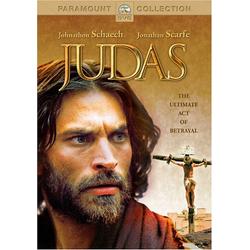
A host of Jesus films focus specifically on the titular character. The ways in which they do so, however, differ drastically. Emphasizing different gospel narratives, showing or avoiding miracles, casting, location…all of these choices affect the cinematic interpretation of Jesus. Other films focus on supporting characters in the Jesus story and feature Jesus as a supporting cast member, to a greater or lesser degree. These films often explore and develop these characters, ranging from the apostles to Barabbas, and the effect their encounters with Jesus have on them. One more recent example is Judas (2004), a made-for-TV movie that premiered on ABC.Directed by Charles Robert Carner, who most recently brought you Witless Protection, Judas presents the title character (played by Johnathon Schaech) as a son of Jewish revolutionary who wants to walk in his father’s footsteps and sees Jesus (Johnathan Scarfe) as a means to overthrow Roman and corrupt Jewish rule. The film opens as Judas’ father is crucified with hundreds of other criminals. This opening scene might be the film’s greatest asset and reveals the enormity of the practice of crucifixion, beginning to get at what theologian Jurgen Moltmann refers to as the countless crosses on the horizon of history.
Cut to an adult Judas, now selling wine in Jerusalem. Word has spread about this man Jesus who Judas and the audience first sees raving mad clearing out the money lenders in the temple. Judas, impressed with Jesus’ angry actions invites him to his house for a meal and to try to recruit him into his movement. Jesus, unfortunately for Judas, admits to having lost his temper. Jesus’ peaceful way will continually confound Judas’ attempts at violent or aggressive revolution.
As the film progresses, Judas joins up with Jesus and his disciples, much to some of the disciples’ dismay. Few of them trust Judas, especially when Jesus entrusts him with their finances, what precious little they do have. When Jesus finally reveals his path to the disciples…that he must be given over to death…Judas actually accuses him of betrayal, an ironic accusation to be sure given our knowledge of the Jesus narrative. Judas does quickly betray Jesus. Another strong point in this film might be the scenes of Judas following this betrayal. Judas realizes what he has done and, wracked with guilt, tries to rescue Jesus or at least convince the authorities to release him. All his efforts fail as Jesus is crucified, and Judas hangs himself.
 Judas suffers from an occasionally laughable script and consistently shallow acting. Moreover, the use of strong British accents for the disciples and American accents for Jesus and Judas is just simply confusing. So is the Anglo-Saxon casting of Jesus who looks just like previous blond-haired-blue-eyed cinematic iterations. The made-for-television breaks make for some awkward sequences and representations of gospel narratives. On the other hand, like many contemporary religious films, Judas exhibits decent production values that are unfortunately overshadowed by these shortcomings.
Ironically, it seems that filmmakers who approach this scriptural subject matter with severe reverence often produce films that are campy and somewhat irreverent. When asked what his favorite Jesus film is, Jesus scholar John Dominic Crossan confessed The Life of Brian because the filmmakers approached the subject matter with a heavy dose of humor. Though Judas‘ filmmakers probably did not intend this, there are several scenes in the film that are downright hilarious. Any scene in which Pontius Pilate (Tim Matheson) and Claudia (Fiona Glascott) embrace one another is something straight out of day-time soap opera love scenes. Judas’ desire to charge for miracles would be even funnier if it was not simply a tool with which to further demonize the betrayer. When Jesus grants his disciples the power to perform miracles, the resulting shots look like something straight out of a high school football pre-game inspirational speech. The Last Supper looks like it takes place at a disco club, and when Jesus is taken from the cross, a rain storm seems to wash away all of his wounds (quite a departure from Mel Gibson’s irreparable torture).
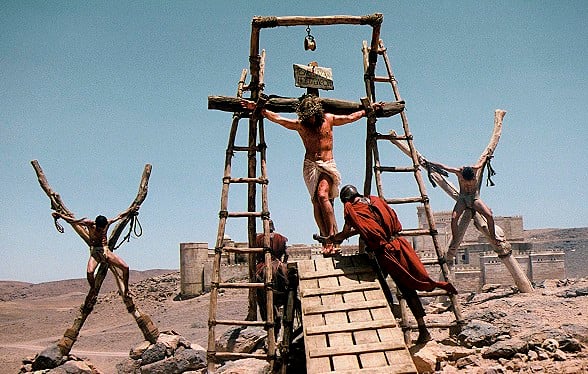
All these embarrassing negatives aside, Judas does offer some worthwhile elements for discussion. The opening crucifixion scene, as mentioned earlier, along with the filmmakers’ sympathy for Judas after he betrays Jesus, are the main highlights. Judas also presents gospel narratives as interesting possibilities, setting interesting scenes for some of Jesus’ speeches. A major issue that “Jesus filmmakers” must confront is how or whether or not they will show Jesus’ miracles. In Judas, the filmmakers avoid financial and special effects difficulties by cutting away or changing camera angles just as or as Jesus performs the miracles. Here, the supporting characters talk about Jesus’ miracles rather than letting us see them. Thankfully, the filmmakers remain consistent here in their refusal to fully portray them. Jesus has a few throw away lines that are good for a bit of intentional comic relief. When he tells Judas to take care of their finances, he says, “I’m no good with money. Whatever I have, I tend to lose.”
It is easy to be highly critical of Jesus movies, and we should be. We should also recognizes that they are extremely difficult to make. Working with four separate accounts and within or across a variety of religious beliefs and traditions makes this one of the most difficult cinematic genres to “get right.” Accusations of money-making about with regards to contemporary religious cinema, especially from me. However, I do not get the sense that this is happening here with Judas. That being said, I wish the filmmakers would have used that sincerity for better casting, a voice coach, and a more firm script.
Previous Post

August 25, 2008
Forgive Us Our Trespasses...
Next Post
September 2, 2008 You May Not Have Known His Name...
Browse Our Archives
Select a Category Classics DVD Film Music News Pop Culture Events Print Sports Television Uncategorized Video Games
Select a Month March 2017 February 2017 January 2017 December 2016 November 2016 October 2016 September 2016 August 2016 July 2016 June 2016 May 2016 April 2016 March 2016 February 2016 January 2016 December 2015 November 2015 October 2015 September 2015 August 2015 July 2015 June 2015 May 2015 April 2015 March 2015 February 2015 January 2015 December 2014 November 2014 October 2014 September 2014 August 2014 July 2014 June 2014 May 2014 April 2014 March 2014 February 2014 January 2014 December 2013 November 2013 October 2013 September 2013 August 2013 July 2013 June 2013 May 2013 April 2013 March 2013 February 2013 January 2013 December 2012 November 2012 October 2012 September 2012 August 2012 July 2012 June 2012 May 2012 April 2012 March 2012 February 2012 January 2012 December 2011 November 2011 October 2011 September 2011 August 2011 July 2011 June 2011 May 2011 April 2011 March 2011 February 2011 January 2011 December 2010 November 2010 October 2010 September 2010 August 2010 July 2010 June 2010 May 2010 April 2010 March 2010 February 2010 January 2010 December 2009 November 2009 October 2009 September 2009 August 2009 July 2009 June 2009 May 2009 April 2009 March 2009 February 2009 January 2009 December 2008 November 2008 October 2008 September 2008 August 2008 July 2008 June 2008 May 2008 April 2008 March 2008 February 2008 January 2008 December 2007 November 2007 October 2007 September 2007 August 2007 July 2007 June 2007 May 2007 April 2007 March 2007
Follow Us!
TAKE THE
Religious Wisdom Quiz
How many commandments were written on stone tablets?
Select your answer to see how you score.
Twelve Seven Ten Thirteen
Related posts from Pop Theology


At SXSW2017: May It Last: A Portrait of...

At SXSW 2017: "Untold Tales of Armistead Maupin"
TRENDING AT PATHEOS Progressive Christian

Why Christians Have a Sacred Duty to Vote:...
The Bible offers strong support for the sacred duty to vote. Here...

What Being a Modern-Day Apostle Means to Me
In my last column, I discussed the ins and outs of modern-day...

Did Ancient China Once Worship the God of...
Across human history, a common thread weaves through the origins of the...

Love Your Neighbor – Including Earth-Kin: Lev. 19,...
God’s command to love your neighbor means acting in an ethical and...

Lead a Church Study of “Jesus and Lao...
Guest writer Jack Thomas (The Irreverent Reverend) reflects on leading his church...

Principles for Understanding the Apostolic Ministry Today
Whenever people discover that my formal ministry title is "apostle," as in...
view all Progressive Christian blogs
Ad-Free & Subscriber Log-In Subscription Support
- About Us
- 2026 Calendar
- Videos
- Podcasts
- Library of World Religions
- Faith In Media Tracker
- Advertise With Us
- Write for Us
- Privacy Policy
- Terms of Service
- Do Not Sell My Data
- Contact Us
- Radiant Digital
- Manage Newsletter Subscriptions
- Unsubscribe From Notifications
- Sitemap
Copyright 2008-2026, Patheos. All rights reserved.
Subscription Support Ad-Free & Subscriber Log-In
Follow Patheos