
BuddhistCatholicContemplativeEvangelicalGeneral ChristianHinduJewishLatter-day SaintMuslimNew VisionsProgressive Christian
Beliefs
- Buddhist
- Catholic
- Contemplative
- Evangelical
- General Christian
- Hindu
- Jewish
- Latter-day Saint
- More Voices
- Muslim
- New Visions
- Pagan
- Progressive Christian
Topics
- Religion News
- Food and Religion
- Sports and Religion
- Religious Art
- Religious Music and Entertainment
- Religious Events
- History and Religion
- Style and Religion
- Politics and Religion
- Women in Religion
- Recreation Outdoors and Religion
- Business Finance and Religion
- Careers Workplace and Religion
- Education and Religion
- Family Parenting and Religion
- Health Fitness and Religion
- Home and Religion
- Relationships and Religion
- Technology and Religion
- Travel and Religion
Columnists
- Buddhist Columnists
- Business Finance and Religion Columnists
- Careers Workplace and Religion Columnists
- Catholic Columnists
- Contemplative Columnists
- Education and Religion Columnists
- Evangelists Columnists
- Family Parenting and Religion Columnists
- General Christian Columnists
- Health Fitness and Religion Columnists
- Hindu Columnists
- History and Religion Columnists
- Home and Religion Columnists
- Jewish Columnists
- More Voices Columnists
- Latter Day Columnists
- Muslim Columnists
- New Visions Columnists
- Nonreligious Columnists
- Pagan Columnists
- Politics and Religion Columnists
- Progressive Columnists
- Recreation Outdoors and Religion Columnists
- Relationships and Religion Columnists
- Religion News Columnists
- Religious Art Columnists
- Religious Events Columnists
- Religious Music and Entertainment Columnists
- Sports and Religion Columnists
- Style and Religion Columnists
- Technology and Religion Columnists
- Travel and Religion Columnists
- Women in Religion Columnists
Resource Library
- 2026 Calendar
- Library of World Religions
- The 100 Most Holy Places on Earth
- Patheos Answers
- Podcasts
- Videos
- Faith Leaders Database
- Anglican Episcopalian
- Bahai
- Baptist
- Buddhism
- Christianity
- Confucianism
- Eastern Orthodoxy
- Hinduism
- Holiness and Pentecostal
- ISKCON
- Islam
- Judaism
- Lutheran
- Methodist
- The Church of Jesus Christ of Latter-day Saints
- New Age
- Paganism
- Presbytarian and Reformed
- Protestantism
- Religion Behind the Scenes
- Roman Catholic
- Scientology
- Shia Islam
- Sikhism
- Sufism
- Sunni Islam
- Taoism
- Zen
- See all religions
Research Tools
 Ad-Free & Subscriber Log-In Subscription Support
Ad-Free & Subscriber Log-In Subscription Support
Follow Patheos 

- Trending:
- Forgiveness
- |
- Marriage
- |
- Consciousness
- |
- Death Penalty
- |
- Election
- |
- Halloween
 Pop Theology
- Home
- Progressive Christian
- Religious Music & Entertainment
- West Side Story at 51
West Side Story at 51
Last updated on: May 5, 2008 at 5:45 am by J. Ryan Parker
West Side Story at 51 2008-05-05T05:45:49-07:00 J. Ryan Parker
Patheos Explore the world's faith through different perspectives on religion and spirituality! Patheos has the views of the prevalent religions and spiritualities of the world.
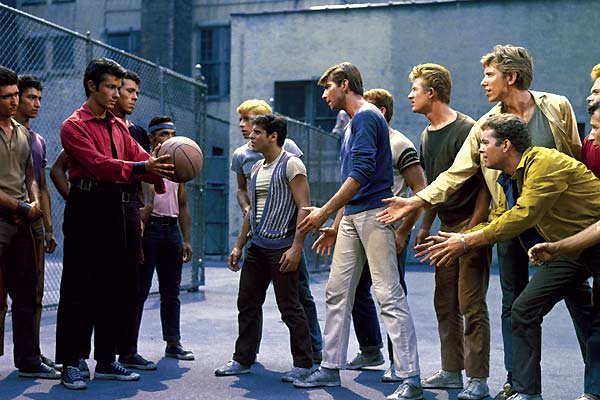
Pop Theology is back and getting better than ever. I still have a few aesthetic and technical wrinkles to iron out (specifically finally getting some images up), but other than that, I hope you enjoy the new layout. The first post since the reconstruction is a great review of a recent screening of West Side Story by new, hopefully frequent, Pop Theology contributor Richard Lindsay. Check out his bio in the contributors page.
Taking advantage of one of the best arts venues in San Francisco, I recently went to the Castro Theatre to see West Side Story. The Castro is a movie palace that has never closed. It retains the same opulence it possessed at its 1922 opening, with muse mosaics on either side of the stage, and a stunning art deco chandelier hanging from the ceiling. (It is the only American venue for which I would accede to an English spelling of “Theatre.”) As it probably did 88 years ago, an organist plays the Mighty Wurlitzer before shows, always closing with “San Francisco, Open your Golden Gate!” and a curtain rises before every screening. Its programming remains a barometer of its surrounding urban culture, not only in its presentation of the post-digital explosion of independent filmmaking from around the world, but in its ongoing screenings of musicals, film noir, and camp classics beloved by gay San Francisco. Gay people, particularly men, have been visiting this theater for decades finding solace in the nurturing Hollywood fantasy world of its vast cinematic opulence.
West Side Story as film is holding up as well, although perhaps in need of some refurbishment and modern amenities. The theatre promoted the weekend showing as a “new print” of the film, although it lacked some of the shockingly rich Technicolor of screenings of The Wizard of Oz and Vertigo witnessed at the theatre in the last year, and there were sound problems throughout. The presentation of musicals on film, both in their creators’ artistic choices and the quality of prints and projection are essential to contemporary devotees of classic Broadway theater. For viewers not lucky enough to have lived in 1940’s and 50’s New York City, the filmed versions of Broadway classics are the musicals. The original productions shined for a bright moment on stage, then went dark, living only in the memories of the lucky few that saw them live. Therefore this essay may swing between the seemingly separate, but historically connected, events of the 1957 original Broadway production of West Side Story and the 1961 film.
The musical continues its brash claim as the most modern version of the Romeo and Juliet story. But of course “modern” no longer means “up-to-date.” One can sense in the musical and the film the nuclear anxiety of the Cold War and the mid-20th Century shock of existential angst. Walter Kerr’s day-after debut 1957 review of the Broadway production famously began with the line, “The radioactive fallout from West Side Story must still be descending on Broadway this morning.” Writer of the original script for the play, Arthur Laurents, claims in 2009 he will be directing a long-overdue revival in which he has “…come up with a way of doing it that will make it absolutely contemporary without changing a word or a note.” My guess is this will be difficult for a gifted writer and theater yeoman in his eighties.
The problem with making a musical or a film topical is how quickly the seemingly intractable problems of the age evolve into new, more complicated problems. It’s amazing how out-of-date even the early-90’s Rent seems today, with its bohemian Gen-Xers and equation of AIDS with Fin de Siecle 19th Century consumption. Likewise, it’s hard to see West Side Story squeezed into the gentrifying West 50’s of Manhattan, a neighborhood cleared of its slums and taken over by the likes of Lincoln Center and Julliard.
The same goes for the gangs of the Story. Layers upon layers of immigrants have followed the Polish, Italians, Jews, and Puerto Ricans of the mid-20th Century, such that we find ourselves watching a conflict between what are now well-established ethnic groups that have long since ceded their ghetto turf and moved into the American middle class. To some extent, these divisive ethnic differences have been blurred through interracial romances like the one that was so shocking to the characters in the film. Fortunately, the Tonys and Marias of the world did not heed Anita’s advice to “Stick to your own kind.” Otherwise, a lot of little Nueva Yorqueños of mixed heritage would not be filling the parks and schools of Manhattan.
There are still conflicts over immigration today, but it’s more likely to take place on the borders of Texas and California than such gentrified grounds as Hell’s Kitchen and Clinton in Manhattan. It’s hard to see gangs of vicious Broadway dancers mixing it up to the nativist rantings of Representative Tom Tancredo. (But just for the record, I think the dancers could kick his ass.) Gang violence still exits, but much of it takes place within ethnic groups rather than between them, and the fear around youth gangs has evolved from the 1950’s obsession over “juvenile delinquency,” to juvenile homicide and even juvenile terrorism. Indeed, it seems a little quaint when Tony tries to broker a “fair fight” between the Sharks and the Jets, one that uses fists rather than pipes, chains, and knives. (You mean they hadn’t figured out how to make a bomb?) The gangs seem truly shocked when one of them gets shot.
Distance also allows perspective on the artistic achievements of the film and the musical. The film offers an expansion of the theater production, such that many sequences are shot on-location, with Manhattan as the background set. In an age where computer animation has opened broader vistas on screen, the more exciting revelation would be how the spare set design of a theater production could produce the same feeling of city life. What holds up from the film is the visionary editing, in which rapid-fire takes of actors and gestures cross-cut each other and produce a seamless ensemble.
Bernstein’s score and Sondheim’s lyrics are still beautiful and unforgettable. One wishes the two had continued their artistic collaboration and produced something unthinkable in the musicals of the 1970’s – Sondheim lyrics with a singable melody. Bernstein’s love songs are sweet and rich with rhythm and harmony. And the dance number “America” continues to be the show-stopping corker and brilliant satire it was 50 years ago. I will refrain from the overused Latina adjective for Rita Moreno (fiery) and just say it was the one number the audience applauded for out loud even in the movie theater.
Perhaps the most musically adventurous number is “Cool.” Music students since the 1950’s have learned difficult intervals like the augmented 4th from humming this West Side Story tune. But the scene, at least in the film, doesn’t hold up as well. Perhaps it’s too full of 50’s slang and hipster ethos. “Go man go…but not like a yo-yo schoolboy.” Writers of the day talked about how the scene captured the seething, boiling repressed rage of youth. Perhaps we would like to return to an era where youth repressed its rage just a little.
The dance numbers choreographed and directed for the screen by Jerome Robinson continue to pulse with tribal violence. If you didn’t know they hadn’t yet invented computer animation in 1961, you wouldn’t believe the athleticism of the dancers as they swing from pipes and skitter over fences in time to the music. Although granted, the conceit of gang members settling their scores with choreography has been parodied many times in the last 51 years, history has hailed the choreographer as the true American innovator of West Side Story‘s creative quartet of Bernstein, Sondheim, Laurents, and Robinson.
As Sondheim once stated about West Side Story, its chief achievements were not social, but theatrical – redefining what dance, music, and theater would be for the next century. Bernstein wrote in 1956 in his journal of the development of the play, that the musical had “to tread the fine line between opera and Broadway, between realism and poetry, ballet and ‘just dancing,’ abstract and representational. Avoid being ‘messagy.’ The line is there, but it’s very fine, and sometimes takes a lot of peering around to discern it.” What is awe-inspiring about the production is how often this fine balance between realism and abstraction was achieved. What is frustrating about the movie is how often the representational medium of film crosses the line, spelling out what should only be inferred.
Reviews from the era were characteristically chauvinistic, saying, in the 1957 Time review of the play, “‘America’ shows the triumph of the spirit over the obstacles often faced by immigrants.” Viewing the film from the luxury box of our post-feminist, post-colonial perspective, Anita, the Puerto Rican character with the most spirit, does no so much “triumph” over these obstacles as become weighed down and jaded by them. But then, having a brother stabbed in a street fight and nearly being raped by a gang will do that to a person.
Much speculation has been spent on how much the immigrant experience played a role in this production created by four Jewish men. Bernstein’s journals record that the initial scenario for the musical centered on the conflict between Christians and Jews around the Easter/Passover holiday. Maybe it’s the distance of time, but I can’t help thinking this would have produced a somewhat pyhrric drama. And a vastly different musical…”Oy, oy, crazy boy…”
Yet the social conflicts the musical and film anticipated simmer just below the surface, as they prefigure the public struggles of queerness in New York City that burst out of the urban closet just eight years after the film’s release. Bosley Crowther’s New York Times review of the film describes Richard Beymer’s performance of Tony as, “a little thin and pretty-pretty.” What he’s really saying is that Beymer’s Tony is less likely to marry Maria on the West Side than move in with Mark in the West Village. There is also a tomboy character that wants to be a member of the Jets and bears all the marks of a budding butch. She goes by the name “Anybodys.” As in, “She could be ‘anybody’s’ girlfriend, girl or boy.” Or, “Her gender is ‘anybody’s’ guess.” At one point, Anybodys refers to one of the baby-faced boys as “jailbait,” suggesting he would be jail-baiting someone in that big, bohemian city of the 1950’s – possibly the four gay male creators.
Perhaps the common social undercurrent unchanged since the 1950’s is the damage caused by youth undirected. As recent experience demonstrates, the adolescent arms race is hardly a problem to be found exclusively in the teeming cities. In the cases of Columbine and Virginia Tech, suburban middle class kids, left to their own psychoses, have been more than capable of wreaking destruction on their communities. This lends the lie to the modernist idea that what drives youth in the ghettos to violence is primarily geographical malaise, and given enough green grass and fresh air, they would naturally turn out as well-adjusted adults. West Side Story troubles the assumptions of social engineers in “Officer Krupke,” a song that critiques easy conclusions about social decay based on religious, social, psychoanalytical, or penal approaches. What the song and the musical are really saying is there are no easy answers to youth violence. What we have learned since the ’57 play and ’61 film is that there are no easy answers to youth violence. This conclusion is, at least, still germane.
As writer Martha Gelhorn wrote to Bernstein, describing her reaction to the play, “What now baffles me is that all the reviews, and everyone who has seen the show, have not talked of this and this only: the mirror held up to nature, and what nature…The music and the dancing, the plan, the allegory of the story do that; but nature is there, in strength; and surely this musical tragedy is a warning.” Perhaps her observation is right. Perhaps there is something in nature that, left to itself, can lead human beings in the most civilized societies to destruction and violence. What saves us from a truly devastating revelation watching West Side Story is the temporary promise of young love, the vitality of dance executed with soulful perfection, and those beautiful, tragic, haunting songs.
Previous Post

April 25, 2008
Pardon Our Progress...
Next Post
May 9, 2008 Hey Look, It's Jesus...
Browse Our Archives
Select a Category Classics DVD Film Music News Pop Culture Events Print Sports Television Uncategorized Video Games
Select a Month March 2017 February 2017 January 2017 December 2016 November 2016 October 2016 September 2016 August 2016 July 2016 June 2016 May 2016 April 2016 March 2016 February 2016 January 2016 December 2015 November 2015 October 2015 September 2015 August 2015 July 2015 June 2015 May 2015 April 2015 March 2015 February 2015 January 2015 December 2014 November 2014 October 2014 September 2014 August 2014 July 2014 June 2014 May 2014 April 2014 March 2014 February 2014 January 2014 December 2013 November 2013 October 2013 September 2013 August 2013 July 2013 June 2013 May 2013 April 2013 March 2013 February 2013 January 2013 December 2012 November 2012 October 2012 September 2012 August 2012 July 2012 June 2012 May 2012 April 2012 March 2012 February 2012 January 2012 December 2011 November 2011 October 2011 September 2011 August 2011 July 2011 June 2011 May 2011 April 2011 March 2011 February 2011 January 2011 December 2010 November 2010 October 2010 September 2010 August 2010 July 2010 June 2010 May 2010 April 2010 March 2010 February 2010 January 2010 December 2009 November 2009 October 2009 September 2009 August 2009 July 2009 June 2009 May 2009 April 2009 March 2009 February 2009 January 2009 December 2008 November 2008 October 2008 September 2008 August 2008 July 2008 June 2008 May 2008 April 2008 March 2008 February 2008 January 2008 December 2007 November 2007 October 2007 September 2007 August 2007 July 2007 June 2007 May 2007 April 2007 March 2007
Follow Us!
TAKE THE
Religious Wisdom Quiz
Who was King Zedekiah, and what did he do to anger God and ensure Jerusalem's fall?
Select your answer to see how you score.
He rebelled against Babylon He burned the scroll He built an idol He killed Jeremiah
Related posts from Pop Theology


At SXSW2017: May It Last: A Portrait of...

At SXSW 2017: "Untold Tales of Armistead Maupin"
TRENDING AT PATHEOS Progressive Christian

Why Christians Have a Sacred Duty to Vote:...
The Bible offers strong support for the sacred duty to vote. Here...

What Being a Modern-Day Apostle Means to Me
In my last column, I discussed the ins and outs of modern-day...

Did Ancient China Once Worship the God of...
Across human history, a common thread weaves through the origins of the...

Love Your Neighbor – Including Earth-Kin: Lev. 19,...
God’s command to love your neighbor means acting in an ethical and...

Lead a Church Study of “Jesus and Lao...
Guest writer Jack Thomas (The Irreverent Reverend) reflects on leading his church...

Principles for Understanding the Apostolic Ministry Today
Whenever people discover that my formal ministry title is "apostle," as in...
view all Progressive Christian blogs
Ad-Free & Subscriber Log-In Subscription Support
- About Us
- 2026 Calendar
- Videos
- Podcasts
- Library of World Religions
- Faith In Media Tracker
- Advertise With Us
- Write for Us
- Privacy Policy
- Terms of Service
- Do Not Sell My Data
- Contact Us
- Radiant Digital
- Manage Newsletter Subscriptions
- Unsubscribe From Notifications
- Sitemap
Copyright 2008-2026, Patheos. All rights reserved.
Subscription Support Ad-Free & Subscriber Log-In
Follow Patheos